A heavyweight full-size Dodge launched just before the oil shock, sold poorly, was renamed in 1977 and later became a film star.
The Dodge Monaco of 1974 to 1976 was a full-size Chrysler-built car with an all-new body on the C platform. It came in five body styles, every one a V8 car, and sales were weak. In 1977 Dodge sold the car as the Royal Monaco.
The Dodge Monaco of 1974 to 1976 was the fourth generation of a full-size family that Chrysler rebuilt just before the first oil price crisis. It kept the C platform but wore an entirely new body, and it came as sedans, coupes and estates, every one powered by a V8 and fitted with one transmission. Sales were poor, and Dodge carried the car on as the Royal Monaco for 1977.
Where did the 1974 Monaco come from?
Chrysler replaced all of its full-size models with newly designed cars for the 1974 model year. Dodge had sold the Polara and the Monaco side by side since 1965, but the Polara was dropped and the new generation appeared only as the Monaco. The body was completely new, although the underpinnings were again Chrysler's C platform.
The generation arrived at a difficult time for its maker. Its heavy cars were among the largest passenger cars of their day, and they sold poorly as fuel prices rose. The production of this generation fell into a period of serious economic problems for the whole Chrysler Corporation.
A heavyweight full-size Dodge that Chrysler built just before the oil shock, and that Dodge renamed in 1977.
Which trim levels did the 1974 Monaco offer?
Buyers could choose the basic Monaco with no additional name, the middle Monaco Custom or the top Monaco Brougham. In practice the entry Monaco and the Custom filled the slot the Polara had held. The Brougham sat at the top of the range.
What engines did the Monaco use?
Every Monaco ran a V8 mounted longitudinally at the front and driving the rear wheels. The engine line-up was more varied than that of the Chrysler and Plymouth sister models. From 1974 to 1976 the standard engine of the coupes and sedans was a 5,898 cc (360 cu in) LA small-block.
The heavier estates came with the 6,551 cc big-block as standard in every model year, while the sedans and coupes kept the smaller LA engine until 1977. In 1977 the coupes and sedans switched to a smaller 5,210 cc (318 cu in) LA V8.
Only one transmission was offered, a three-speed TorqueFlite automatic fitted to every engine. Optional engines included several versions of the 7,206 cc (440 cu in) big-block from the RB series. Power figures changed from year to year as emissions and fuel consumption rules grew stricter.
| Specification | Detail |
|---|---|
| Wheelbase, sedans and coupes | 3,090 mm (121.7 in) |
| Standard V8, coupes and sedans, 1974 to 1976 | 5,898 cc (360 cu in) |
| Standard V8, estates | 6,551 cc (400 cu in) |
| Optional big-block | 7,206 cc (440 cu in) |
| Police engine output | 280 PS (206 kW; 276 hp) at 3,200 rpm |
| Transmission | Three-speed TorqueFlite automatic |
What were the lean-burn engines?
From 1976 Chrysler offered lean-burn engines with computer-controlled ignition, aimed at lower fuel use and fleet economy rules. It debuted on the 6.6-litre (400 cu in) V8, and in 1977 it spread to every eight-cylinder engine. It cut fuel consumption noticeably, but it was prone to faults.
A major reason was the poor heat protection for the computer, which sat right in the engine area. Many buyers removed the control after a short time.
How much did the Monaco cost and how many were built?
The basic four-door sedan was listed at US$4,283 in 1974, and a four-door Brougham hardtop sedan cost US$4,999. Output fell from more than 137,000 Monacos and Polaras in 1973 to just over 66,000 cars in 1974. Dodge built 52,113 Monacos in 1975.
Sales of the new generation fell well short of expectations from the start. Prices for 1975 sat about US$250 above the 1974 models, and 1976 prices were trimmed slightly. Total production for 1976 fell to 35,591 units. The Royal Monaco Four Door Sedan accounted for 11,320 of them, and every other version was built only in low four-figure numbers.
Why was the Monaco renamed the Royal Monaco in 1977?
For 1977 Dodge moved the Monaco name to the intermediate Coronet, which was then sold as the Monaco for two years. The former full-size Monaco became the Royal Monaco, a name that had until then stood for a trim variant of the big car.
The Coronet's technology dated back to the 1960s, so the Monaco name was meant to give it an image boost. The plain Monaco series, with no additional name, was no longer built, so the whole range was called the Dodge Royal Monaco. The cheaper base series was the entry point, and the Royal Monaco Brougham was the upper line. All variants had concealed headlamps. The Royal Monaco Brougham Sedan was listed at US$4,996, US$200 below the comparable model of the year before. Dodge built 53,434 Royal Monacos in 1977.
Body styles and front ends
The body came as a two-door notchback coupe marketed as the Pillared Hardtop, a two-door hardtop coupe, a four-door notchback sedan, a four-door hardtop sedan and a five-door estate. The estate was the only five-door body, and the only one on the longest wheelbase. The 1974 cars had round twin headlamps set in a chrome grille. The higher-grade versions later hid their headlamps behind flaps painted in body colour and moved the indicators into the wing corners; from 1977 only this design was available.
What changed in 1975 and 1976?
The 1975 cars swapped the names of the trim lines. The middle Monaco Custom became the Royal Monaco, and the top Monaco Brougham became the Royal Monaco Brougham. The two Royal Monaco versions also gained headlamps hidden behind flaps, while the basic car kept its freestanding round twin lamps.
For 1976 the three-tier trim structure stayed, but the body range was trimmed. The four-door hardtop sedan without a continuous B-pillar disappeared at Dodge, as it did at the sister models of the other group brands. Alongside the Pillared Hardtop Coupe, the two-door hardtop coupe remained available, and list prices came down a little.
How did the Monaco fit among its sister models?
The Monaco had several sister models. At the core brand Chrysler, the Newport and New Yorker ran from 1974 to 1978. At Imperial, the LeBaron ran from 1974 to 1975, and at Plymouth the Fury came in 1974 and the Gran Fury from 1975 to 1977.
The Monaco's body panels largely matched those of the Plymouth Fury and Gran Fury. Only the Monaco estate used the long wheelbase of the Newport, New Yorker and Imperial, while the sedans and coupes kept the shorter layout.
What was under the body?
The unibody steel structure had a front subframe. The front wheels were independently suspended on torsion bars, and at the rear a rigid axle sat on leaf springs. Disc brakes were fitted at the front and drum brakes at the rear.
Rear disc brakes appeared only on the especially expensive Imperial LeBaron. Everything else in the Monaco range used drum brakes at the back.
How did the generation end?
Dodge ended production of this full-size generation with model year 1977, as Plymouth did with its counterpart. Chrysler's own twin models kept running for another year. The next new full-size Dodge arrived only in 1979, under the St. Regis name.
Police service and film fame
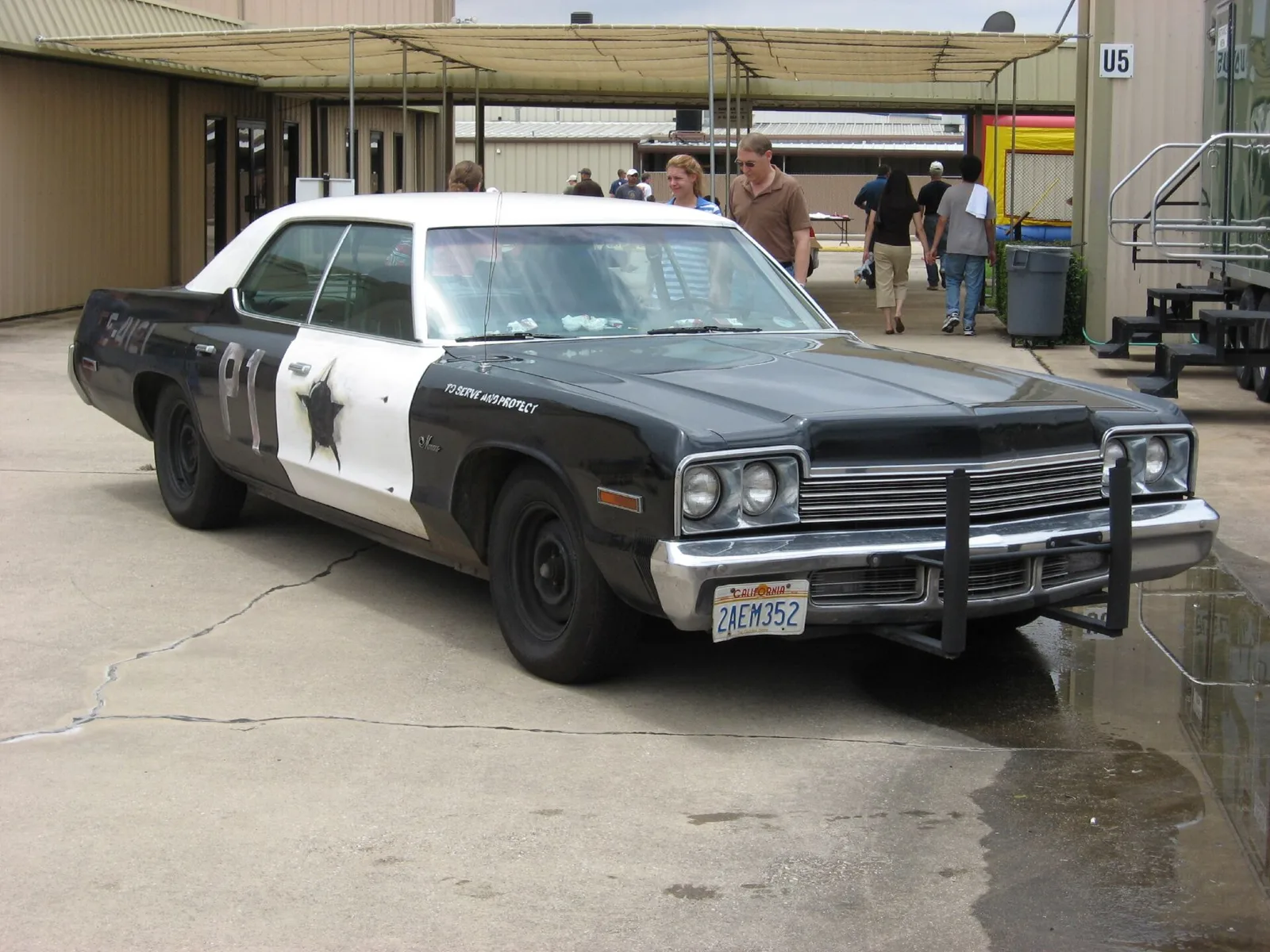
US authorities used full-size four-door cars as patrol cars. Dodge supplied the Monaco in police specification as the A-38 Police Package, with ram bumpers and a 7.2-litre Magnum V8. A fast-idle lock kept the air conditioning and the alternator running for radio and lighting even when the car was stationary.
In the 1980 film The Blues Brothers, a 1974 police-specification Monaco painted in black and white plays a major role as the Bluesmobile. The action scenes needed a dozen Bluesmobiles and five dozen police cars. Film fans and replicas have kept the 1974 model well known, and it is still often seen.