A wooden-bodied DKW from Auto Union with a floating front axle, a two-stroke V4 and a run of engine problems that dominated its short life.
The DKW Schwebeklasse was a streamlined medium-class saloon built from 1934 to 1937 by Auto Union's DKW brand. It had a wooden body, a floating front axle and a 988 cc two-stroke V4 making 26 PS (19 kW; 26 hp), and chronic engine faults held back its sales.
The first DKW Schwebeklasse prototype was built at the Horch plant less than four months after the project was approved, but the engine caused most of the car's trouble. The streamlined saloon was meant to restore a reputation that the rear-wheel-drive DKW models had lost, and its floating front axle was the real technical novelty.
Where did the Schwebeklasse come from?
The groundwork came from Hermann Ahrens, a designer at Horch, who built a very streamlined body on a rear-engined chassis in mid-1932. Auto Union's board then approved a front-engined saloon on the rear-wheel-drive DKW base, three days after the proposal was presented on 3 October 1933.
The chassis carried a rear engine derived from the 0.6-litre twin of the front-wheel-drive DKW cars. Ahrens's streamlined body was built on that layout, and it never went beyond the prototype stage.
The change for the production car was simple: the engine moved from the rear to the front, while the rest of the rear-wheel-drive DKW mechanics stayed in place.
Ahrens's prototype never went further, but it showed that a self-supporting wooden body could work with high aerodynamic qualities. Ahrens moved to Daimler-Benz from September 1933 and later designed the Mercedes-Benz 130H, another streamlined car with a rear engine.
Europe was experimenting with streamlining at the time. Chrysler's Airflow was about to appear in the United States, Peugeot was preparing the 402, Tatra was known for its futuristic shapes, and Fiat was about to launch the 6C 1500. In Germany, the most famous project was the people's car, which after the war became known to Italians as the Maggiolino.
Hitler's government pushed the motor industry and road building forward, and the Frankfurt-Darmstadt motorway, completed in a relatively short time, helped the public see the value of aerodynamic bodywork. That backdrop matters, although the Schwebeklasse's origins actually predate Hitler's rise to power.
The problem was the average motorist. At the start of the decade cars were generally driven at around 40 km/h, a speed at which a streamlined body offered few fuel savings, so most drivers did not feel the benefit.
The body drew attention, but reliability decided how many buyers stayed.
How quickly was the Schwebeklasse built and sold?
The first prototype was finished on 23 January 1934 at the Horch plant. It was shown in March at the Berlin show with four pre-series cabriolet-limousines, and sales were planned for May 1934. Engine tests pushed the start of sales back to August 1934.
Less than four months passed between approval and the first prototype, which was a record time even by the standards of a skilled team of designers today. The first prototypes also took part in some sporting events during the summer of 1934, though without notable results.
Three Auto Union board members, Richard Bruhn, Carl Hahn and William Werner, made a trip in a Schwebeklasse on 6 April 1934. Changes followed to the fitting of the interior mirror and to the seat adjustment mechanism.
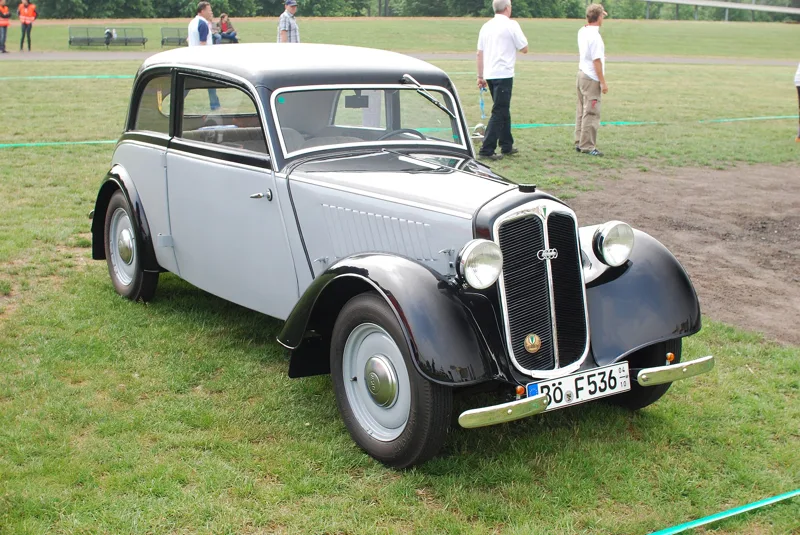
The pre-series cars were easy to spot. Their four-ring badge sat tilted inside one half of the grille, while production cars carried it centred and horizontal across the grille's dividing line.
What trim levels did the Schwebeklasse come in?
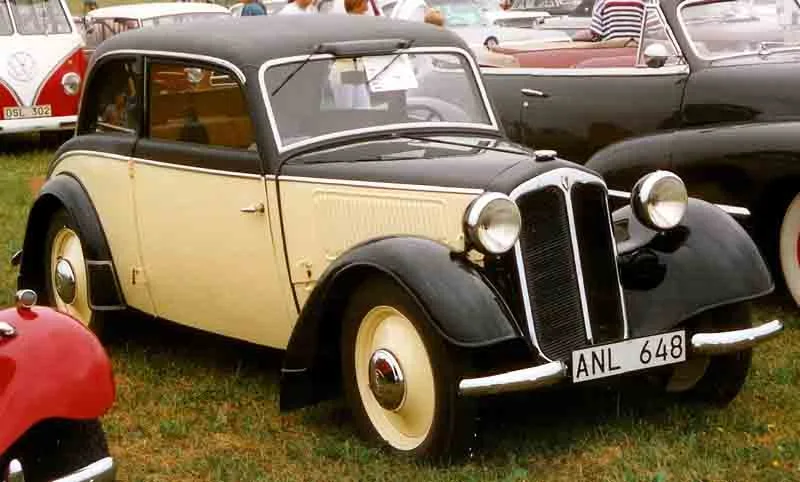
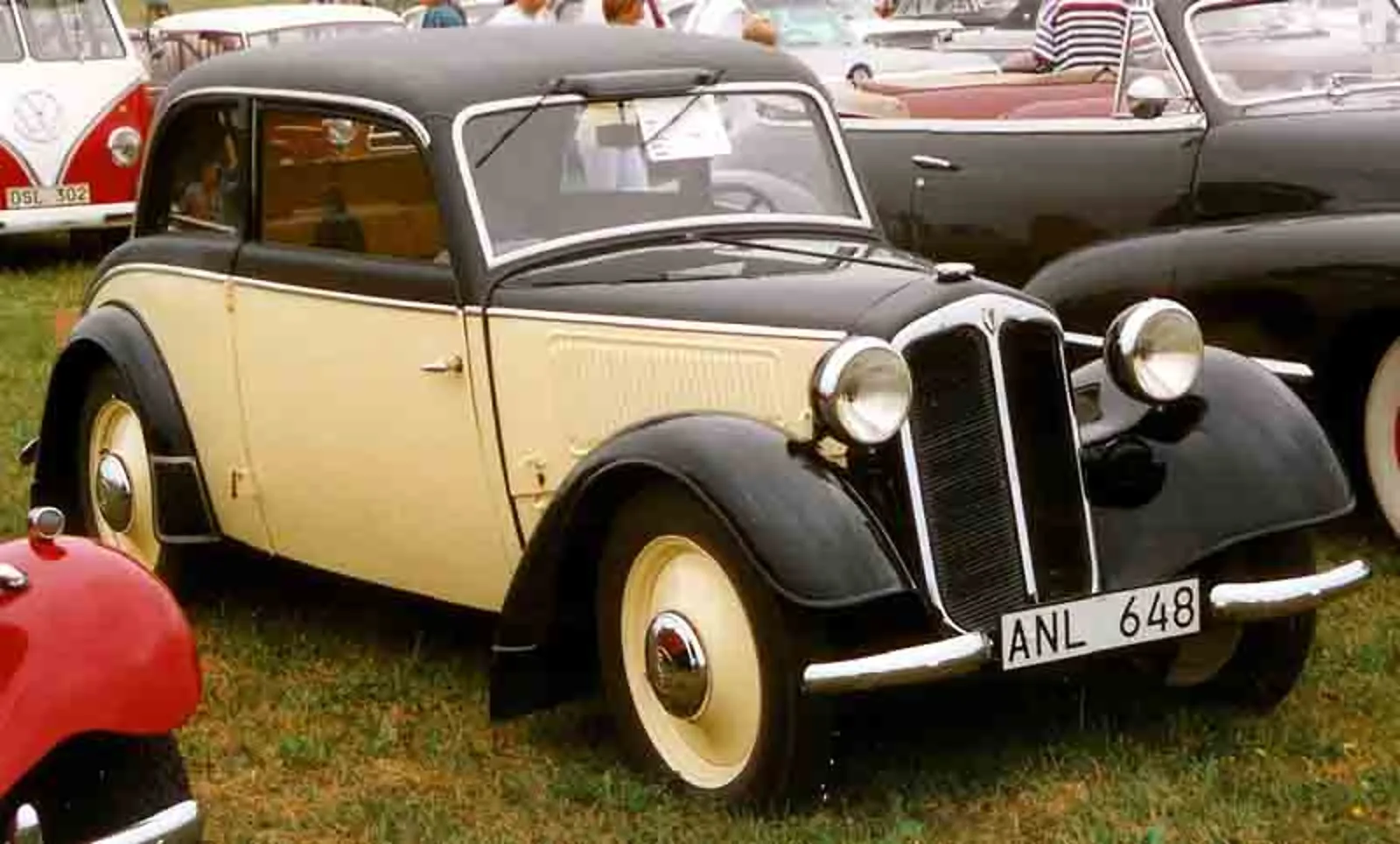
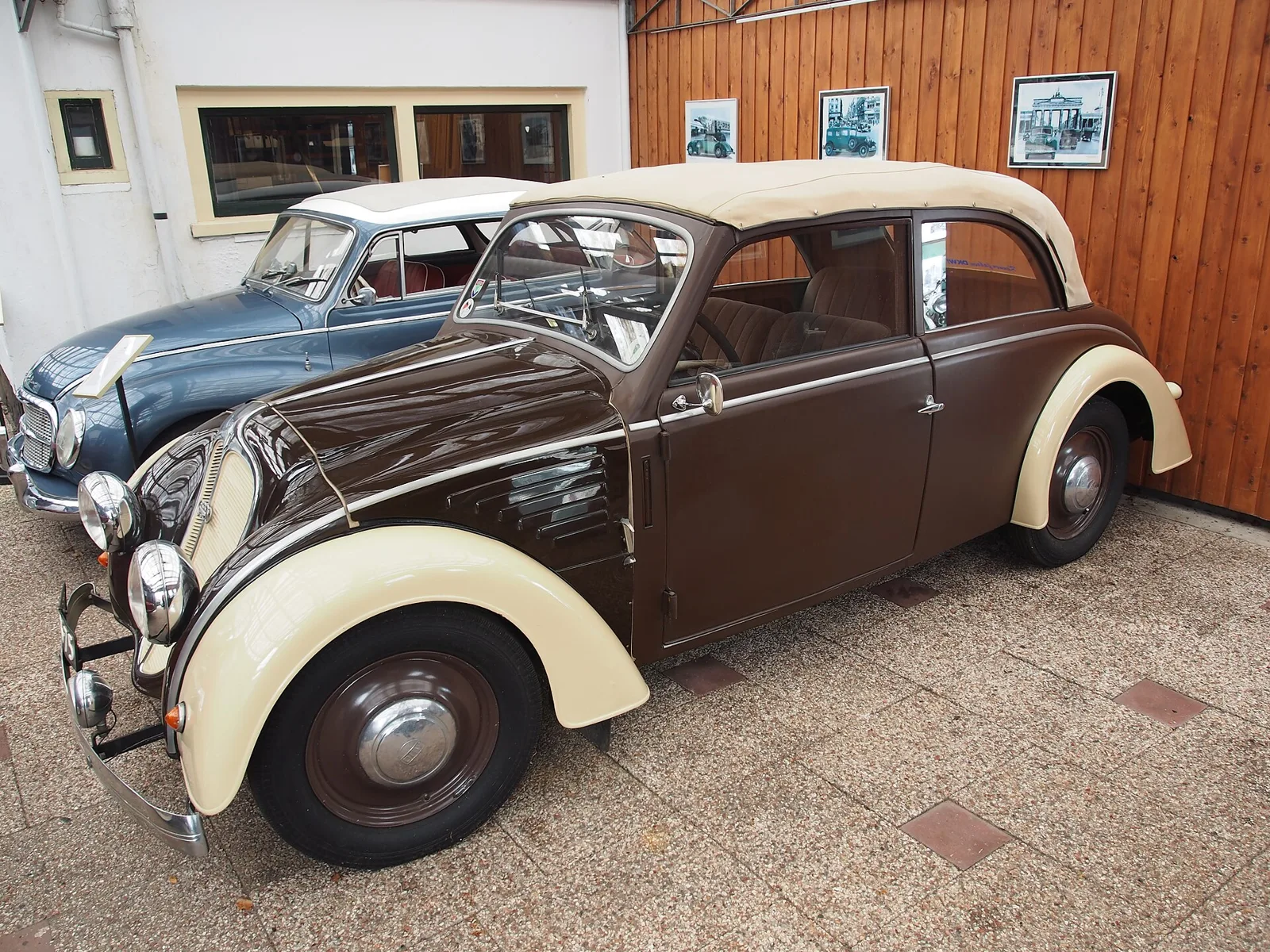
At launch the Schwebeklasse came in two trims. The normal car cost 3,350 RM and came only in grey, while the Sondermodell, or special model, cost 3,550 RM and had spoked wheels and a two-tone beige paint scheme with brown wings and roof.
The four-seat cabriolet-limousine was the only body on offer in the early months. The two-door saloon arrived in December 1934, having been almost ready as a prototype since the summer.
What made the Schwebeklasse look different?
Its shape was built around aerodynamics. The headlamps sat lower, the grille was a concave shield split from top to bottom, and the windscreen was raked more steeply than on earlier DKW models. The rear wings were partly built into the body, and the beltline was rather high.
The interior broke with the old layout. One large central instrument combined the speedometer, clock, fuel gauge and ammeter, and it sat on a Bakelite carrier, a modern material that Auto Union was adopting across its models. Two large storage bins without doors sat either side of the dashboard.
The tail had a new boot that opened from the outside, with the spare wheel mounted inside it. The choice helped the aerodynamics but cut the luggage space.
Key specifications
| Item | Figure |
|---|---|
| Engine at launch | 988 cc (60.3 cu in) two-stroke V4 |
| Power at launch | 26 PS (19 kW; 26 hp) |
| Engine from July 1935 | 1,047 cc (63.9 cu in) |
| Power from July 1935 | 32 PS (24 kW; 32 hp) |
| Gearbox | Manual four-speed with freewheel |
| Brakes | Hydraulic, four drums |
| Wheelbase cut in major update | 10 cm (3.9 in) |
| Weight cut in major update | 75 kg (165 lb) |
| Launch price, normal trim | 3,350 RM |
How did the engine and chassis work?
The Schwebeklasse used a wooden monocoque, with the engine at the front and drive to the rear wheels. Its two-stroke V4 came straight from the rear-wheel-drive DKW cars, and its floating front axle, called Schwebeachse, gave the model its name.
The bodywork team worked on the shape above all for lower fuel consumption, which had always been a weak point of the rear-wheel-drive DKW cars.
The rear end used the same floating layout as the 1001/1002 series. Braking stayed with hydraulic drums on all four wheels, and the four-speed manual gearbox had a freewheel system.
The engine was the real problem. Planners wanted to raise the V4 from 1 to 1.2 litres, but the 1.2-litre unit used as much as 16 litres per 100 km, and road tests showed the old V4's problems of early piston wear and heavy oil and fuel use. The team dropped the 1.2-litre plan and went back to the one-litre V4, which was still far from well tuned.
Did the Schwebeklasse engine ever get sorted?
Not fully. In January 1935 the output rose from 26 PS to 30 PS (22 kW; 30 hp). In July 1935 the engine grew to 1,047 cc (63.9 cu in) with a rev limit of 3,800 rpm and 32 PS (24 kW; 32 hp), below the 35 PS (26 kW; 35 hp) originally planned.
The 32 PS version cut the price to 2,990 RM, and sales rose for a few months before the faults returned. Attempts to lower the top engine speed further brought performance down to the level of the contemporary DKW F2.
People had by then stopped talking about the 1.2-litre engine after many fruitless attempts to fix the chronic problem. Auto Union and DKW leaders were worried, with their backs to the wall and few options left.
Small changes came in early 1935. New, larger chromed hub caps arrived in February, and in April the side storage compartments were made of Bakelite as well. The clock disappeared from the central instrument, and the tubular-frame seats gave way to conventional seats with an adjustment mechanism.
What changed in the major update?
The major update shortened the wheelbase by 10 cm (3.9 in), moved the spare wheel outside the boot, and made the boot reachable from inside by folding down the rear bench. The windscreen, side windows and tail were redrawn, and the bonnet grew by 6 cm to let more air through for cooling.
Inside, the dashboard became a single Bakelite piece, and the car lost 75 kg (165 lb). Those changes were meant to revive sales, but the unusual shape had already left many potential buyers wary.
Which special bodies were built?
Auto Union commissioned two cabriolets from a German coachbuilder, and eleven torpedo-bodied cars were made. The torpedo cars were never part of the official range, but production records include them. Four cars with Kubelwagen bodies were built too.
A cabriolet had been planned for the 1934 debut but was dropped for reasons that are not known. Two cabriolets were later commissioned from a German coachbuilder and were ready in February 1935.
One ultra-streamlined car stood apart. Its body was made of aluminium sheet rather than wood, and it was ordered by a count and built under a licence from the designer Paul Jaray.
Four other cars were converted to light vans. Two of them, built in the spring of 1935, were used to advise DKW dealers on the customer complaints about technical problems.
How did production end?
The last cars left the Spandau plant in April 1937. By then a successor was already in preparation: a new edition of the Sonderklasse with a more conventional body, whose first prototype was already being prepared within a few months of the major update.