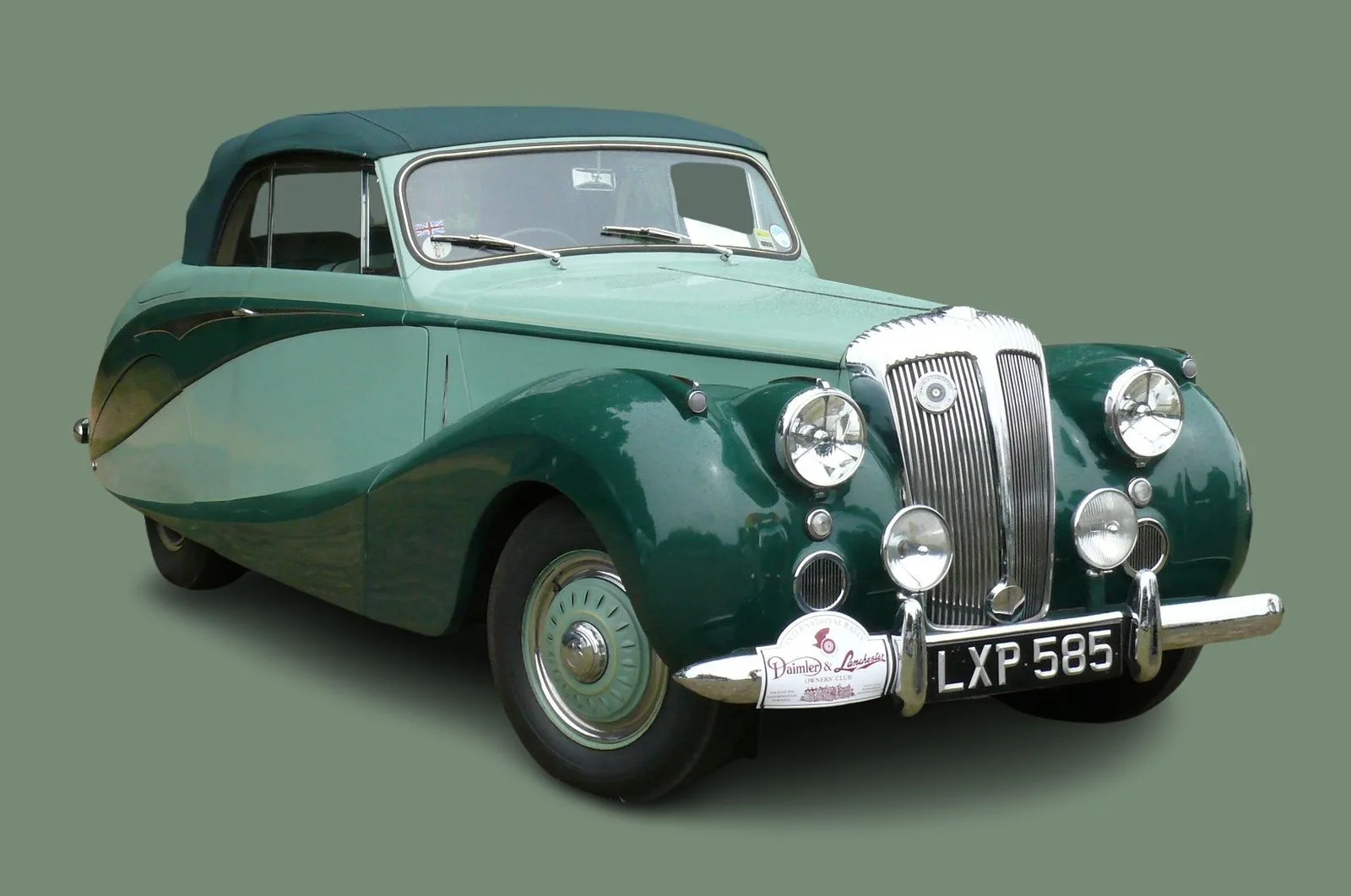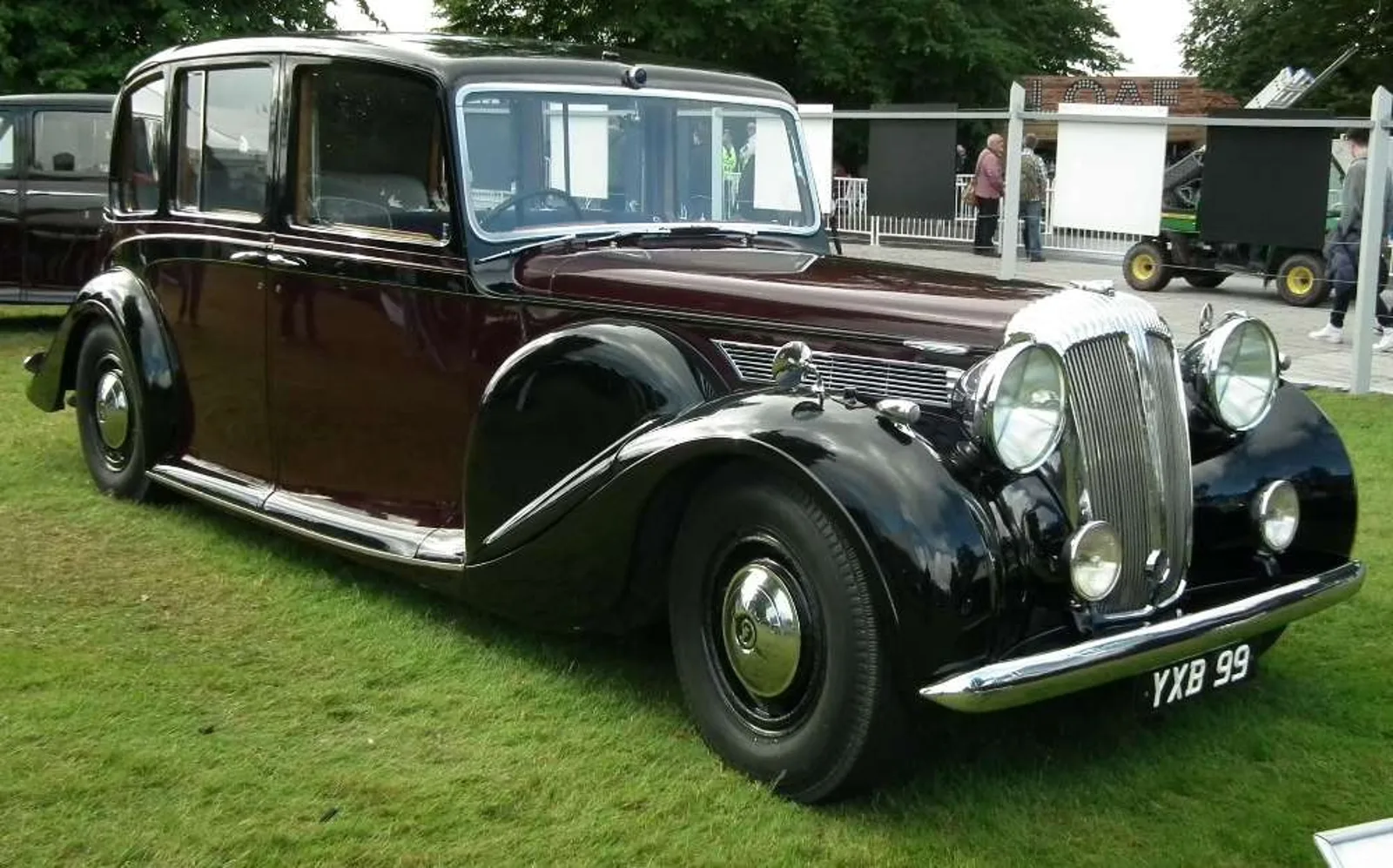
A rare postwar luxury car from Coventry, usually fitted with Hooper bodies, powered by a 5,460 cc straight-eight and bought by royal households.
The Daimler DE36 was a large British luxury car built from 1946 to 1953. Its 5,460 cc straight-eight, usually bodied by Hooper, made it one of the costliest cars of its era, and its successor was a straight-six.
Daimler's DE36 headed a three-model postwar range and ranked among the dearest British cars of its era. Built in Coventry in small numbers between 1946 and 1953, it used an eight-cylinder engine that Daimler had lengthened from a wartime six. Most cars received bodies from Hooper, though some chassis were finished by other coachbuilders.
Where did the DE36 sit in Daimler's postwar range?
The DE36 was the top model in a line-up that also included the shorter DE27 and the DB18, the smallest and cheapest Daimler. The DE27 was largely identical to it in design. Daimler presented these cars as new designs, although many details echoed pre-war models, and it hoped they would restore the marque's old standing.
That hope held only for a time. Austin slowly took over leadership in the chauffeur limousine market with its Princess, built by Vanden Plas. Daimler, meanwhile, lost standing in the 1950s, partly through the flamboyant conduct of Norah Docker, married to BSA's Bernard Docker, and its share of the market kept dropping against Bentley and Rolls-Royce.
Daimler had been founded in 1896 and had belonged to the Birmingham Small Arms Company since 1910. The firm supplied cars to the British royal household on a steady basis, and during the Second World War it had mostly built light armoured cars.
A straight-eight engine, Hooper coachwork and a price above a Bentley Mark VI.
Why is the DE36 also called the Straight Eight?
The car is also called the Daimler Straight Eight, a label modelled on a designation that was common before the war. Its engine had eight cylinders in a row, a stretched version of the six-cylinder unit Daimler had built in wartime for an armoured vehicle, with two cylinders added.
What engine and chassis did the DE36 use?
Chief engineer C. M. Simpson penned the chassis, which matched the DE27 apart from its longer wheelbase. The frame was a separate steel structure tied together with cross-shaped bracing. The front wheels had independent suspension on double wishbones and coil springs, and the rear used a live axle on leaf springs.
The eight-cylinder shared its bore and stroke with the six, measuring 85 mm by 120 mm. Its block was grey cast iron, and pushrods operated one inlet and one exhaust valve per cylinder. Two SU carburettors mixed the fuel, and power went through a preselector gearbox that Daimler called the Fluid Flywheel.
Daimler DE36 specifications
| Item | Daimler DE36 |
|---|---|
| Built | 1946 to 1953 |
| Engine | Straight-eight, 5,460 cc (333.2 cu in) |
| Bore and stroke | 85 mm by 120 mm |
| Carburation | Two SU carburettors |
| Output | 150 bhp (152 PS; 110 kW) |
| Transmission | Preselector gearbox, Fluid Flywheel |
| Front suspension | Double wishbones, coil springs |
| Rear suspension | Live axle, leaf springs |
| Wheelbase | 3,734 mm (147.0 in), against 3,515 mm (138.4 in) on the DE27 |
| Price, 1947 saloon | GBP 6,410 including tax |
Which coachbuilders made DE36 bodies?
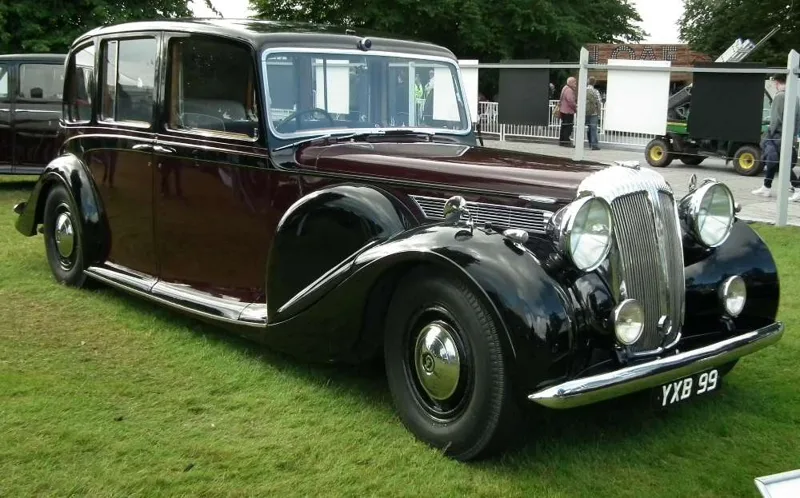
Most DE36 cars were delivered with Hooper bodies. Hooper belonged to the same BSA group as Daimler and had served as a works supplier between the wars. It also owned the Barker name, which it had taken over in 1938, and some bodies were sold under that badge.
Many of Hooper's bodies were standard saloons aimed at hire-car operators. The spare wheel gives the game away: on DE36 bodies they sit recessed into the front wings, whereas DE27 bodies have none mounted outside.
Some individual DE36 chassis were fitted with one-off Hooper bodies, and some of these borrowed the styling of the Hooper Empress, which appeared on several other chassis too.
What were the Freestone & Webb and Windover bodies like?
The London coachbuilder Freestone & Webb clothed six DE36 chassis as Touring Limousines, with free-standing wings and a cut-off rear that English usage calls razor-edged. They could be ordered with or without a partition, for a chauffeur or for an owner who drove.
A pair of Fixed Head Saloons also came from Freestone & Webb. Each had four doors, two side windows and long front wings ending in a rounded notchback. Length was 5,700 mm (224.4 in) and width 1,900 mm (74.8 in), while the height of 1,550 mm (61.0 in) was unusually low for the model. The first one, chassis no. 51238, was ordered by a timber merchant in Jamaica. It took two years to finish, reached its owner in spring 1949, and had air conditioning. A second example with two-tone paint appeared at the Earls Court Motor Show that autumn.
Windover, another long-established London firm, designed two body types that fitted both the DE27 and DE36 chassis. Between them it built 50 bodies, of which ten were mounted on DE36 chassis. Every Windover body was formed by hand from steel panels over an ash-wood frame.
Windover's first design, catalogued as number 116, was a chauffeur limousine with a partition and three windows a side, called Six Light in English. Its boot was a separate unit, unlike on the Hooper and Freestone & Webb cars. An initial order for 50 bodies shrank: only 30 were produced from 1946 to 1949, and five of them went onto the large DE36 chassis.
Design number 136 was a six-seat saloon with no partition, and Windover completed twenty between May 1947 and May 1949, with five earmarked for DE36 chassis. Its rear beltline dips a little, and the back door glass runs straight into the rear side glass, creating the look of a single large window.
What were the Green Goddess and the Docker Daimlers?
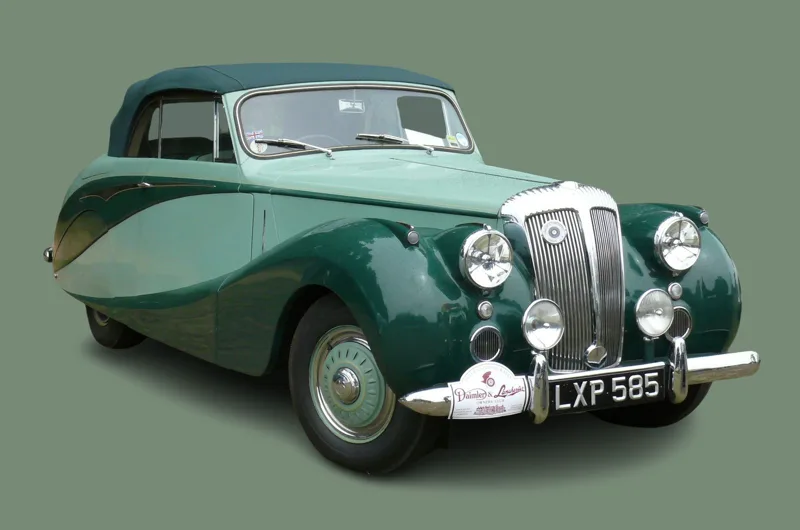
Hooper fitted several special bodies to the DE36 chassis, and the press gave some of them names that are still used. The first was the Green Goddess, a two-door, five-seat convertible built in 1948 as an exhibit for the British International Motor Show. Over 6 metres (19.7 ft) long, it had long front wings, no rear wings and headlamps behind a transparent plastic cover, described as Perspex.
Its styling anticipated the Hooper Empress Line designed by Osmond Rivers, which entered series production in several versions in 1950. Bernard Docker and Norah used the Green Goddess as a private car for several years. After the exhibit, Hooper built five, seven or eight near-identical cars, each priced above GBP 7,000. Four of those are still around in the 21st century.
The Docker Daimlers were a follow-on from that publicity. Norah Docker's plan was an unusual show car each year at the Earls Court show, keeping a brand considered stolid in the public eye. Five were made between 1951 and 1955, each to a design by Osmond Rivers. Gilded bumpers, trim in reptile leather and 7,000 stars painted by hand across the bodywork were among her touches, and some contemporaries found them tasteless or vulgar.
Only the first two Docker Daimlers sat on DE36 chassis. They were the 1951 saloon named The Gold Car and the 1952 coupe Blue Clover, and both remained one-offs. Models from 1953 to 1955 rode on younger Daimler chassis.
How much did a DE36 cost?
In 1947 a saloon-bodied DE36 cost GBP 6,410 including tax, equal to the value of 21 Ford Anglia cars. That year a Bristol 400, newly arrived on the market, was priced at GBP 2,375. The Jaguar Mark IV came in at GBP 1,263, while a Bentley Mark VI with standard coachwork cost GBP 4,038.
How many DE36 cars were built?
Figures differ, with totals of 205 or 216 chassis built between 1946 and 1953. It is uncertain whether every chassis was bodied, and one estimate says only 145 cars were finished. Output was not steady, and in one documented case two years separated the chassis from its body.
Many DE36 cars were supplied to royal households as state cars. Customers included, alongside the British royal family, the monarchs of Thailand, Abyssinia and Afghanistan.
Did the DE36 compete in motorsport?
Three drivers, Tommy Wisdom, Lord Selsdon and Anthony Hume, entered the 1952 Monte Carlo Rally in a DE36 wearing Hooper bodywork. They started in Lisbon and completed the event, though they were not classified.