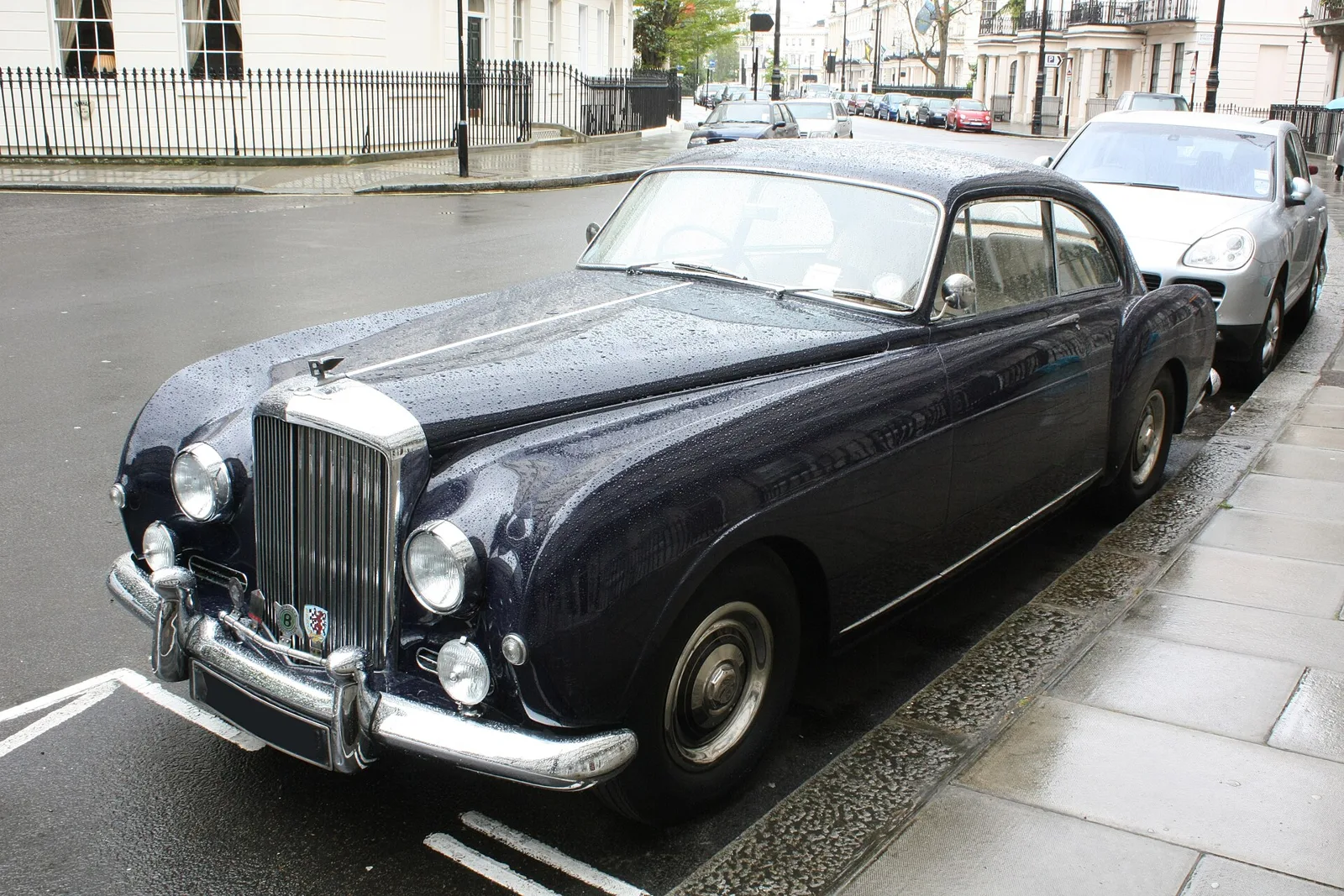
A sporting special built in 431 units from 1955 to 1959, with bodies from Mulliner, Park Ward, James Young and a few others.
Between 1955 and 1959 Bentley built 431 S1 Continentals, a sporting version of its S1 that paired a 4.9-litre six with bodies from independent coachbuilders, most often H. J. Mulliner. Designs ranged from two-door fastbacks to four-door Flying Spurs and a Park Ward convertible.
The Bentley S1 Continental was a sporting special that Bentley built from 1955 to 1959 in 431 units. It rode on the S1 chassis, which was almost identical to the Rolls-Royce Silver Cloud I, but its bodies came from several independent coachbuilders. The result was one of the most expensive automobiles of its day.
Where did the S1 Continental come from?
Bentley, then part of Rolls-Royce, had launched the R-Type Continental in 1952 as a sporting alternative to the standard R-series. In April 1955 the S1 replaced the R-Type, and six months later Bentley added a Continental series built on the standard model's technology.
In standard form both models shared one body, and the only outward distinction was the marque's own radiator grille. The Continental took up the R-Type Continental's basic concept and developed it further.
Bentley delivered just the rolling chassis, as it had with the R-Type, while independent coachbuilders built the bodies to order. No Rolls-Royce version of the Continental was offered; it was a Bentley only. From October 1955 every interested coachbuilder could take a chassis.
431 cars on one chassis, dressed by several coachbuilders, each body telling its own story.
What engine and chassis did the Continental use?
Under the skin the Continental was almost entirely the same as the standard S1. It had a steel ladder frame and a 4.9-litre (299.0 cu in) six-cylinder inline engine already known from its predecessor. Its compression ratio was higher than that of the standard S1, starting at 7.5:1 and rising to 8.0:1 in 1957. It produced about 178 PS (131 kW; 176 hp), which was 10 PS more than the standard car.
The wheelbase measured 3,124 mm (123.0 in), 80 longer than that of the R-Type. A four-speed automatic gearbox was fitted as standard, and a manual four-speed was available as an alternative. The exhaust system was changed as well.
Power steering could be ordered for an extra charge from April 1956. Almost every car that left the factory from then on had it fitted.
Who built the S1 Continental bodies?
H. J. Mulliner was the preferred body supplier, clothing 218 vehicles, more than half of all S1 Continentals. Its bodies used aluminium panels on a steel frame. Mulliner's fastback had been by far the most successful body of the R-Type Continental, with 191 units. Park Ward, which had belonged to Rolls-Royce since 1931, also built bodies, as did James Young, Hooper, the Swiss firm Graber and Freestone and Webb.
After Mulliner, the Park Ward bodies made up the largest group, with James Young's cars next in line and only a few individual bodies from the others.
What was the Sports Saloon?
The Sports Saloon was a two-door fastback that Mulliner gave design number 7400. It carried over the R-Type Continental's body with few changes, and most of the differences lay in the front wings and rear lamps. Its long roof section ran in one curve from the windscreen to the rear bumper, a central feature of the R-Type Continental that the design kept. Figures vary, but 119 or 123 were built, and about 20 had left-hand drive.
On the S1 the front wings ran horizontally and no longer stood apart from the engine bay and passenger compartment, while the rear lamps were one-piece and larger. Two cars carried the Sports Saloon body on standard S1 chassis, and both had a three-part rear window.
In 1957 the Sports Saloon was revised under design number 7466, moving the front side lamps into the wing tips. Mulliner built 20 of this version up to 1959, four with left-hand drive. The Sports Saloon reached 120 miles per hour (193 km/h), and the fastback body was not carried over to the S2 Continental.
How did the Flying Spur differ?
The Flying Spur was Mulliner's four-door body, introduced in 1957 and designed by George Moseley. Its name drew on a motif from the family crest of Arthur Talbot Johnstone, then managing director of H. J. Mulliner, and the Volkswagen Group revived the name in 2005.
The Flying Spur had a lower roofline and larger glass areas than the standard S1 saloon, though its rear doors were cut much more narrowly. The front section matched the Sports Saloon in design 7466 form, and the body looked lighter and sportier than the standard car.
Three versions were built, distinguished by the C-pillar. The Six Light, design 7443, had three windows on each side and a narrow C-pillar. It cost 8,033 pounds sterling in 1958, which was 2,490 pounds sterling more than the standard S1, and 54 or 55 were built up to 1959.
From 1958 the Four Light, design 7443B, had two side windows and a fully panelled C-pillar, giving passengers in the rear more discretion. Fourteen were built. The Van Gerbig variant, design 7443 Mod. 2, was a hybrid of the two, made at the request of the American entrepreneur Peter van Gerbig, and only two were built. Later Continental versions and some Rolls-Royce variants also offered the design, which stayed very rare.
What was the Continental Special?
The Continental Special was a two-door notchback coupe, design number 7500, built from 1958. It answered criticism from some customers about the small boot of the Sports Saloon. Its front was angular, with covers over the wings that hid the side lamps. Nine were built on S1 Continental chassis, and they carried small tail fins at the rear.
A 1959 revision dropped the fins and matched the front to the Flying Spur. In that form the design largely resembled the two-door coupe, design 7407, which Mulliner had offered on the standard S1 since 1957. Only one was built on the Continental chassis in 1959, but from 1960 the design became Mulliner's standard two-door for the S2 Continental.
Why is the Park Ward convertible so prized?
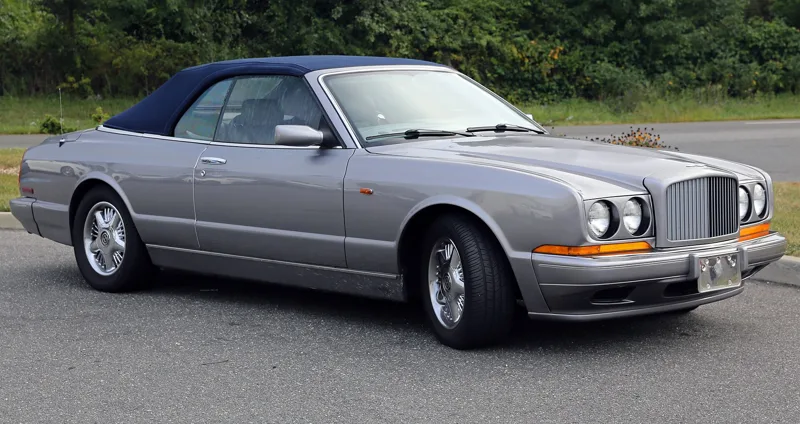
The Park Ward Drophead Coupe is regarded as the most sought-after and most expensive version of the S1 Continental. It was built in 86 units and derived from the Park Ward coupe, which John Blatchley, Rolls-Royce's chief stylist, designed on a conventional notchback. Of that coupe 39 were built.
The Park Ward coupe had wide doors, a small rear side window and a broad C-pillar, with small tail fins and three round rear lamps stacked one above the other. The rear wings, as on most other versions, were clearly shaped. In 2010 Park Ward convertibles were reaching prices of up to 450,000 pounds sterling.
What did James Young and Hooper build?
From a base in Bromley, a London district, James Young built a few four-door saloons for the S1 Continental, and 22 cars carried its bodies in total. Its layout generally matched the Mulliner saloons, but the boot line had larger curves and the wings were shaped differently. Its nose carried less chrome than Mulliner's version and resembled that of the R-Type Continental.
Many observers rank the James Young Flying Spurs as the handsomest four-door models in the range. Some Continental chassis also received a two-door saloon body from James Young, with a broad C-pillar and a notchback with hinted tail fins.
Hooper built six three-window saloons whose front and flanks recalled the so-called Docker Daimlers, and their headlamps were covered. That feature reappeared on the Park Ward coupes and convertibles of the S2 Continental.
Bentley S1 Continental at a glance
| Item | Detail |
|---|---|
| Production | 431 units, 1955 to 1959 |
| Engine | 4.9-litre (299.0 cu in) inline six |
| Output | About 178 PS (131 kW; 176 hp) |
| Compression ratio | 7.5:1, raised to 8.0:1 in 1957 |
| Wheelbase | 3,124 mm (123.0 in) |
| Top speed, Sports Saloon | 120 miles per hour (193 km/h) |
| Six Light price, 1958 | 8,033 pounds sterling |
Why does the S1 Continental still interest collectors?
The S1 Continental matters because it was among the costliest cars of its era, and because its coachwork varied so widely on one chassis. Collectors prize the Park Ward convertible and the James Young Flying Spurs in particular.
Many of the variants were built in very small numbers. The Van Gerbig design remained extremely rare, and the Continental Special reached only nine examples.