The big postwar Daimler chassis carried royalty, ambulance crews and hire-car passengers, and then Lady Docker's yearly Earls Court extravagance.
The Daimler DE was a chassis series from 1946 to 1953 that carried the DE 27 straight-six and the DE 36, the last Daimler Straight-Eight. The Docker Daimlers were extravagant Hooper-bodied show cars built for Sir Bernard and Lady Docker for Earls Court from 1951 to 1955.
When the Golden Daimler was sold to a motorcycle distributor in Pasadena in 1959 for 7,300 pounds, its gold leaf had to come off first, because Britain had banned the export of gold. The car had worn 7,000 gold stars on its flanks. It was one of the Docker Daimlers, built on a Daimler DE chassis, the heavy postwar frame that also carried royalty, heads of state, hire-car passengers and, in a more sober role, ambulance crews. The chassis and the extravagant cars Sir Bernard and Lady Docker built on it tell a good part of Daimler's story in the years after the war.
Daimler DE: the chassis under the biggest postwar Daimlers
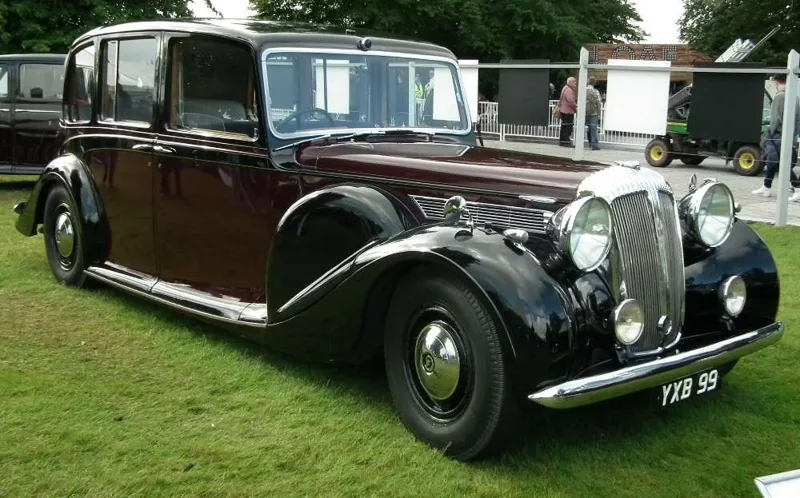
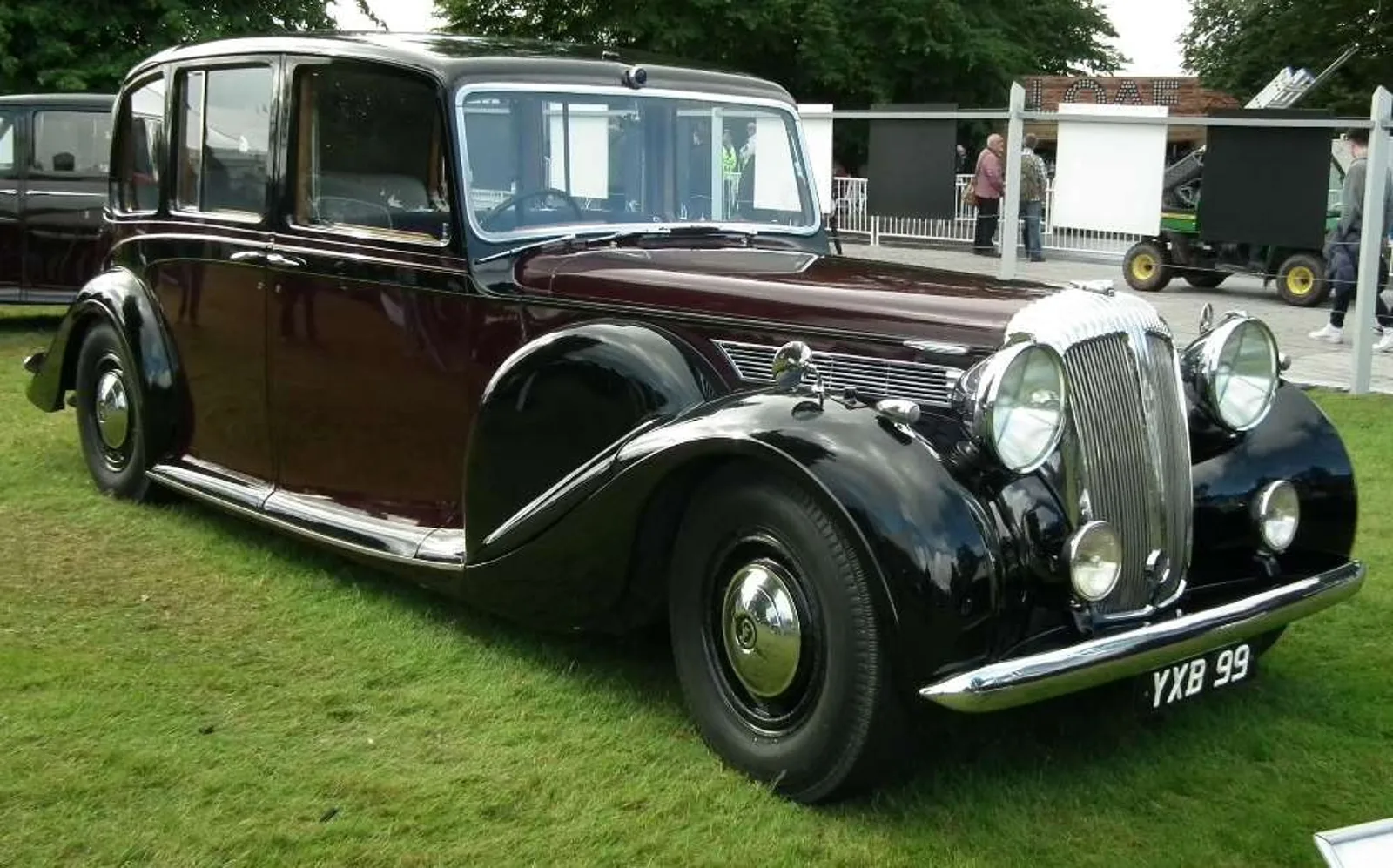
Daimler built the DE series of chassis from 1946 until 1953, and they underpinned the company's largest and most expensive cars of the period. There were two versions. The short-wheelbase DE 27 carried the Daimler Twenty-seven straight-six, and the long-wheelbase DE 36, the last Daimler Straight-Eight, carried the Thirty-six straight-eight. Both were sold to royalty and heads of state around the world, the DE 36 above all, and British royalty bought them under the royal warrant that Daimler had held since 1900.
Chief engineer C. M. Simpson designed the chassis around a separate steel frame, which was normal practice then. The point of a separate frame was that a customer could order a rolling chassis and have a coachbuilder make a body to personal taste. X-braced crossmembers stiffened the side rails.
The rear wheels were driven through a Hotchkiss system with a twist. Control arms ran from the axle casing to pivot points on the frame, sited directly above the true pivot of the leaf springs. The arms stopped the axle moving sideways without upsetting how the springs worked, leaving it free to move up and down and fore and aft. Final drive was by hypoid gears, which replaced the worm drive Daimler had used in its final drives since 1910. The rear track was 1,600 mm (63 in), and all four tyres were 8.00 x 17.
At the front the wheels were suspended independently, using the same layout as the DB 18. Each side had a pair of control arms: the lower one a wide-based wishbone resting on a coil spring mounted to the frame, the upper one shorter and working a Luvax-Girling damper. The track rods swung on the same radius as the suspension links, and an anti-roll bar connected the front dampers. The front track was 1,524 mm (60 in). Steering used Marles roller gear, but with an unusual twist. Instead of tilting the kingpin to create castor, the makers put the hub centre behind the kingpin centres, which they did to make the car easier to control.
Girling hydro-mechanical brakes did the stopping, hydraulic at the front and mechanical at the rear, with a Clayton-Dewandre servo to assist. Daimler's own coachwork could include electric windows and divider, interior lights that switched on with a door or the boot lid, and rear-wing warning lights that glowed while the boot stood open.
The Golden Daimler had to be stripped of its gold leaf before it could leave Britain in 1959.
Daimler DE 27, the straight-six
The DE 27 sat between the DB 18 and the DE 36 Straight-Eight, using the short DE chassis and the Twenty-seven engine. Production ended in 1951. That engine had been developed for the Daimler Armoured Car and later powered the DE 27, the DC 27 ambulance and the DH 27 hire limousine. Its cylinders were cast together with the upper crankcase, and a four-bearing crankshaft carried counterbalancing weights. The big end bearings were flanged over the crankshaft's sides to hold the rods against the crank webs, which reduced noise.
The DE 27 chassis weighed 1,778 kg (3,920 lb) and had a wheelbase of 3,515 mm (138.4 in). Fluid capacities were 91 L (20 imperial gallons) of petrol, 9.9 L (17.5 imperial pints) of oil and 17.6 L (31 imperial pints) of coolant.
Daimler DE 36, the last British straight-eight
The DE 36 closed two chapters at once: it was the final Daimler Straight-Eight and the last British car with a straight-eight engine sold to the public. Customers could choose a saloon, a limousine or a drophead coupe. Beyond the British royal family, buyers included the royal houses of Afghanistan, Ethiopia, the Netherlands, Monaco, Saudi Arabia and Thailand. A total of 205 chassis were built, and production ended in 1953.
The Thirty-six straight-eight engine sat in a chassis with a wheelbase of 3,734 mm (147 in). It was the last very large Daimler with an engine of more than 5 litres.
The DC 27 ambulance and DH 27 limousine
Once the war ended, the London County Council had a prototype ambulance built and sounded out the motor industry for more like it. Daimler offered one with nearly all the prototype's features, including the essentials set by an advisory committee to the Ministry of Health, and it designed the DC 27 chassis for the job. The DC 27 was the first purpose-built ambulance on sale in Britain after the war.
Crews valued its low floor, which made stretcher work easier, and its roomy, heated and air-conditioned working area. It also had high headroom, a smooth ride and stable handling. On the debit side, crews could not reach the cab from the back, the car drank about 33 L/100 km (8.5 mpg imp) and the brakes were inadequate. London placed an initial order for 120, standardised on the type and eventually bought more than 200. Bath, Belfast, Birmingham, Carmarthenshire, Croydon, Cumberland, Hertfordshire, the Isle of Wight, Nottingham, Plymouth, Salford and Surrey also used it. London retired its last Daimler ambulance in 1964. Slow sales, caused by the price, led Daimler to stop after five hundred chassis.
Chassis numbers ran from 54000 to 54499. Barker & Co. built the first bodies and Hooper & Co. built some later ones, and you can tell them apart by the lines along the side: two on a Barker body, one on a Hooper. The frame was ash. The engine was the Twenty-seven, fitted with a modified distributor and one Solex carburettor instead of the DE 27's pair of SUs, giving 105 bhp (78 kW; 106 PS) at 3,600 rpm and a top speed of 97 km/h (60 mph). As on Daimlers of the era, a four-speed Wilson-type pre-selector gearbox worked with a fluid flywheel. Like the DE, it had hypoid final drive, independent front suspension and hydro-mechanical brakes, though the engine sat at a slight angle and the final drive and differential were offset to the left. The wheelbase was 3,810 mm (150 in).
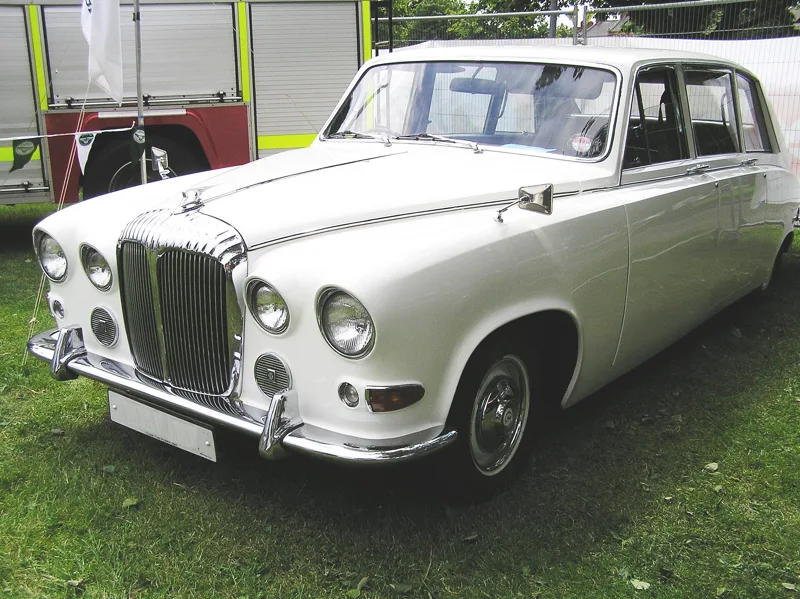
The DH 27 limousine came from the same chassis. Fifty were built for Daimler Hire with Hooper bodies, carrying up to seven passengers and equipped with air conditioning, a heater and an electric screen between the rear and the driver. The chassis, numbered D 52900 to D 52949, had the DC 27's 3,810 mm wheelbase, which was three inches longer than the DE 36's. Track was 1,524 mm (60 in) at the front and 1,575 mm (62 in) at the rear. One of them, chassis D 52948, passed from Daimler Hire to Vickers-Armstrongs and then, in 1961, to Thomas Corbett, 2nd Baron Rowallan, who used it as his state car as Governor of Tasmania.
The Docker Daimlers: show cars for Earls Court
The Docker Daimlers were cars built for the British International Motor Show at Earls Court from 1951 to 1955. Hooper, a Daimler subsidiary, built them on Daimler chassis to the order of Sir Bernard Docker, who chaired Daimler and was managing director of its parent, Birmingham Small Arms Company (BSA), and of his second wife, Lady Docker, whom he had made a director of Hooper. Her publicity campaign for Hooper and Daimler hinged on a sensational new car at Earls Court every year. The 1948 Green Goddess, built for Sir Bernard before the marriage, set the style.
Green Goddess, the 1948 show car
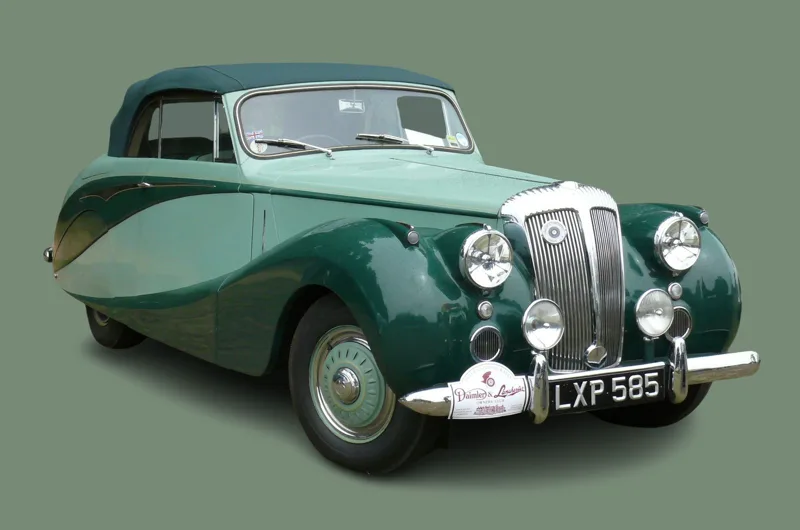
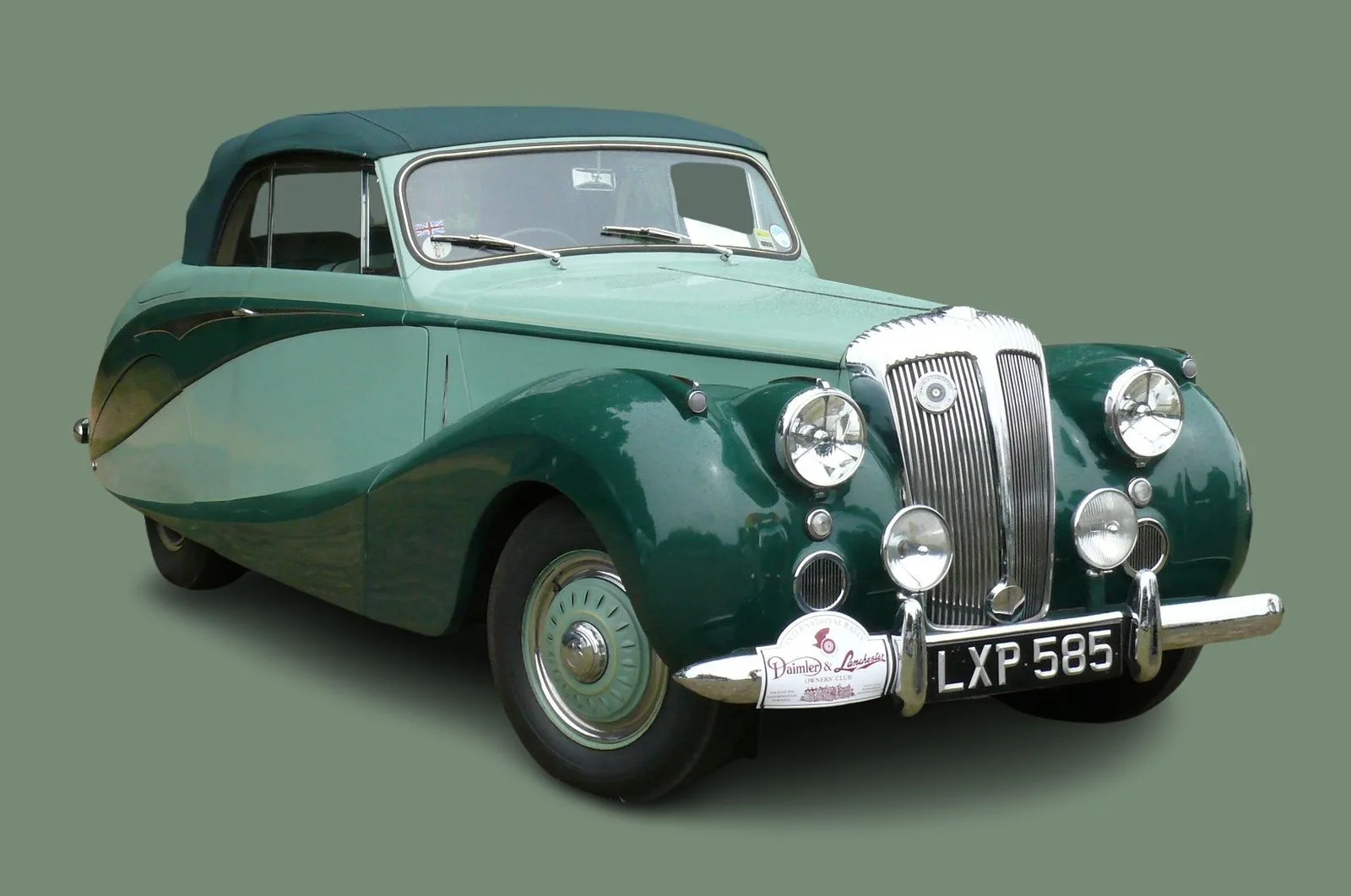
Sir Bernard had a car built by Hooper on a DE 36 chassis in 1948, the year before his second marriage, for that year's show. At 7,001 pounds it was the most expensive car at the show. The drophead coupe on chassis number 51223 was painted pastel jade green, which gave the press its nickname. An electro-hydraulic mechanism worked the hood, including the metal cover that hid it when folded. The door windows were electric, the curved, raked windscreen had three wipers, and the headlights and pass lights sat in recesses in the front wings behind Perspex covers in chrome bezels fluted at the top to echo the radiator grille. Aluminium spats covered the rear wheels, hinged on spring-balanced arms so they could be moved away for wheel access.
Seating was for five. A front bench had three separate backs, the outer two folding to let passengers reach two armchairs in the rear, whose backs could also fold flat for luggage. The rear seats were set so their occupants could see forward between the front passengers' heads. The gear selectors reached almost to the steering wheel rim for fingertip control, and the speedometer could be switched between miles and kilometres.
Hooper built six or seven more bodies of this type on DE 36 chassis, differing mainly in headlight and side light positions and in the wheel spats, some of which had diagonal louvres. Four examples, including the show car, were known to exist in 2010. One belongs to the Jaguar Daimler Heritage Trust and is displayed at the British Motor Museum in Warwickshire.
Golden Daimler, the 1951 Gold Car
Lady Docker's first special was a touring limousine known as the Gold Car, the Gold Daimler or the Golden Daimler. Gold took the place of chrome on every piece of trim, and 7,000 gold stars ran along the sides below the waistline. Gold silk brocade, woven by hand on a loom, lined the rear. The division cabinets were Australian camphor wood, picked for its golden hue, and held a gold and crystal cocktail set, a gold and black china tea service with a gold-plated Thermos jug, folding tables and a gold vanity set. Even the radio controls in the armrests were gold-plated.
The driver sat in black leather with gold piping. Every side window was double glazed, the rear window had an electric demister, and the sunroof over the passengers was toughened glass. Sunroof, side windows and division window all worked electrically. The flush rear wheel spats on spring-balanced rods and the headlights faired into the wings came from the Green Goddess, though the bezels were plain rather than fluted.
The car won its class in the annual coachwork competition of the Institute of British Carriage and Automobile Manufacturers. Lady Docker put its cost at 8,500 pounds. In 1956 it was shipped from London to Sydney for the Australian World's Fair at the Showground, from 26 July to 4 August.
Blue Clover, the 1952 show car
Hooper's 1952 car was a touring fixed-head coupe on the DE 36 chassis. It wore two tones of powder blue and grey, with a regular pattern of four-leaf clovers in the darker shade across the lighter panels. The front wings tapered all the way to the tail, so there were no separate rear wings, and spats again covered the rear wheels.
Inside, a three-person front bench and two rear armchairs echoed the Green Goddess. The leather was lavender blue with dark blue piping, and grey-blue lizard skin took the place of wood veneer on the steering wheel, door panels, rear cabinets and the manicure set in the left door. The cabinets held cut glass, a silver Thermos, sandwich boxes, cups and saucers, while recesses above the rear seat stored an 8 mm cine camera and field glasses. The roof was thermally insulated, with a transparent sun panel at the front and a blind beneath it, and the screen and electric quarter-lights used Triplex heat-reflecting safety glass. The Motor called Blue Clover the "most elegant thing at Earls Court" that year.
Silver Flash, the 1953 show car
The 1953 car was commissioned by Lady Docker. The show guide and Hooper's records describe it as a Daimler 3-litre chassis, but its number, 85001, belongs to a Lanchester Fourteen chassis modified to take a Daimler engine. The body, Hooper number 9966, was a two-seat, two-door fixed-head coupe in aluminium, with a Sundym glass roof panel and a smaller, restyled fluted grille.
It started out dark green, which clashed with the black and red interior, where red crocodile leather covered the dashboard and trim. Two days before the show, Lady Docker told chief designer Osmond Rivers to repaint the body metallic silver. She named it Silver Flash, after the Golden Flash motorcycle that BSA was building. Behind the seats were two red crocodile suitcases, and a vanity drawer held a mirror, compact, cigarette case, lighter and clothes brush in silver. It had a radio, heating and ventilation, an internal shutter for the roof panel, a screen washer, a demister and a speedometer marked to 120 mph. It won no prize in the coachwork competition, and the new Conquest Roadster came second.
Stardust, the 1954 show car
In 1954 the Gold Car went to Paris for Daimler's new showroom there, and the year's show car, Stardust, took up its theme: a dark touring limousine with metal six-point stars along the flanks. Where the Gold Car was black with gold stars, Stardust was royal blue with silver ones. Osmond Rivers called the look "sham caning in reverse".
Its basis was a prototype DK400 chassis, number 92700, which had narrower tracks than standard and a wheelbase two inches shorter. Recessed lights and hinged rear spats followed the earlier cars. The rear compartment was trimmed in hand-woven silver silk brocatelle, with aluminium cabinets covered in pale blue crocodile leather, cut-crystal decanters, silverware and Wedgwood china, and a nylon fur rug on the floor. Four matching crocodile suitcases filled the large boot. Each compartment had its own heating and ventilation, and the double-glazed side windows, the division window and the shutter under the glass roof were all electric.
Golden Zebra, the 1955 show car
The last of the series was an ivory-white fixed-head coupe on a DK400 chassis. Golden Zebra had gold-plated brightwork inside and out, zebra skin on the seats and door panels, a gold-plated miniature zebra as the grille mascot and Lady Docker's initials on the door. The headlights and indicators sat higher and further forward than before, each under a wing curve that formed a hood.
The interior was ivory leather, with real ivory set in gold frames on the dashboard and all cappings, and a headliner woven in ivory with a small gold spot. Controlled heating and ventilation and automatic indirect lighting were fitted. One rear cabinet held cocktail equipment and the other picnic equipment, including Perspex sandwich boxes. Details included a folding table in the middle of the front seat, a manicure set let into the passenger door, a nylon umbrella with an ivory handle, and, in the boot, rawhide suitcases with gilt Bramah locks.
What happened to the Docker Daimlers
When Bernard Docker was removed from the BSA board, the five show cars went back to Daimler, which stripped off their non-standard trim and sold them. The Golden Daimler went in 1959 to William E. Johnson, Junior, in Pasadena for 7,300 pounds, without its gold leaf.
Blue Clover has been restored and is on show at the Samsung Transportation Museum in Yongin, South Korea. Silver Flash reached the United States in 1966, owned by someone in Kansas City, Missouri, and was sold at James Leake's auction in 1974. By the mid-1980s it appeared in an auction catalogue repainted tan over cream, with chassis number 85001 and engine number 76698. Its present whereabouts are unknown.
Stardust turned up abandoned on a Welsh farm and was restored to show condition in 1980. It went on show at the Blackhawk Museum, was sold and shipped to Japan, and was auctioned at the Goodwood Revival in September 2014. Daimler collector John Wentworth bought Golden Zebra in the United States and brought it back to Britain in 1988 to begin restoration. His widow oversaw the completion after his death, and the restored car sold in December 2006.
The Docker Daimlers side by side
| Car | Show year | Chassis | Body | Signature detail |
|---|---|---|---|---|
| Green Goddess | 1948 | DE 36, number 51223 | Five-seat drophead coupe | Pastel jade green, electro-hydraulic hood, 7,001 pounds |
| Golden Daimler | 1951 | DE 36 | Touring limousine | 7,000 gold stars, gold silk brocade |
| Blue Clover | 1952 | DE 36 | Five-seat fixed-head coupe | Four-leaf clover pattern, lizard-skin trim |
| Silver Flash | 1953 | Modified Lanchester Fourteen chassis, number 85001 | Two-seat fixed-head coupe | Repainted silver two days before the show |
| Stardust | 1954 | Prototype DK400, number 92700 | Touring limousine | Royal blue with silver stars |
| Golden Zebra | 1955 | DK400 | Fixed-head coupe | Zebra-skin seats, gold-plated brightwork |