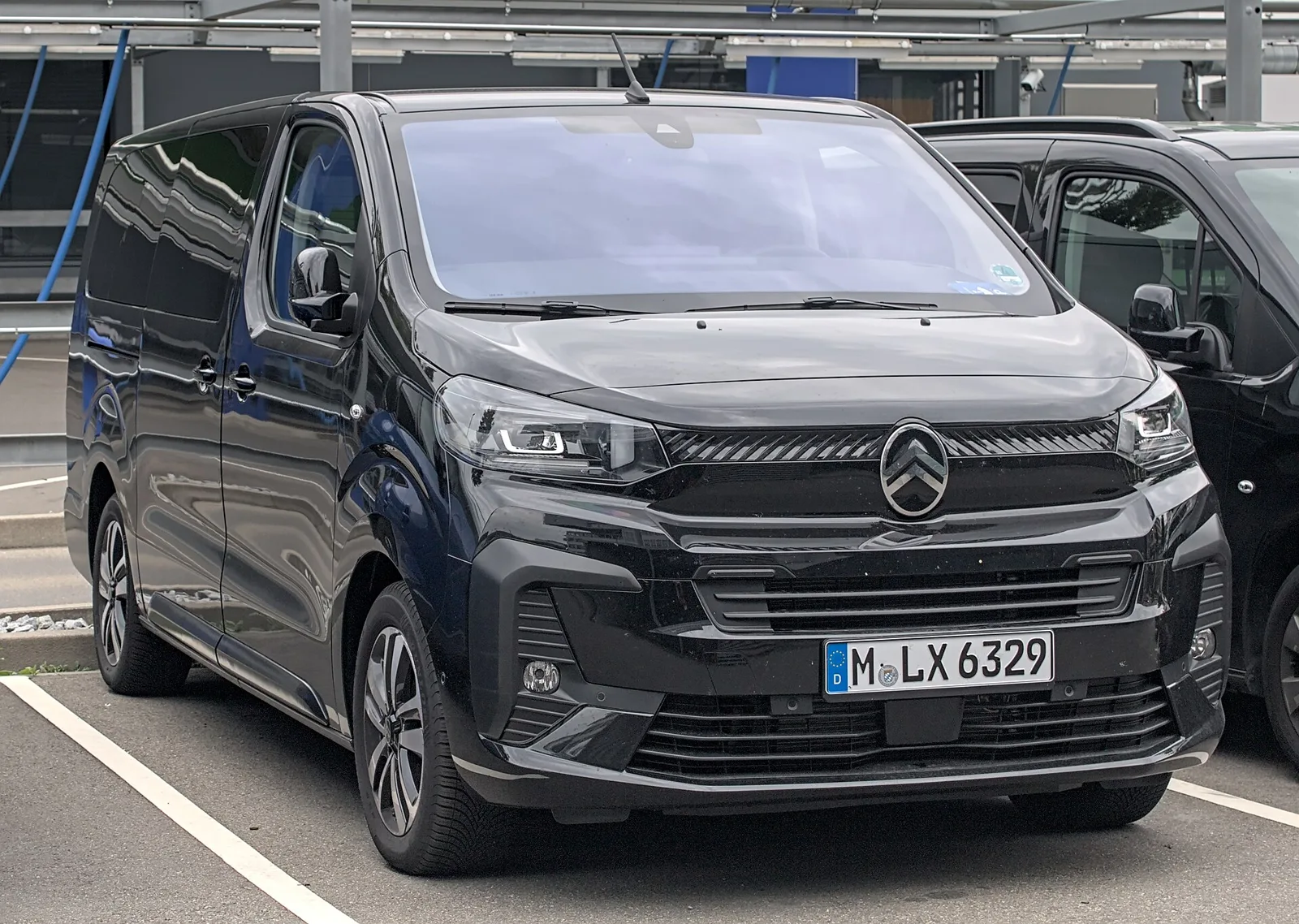
One van platform shared by Citroen, Peugeot, Opel, Fiat and Toyota, from the 2016 launch to hydrogen and electric versions.
The Citroen Jumpy III is a commercial van from a PSA-Toyota family launched in 2016 alongside the Peugeot Expert III and Toyota ProAce II, and later joined by the Opel Vivaro C and Fiat Scudo III. The same base produced the SpaceTourer minivans. Electric and hydrogen versions followed from 2020.
The Citroen Jumpy III did not arrive alone. It belonged to a family of vans and minivans built by PSA and Toyota from 2016 and later sold under Opel, Vauxhall, Fiat, Iveco and Ram badges. The commercial versions kept the Jumpy/Dispatch and Expert names, while the passenger models were called SpaceTourer and Traveller.
Iveco began building its eJolly version in 2025, and Ram followed in 2026 with the ProMaster City, so the same vans were sold under even more names. From 2017 a company in Uruguay had already assembled Jumpy and Expert vans in CKD form for PSA, to supply the South American market.
Where did the Jumpy III project begin?
PSA announced its K-Zero light commercial vehicle project in August 2012. It was meant to replace the Jumpy-Dispatch II, the Expert II and the ProAce, and Toyota took over from Fiat as PSA's partner in sharing design and production costs from 2016.
Both Citroen and Peugeot had already tested ideas for vans. Citroen showed the Tubik concept at the 2011 Frankfurt Motor Show, though few of its features made it into the production SpaceTourer. In 2015 Peugeot brought a FoodTruck to Milan Design Week, a prototype food-truck restaurant that proved fully functional throughout the event.
The FoodTruck's nose, with the Peugeot lion set in a chrome-framed grille and an insert between the headlights like the pupil of a cat's eye, was followed by a similar front end on the production Traveller.
A family of vans sold under many badges, with electric and hydrogen versions from 2020.
When did the vans go on sale?
The SpaceTourer, Traveller and ProAce II were unveiled on 1 December 2015 and shown at the Geneva motor show on 3 March 2016. Commercial versions followed on 30 March 2016, and the commercial variants were launched that March under the Jumpy, Expert and ProAce names.
Production was announced for the SEVEL Nord plant, which was upgraded for the launch with better logistics and the introduction of full kitting. Each model came in three lengths, L1, L2 and L3, with one height, H1.
Passenger Combi versions were designed to carry five to nine people, while the commercial Navette versions carried goods. The French commercial vans kept the Citroen Jumpy/Dispatch and Peugeot Expert names.
Euro NCAP gave the trio five stars in crash tests. On 7 December L'Argus named the Peugeot Expert the 2017 utility vehicle of the year, with the award handed over at the Palais de Tokyo, a structure dating from the Paris world fair of 1937.
Why did the family turn electric and hydrogen?
In January 2022 Stellantis ended sales of combustion-engined passenger vans across most of Europe, with Switzerland and the Balkans as the exceptions. The move was motivated by a wish to lower average CO2 emissions under the EU's CAFE rules. Consequently, the SpaceTourer, Traveller and Zafira Life came only with electric or hydrogen power. Other pressures played a part too: the ecological malus, a penalty that grows more severe each year, and a weight-based malus that came into force in France.
Citroen presented the e-SpaceTourer on 12 June 2020 as the 100% electric version of its van. Then came the electric Jumpy and Dispatch, the e-Traveller and e-Expert from Peugeot, Opel's Zafira-e Life and Vivaro-e, Vauxhall's own versions and the Toyota ProAce Electric. Toyota also offered the ProAce Verso Electric, and Vauxhall sold the Zafira Life in Britain as the Vivaro Life.
Opel's Vivaro-e Hydrogen, shown on 18 May 2021, paired a 45 kW fuel cell with a lithium-ion battery rated at 10.5 kW. Its payload was 1,100 kg, while the battery version managed 1,200 kg and the combustion model 1,400 kg. A few days later Peugeot showed the e-Expert Hydrogen, and Citroen showed an e-Jumpy Hydrogen too. These were built at Valenciennes and converted at a former Opel works in Russelsheim.
Opel quoted a range of 200 to 300 km for its electric Vivaro, which was offered with batteries of 50 and 75 kWh.
Opel presented the new Zafira Life on 11 January 2019. It was a family derivative of the Vivaro C rather than a minivan, and it went on sale in September 2019. The commercial Vivaro C was shown on 23 January 2019.
In September 2021 a successor to the Fiat Talento II was announced, one that likewise dropped the Renault Trafic base for the Citroen Jumpy and Peugeot Expert platform.
Why did the Russian exports stop?
Starting in February 2022 Stellantis sent some of the Kaluga plant's Russian output to Western Europe, and the Citroen, Peugeot and Opel models were among those built there. In March 2022 it announced that it would stop exporting vehicles from Russia after Moscow invaded Ukraine, ending a programme that had only just started.
Assembly of the Fiat Scudo in CKD form also began in Uruguay in July 2022, alongside the Jumpy and the Expert, following earlier CKD work there from 2017.
Which engines changed for the 2026 standard?
Under the 2026 emission rules, BlueHDi units of 145 PS and 180 PS were swapped for Fiat Multijet engines rated at 150 and 180 PS. The 180 PS output stayed the same, while the 145 PS unit became a 150 PS one.
What did the 2024 update bring?
Stellantis and Toyota presented the update on 23 October 2023, with a different look for each brand. In 2024 Citroen added the Holidays, a SpaceTourer conversion that sleeps up to four guests overnight, with a kitchen, water tank and fridge as standard. Options included an outdoor shower, extra heating and a removable kitchen.
Fiat revived the Ulysse and Scudo names with third-generation vans presented on 27 October 2021. The electric e-Scudo followed in December 2021, and the Scudo III reached showrooms in January 2022.
Fiat's e-Ulysse arrived on 2 March 2022 in medium and long lengths, and the long one was named e-Ulysse Living. Fiat dropped the e-Ulysse from French sales in October 2023, after about a hundred registrations, though it stayed on sale elsewhere.
Which trim levels did the family offer?
Citroen offered the SpaceTourer in Feel, Shine, Business, Business Lounge and a special edition, and the Jumpy in Confort, Club and Business. Peugeot used Traveller and Traveller Business for passengers and Pro, Premium and Premium Pro for the Expert.
- Toyota ProAce Verso II: Dynamic, Executive and Lounge
- Toyota ProAce: Active, Dynamic and Business, with only Business left from July 2022
- Opel Vivaro: an electric version announced in November 2019, with batteries of 50 and 75 kWh
- Opel Zafira Life: sold as Vivaro Life in Great Britain
The earlier Vivaro Life, at Vauxhall and at Opel alike, had been a rebadged Renault Trafic SpaceClass Escapade.
What concept versions were shown?
Barely officialised, the SpaceTourer and Traveller were given specific versions as show cars. Citroen's SpaceTourer Hyphen came to Geneva in 2016 as a colourful 4x4 with all-wheel drive, and the 4x4 E Concept of 2017 was painted white and grey with red accents. The Peugeot Traveller i-Lab of early 2016 had a 32-inch tablet and four facing seats.
The Hyphen takes its name from the band Hyphen Hyphen, and it hinted at a possible eight-seat all-terrain minivan that an Alsace specialist might have sold. A sports-brand partnership produced a camper concept shown at Frankfurt in 2017, with all-wheel drive, a roof that lifts, and a living area fitted by a specialist company.
The Citroenist concept marked the maker's centenary at Geneva in 2019 with stickers on the front doors. The show car also came with a bicycle called The Citroenist, sold through the brand's online shop.
Electric and hydrogen versions by model
| Model | Brand | Launch | Electric or hydrogen version |
|---|---|---|---|
| Jumpy and Dispatch III | Citroen | March 2016 | e-Jumpy, e-Dispatch, e-Jumpy Hydrogen |
| Expert III | Peugeot | March 2016 | e-Expert, e-Expert Hydrogen |
| ProAce II | Toyota | March 2016 | ProAce Electric |
| Vivaro C | Opel | 23 January 2019 | Vivaro-e, Vivaro-e Hydrogen |
| Scudo III | Fiat | 27 October 2021 | e-Scudo, December 2021 |
| Ulysse III | Fiat | 27 October 2021 | e-Ulysse, 2 March 2022 |