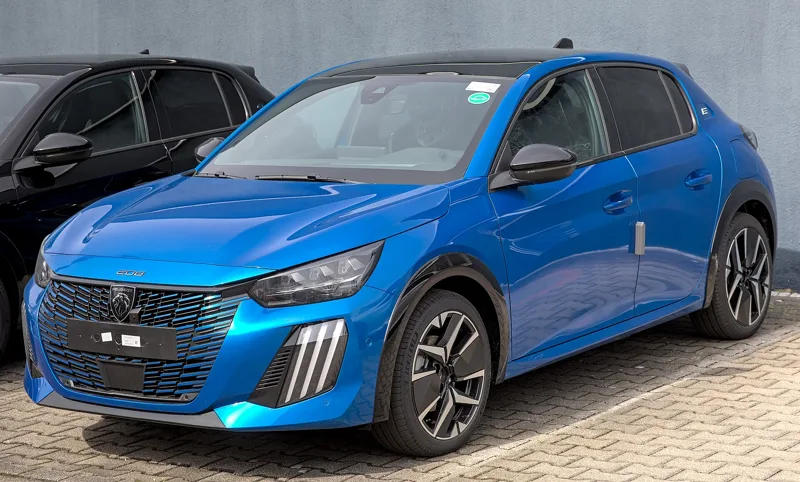
The second-generation 208 from 2019, its electric e-208, South American variants and the Opel and Lancia cousins built on the same body.
Launched in October 2019 as the second generation of the 208, the car won European Car of the Year for 2020 and led French sales for three years. Its range covers petrol, mild-hybrid and the all-electric e-208 with up to 400 km.
The Peugeot 208 II is a segment B car that Peugeot has sold since 6 October 2019. It replaced the first 208, won the European Car of the Year title for 2020, led French sales in 2020, 2021 and 2022, and was the number one seller in Europe in 2022 across all models.
How did the 208 II arrive on sale?
Peugeot unveiled the 208 II on 25 February 2019, ahead of its first public showing at the Geneva show that year. The project had begun in 2014, series production started in July 2019, and the electric e-208 followed in November of the same year.
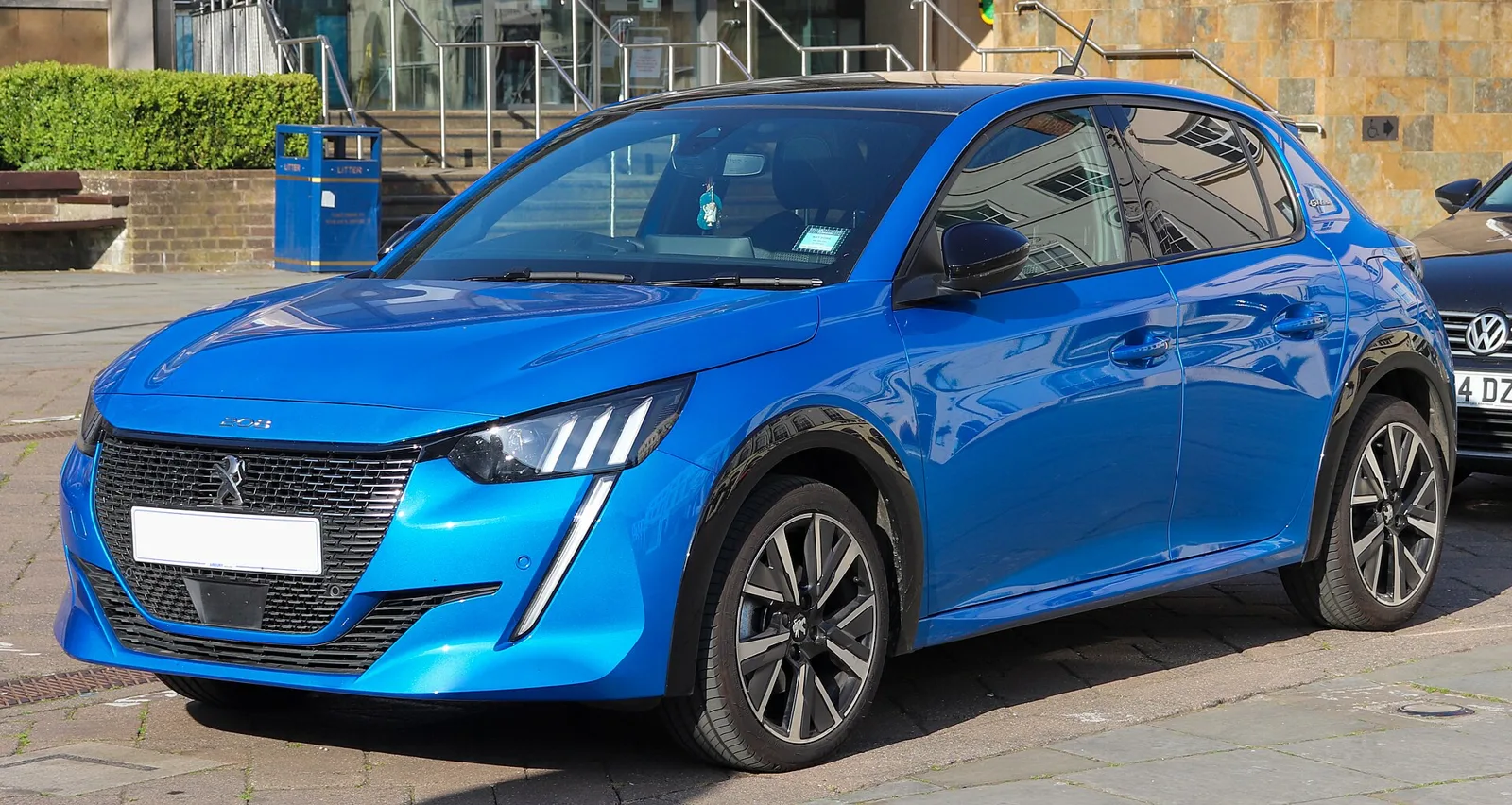
The second generation replaced a first generation that had been built from 29 March 2012 to 5 October 2019. The new car gave up the roundness of the 206, 207 and first 208. Its rear lamps took a claw shape like recent Peugeot models such as the 508 and 3008, and the daytime lights took a sabre shape, as on the new 508 II.
The new car also introduced the CMP modular platform of the PSA group, already used by its cousin the DS 3 Crossback. Certain details recall the 205, including the window line and the notches on the rear wings where the trim name is written. Kevin Goncalves was the designer, working under Yann Beurel as project design manager, and the interior was drawn by Eric Dejou.
A segment B car that led French sales for three years and added an electric e-208 to the range.
What changed in the 2023 facelift?
The facelifted 208 was presented on 6 July 2023 and went on sale from November of that year. Its headlamps gained a new LED signature under three independent modules, and the bumper took claw-shaped daytime lights. The three rear claws now sit horizontally, one above the other.
A black strip in the middle of the rear lamps carries the Peugeot name, while the lion disappears from the tailgate. New upholstery was introduced, and massage seats became an option on GT trim.
The 208 has the i-Cockpit layout: a high-mounted instrument display, a small wheel with a flat-bottomed rim, and a touchscreen. Screen sizes measure 13, 18 or 26 cm depending on the trim, and Connect Apps debuted on the 208.
Where is the 208 II built?
Production has left France. The 208 is now made in Slovakia and Morocco, the e-208 is built only at the Travna site, and Argentina has its own plant at Buenos Aires, where production began in 2020, for South American markets. Earlier, the Mulhouse and Poissy works built the 20X range.
Sales figures for 2020 in Argentina and Brazil combine the first and second generations, so those totals do not show the 208 II on its own.
From the second half of 2022, Chilean buyers could also get some 208s built in Argentina, alongside the European-built car that was already sold in that market.
South American models
The Argentine 208 uses the 1.6 VTi 116 PS petrol engine and an 82 PS three-cylinder, and it is built only with combustion engines. Some high-end versions, the 208 GT and the e-208, are imported for sale in Latin America.
The South American version sits higher. Its ground clearance is 10 to 12 mm greater and its approach angle is 16 degrees instead of 14, to suit local roads that are rougher than European ones. Local models use cheaper materials, with steel favoured over aluminium in places, different rear seats and a larger fuel tank.
From May 2022, after the merger of PSA and FCA to form Stellantis, the Argentine plant also built 208s with a 71 PS 1.0 Firefly naturally aspirated engine, for export to Brazil. That engine is shared with the Fiat Argo, and one-litre naturally aspirated units account for most sales in that segment in Brazil.
In September 2023 Peugeot added a three-cylinder 1.0 Turbo 200 engine of 130 PS, of Fiat origin, to the Brazilian line-up. In August 2024 a facelift visually similar to the European model appeared. It brought the 1.0 Turbo 200 of 130 PS to Argentina and removed the 1.2 engine of 82 PS.
Which engines and gearboxes did it get?
The first-phase petrol engines were 1.2 PureTech units in 75, 100 and 130 PS forms, with a 1.5 BlueHDi diesel of 100 PS and a 1.6 HDi of 92 PS for Morocco, plus an electric motor of 136 PS. Gearboxes were a six-speed manual (five-speed on the PureTech 75) or, as an option on the most powerful versions, an eight-speed automatic known as EAT8.
The facelift added two mild-hybrid 1.2 engines, of 100 and 136 PS. They replaced the 1.5 BlueHDi 100 diesel and the 1.2 PureTech 130 petrol, and from then on no diesel engine remained in the catalogue.
The mild-hybrid models gained the e-DCS6, a six-speed automatic dual-clutch unit from the Belgian supplier Punch Powertrain. Stellantis gave it a name built from its parts: the e marks an integrated electric motor, DC marks the dual clutch, S refers to a novel feature in one of the clutches, and the 6 counts the gears.
In 2026 the 1.2 of 100 PS switched from a timing belt to a timing chain, which is the same arrangement as the mild-hybrid engines.
How far does the e-208 go?
The e-208 was built on the technical layout of the DS 3 Crossback e-tense. It uses a 100 kW (136 PS; 134 hp) motor with 260 Nm (192 lb ft) of torque, fed by a 50 kWh battery that gives 340 km of range. Its Eco mode offers 82 PS, Normal 109 PS and Sport 136 PS.
Sport mode takes the car from 0 to 100 km/h in 8.1 seconds. A household socket needs 16 hours for a full charge, a wallbox takes between 5 and 11 hours depending on the power available, and a fast DC charger reaches 80% in 30 minutes.
In December 2021 Peugeot made changes that added between 15 and 22 km of range. The reduction gear ratio was revised, low-rolling-resistance tyres rated A+ were fitted on some versions, and a humidity sensor was added to the climate control software.
August 2022 brought the Like trim to the e-208. That most affordable version carried little equipment, but its 52 kWh battery lifted range to 400 km. In March 2023 a 115 kW (156 PS) motor and a 51 kWh battery arrived for GT trim, with a WLTP range of 398 km and average consumption near 14.5 kWh per 100 km.
Trim levels and special editions
Over the years the maker changed the names and content of the trims, and a GT Pack appeared several months after launch. That trim disappeared in October 2022.
Phase 1 began with Like, then Active, Active Pack, Allure, Allure Pack and GT. Like had cruise control, manual air conditioning and a 5-inch touchscreen radio with DAB, which became a 7-inch screen on the e-208. Active added ESC, a compact wheel with multimedia controls and LED daytime lights.
GT added blind-spot monitoring, Full LED headlamps and connected 3D navigation with a 10-inch touchscreen. On GT Line and GT versions the wheel arches carry black-lacquered protection, a detail that the GT Pack also had between 2020 and 2022. Special editions included Style for 2020 in Europe, Roadtrip from 2021 to October 2022, E-Style from September 2023 to January 2024, and Envy from September 2025. South America had its own specials: Style in Argentina in 2022 and Road Trip in Brazil the same year.
Key specifications
| Specification | Detail |
|---|---|
| On sale | From 6 October 2019 |
| Petrol engines, first phase | 1.2 PureTech of 75, 100 and 130 PS |
| Mild-hybrid engines | 1.2 of 100 PS and 136 PS |
| e-208 motor | 100 kW (136 PS; 134 hp) |
| e-208 torque | 260 Nm (192 lb ft) |
| e-208 range | 340 km with 50 kWh; up to 400 km with 52 kWh; 398 km WLTP with 51 kWh |
| e-208 sprint | 0 to 100 km/h in 8.1 seconds in Sport mode |
| Charging | 16 hours from a household socket; 5 to 11 hours by wallbox; 80% in 30 minutes on DC |
| Gearboxes | Six-speed manual (five-speed on the PureTech 75); EAT8 eight-speed automatic; e-DCS6 six-speed dual clutch |
| South American ground clearance | 10 to 12 mm higher than the European car |
| Price, launch to January 2023 | 3,520 to 5,150 euros, depending on model |
How did prices move after launch?
According to L'Argus, prices rose from 3,520 euros to 5,150 euros depending on the model, between launch and January 2023. The increase was linked above all to a shortage of semiconductors. At the start of 2023 Peugeot also offered a tailored 36-month long-term rental that put an e-208 at 150 euros a month under certain conditions.
Sister cars: the Corsa F and Ypsilon III
Opel launched the Corsa F in 2019, the same year as the 208. It is mostly a re-bodied 208 II, since it shares the body structure and front doors with the Peugeot, as well as much of its glass, roof, mirrors and rear spoiler. The front wings and bonnet are identical to those of the 208. The two cars differ in their front end, rear quarter-light, tailgate, rear bumper, rear lamps and cabin, although the headlining and courtesy light are shared. In England the Corsa F is sold under the Vauxhall name.
Lancia's third-generation Ypsilon arrived in February 2024 as the first car of that family built under the Stellantis group. Like the Corsa F, it borrows the 208 II's body structure and front doors, and takes over its wheel arches and rear spoiler as well. Its front end, rear quarter-light, tailgate and rear lamps are different.
Did the 208 II win awards?
The 208 II won L'Argus's Car of the Year 2020 award in January 2020. On 2 March 2020 it took the European Car of the Year title with 281 points, ahead of the Tesla Model 3 on 242 points and the Porsche Taycan on 222 points.
The European prize is normally presented the day before the Geneva show opens to the press. In 2020 that show was cancelled because of COVID-19, and the 90th edition never took place. Novak Djokovic fronted the e-208 advertising, under the slogan Move to Electric.
Sport and GTi versions
On 17 October 2024 Peugeot Sport unveiled the 208 Racing, with the French motorsport federation's new FR6 Trophy launched in the same announcement.
Around the 24 Hours of Le Mans, Peugeot announced on 13 June 2025 a 208 GTi with 280 PS. Its electric motor came from Emotors, the same supplier used by the Alfa Romeo Junior, the Abarth 600e and the Lancia Ypsilon HF. The GTi also had a lowered, reworked chassis, a body kit, and red details inside and out with Alcantara upholstery.
In August 2025 Peugeot unveiled the all-electric e-208 GTi, which revived the GTi name among the brand's sporting models.