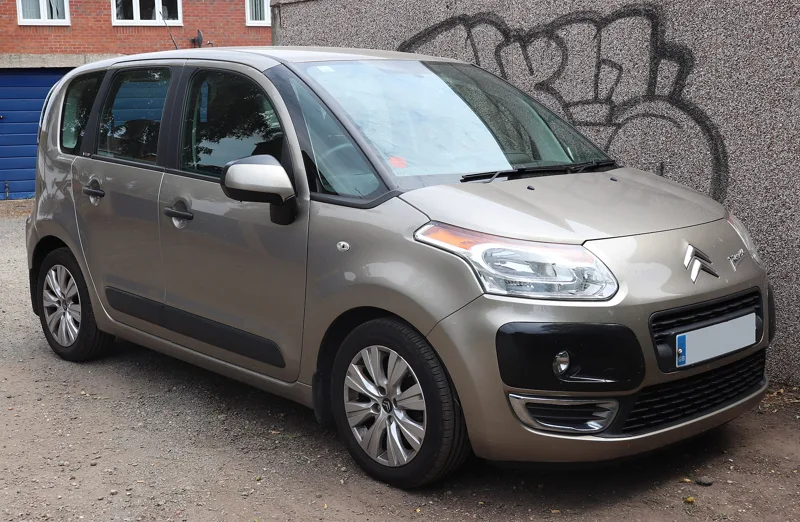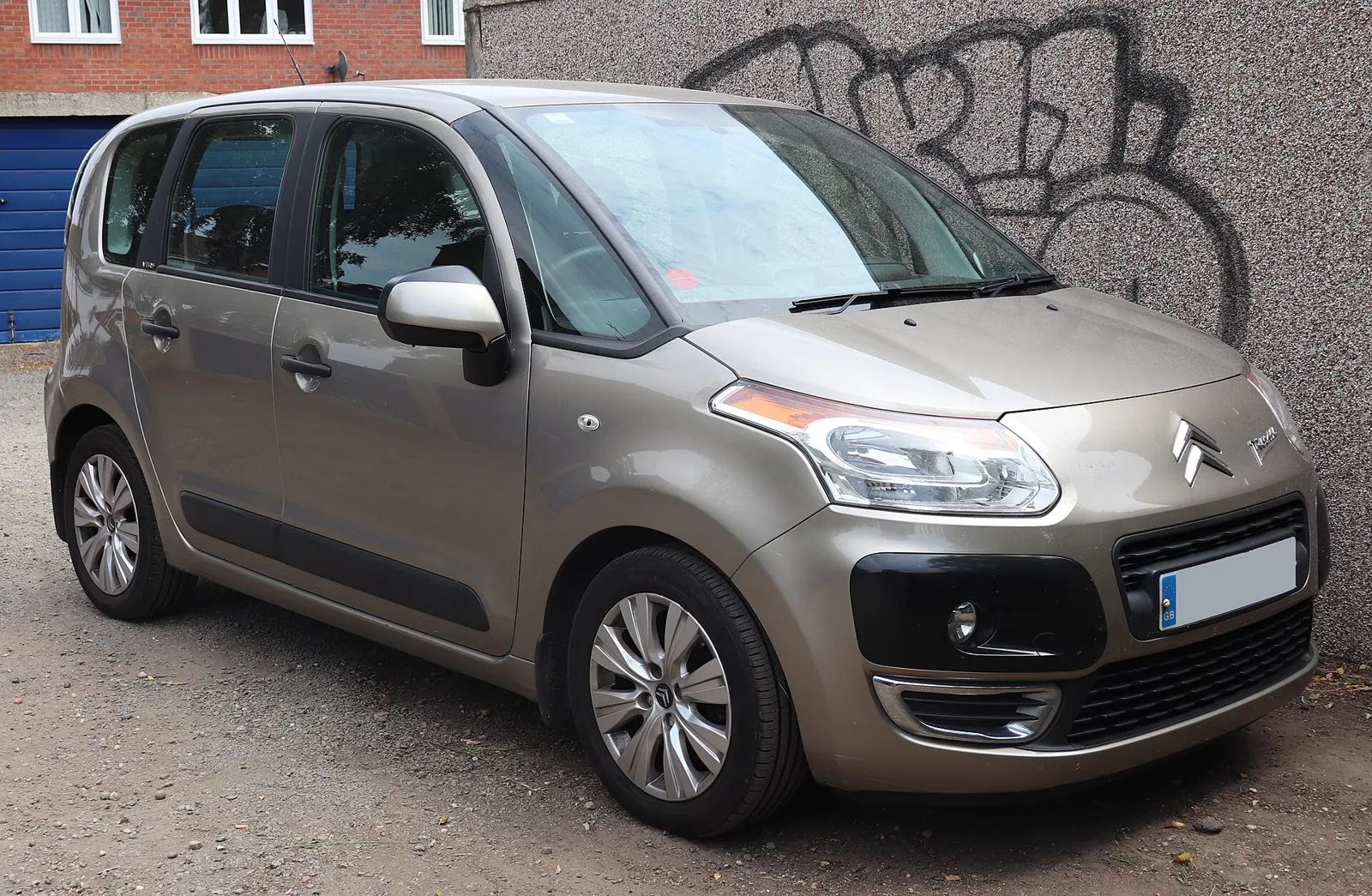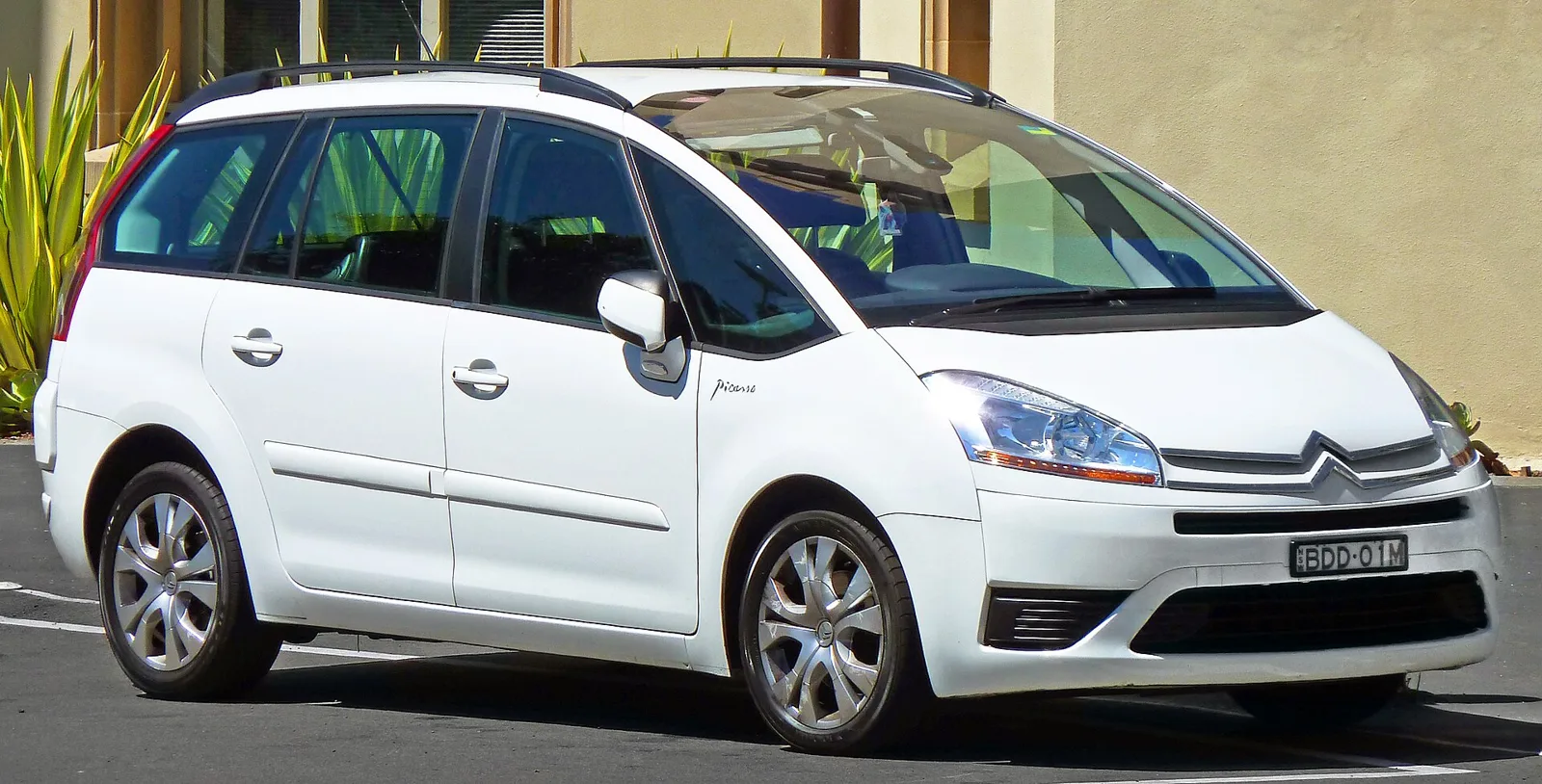
A compact MPV from 2006 with a seven-seat and five-seat version, a roomy cabin that reviewers praised, and several recall campaigns.
The first Citroen C4 Picasso arrived as a compact MPV built on the C4 platform, with a seven-seat version in 2006 and a five-seat version in 2007. Europe bought more than 800 thousand, and a second generation followed in 2013.
The first-generation Citroen C4 Picasso was a compact MPV from the French maker, presented in 2006 as a seven-seater and in 2007 as a five-seater. Built on the platform of the C4 hatchback, it sold more than 800 thousand cars in Europe.
Its unusual looks and roomy cabin won praise from several magazines, but critics said its handling in sharp turns was not good enough.
Why did the C4 Picasso replace the Xsara Picasso?
By 2003 the Xsara Picasso was becoming outdated. Reports of a successor built on the C4 hatchback appeared in November 2004, a month after that hatchback premiered, and more than 100 million euros had been put into development by then.
First hints of the new compact MPV appeared in May 2003, when the launch was expected in 2005 with a seven-seat version called Picasso Plus. The future car was spotted on test runs in March 2005.
The debut slipped a year. The seven-seater was shown first at the Paris Motor Show in October 2006, and the five-seater followed at the Geneva Motor Show in March 2007. The seven-seater then became the Grand C4 Picasso, and the C4 Picasso name stayed with the five-seater. Prices started at about 21,000 euros in the basic trim.
An unusual, roomy people carrier that Europe bought in hundreds of thousands.
How did the C4 Picasso sell outside Europe?
Exports went to Russia, China and Latin America. In China the seven-seater was shown at the Beijing Motor Show in April 2008 and went on sale that December at about 300,000 yuan, while Brazil received the seven-seater from May 2008 from 89,800 reais.
The Xsara Picasso had been assembled for the Chinese market at the Dongfeng plant in Wuhan. For the new model the decision was to import the cars rather than build them locally.
Brazil took the five-seater in January 2009 from 80,700 reais. Argentina followed in spring 2010 from 140 thousand pesos, and in Russia the 2010 facelifted cars started at 709 thousand roubles for the five-seater and 809 thousand for the seven-seater.
What did the cabin of the C4 Picasso look like?
The interior shared its layout with the C4 hatchback, with the instrument panel set in the centre rather than above the steering wheel. The gear lever sat on the steering column, so there was no centre tunnel. The windscreen ran far onto the roof, giving a 70-degree field of view.
The steering wheel had a fixed hub, which was tied to the design of the airbag. Cruise control, audio, phone and navigation buttons were placed on that hub.
Storage was generous. Besides the glovebox there were compartments on both sides of the dashboard, and a chilled box sat in the centre console.
The second row had three separate seats, with tables on the front seat backs. Optional DVD screens and rear window blinds were available for an extra fee, and a tool box sat in the floor between the first and second rows.
Reaching the third row meant pushing the second-row seats forward, which stood the seat cushions upright. The third row had two small seats.
How did the five-seat and seven-seat bodies differ?
The five-seat car kept the teardrop body of its predecessor, while the seven-seat version had a flat rear end like most minivans. Both had front doors that did not reach the roof pillars, and the Citroen emblem sat inside the radiator grille.
On the seven-seater the rear lights were mounted on the rear roof pillars. Each light was made of four tubes, lit by twelve LEDs.
Luggage space depended on the seating. With all seven seats in use the boot held 208 litres, while the five-seater offered 500 litres, rising to 1,734 litres with the rear seats folded. Front xenon headlights that turned with the steering wheel could be bought for an extra charge.
What engines and gearboxes did the C4 Picasso offer?
The launch line-up had two petrol engines, a 1.8-litre (110 cu in) with 125 PS (123 hp; 92 kW) and a 2-litre (122 cu in) with 143 PS (141 hp; 105 kW). The two diesels were a 1.6-litre (98 cu in) with 110 PS (108 hp; 80 kW) and 240 Nm (177 lb ft) of torque, and a 2-litre (122 cu in) with 138 PS (136 hp; 100 kW). That original list was not supplied to Russia, where fuel quality was poor.
The 2010 facelift added a 1.6-litre (98 cu in) petrol with 120 PS (118 hp; 88 kW), and a turbocharged version with 150 PS (148 hp; 110 kW).
Transmissions were a 5-speed manual, a 6-speed robotised manual or a 4-speed automatic. The suspension used McPherson struts at the front and a semi-independent coil-spring rear, with air suspension as an option at the back.
What are the Citroen C4 Picasso specifications?
| Specification | Detail |
|---|---|
| Platform | PF2, shared with the C4 |
| Seats | Five or seven |
| Launch petrol | 1.8-litre (110 cu in), 125 PS (123 hp; 92 kW); 2-litre (122 cu in), 143 PS (141 hp; 105 kW) |
| Launch diesel | 1.6-litre (98 cu in), 110 PS (108 hp; 80 kW), 240 Nm (177 lb ft); 2-litre (122 cu in), 138 PS (136 hp; 100 kW) |
| After 2010 | 1.6-litre (98 cu in) petrol, 120 PS (118 hp; 88 kW); turbo 1.6-litre, 150 PS (148 hp; 110 kW) |
| Gearboxes | 5-speed manual, 6-speed robotised, 4-speed automatic |
| Luggage | 208 litres with seven seats; 500 to 1,734 litres with five |
| Safety systems score | 89% after the 2009 retest |
How safe was the C4 Picasso in Euro NCAP tests?
The seven-seat model was crash tested by Euro NCAP in 2006. In the frontal test, the dashboard structures near the driver's legs were flagged as a potential hazard, while the side impact earned the maximum 18 points.
Child protection was weaker. The head of an 18-month-old struck the driver's seat, and points were lost for that. Pedestrian results were also a concern, because an adult head could suffer serious injury after hitting the bonnet.
At Citroen's request the car was retested in 2009 under the new scoring system. The front pillar moved back only 4 mm, and no dangerous dashboard structures were found. The side impact showed weak chest protection for the passenger against a pole, and neck protection in a rear impact was not sufficient. Child protection improved, and pedestrian protection did not change.
What did reviewers say about the C4 Picasso?
Reviewers liked the unusual styling and the roomy rear seats. Handling and the robotised gearbox drew the most criticism.
The Russian magazine Avtorevu compared three compact MPVs in 2007, against the Volkswagen Touran and the Ford C-Max. It rated the rear seats the most spacious of the three and the load height the best. The C4 Picasso was also the most economical at 10.8 l/100 km, and its braking distance from 150 km/h was the shortest at 92 m, against 95 m for the C-Max and 99 m for the Touran.
The same test criticised the gearbox and noted large body roll. In an elk test the steering was reported to lock up.
Za Rulyom compared it with the Ford C-Max, Mazda 5 and Renault Scenic. Design and rear space came out on top again, though the seat adjustment controls were awkward and body roll was the only handling complaint.
Auto Express rated the car positively, criticising only a slightly slow gearchange and a high price. The magazine Car gave it 3 out of 5 overall, with comfort at 5 out of 5 and design, performance and handling at 3.
Which recalls affected the C4 Picasso?
The car went through several recall campaigns. The first came in 2007 over seatbelt pretensioners and load limiters, and 2008 alone brought five separate recalls.
The 2008 recalls covered brake assistance in July, panoramic roof mounting in August, front brake caliper reliability in September, the parking brake in November and battery charging in December. Later campaigns came in June 2010 for a seatbelt anchor socket, and in 2011 for fuel leakage and then the parking brake.
The last two recalls came in 2012, one over seatbelt mounting bolts and one over fire risk.
How well did the C4 Picasso sell?
Like the Xsara Picasso, the C4 Picasso was a strong seller in Europe, where more than 800 thousand cars were sold.
Russia was relatively weak, with about 4 thousand cars sold over five years.