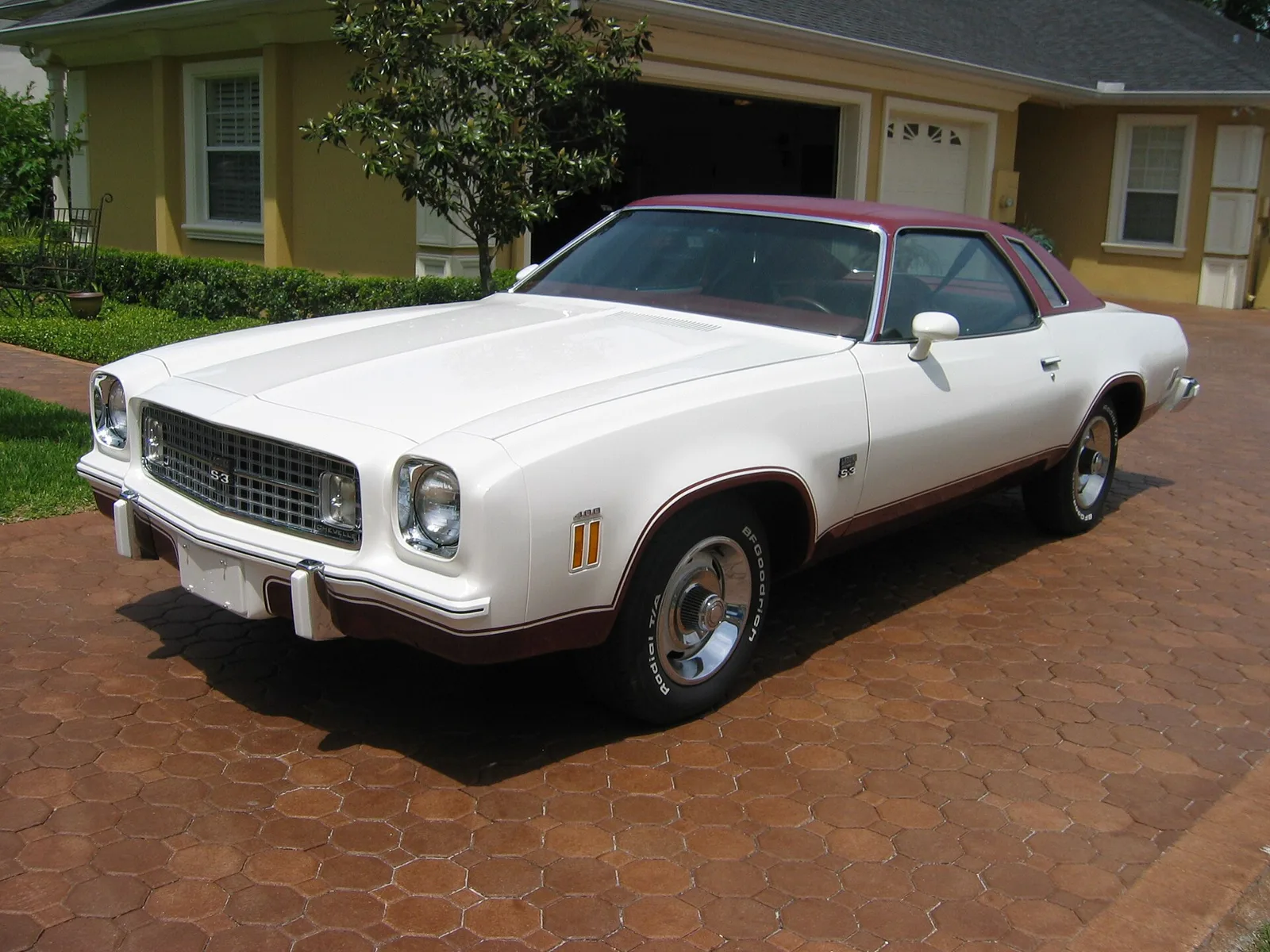
A 1973 to 1976 coupe with a body-coloured nose, a 350 V8 as standard and a Winston Cup record that carried Cale Yarborough to two titles.
The Chevrolet Chevelle Laguna was the top-line third-generation Chevelle from 1973 to 1976, with a urethane front end and a 145 hp V8 as standard. It later became the Type S-3 coupe and carried Cale Yarborough to the first two of three consecutive NASCAR titles.
The Laguna was the top-line Chevelle for 1973, sitting above the Malibu, and its body-coloured urethane front end made it easy to tell apart from other Chevelles. Between 1973 and 1976 it also became a regular fixture at NASCAR's fastest tracks, where Cale Yarborough drove one to the first two of his three consecutive Winston Cup titles.
The Laguna sat on the GM A-Body platform, shared with the rest of the third-generation Chevelle range, and it was offered in several body styles from the start.
What was the Chevrolet Chevelle Laguna?
The Laguna was the top-line Chevelle series for the 1973 model year, above the Malibu, and it was offered as coupes, sedans and station wagons. From 1974 to 1976 it became a one-model Laguna Type S-3 coupe, while the new Malibu Classic took the top luxury position.
Chevrolet honoured California beach resorts again by giving the top 1973 Chevelle series the Laguna name. The Malibu took the middle spot, and the base series was called simply Deluxe.
Across 1973 to 1976 the Laguna accounted for 108,815 of nearly 1.7 million third-generation Chevelle sales. The 1973 Laguna coupes numbered 42,941, and the 1974 to 1976 Type S-3 coupes reached 38,790, which makes them relatively scarce among collectors today.
A Chevelle with a urethane nose that helped Cale Yarborough win the first two of three straight titles.
Why does the urethane front end matter?
Every Laguna had a body-coloured urethane front end that concealed the new 5 mph bumper system. On a minor impact the nose cone deflected and rebounded, backed by shock-absorbing cylinders, and the look set the car apart from every other Chevelle.
The nose sat alongside a diecast chrome grille with a bowtie emblem, a body-coloured steel rear bumper, bright roof drip mouldings and Laguna fender nameplates. The interior was richer than the Malibu's, with map pockets, deep-twist carpet and woodgrain vinyl accents.
Motor Trend's 1973 buyers guide suggested readers might want to buy General Motors stock after seeing what the stylists had done with the pillar coupe. Car and Driver liked how the urethane nose kept the front flat and free of gaps, a clean look at a time when many cars had protruding bumpers.
How did reviewers judge the 1973 Laguna?
Reviewers liked the balance of style, comfort and performance. Speed and Supercar's editor said the car was so comfortable that he bought one, and the magazine's June 1973 street test called the 350 Laguna a groovy all-round car.
That test admitted the car could not run the quarter mile in 13 seconds, but it argued that few cars of 1973 could. The magazine's view was that the Laguna offered enough performance without being overpowering.
Motor Trend's 1973 buyers guide noted that competing lines from Ford and Chrysler were one or more years old when the Laguna arrived, which made the new Chevelle look especially fresh. The magazine described the Grand Am and the Laguna as large small cars that were nimble, quick and responsive.
Motor Trend linked the car's tight feel to its heavily ribbed underbody and double-panelled roof. It also praised the integrated, body-coloured urethane front end as far better looking than the big bumper approach.
Car and Driver found the highway stability so strong that the Laguna seemed locked onto a guidance beam aimed at the destination. Its urethane nose cap let the front end stay flat, and the magazine said the car looked as though it could bowl over most of the traffic on the road.
How was the Laguna's chassis different from the older Chevelle?
The 1973 Chevelle shared the most extensive redesign in the model's 10-year history, and its chassis were as new as its bodies. Wheelbase dimensions carried over from the 1968 to 1972 cars at 112 inches for coupes and 116 inches for sedans and wagons.
The perimeter frame was all new and sturdier, with more front and rear suspension travel, an eight-and-a-half-inch rear axle and six-inch wide wheel rims. Front suspension geometry was improved, and new body mounts and refined rear control arm bushings completed the work.
The coil springs were computer-selected to match each car's weight, and the left wheel was set with slightly more positive camber than the right. That gave a more uniform steering feel on high-crown roads while keeping freeway stability strong.
Power brakes with front disc calipers were standard on every 1973 Chevelle. The fuel tank held 22 gallons, and the Laguna's flush door handles, molded foam seats and flow-through ventilation added to the refinement.
Did the 1973 body add safety and visibility?
The new B pillars were strong enough to contribute to occupant safety in a rollover, and the unusually thin windshield pillars made the car much easier to see out of than earlier Chevelles. GM had expected federal rollover standards for January 1974, but those rules never arrived.
The Colonnade hardtop of 1973 had a semi-fastback roof, frameless door glass and a distinctive rear quarter window on two-door models. Four-door sedans had side windows with styled centre pillars instead.
Two station wagons joined the range, one of them the Laguna estate, with six- or nine-passenger seating and a counterbalanced liftgate.
Which engines did the Laguna offer?
The Laguna came standard with a 350-cubic-inch two-barrel V8 rated at 108 kW (145 hp). Buyers could also order a 350 four-barrel rated at 175 hp (130 kW), or a 454 four-barrel rated at 245 hp (183 kW), and a three-speed manual was the standard gearbox.
Hardened engine valve seats and hydraulic camshafts made these engines durable, and they accepted the unleaded gasoline that was becoming popular. Crossflow radiators and coolant reservoirs that kept air out of the system helped prevent overheating.
A four-speed manual and the Turbo Hydra-Matic three-speed automatic were the two optional gearboxes on the 1973 car.
What changed when the Laguna became the S-3 in 1974?
For 1974 the Laguna became the Laguna Type S-3, offered only as the Colonnade coupe. It kept the urethane front end with a revised grille and new parking lamps, and it gained a federally mandated 5 mph (8.0 km/h) chrome rear bumper in place of the 1973 steel unit.
The S-3 replaced the discontinued SS as the Chevelle's performance option. It came with firmer shocks and springs, a front stabiliser bar and HR70x15 radial tyres on Rally wheels, plus a console, a vinyl roof and body side striping.
Production totalled 15,792 cars in 1974, with prices starting at $3,723 and enough options to push the bill past $5,000. Inside, swivel bucket seats looked out at a set of round dials and a sport steering wheel with four spokes.
The standard engine was the 145 hp 350 two-barrel V8. Optional powerplants were a 150 hp (110 kW) 400 two-barrel, a 175 hp (130 kW) 400 four-barrel and a 235 hp (175 kW) 454 four-barrel. In California a 155 hp (116 kW) 350 four-barrel was standard, and the 400 and 454 were optional.
Turbo Hydra-matic was standard, and a four-speed manual was available only with the 454. Horsepower looked lower than before because ratings had switched from gross to net in 1972.
What changed in the final two years of the Laguna?
The 1975 Laguna arrived mid-year in January 1975 with a slanted, urethane-covered aero nose designed for NASCAR, louvered opera windows and no Colonnade designation. The vinyl half-roof, Strato-bucket seats and four-spoke sport wheel were no longer standard, having been made optional in mid-1974 to reduce the base price.
The 454 was available only for the first half of the 1975 model year, so the 400 became the top engine for the rest of it. The 49-state line-up was the standard 145 hp 350, an optional 175 hp 400 four-barrel and a 215 hp 454 four-barrel. California kept a 155 hp 350 four-barrel as standard, with a 180 hp 400 as the only option.
All 1975 models gained the new catalytic converter, and Turbo Hydra-matic became the only transmission because manual gearboxes were discontinued. An Econominder gauge package was offered during the gasoline shortage of the mid-seventies.
The 1976 car, in its third and final year, kept a sloped urethane nose and quarter-window louvers, while new rear styling and horizontal taillights tied it to the other Chevelles. The standard engine became a new 140 hp 305 two-barrel V8, with the 145 hp 350 and 175 hp 400 four-barrel as options.
Lagunas shared their round-gauge dashboard with the Monte Carlo, while Malibus used a more conventional layout. Production of the Laguna edged up to 9,100 cars that year, as the base price rose to $4,621.
How successful was the Laguna in NASCAR?
The Laguna S-3 was one of the most successful NASCAR bodies of its era. The nose sloped, the rear quarter windows were small and the rear glass ran fastback-style, which gave the car an aero edge over other General Motors bodies on the sport's quickest circuits. Junior Johnson's team, with Cale Yarborough driving, won 34 races with it.
Yarborough won the 1976 Winston Cup championship by 195 points over Richard Petty, with nine wins along the way. He won the title again in 1977, finishing 386 points ahead of Petty after taking nine wins in 30 starts. Those were the first two of three consecutive titles.
Benny Parsons had won the 1973 championship in a Chevelle, holding off a late rally by Yarborough to win by only 67.15 points. It was an early sign of how strong the car was on the NASCAR circuit.
NASCAR considered the Laguna S-3 a limited-edition aero model, and it was made ineligible for competition after the 1977 season. Before that, the Laguna was so fast that NASCAR required restrictor plates on it, even though no other cars carried that rule.
What were the standout NASCAR moments?
Cale Yarborough led all 500 laps to win the Southeastern 500 at Bristol on 25 March 1973, back in NASCAR after a spell in USAC Indy Cars. The race was one of the clearest demonstrations of what the Chevelle could do.
- 16 February 1975: Benny Parsons took the lead three laps from the finish and won the Daytona 500 from 32nd on the grid, when leader David Pearson spun on the backstretch.
- 10 May 1975: Darrell Waltrip won his first career Winston Cup race in his No. 17 Laguna at Nashville, by two laps.
- 20 February 1977: Yarborough won his second Daytona 500, pulling away from Parsons in the final laps.
The third-generation Chevelle victory list runs to fifty-three races, and every entry shows a Chevrolet as the winning car. Yarborough is the most frequent name on it.
Chevrolet Chevelle Laguna specifications
| Specification | Detail |
|---|---|
| Model years | 1973 to 1976 |
| Platform | GM A-Body, third-generation Chevelle |
| Wheelbase | 112 inches for coupes, 116 inches for sedans and wagons |
| Standard engine, 1973 | 350 two-barrel V8, 108 kW (145 hp) |
| Options, 1973 | 350 four-barrel 130 kW (175 hp); 454 four-barrel 183 kW (245 hp) |
| Engines, 1974 | 400 two-barrel 110 kW (150 hp); 454 four-barrel 175 kW (235 hp) |
| Standard engine, 1976 | 305 two-barrel V8, 140 hp |
| Price from, 1974 | $3,723 |
| Base price, 1976 | $4,621 |
| Coupes built, 1973 | 42,941 |
| Type S-3 coupes built, 1974 to 1976 | 38,790 |
| Production, 1974 | 15,792 |
| Production, 1976 | 9,100 |