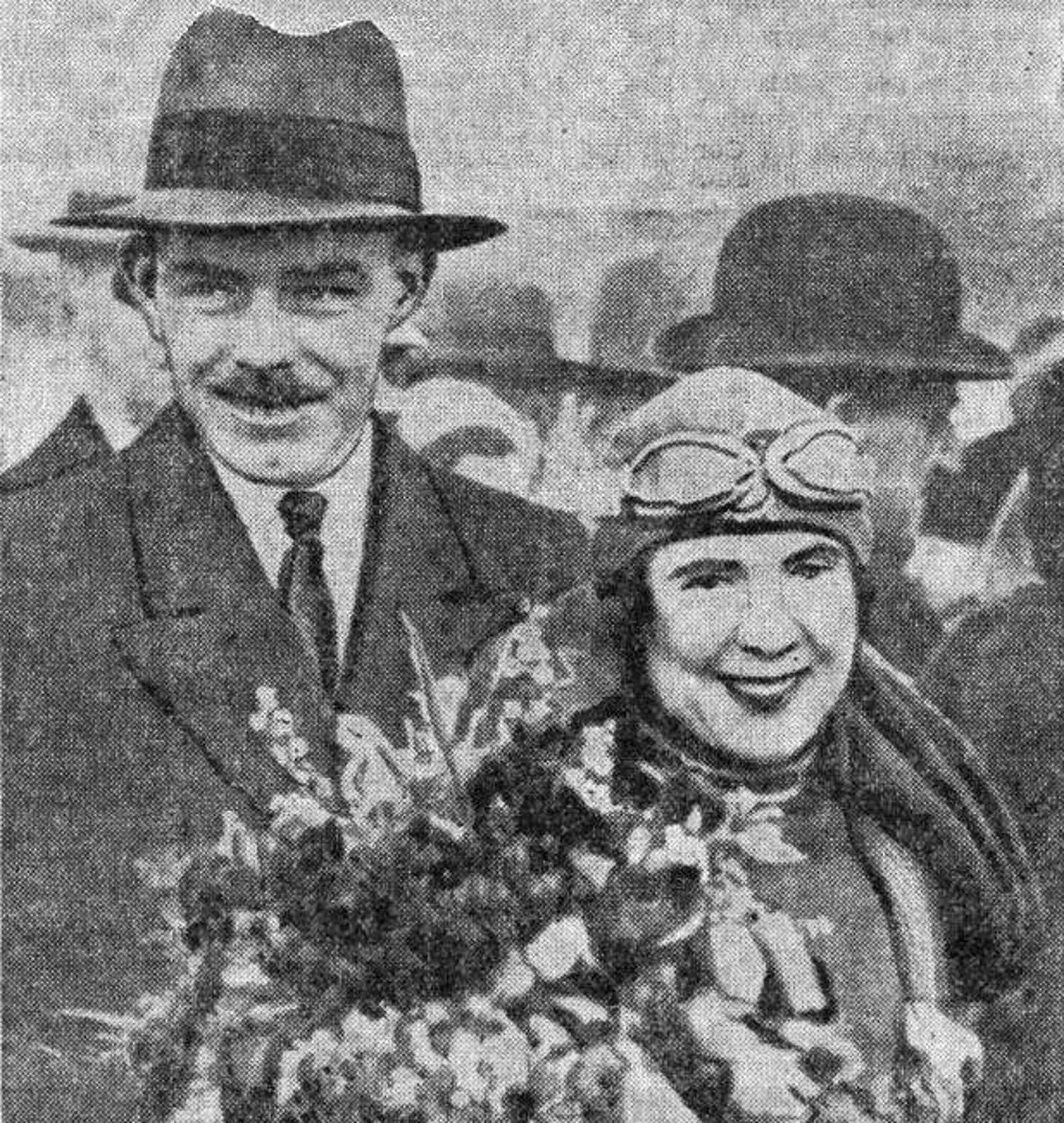
The motorist who drove beyond the Arctic Circle, set endurance records on land and water, and flew round the world alone in 1930-31.
Mildred Mary Petre, known as Mrs Victor Bruce, was born in 1895 and died in 1990, aged 94. She raced cars and boats, flew solo around the world in 1930-31 and later ran airline and coachbuilding companies. Her life was recorded in the Oxford Dictionary of National Biography, which published an entry on her in 2004.
Mildred Mary Petre, usually known as Mrs Victor Bruce, set records on land, on water and in the air between the wars. She later ran a group of airline and coachbuilding businesses. She is best remembered for becoming the first woman to circle the globe by air alone, although she made the ocean crossings by liner.
Who was Mildred Mary Petre before she became Mrs Victor Bruce?
Mildred Mary Petre was born at Coptfold Hall in Margaretting, Essex, on 10 November 1895. Her mother was a Shakespearean actress from Indiana, and Mildred grew up with five brothers. She was educated at the Convent of Notre Dame de Sion in Bayswater, London.
Sailing, riding and driving were part of her childhood. In 1911, aged 15, she began riding her brother's Matchless motorcycle around Osterley in west London, with her collie Laddie in the sidecar. A police court in Hounslow dismissed a motoring charge against her, but it ordered her to pay costs of 6 shillings and banned her from riding the motorcycle until she turned 16.
In 1920 she bought her first car, an Enfield-Allday. She was prosecuted for speeding many times over the following years, including three days running at Bow Street Magistrates' Court.
In 1926 she married the Honourable Victor Austin Bruce, a son of the 2nd Baron Aberdare. He was a works driver for AC Cars and had won the 1926 Monte Carlo Rally in an AC. She kept the Bruce name after the couple divorced in 1941, and they had no children.
A driver, boat racer and pilot who flew round the world alone, then ran airlines and a coachworks through the war years.
How did she become a record-breaking motorist?
In 1927 she started the Monte Carlo Rally from John o' Groats in an AC Six borrowed from Selwyn Edge. She covered 1,700 miles (2,700 km) in 72 hours without sleeping, finished sixth overall and won the Coupe des Dames for the women's class.
Her next challenge was an 8,000-mile (13,000 km) endurance trial, which she set off on from Monte Carlo on 28 January 1927. It took her through Italy, Sicily, Tunisia, Morocco, Spain and France, and she drove 1,000 miles (1,600 km) round the Montlhery oval near Paris before returning to England.
On 9 July 1927 she left London in the same car, accompanied by her husband, a journalist and an engineer. Their route covered much of northern Europe, reaching Finland, where they raised a Union Jack roughly 250 miles (400 km) past the Arctic Circle. No motorist had gone that far north before, and the mark stood into the 21st century.
In December 1927 she and her husband, helped by J. A. Joyce, began a 10-day endurance record in fog at Montlhery. Their AC Six had a racing screen but no roof, mudguards or lights. They averaged 68 mph (109 km/h) over about 15,000 miles (24,000 km).
On 6 June 1929 she drove a Bentley 4 1/2 Litre at Montlhery for 24 hours and set a world record for single-handed driving. Her average was over 89 mph (143 km/h), a figure that made the record one of the most notable of her career.
What records did she set on water?
In 1929 she bought an outboard speedboat named Mosquito and raced it at events on the Welsh Harp reservoir. On 15 September 1929 she took the boat from Dover to Calais and turned straight back, making a non-stop round trip to Dover. The round trip took 1 hour 47 minutes.
The manufacturer gave her a replacement boat after Mosquito had almost destroyed itself on the crossing. In October 1929 she took the wheel of a borrowed 23-foot boat, British Power Boats, and set a 24-hour distance mark. The course looped around a lightship and a moored yacht in the Solent, and she logged 694 nautical miles (1,285 km; 799 mi).
How did she learn to fly and prepare a world flight?
Bruce joined the Mayfair Flying Club in 1928 and owned a Gipsy Moth by January 1930. She took her first flying lesson on 25 May 1930, the day after Amy Johnson completed her record flight to Australia. She learned at the Brooklands School of Flying, soloed on 22 June 1930 and received A-Licence number 2855 on 26 July.
In July 1930 she bought a Blackburn Bluebird IV, registered G-ABDS, with a de Havilland Gipsy II engine. The aircraft went to the Blackburn factory at Brough for modifications before the attempt. In her 1931 book The Bluebird's Flight she claimed that she had been in an aeroplane only once before buying it, and that she did not care for flying.
She named the aircraft Bluebird and took off from Heston Aerodrome on 25 September 1930. The route ran east through Germany, Austria, Yugoslavia, Turkey, Syria and Iraq. An oil leak forced a landing on the shore of the Persian Gulf, where Baluchi tribesmen sheltered her for two days before a British rescue party reached her.
The flight continued through India, Burma, Siam and French Indo-China. Torrential monsoon rains forced a landing in a jungle clearing beside the Mekong River, and she contracted malaria. The route then passed Hanoi, Hong Kong, Shanghai and Seoul, and it included the first flight across the Yellow Sea.
She reached Tokyo on 24 November 1930, having covered 10,330 miles (16,620 km) in 25 flying days. She crossed the Pacific aboard the Empress of Japan to Vancouver. An undercarriage failure at Medford, Oregon cost another week, and she reached New York in early February 1931.
She sailed to Le Havre on the Ile de France and flew into Lympne on 19 February 1931, having covered about 19,000 miles (31,000 km) in total. On 20 February Amy Johnson and Winifred Spooner flew her in, and press and celebrities were waiting at Croydon. She was the first person to fly from England to Japan and the first to fly across the Yellow Sea.
What did her refuelling and flying circus work involve?
In July 1932 Bruce bought a Saro Windhover amphibian named City of Portsmouth and had its undercarriage temporarily removed. She also bought a Bristol F.2 and converted it into a refuelling tanker. Over the Solent in August 1932 she made three failed attempts at the flight-refuelled endurance record, with Flt Lt John B W Pugh as co-pilot.
In early 1933 she joined the British Hospital Air Pageants flying circus. She bought a Miles Satyr through her company, Luxury Air Tours Ltd, for aerobatic displays, and a Fairey Fox from a scrapyard for 2 pounds 10 shillings, plus 10 pounds for an engine. The Fox was modified at Hanworth for passengers, but it crashed in July 1933, and she left the circus.
On 25 November 1934 she left Lympne in a Cierva C.30A autogiro, bound for Cape Town and an attempt at the longest autogiro flight. The aircraft was damaged at Nimes in France after 610 miles (980 km), and the attempt ended there.
How did her airline businesses develop?
Bruce founded Air Dispatch Ltd on 9 July 1934 and Commercial Air Hire Ltd on 7 August 1934. Commercial Air Hire began newspaper delivery flights between Croydon and Paris with two DH.84 Dragons, and the two companies later worked closely together.
In 1935 Air Dispatch started weekend freight services from its Croydon base to Le Touquet and Le Bourget in Paris, and later passenger services as well. Commercial Air Hire ran Inner Circle Air Lines, a shuttle between Croydon and Heston using GAL Monospar ST-4s, and bought an Avro 642 Eighteen airliner with 16 seats for newspaper contracts.
She was co-managing director, with Eric E. Noddings, of both closely linked companies. They were merged in 1936 as Air Dispatch Ltd. The combined fleet included Monospars, DH.84 Dragons, DH.89 Dragon Rapides, DH.90 Dragonflies and Airspeed AS.6 Envoys, along with aircraft leased from other operators.
In late 1936 she sold two DH.84 Dragons for a large sum of cash to an unidentified buyer, and they were exported covertly for use in the Spanish Civil War. From 1936 the company also flew Territorial Army co-operation exercises for the British Army, which included night flying with searchlights.
What happened to her businesses in the Second World War?
When war broke out on 3 September 1939, Air Dispatch moved with its aircraft to Cardiff Municipal Airport. Under the Civilian Repair Organisation it rebuilt damaged RAF aircraft and wings, eventually employing about 700 people.
After the war the company tried to return to commercial air services, but the nationalised airlines were too dominant. It turned instead to repairing and then building bus and trolley bodies. It was renamed Air Dispatch (Coachbuilders) Ltd in 1947, and in 1948 it became Bruce Coach Works Ltd under the management of her son Anthony.
The coachworks closed in 1952. Her fortunes grew further through property investments, a move that gave her a secure base in later life.
Around 1938 she had renewed a childhood love of horses and bought a show jumper named Grand Manor. She rode him at shows at Olympia and Windsor, one of the many activities she took up between her businesses and her flying.
Key flights and records at a glance
| Year | Event | Machine | Highlight |
|---|---|---|---|
| 1927 | Monte Carlo Rally | AC Six PF6465 | Sixth overall and the Coupe des Dames |
| 1927 | Arctic drive | AC Six | Union Jack planted about 250 miles (400 km) north of the Arctic Circle |
| 1929 | 24-hour solo record at Montlhery | Bentley 4 1/2 Litre | World record for single-handed driving, averaging over 89 mph |
| 1929 | Dover to Calais and back | Mosquito speedboat | Round trip in 1 hour 47 minutes |
| 1930 | Round-the-world flight | Blackburn Bluebird IV G-ABDS | Reached Tokyo on 24 November 1930; about 19,000 miles in total |
| 1934 | Cape Town autogiro attempt | Cierva C.30A | Damaged at Nimes after 610 miles (980 km) |
How is she remembered?
Mrs Victor Bruce is remembered as a pioneer of record-breaking motoring and flying. The Oxford Dictionary of National Biography published an entry on her in 2004. The television presenter Carol Vorderman named her plane Mildred after Bruce, calling her one of the most incredible women of the last century.
Her son Anthony Easter-Bruce died in 1997, and her grandson Michael Easter-Bruce was born in 1952. She died on 21 May 1990 at the age of 94. She was cremated at Golders Green in London, where a plaque to her memory was installed.
Her life spanned nearly the whole of the twentieth century, and she stayed active in motoring and flying into her eighties. At 78 she test-drove a Ford Capri Ghia at 110 mph (180 km/h) at Thruxton, and at 81 she performed a loop in a de Havilland Chipmunk. Her writing reflects her varied life. It includes Nine Thousand Miles in Eight Weeks (1927), The Woman Owner-Driver (1928), The Bluebird's Flight (1931) and her autobiography Nine Lives Plus (1977), which covers record breaking on land, sea and in the air.