A mechanic who rebuilt a car he had hidden from occupying troops, then built a line of Bandini racers that won in Italy, America and at Daytona.
Bandini built racing cars in Forli, raced them in Italy and the United States, and became known for his 750 and Formula Junior designs. He died in Forli in 1992.
Ilario Bandini was an Italian businessman, racing driver and car maker from Romagna. He built his cars in a small workshop in Forli, raced them across Italy and the United States, and kept the Bandini name in production through the 1960s and 1970s.
Where did Bandini come from?
Bandini was born on 18 April 1911 in Villa Rovere, Romagna. Training in Forli as an apprentice mechanic and turner came first. At 25 he left for Eritrea, an Italian colony in East Africa, and ran a haulage firm on the road linking Dekemhare with Asmara. He was back in Italy by 1939.
On his return he opened a garage in Forli that also offered car rental and a limousine service. Racing came the same year, when he started competing as a motorcycle racer at Faenza, Lugo di Romagna and Imola.
A garage mechanic who rebuilt a hidden car became a builder of racers that won in Italy, America and at Daytona.
How did Bandini build his first car during the war?
In 1940 Bandini drove a Fiat Balilla in the Mille Miglia. During the war, fuel was scarce for civilians, so he adapted his engines to run on wood gas.
By 1946 he had put back together a Fiat 1100 that he had hidden from the German army. As he rebuilt it, he changed the chassis and suspension, and Turin coachbuilder Rocco Motto supplied an aluminium body.
That car became the Bandini 1100, the first car to carry the name.
What were his early races in Italy?
At Asti in 1947, Bandini drove a Cisitalia D46. Later that year his own 1100 Sport finished second in its class at the Predappio-Rocca delle Camminate hillclimb.
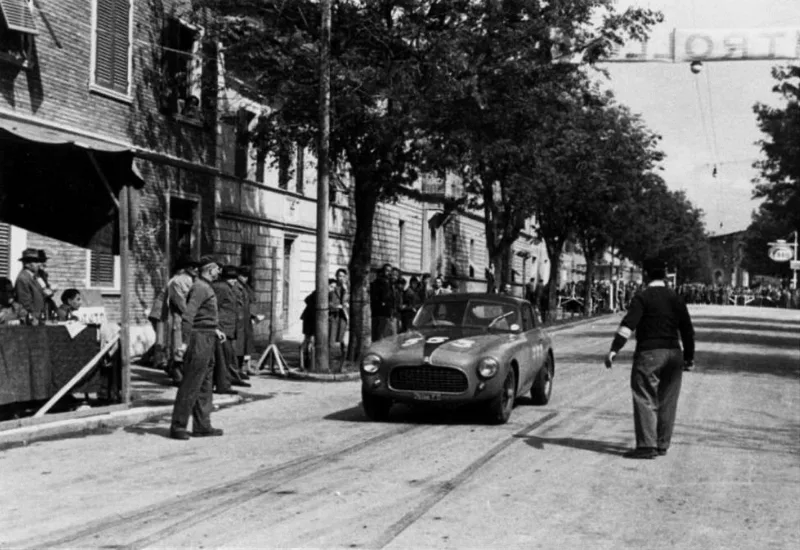
For the 1949 Mille Miglia he entered a second 1100, a torpedo-bodied siluro with separate mudguards. His first victory came as a class win at the Tour of Umbria.
At the start of the 1950s he became a dealer in Italy, first for Alfa Romeo and then for Lancia. That work gave him a steady business alongside his racing.
How did the 750 reach the United States?
American importer Tony Pompeo saw potential in Bandini's space-frame chassis for the 750 cc class. Bandini enlarged the engine from 721 cc to 747 cc and built frames of 18 kg (40 lb) each, which he fitted with bodies by Rocco Motto.
Chicago saw two Bandinis on display in 1952, and a 750 sports torpedo was shown at the 1953 New York Auto Show. As exports grew, so did the press coverage that followed the cars abroad.
The 750 had won its first race in Italy in 1952, at the Bologna-Raticosa Hillclimb. The same era brought a 750 to the 12 Hours of Sebring in 1953, the opening round of the World Sports Car Championship, where Chuck Hassan and Beau Clarke shared the driving.
How was the engineering developed?
Bandini designed the cars in the corner of a garage, and his brother Aurelio built them with a small team. Bandini oversaw each stage, from design to assembly and testing.
Body panels were made in-house from 1953 onwards, and a gear-driven DOHC head replaced the original Crosley cylinder head. Almost every moving part of the Crosley-sourced engine was swapped out, leaving the aluminium block as the only original component.
In 1957 the 750 gained disc brakes on all four wheels. Bandini also combined racing, development, production and dealership work under the name Gruppo sportivo Bandini.
How did Bandini cars fare in Italian racing during the 1950s?
Bandini cars were regular contenders in class events across Italy. In the 1955 Mille Miglia a 750 shared by Rusconi and Sintoni retired at Florence after a refuelling fire, while Massimo Bondi finished ninth in class from a field of 69 entrants.
A single-seat Formula 3 car arrived in 1954, with a claimed output of 69 kW (93 hp) at 9,000 rpm, alongside the two-seat sport torpedo. A lower centre of gravity was sought by packaging the gearbox and differential as one unit across the rear axle.
Hillclimbs and circuit events provided the steadiest results, and the cars were often placed in the top three.
How did Bandini cars perform in the United States?
In the American SCCA championship Bandini cars were strong in the small-engine classes. In 1955 Dave Michaels won the 2000 cc E Modified class at Watkins, and he set a Thompson track record that stood for a year and a half.
The 750 cc H Modified class was a Bandini stronghold in 1957. Melvin Sachs won the SCCA title with 3,600 points, and Henry Rudkin, who ran Saab power that year, took second with 3,200 points.
The cars also appeared in popular culture. Writer William F. Nolan gave a Bandini Torpedo a starring role in his 1957 short story, a sign of how well known the marque had become.
How did Bandini's car programme develop over time?
| Car | Year | Engine or structure | Highlight |
|---|---|---|---|
| Bandini 1100 | 1946 | Rebuilt Fiat 1100 with aluminium body | First car to carry the Bandini name |
| Bandini 750 siluro | 1952 | Space frame, enlarged to 747 cc | First 750 victory at the Bologna-Raticosa Hillclimb |
| Formula Junior | Late 1950s | Rear-mounted Fiat, tilted 15 degrees | In demand in the US, though Coopers dominated |
| 850 and 1000 engines | Later | Built entirely by Bandini | The 850 became the basis of the 1000 |
| 100GT | 1963 | Bodywork by Corna | Corna was a Zagato subcontractor |
| 1000 barchetta | 1966 | Mid-engined 1000 | Donated to Forli in the mid-1970s |
| 1000V and 1000SP | 1970 | Sports prototypes | First aerodynamic element, a rear wing |
| 1300 | 1980 | 16 valves | Presented by the company |
What was the Formula Junior era like?
Formula Junior called for an 1100 cc production engine. Bandini's answer put a Fiat unit at the rear, canted 15 degrees, but Coopers dominated the class at the time.
The car was nevertheless in demand in the United States, and drivers including Rodger Ward and Neil Babbs Jr. raced them in junior events. The 850 cc engine was the first Bandini engine built entirely in-house, and it became the basis for the 1000 cc unit.
In 1960 a Racemaster team took a Saponetta and a Zagato-bodied Berlinetta to Daytona. CBS feted Bandini there, and he was given the keys to the city.
How did the later cars and recognition unfold?
The 100GT appeared in 1963 with bodywork by Corna, a subcontractor of Zagato. In 1966 Bandini produced a new mid-engined 1000 barchetta with new lines and a Colotti gearbox, and that car was later donated to Forli in the mid-1970s.
The 1970 1000V sports prototype was followed by the 1000SP, which brought in the first aerodynamic aid on a Bandini, a rear wing. In 1980 the company presented the 1300, which had 16 valves.
In 1975 Bandini hosted the Group Bandini exhibition for former drivers, and James Hunt and Niki Lauda appeared in Forli before 1979. In 1978 he restarted the Predappio-Rocca delle Camminate hillclimb, which had been interrupted for a time.
What honours did Bandini receive late in life?
In 1981 Bandini received an honorary doctorate in mechanical engineering from New York University. The same year he was given the gold medal of the Municipality of Forli,.
His final creation was the Berlinetta 1000 turbo 16v, built when he was 80. He died in Forli on 12 April 1992.
How did the Mille Miglia shape the Bandini programme?
The Mille Miglia was the cars' proving ground in Italy. In 1953 new Italian regulations required fenders to be integrated into the body shell, and the 750 was adapted to meet them. The car showed that its Sebring result had not been a fluke, and it regularly finished in the top three at hillclimbs and circuits such as Salerno, Ascoli Piceno and Teramo.
The 1955 race saw a 750 shared by Rusconi and Sintoni retire after a refuelling fire at Florence, though the leg to Rome took 7 hours 35 minutes 30 seconds first. By 1957 thirteen more entries had been made by other teams, which showed the marque's growing appeal among private drivers.
What were the American results of 1956?
The 1956 season brought a string of American class wins. Henry Rudkin won at Beverly, Yares won at Watkins, Dave Michaels won at Thompson and Bob Major won at Bryanfan. Tom O'Brien also won the 2000 cc class at Bryanfan in an Alfa-powered Bandini, a car that later took him into Alfa's official driver ranks.
Another 750 sport siluro, fitted with a 1250 cc MG engine tuned by David Uihlein, won twice and placed second twice in the same year. That result showed how far the basic design could be pushed with different power units.
How did 1957 and 1958 unfold?
The Saponeta, a 750 International Sport, debuted in 1957 with reduced combustion chambers, revised rear suspension and altered track and ride height. A Zagato Berlinetta won the concours at Rimini that year, and the Bandini team ended the season second in the overall US classifications.
The Saponeta was also first at the Predappio-Rocca delle Camminate in 1958. James Eichenlaub won at Cumberland and finished second at Toronto, and Gene Parsons won at Miami and in the Congressional Cup. At Galveston Jack Connoly recovered 22 positions in six laps before a fuel tank rupture ended his run.
What about the years from 1959 to 1961?
In 1959 Bandini took class victories at Compiano Vetto d'Enza and Trapani-Mount Erice, and the Formula Junior made its debut at Cesenatico with an 850 cc engine. The same year the 750 class also produced podiums for the marque across Italy.
In the United States in 1961, Dave Lang won three races and a second place, which carried him to third in the SCCA HM class championship without his entering every round. That season also gave the Bandini name a strong showing in American club racing.
What were the later prototypes and wins?
Benelli took a 1965 Predappio hillclimb win in a Belgian racing yellow 1000P, and a new Bandini saloncino was presented at the Turin Sports Car Exhibition in 1968. Its track debut at Mugello did not bring the results Bandini hoped for, and the car was later refined for road use.