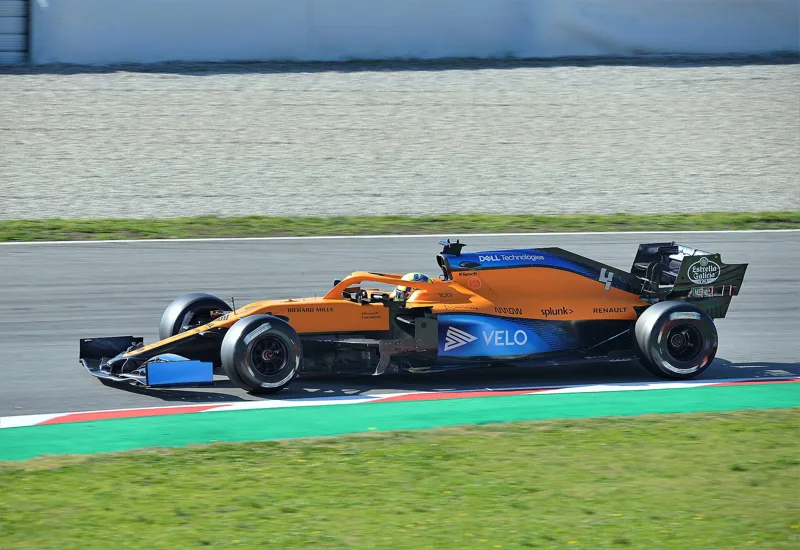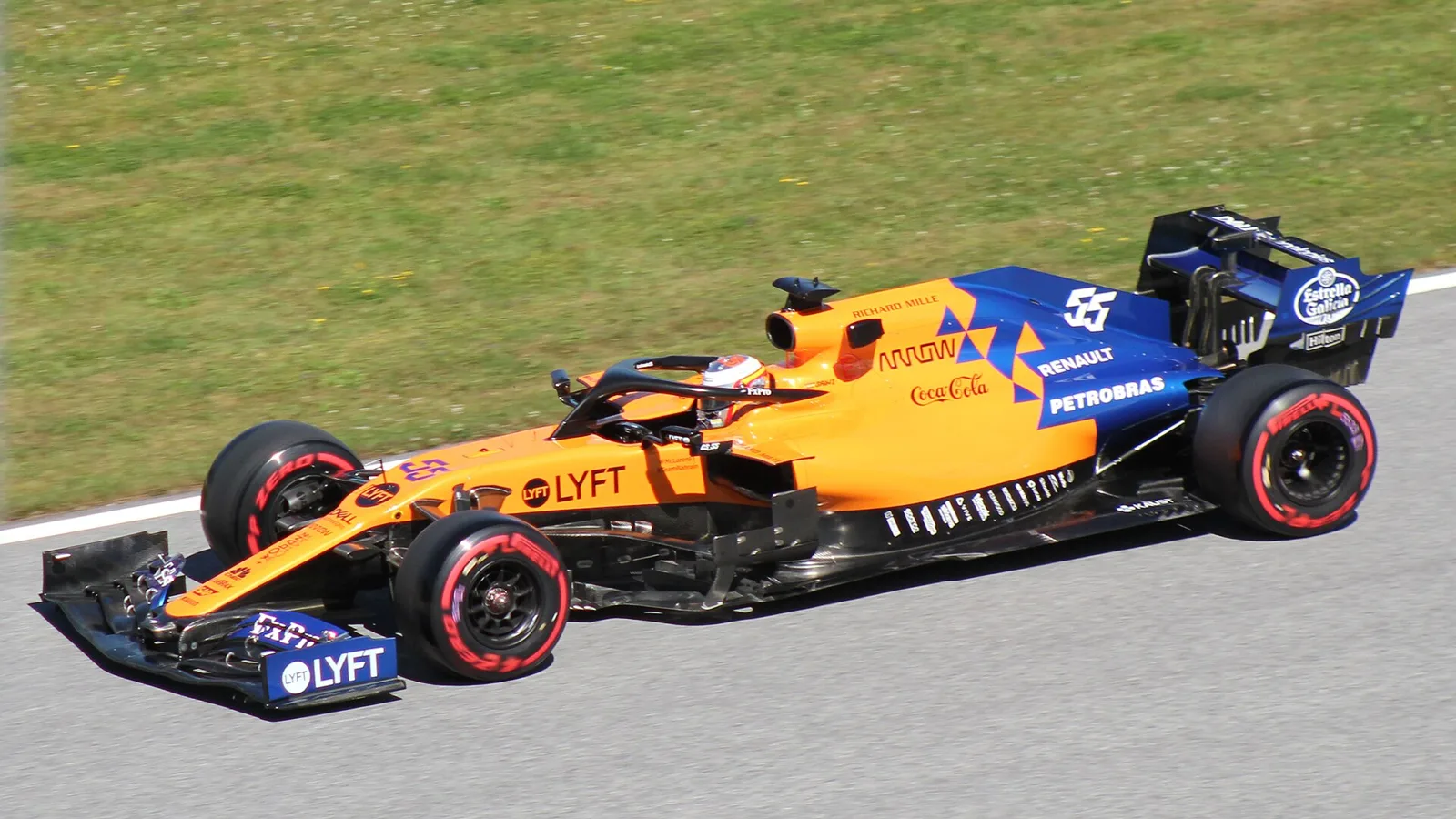
A Pat Fry design with a new Sainz and Norris pairing, a Renault engine and a season in which McLaren finally pulled clear of the midfield and reached the podium.
Built by Pat Fry, the MCL34 carried Carlos Sainz Jr. and Lando Norris to 145 points in 2019. Its high point came in Brazil, where Sainz finished third, and the team ended the year fourth in the constructors' standings, its best finish since 2012.
The McLaren MCL34 was the Formula One car McLaren raced in the 2019 championship, designed by Pat Fry and powered by the Renault E-Tech 19 engine. It was a clear step forward from the MCL33, and it gave Carlos Sainz Jr. and Lando Norris a car that often ran as the best of the rest behind Mercedes, Ferrari and Red Bull. Sainz's third place at the Brazilian Grand Prix was McLaren's first podium since 2014 and the team's best result of the year.
What was the McLaren MCL34?
The MCL34 was McLaren's Formula One car for 2019, designed by Pat Fry and built to replace the disappointing MCL33. Its drivers were Carlos Sainz Jr., who joined from the Renault team, and Lando Norris, the 2018 Formula 2 Championship runner-up. The car made its debut at the Australian Grand Prix.
The car ran the Renault E-Tech 19 unit. It was a big improvement on its predecessor, and it was often the best of the rest in both qualifying and race trim, behind the three leading teams of Mercedes, Ferrari and Red Bull.
A car that gave McLaren its first podium since 2014 and a fourth-place finish that felt like a turning point.
Who designed and drove the MCL34?
Pat Fry designed the MCL34 and returned to the team as engineering director. He had previously worked for McLaren between 1993 and 2010 before moving to Ferrari. Sainz and Norris replaced Fernando Alonso and Stoffel Vandoorne, both of whom left at the end of the 2018 championship.
How did the design team change for 2019?
Tim Goss and Matt Morris left McLaren at the end of the 2018 championship, so the engineering structure had to be rebuilt. Peter Prodromou stayed on as chief aerodynamics engineer, while Fry's return took charge of engineering direction for the car.
James Key arrived from Scuderia Toro Rosso partway through the year to lead the car's development. That gave the project a new technical lead for the rest of the year.
How did McLaren's season start in Australia and Bahrain?
In Australia Norris impressed in his debut qualifying session and started eighth, but he was held up by Antonio Giovinazzi and finished twelfth. Sainz was stuck in traffic on his final qualifying run and started eighteenth, then retired on lap 9 with a power unit problem.
Bahrain was better. Both cars reached Q3 for the first time since the 2017 Malaysian race. Sainz qualified seventh and Norris tenth, which became ninth after a grid penalty for Romain Grosjean. Sainz lost his front wing on lap 4 after contact with Max Verstappen, pitted, dropped to last, and later retired with gearbox issues. Norris finished sixth, earning McLaren's first points of the season.
The 1000th Formula One Grand Prix in China was a difficult weekend. Both cars were knocked out in Q2 for the first time that season, and both were caught up in a first-lap collision with Daniil Kvyat at turn 6 that dropped them to the back. Norris retired from the race, and the team left with no points.
In Azerbaijan Norris qualified seventh, while Sainz was knocked out again. Sainz rebounded in the race to finish seventh after chasing Sergio Perez for most of it, and Norris followed in eighth.
How did the MCL34 perform in Europe?
McLaren arrived in Spain with major upgrades, including revised bargeboards, a new engine cover and a reshaped front wing. Neither car reached Q3, and Norris collided with Lance Stroll on lap 44 to end both drivers' races. Sainz finished eighth, which moved McLaren into fourth in the constructors' championship.
In Monaco Sainz qualified ninth, and he fell back to tenth at the start before a strong overtake took him to eighth. He eventually finished sixth. Norris was held to eleventh. In Canada the team had a weak weekend, with Sainz taking a three-place grid penalty for impeding Alexander Albon after qualifying ninth, and Norris had started eighth, which put both cars in the middle of the grid and a visor tearoff causing an overheating brake duct. Sainz finished eleventh and Norris retired with overheating rear brakes.
The French Grand Prix brought better results. Norris and Sainz qualified fifth and sixth, and Sainz finished sixth, about 33 seconds behind Sebastian Vettel. Norris ran seventh until his hydraulics failed on the final lap, and Ricciardo's penalties later moved him up to ninth. At Austria Sainz started from the back after exceeding his power unit quota and climbed to eighth, while Norris finished sixth, equalling his best result in Formula One.
Britain brought Sainz sixth from thirteenth on the grid, while Norris faded to eleventh. In Germany, heavy rain made the race chaotic. Sainz went wide and aquaplaned at turn 16, but the team switched him to intermediates when many rivals went to dry tyres, and he finished fifth, the team's best result of the season. The result lifted McLaren's points to 70, passing the 62 scored by the MCL33 in 2018.
What did the mid-season races mean for McLaren?
The mid-season races were McLaren's most consistent stretch. The team ended the first half of the season in Hungary with both cars in Q3 and points on the board. Sainz earned his second consecutive fifth-place finish, and the team entered the summer break 82 to 43 points clear of fifth-placed Toro Rosso.
Belgium was harder. Sainz took a fifteen-place grid penalty for exceeding his power unit quota and stalled at the start, retiring before he crossed the line. Norris was running fifth when his car lost power on the penultimate lap, and he was classified eleventh. Italy was similar, with Sainz reaching Q3 but retiring after an error fitting his right front tyre. Norris started sixteenth after a grid penalty and fought through to tenth, which was the team's only point. Renault's fourth and fifth places cut McLaren's lead over them to 18 points.
Singapore began well, with Sainz and Norris both reaching Q3 and qualifying seventh and ninth. Sainz collided with Nico Hulkenberg at turn five and needed a stop where the rear jack gave trouble, leaving him stationary for over 40 seconds. Norris gained two places from that and finished seventh, while Sainz recovered to twelfth.
Russia was another steady result, with Sainz sixth and Norris eighth. McLaren passed 100 points in a season for the first time since 2014 on the back of that finish. In Japan Norris collided with Albon on lap 4, suffered floor damage, and later pitted to avoid a brake fire, which dropped him to the back. Sainz finished fifth, his third fifth-place finish of 2019, and McLaren extended its advantage over Renault to 38 points.
How did the closing rounds decide McLaren's season?
The closing rounds were a mixed bag. McLaren slipped out of the points in Mexico, where Norris retired after a pit stop problem and Sainz finished thirteenth. In the United States, Sainz collided with Albon on the opening lap and finished eighth, with Norris seventh after losing sixth to Ricciardo by 4 tenths.
Brazil was the high point. Sainz had engine problems in Q1 and Norris was out in Q2, but Sainz used a one-stop strategy to climb through the midfield. After several safety cars and collisions among the frontrunners, Sainz was fifth and then moved up when Hamilton was penalised five seconds after his crash with Albon. Sainz finished third, only 2.257 seconds behind Hamilton. Norris could not gain a place from Hamilton, finishing more than five seconds behind him in eighth, and the result put McLaren fourth in the constructors' table, 49 points clear of Renault.
Abu Dhabi closed the season. Both drivers reached Q3 and started seventh and ninth, but Norris lost seventh to Sergio Perez late on. Sainz pitted a second time for tyres that he feared would be passed by rivals on fresher rubber, and on the last lap he passed Hulkenberg for tenth and a point. That point moved him ahead of Gasly in the championship, and Sainz finished sixth overall.
Did McLaren's midfield form match expectations?
Renault were expected to be the best of the rest, but McLaren recovered from a slow start to claim that position with a race still to run. From the middle of the season McLaren dominated the midfield in almost every race, and at times it pulled clear of the rest of it altogether.
The team had a relatively successful 2019 compared with the 2015 to 2018 seasons, when its best constructors' finish was sixth. Sainz remarked that McLaren was not just the best of the rest, but was also profiting when something went wrong for the cars ahead. That midfield form stood in sharp contrast to the struggles of the MCL33 a year earlier.
How good was the MCL34 over the season?
The MCL34 scored 145 points across the season, including one podium and three other top five finishes. McLaren finished fourth in the constructors' championship, its best position since 2012, and the car was the strongest of the teams outside the top three for most of the year.
The table below lists key results for both drivers, so the difference between the points-scoring rounds and the setbacks is easy to see. The most important single result was Sainz's third place in Brazil, which put McLaren back on the podium for the first time since 2014. Sainz finished sixth in the drivers' championship and Norris eleventh, a gap that the retirements in Spain, China and Canada help explain.
| Event | Sainz | Norris |
|---|---|---|
| Australia | Retired, power unit | 12th |
| Bahrain | Retired, gearbox | 6th |
| China | Last after collision at turn 6 | Retired, damage |
| Spain | 8th | Retired, collision |
| Monaco | 6th | 11th |
| France | 6th | 9th |
| Austria | 8th | 6th |
| Germany | 5th | Power loss on lap 26 |
| Hungary | 5th | 9th |
| Japan | 5th | 11th |
| Brazil | 3rd | 8th |
| Abu Dhabi | Tenth | 11th |