Founded as FAS Lane Racing in 2011, the team merged with Go Green Racing, took its first Daytona 500 top ten in 2017 and closed its full-time operation in 2020.
Founded as FAS Lane Racing in 2011 by crew chief Frank Allen Stoddard, this No. 32 operation merged with Go Green Racing in 2014 and ran in NASCAR's top series until its full-time exit in 2020. Its drivers included Terry Labonte and Corey LaJoie.
Go Fas Racing was an American stock car team that began as FAS Lane Racing in 2011, when crew chief Frank Allen Stoddard formed a new operation after his previous team closed. It merged with Archie St. Hilaire's Go Green Racing in 2014 and fielded the No. 32 in NASCAR's top series until the team stopped full-time competition in 2020.
How did FAS Lane Racing begin?
FAS Lane Racing was established in 2011 when Stoddard's previous team, Latitude 43 Motorsports, closed its doors. Stoddard then formed his own operation with the crew members who remained, buying cars and equipment from No Fear Racing, the team run by Mark Simo and Boris Said. He also bought parts from Richard Petty Motorsports and Roush Fenway Racing, plus the remnants of Latitude 43.
The FAS name stood for Stoddard's initials, Francis Allen Stoddard. He chose the number 32 in tribute to his racing mentor, Stub Fadden, a Busch North Series driver from New England.
A team that built its identity around one car number and a series of drivers, from a 2011 start to a full-time exit in 2020.
What did the 2011 Cup season look like?
The team's first Cup season was a patchwork of drivers. Terry Labonte drove the Daytona 500 and finished 15th, and Mike Skinner ran the next two races. Ken Schrader then took the car to 33rd at Auto Club and 22nd at Martinsville, while the full race at Texas ended 33rd with the Big Red sponsorship on the car.
At Talladega Labonte returned, with Texas-based C&J Energy as sponsor. The car ran near the front for a spell, with J. J. Yeley drafting alongside, but an engine failure dropped it to 34th. Other sponsors across the year included VA Mortgage Centers and U.S. Chrome.
Two drivers made their Cup debuts that season. Jason White started 41st and finished 33rd at Pocono. Andrew Ranger, a former NASCAR Canadian Tire Series champion from Quebec, debuted at Watkins Glen and finished 35th, although transmission failure cut his race short by about 15 laps.
The team finished 34th in the owners' standings. Those points went to Michael Waltrip Racing in 2012, which freed a spot that let Mark Martin into the Daytona 500, and Labonte used the past champion's provisional himself.
How did the team run in 2012 and 2013?
For 2012 the team ran full-time with several drivers. Labonte ran four races with C&J Energy, Mike Bliss ran seven races with U.S. Chrome and Air National Guard, and Ken Schrader ran nine races with Federated Auto Parts. Boris Said ran two races, at Sonoma and Watkins Glen, with HendrickCars.com on the car. After the Daytona 500 the team acquired the points of the No. 6 Roush Fenway Racing team.
The 2013 line-up included Schrader, Timmy Hill, Said and Labonte. In January 2013 Hill declared his intention to run for Sprint Cup Rookie of the Year honours against Danica Patrick and Ricky Stenhouse Jr.
What went wrong with the OXY Water sponsorship?
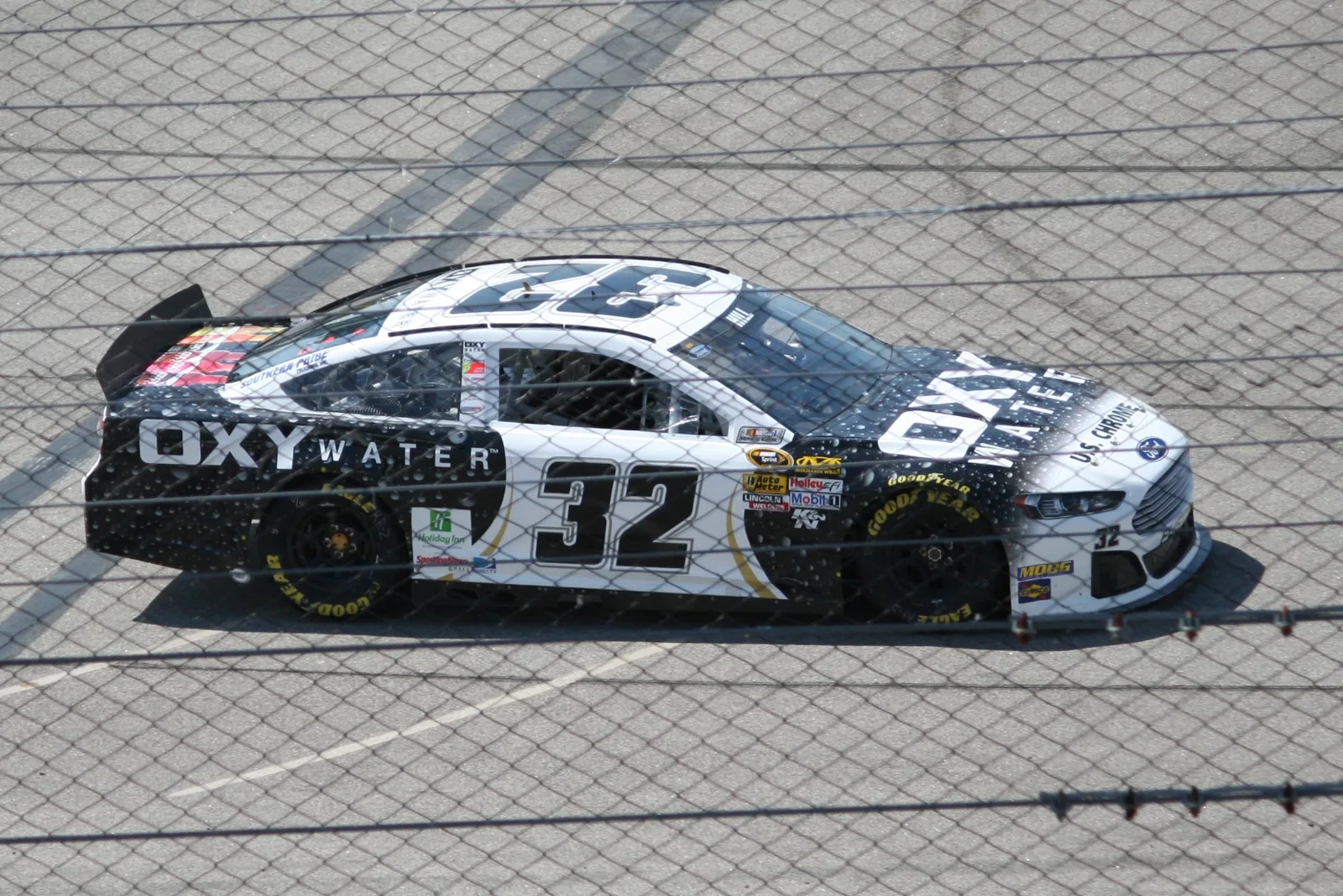
In March 2013 the team announced a 24-race sponsorship from OXY Water, beginning at Bristol with Labonte, which was also meant to cover the full 2014 and 2015 seasons. The sponsor was then investigated by the IRS over allegations that it had misappropriated more than $2 million in invested funds.
OXY Water filed for bankruptcy, a collapse that cost investors more than $9 million. The company did not appear as a primary sponsor after Indianapolis, leaving the team to search for backing in the middle of the season.
| Season | Key result | Owner standing |
|---|---|---|
| 2011 | Daytona 500 15th for Labonte | 34th |
| 2012 | Full-time operation with four drivers | Points acquired from the No. 6 team |
| 2014 | 11th at the Coke Zero 400 | 38th |
| 2015 | Best finish 31st, twice, for Bliss | 42nd |
| 2017 | 9th at the Daytona 500, 8th at Indianapolis | DiBenedetto 32nd in points |
| 2018 | 7th at the Coke Zero Sugar 400, 17th on a road course | Charter sold to Wood Brothers |
How did the merger with Go Green Racing change the team?
In December 2013 it was announced that FAS Lane Racing and fellow Ford team Go Green Racing would merge in 2014 to form Go Fas Racing. The team kept operating from the FAS Lane Racing shop, and by 2017 the primary owner was Archie St. Hilaire, with Stoddard as consultant and Mason St. Hilaire as general manager.
For 2014 Labonte ran the Daytona 500 and the other superspeedway events in what was his final season, with Said on the road courses and Travis Kvapil covering the rest of the schedule. Blake Koch was placed in the car for the Sprint Showdown, the Coca-Cola 600 and Dover, and Eddie MacDonald ran Loudon.
The team's best finish of the year was 11th with Labonte at the rain-shortened Coke Zero 400. Labonte then announced his retirement. His final race came at the GEICO 500 at Talladega, where the car's sides were painted in the Kellogg's Corn Flakes scheme of his 1996 championship season and its roof replicated the car he debuted in 1978.
What was the team's Cup record in 2015 and 2016?
In 2015 Bobby Labonte ran the four superspeedway events with C&J Energy, and Boris Said returned for the two road courses. Mike Bliss was the planned primary driver for the rest of the schedule, but he failed to qualify at Las Vegas for the first time since 2011 and again at Charlotte. His last race for the team came at Michigan in June, and his best finish with the team was 31st, achieved twice.
Joey Gase ran four races that year, and other drivers including Will Kimmel, Travis Kvapil, Eddie MacDonald and Josh Wise also took turns. Jeffrey Earnhardt made his debut at Richmond, running the full race to finish 40th, 13 laps behind the leaders. The team ended 2015 42nd in owner points, down from 38th a year earlier, and was the best-placed full-time outfit below the part-time No. 21 at season's end.
For 2016 Earnhardt and Labonte split the ride, with Earnhardt running most of the season and Labonte the restrictor-plate races. The team was one of the 36 charter teams, which guaranteed it a start in every race.
Why did Matt DiBenedetto's seasons matter?
After the 2016 season the team dropped most of its drivers and announced that Matt DiBenedetto would run the car alone in 2017. It also loaned its charter to the Wood Brothers' No. 21 driven by Ryan Blaney, after buying the No. 44 team and its charter from Richard Petty Motorsports.
The change worked. DiBenedetto finished 9th at the 2017 Daytona 500 for the team's first top ten, and then 8th at the Brickyard 400, a race with a record 14 cautions. He finished a then-career-best 32nd in points, and the team moved from the bottom five to a mid-pack operation by focusing on one driver.
In January 2018 the team sold its charter to the Wood Brothers in exchange for manufacturer support, although NASCAR still listed Go Fas as the charter's owner. It then teamed up with Circle Sport to run the No. 32 Ford on the No. 33 charter. Gene Nead was crew chief for two races before the two parted ways, and Randy Cox took over from the Pennzoil 400.
DiBenedetto's 2018 results included a 17th-place finish on the road course at the Toyota/Save Mart 350 in June, the team's best road course result. Two weeks later at the Coke Zero Sugar 400 he took 7th, the team's best finish. He announced in September that he would leave the team after the season for a deal with Leavine Family Racing.
What did the Corey LaJoie years deliver?
In December 2018 Corey LaJoie was confirmed as the full-time driver for 2019, with new sponsor Schluter Systems. Go Fas also partnered with Team Penske for pit crew support, while the longtime sponsor Can-Am left the team. For the 2019 Daytona 500, LaJoie's face appeared on the car as part of an Old Spice promotion. He finished 18th after a right-front tire blew just 20 laps in.
Statistically, LaJoie was the team's most productive driver, with many top-20 and top-15 finishes and one top-ten result in more than 20 starts. On 21 August 2020 it was confirmed that he would not return to the No. 32 in 2021.
How did the team end its run?
On 22 October 2020 Archie St. Hilaire, the majority owner, and Mason St. Hilaire, the team manager, said they had sold their share of the charter to an undisclosed buyer. That buyer was later revealed to be B. J. McLeod and Matt Tifft, who ran the charter for Live Fast Motorsports. The same announcement said the team would exit full-time competition and run only a handful of Cup races in 2021.
The team planned to run five or six races in 2021, but it did not run a race in its first 35 starts of the season. In an interview, McLeod confirmed that the team had ceased operations. The closure followed a series of sponsorship gaps that the team had struggled to fill.
Did Go Fas Racing have international or regional spin-offs?
Yes. The team debuted a Whelen Euro Series operation in 2018, Romain Iannetta drove the Elite 1 numbered 32, and Florian Venturi drove the Elite 2 Ford Mustang. The first season brought two wins and a pole, and Jacques Villeneuve returned to drive the No. 32 Elite 1 in 2019, while Venturi stayed in the Elite 2 entry.
In Canada, Go Fas Racing Canada entered the NASCAR Pinty's Series in 2016. Founded by Alain Lord Mounir, the team ran under the supervision of Dave Jacombs, with Alex Labbe driving the No. 32. It closed after the 2017 season when Labbe moved to the NASCAR Xfinity Series with DGM Racing.
What is the legacy of Go Fas Racing?
Go Fas Racing's legacy is a story of a small team built around one number and a handful of drivers. It rose from a 2011 start to the Daytona 500 top ten in 2017 and its best road course result in 2018, before its full-time operation ended.
The team also shows how dependent such operations were on sponsors and charters. The OXY Water collapse, the charter sales and the 2020 exit each shaped the team's trajectory, and the No. 32 remained in the field only as long as its funding allowed.