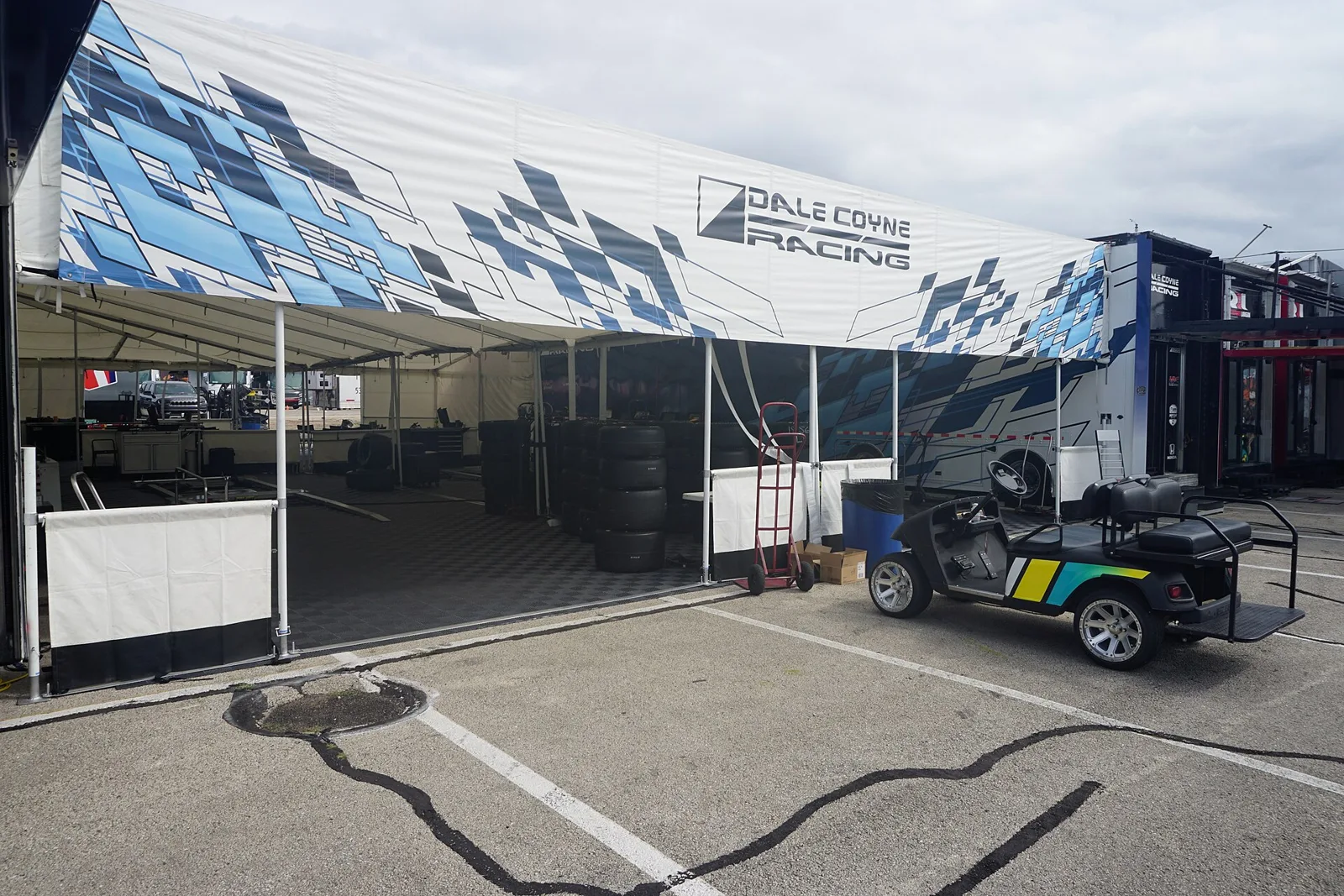
Founded in 1984 by former driver Dale Coyne, the Chicago-area team ran on modest budgets for decades, won its first race in 2009 and still competes in IndyCar.
Founded in 1984 by Dale Coyne, the team is a privateer open-wheel operation whose cars race in IndyCar and Indy NXT. It won its first race at Watkins Glen in 2009 and has partnered with Honda for many seasons.
Dale Coyne Racing is an American professional open-wheel team that competes in the IndyCar Series and Indy NXT. It was founded in 1984 by former driver Dale Coyne, and it became known for running on budgets far smaller than most of its rivals, until it earned its first victory in 2009.
What is Dale Coyne Racing?
Dale Coyne Racing, or DCR, is owned by Dale Coyne, who drove in the earlier years of the team's history. Between 1995 and 2000 the outfit ran as Payton-Coyne Racing, a tie-up with the Chicago Bears legend Walter Payton.
Its story is one of persistence. The team was for many years a privateer operation that relied on pay drivers, but it developed a reputation for turning young and self-funded racers into capable professionals. Its maiden victory came after 25 years of racing.
A privateer team that built careers for many drivers and won its first IndyCar race in 2009, after 25 years on modest budgets.
How did Coyne start in CART?
Dale Coyne raced smaller open-cockpit cars in the late 1970s and early 1980s before turning to the young CART series. Coyne tried to qualify for every CART race in 1984 with little success, yet those attempts won him a franchise for the next year.
In 1986 the team raced the Coyne DC-1, a 1984 Lola Indy car modified to fit a Chevrolet stock-block engine. The next season it returned to a customer March chassis, with Coyne doing all of the driving. Budget limits meant the team used one of the few stock-block Chevrolet engines in the field.
After using Dominic Dobson for one race in 1988, with little improvement, Coyne decided the team could not improve without better equipment. In 1989 it upgraded to a pair of 1988 Lola-Cosworth cars for the Italian pay drivers Guido Dacco and Fulvio Ballabio.
When did the team's pay-driver model begin?
Coyne retired as a driver at the end of 1988 to concentrate on tutoring younger drivers, although he contested several more races through 1991. In 1990 the team fielded a new Lola for Dean Hall, backed by full-time sponsorship from a Japanese group. Chief mechanic Bernie Myers prepared the car, which made the team's first Indianapolis 500 start and scored 4 points during the season. That first Indy start was a milestone for a team that had spent years on the fringes of the field.
The team's engineering was recognised in the Clint Brawner Mechanical Excellence Award, which Coyne and Myers received at the 1990 and 1992 Indy 500 races respectively. Those awards reflected a team that punched above its budget.
For much of the following years the team used pay drivers, who financed their racing with personal funds or self-obtained sponsorship. Often one driver ran a full season, while a second car rotated drivers with only partial funding. Coyne earned a reputation for developing these drivers quickly enough for them to advance their careers.
Drivers who had their first CART rides with Coyne included Paul Tracy, a future series champion, Eric Bachelart, the Indy Lights champion, and Andre Lotterer, who later won Le Mans.
Did the team ever reach the podium in CART?
Despite the lack of competitive results in its first two decades, the team was a consistent full-time entrant year after year. Roberto Moreno, a former Formula One driver, returned to CART in 1996 and took the team's first podium at the 1996 U.S. 500.
Michel Jourdain Jr. then took over driving duties and earned STP Most Improved Driver honours from his peers in 1997. He stayed with the team through 1999, while the second car went to a rotating cast with few competitive results.
In 2000 Tarso Marques carried most of the effort, making 17 starts in a factory-supported Swift chassis after a deal with Swift Engineering. Takuya Kurosawa was the first Japanese driver to lead a CART race, at Long Beach, before an accident ended his hopes of a top ten finish. Alex Barron ran as high as second in Australia before an engine failure.
How did the team survive the lean years?
The team struggled to stay afloat in 2001, after a short partnership with the Project Racing Group that allowed it to contest only two races. Coyne returned the following year with a one-off Team St. George entry for Darren Manning, which finished 9th at the 2002 Rockingham 500.
The team returned to full-time competition in 2003 with six drivers, the best of whom was the veteran Gualter Salles in sixth. The 2004 season was better, with new sponsors American Medical Response and Yoke TV. Oriol Servia finished third at Laguna Seca, the best result in the team's history, and ended 10th in the final standings.
In 2007 Bruno Junqueira recorded consecutive podium finishes at Zolder, Assen and Surfers Paradise, on his way to seventh in the standings. That run showed what a well-driven car could still achieve for the team.
How did the IndyCar years begin?
In 2008 the team made its first IndyCar Series season, and Bruno Junqueira and Mario Moraes recorded five combined top-ten finishes. Both drivers led laps during the famous Indianapolis 500.
In the first race of 2009, the Honda Grand Prix of St. Petersburg, Justin Wilson finished third, the first IRL podium for the team. On 5 July 2009 Wilson won the Camping World Grand Prix at Watkins Glen, leading 49 of 60 laps. It was Coyne's 558th career start as an owner or driver. The victory came on a road course and was the first in a long history of mid-field results.
The 2010 season brought Milka Duno to the No. 18 car and Alex Lloyd to the No. 19. Lloyd finished fourth at the Indy 500 and won rookie of the year honours. Duno later moved to ARCA, and the team's 2011 line-up included James Jakes and Sebastien Bourdais on road courses.
Dale Coyne Racing is also the second oldest and longest-stay Honda engine partner in IndyCar since 2008, because several rivals switched engine suppliers over the years.
What changed with Honda and Justin Wilson?
In January 2012 Honda and its Honda Performance Development arm announced that they would power a two-car effort for the team with an all-new 2.2-litre turbocharged V6. Justin Wilson returned to the team, and the team also re-signed the engineer Bill Pappas, reuniting the group that had delivered its first win in 2009.
The team scored its second win and its first oval victory with Wilson at Texas Motor Speedway in 2012. In 2013 Mike Conway won the first Detroit Belle Isle race for the team, and Wilson finished third in the same race, putting two Coyne cars on the podium for the first time.
Carlos Huertas took the No. 18 in 2014 and scored his first career win at the first round of the Grand Prix of Houston. The 2015 season was disrupted when Huertas was sidelined by an ear problem, and several drivers took over the car.
In 2016 Conor Daly drove the No. 18 for the whole season and finished 18th in the standings, while the No. 19 was shared by several drivers, including RC Enerson, whose appearances at Mid-Ohio and Watkins Glen were impressive. In 2017 Sebastien Bourdais won at St. Petersburg and Ed Jones finished third at the Indy 500 on his way to rookie of the year honours.
How did Bourdais's injury and the 2018 partnership change the team?
In 2017 Bourdais suffered a severe accident in qualifying for the Indy 500, with pelvic and hip fractures. James Davison and Esteban Gutierrez drove the car while he recovered, and Bourdais returned at Gateway after a rapid recovery.
In February 2018 former KVSH co-owners Jimmy Vasser and James Sullivan formed a partnership with the team to field Bourdais as Dale Coyne Racing with Vasser-Sullivan. Pietro Fittipaldi was injured during qualifying for the Spa 6 Hours, and Zachary Claman DeMelo stood in for him. Santino Ferrucci made his debut at the Detroit Grand Prix.
Bourdais stayed in the No. 18 car through 2019 and achieved a podium at Barber Motorsports Park. The team kept rotating drivers, with Ferrucci the only driver in the No. 19 that season. Ferrucci drove the No. 19 for the full 2019 season, with his best finish of ninth at the opening race.
What are the key results?
| Series or race | Result | Year |
|---|---|---|
| CART, U.S. 500 | First podium, Roberto Moreno | 1996 |
| CART, Laguna Seca | Third, Oriol Servia, best season ever | 2004 |
| IndyCar, St. Petersburg | Third, Justin Wilson, first IRL podium | 2009 |
| IndyCar, Watkins Glen | First win, Justin Wilson | 2009 |
| Indianapolis 500 | Fourth, Alex Lloyd | 2010 |
| IndyCar, Texas | First oval win, Justin Wilson | 2012 |
| IndyCar, Detroit | Win, Mike Conway | 2013 |
| IndyCar, Houston | First career win, Carlos Huertas | 2014 |
| IndyCar, St. Petersburg | Win, Sebastien Bourdais | 2017 |
| Indianapolis 500 | Third, Ed Jones | 2017 |
What else did Coyne build?
In 1998 Coyne designed and built Route 66 Raceway in Joliet, Illinois, a drag racing facility that drew the attention of Indianapolis Motor Speedway CEO Tony George. Together with George and International Speedway Corporation, Coyne helped build Chicagoland Speedway and served as its president through construction and the opening season.
Coyne also sat on the facility's management committee until ISC bought it out in 2007. That work gave the team's owner a second role in motorsport infrastructure alongside the racing, and it remains one of Coyne's notable projects.
What is the legacy of Dale Coyne Racing?
Dale Coyne Racing's legacy is a long list of drivers who used the team as a stepping stone, from Paul Tracy and Andre Lotterer to Sebastien Bourdais and Ed Jones. Its willingness to take on pay drivers and develop them shaped its identity.
In December 2021 the team announced Takuma Sato would race full-time in the No. 51 car for 2022, replacing Romain Grosjean. The team remains a fixture of the IndyCar paddock, and its Indy NXT programme keeps the development pathway open.