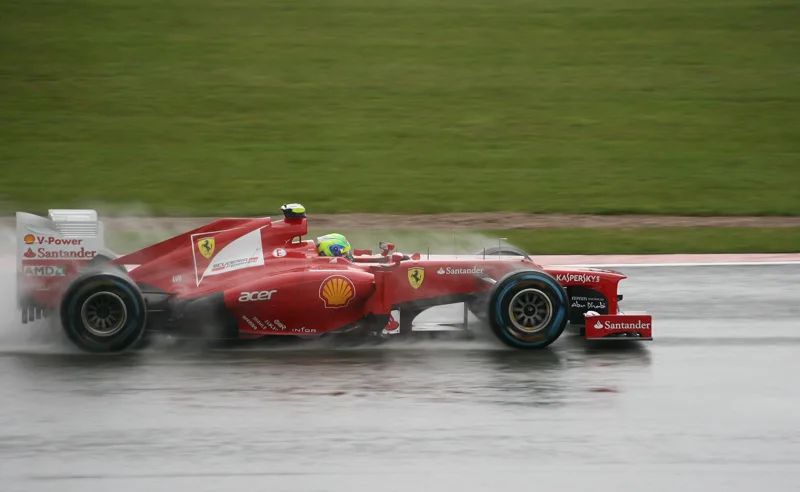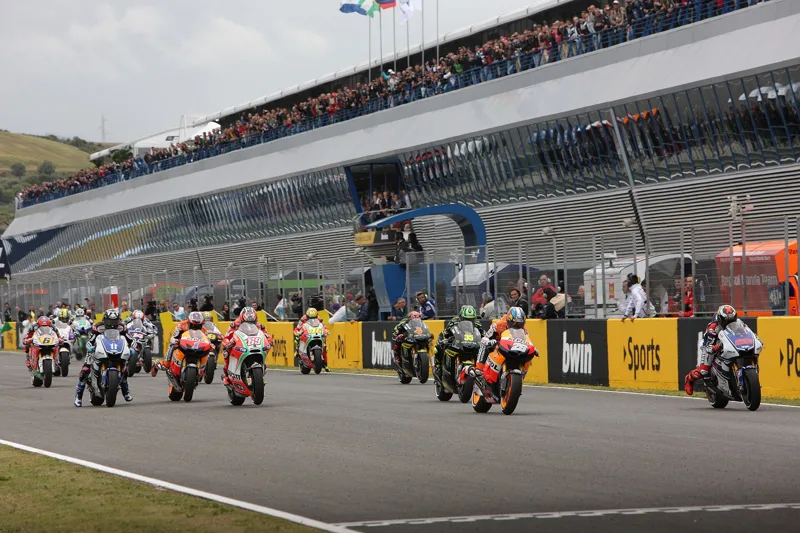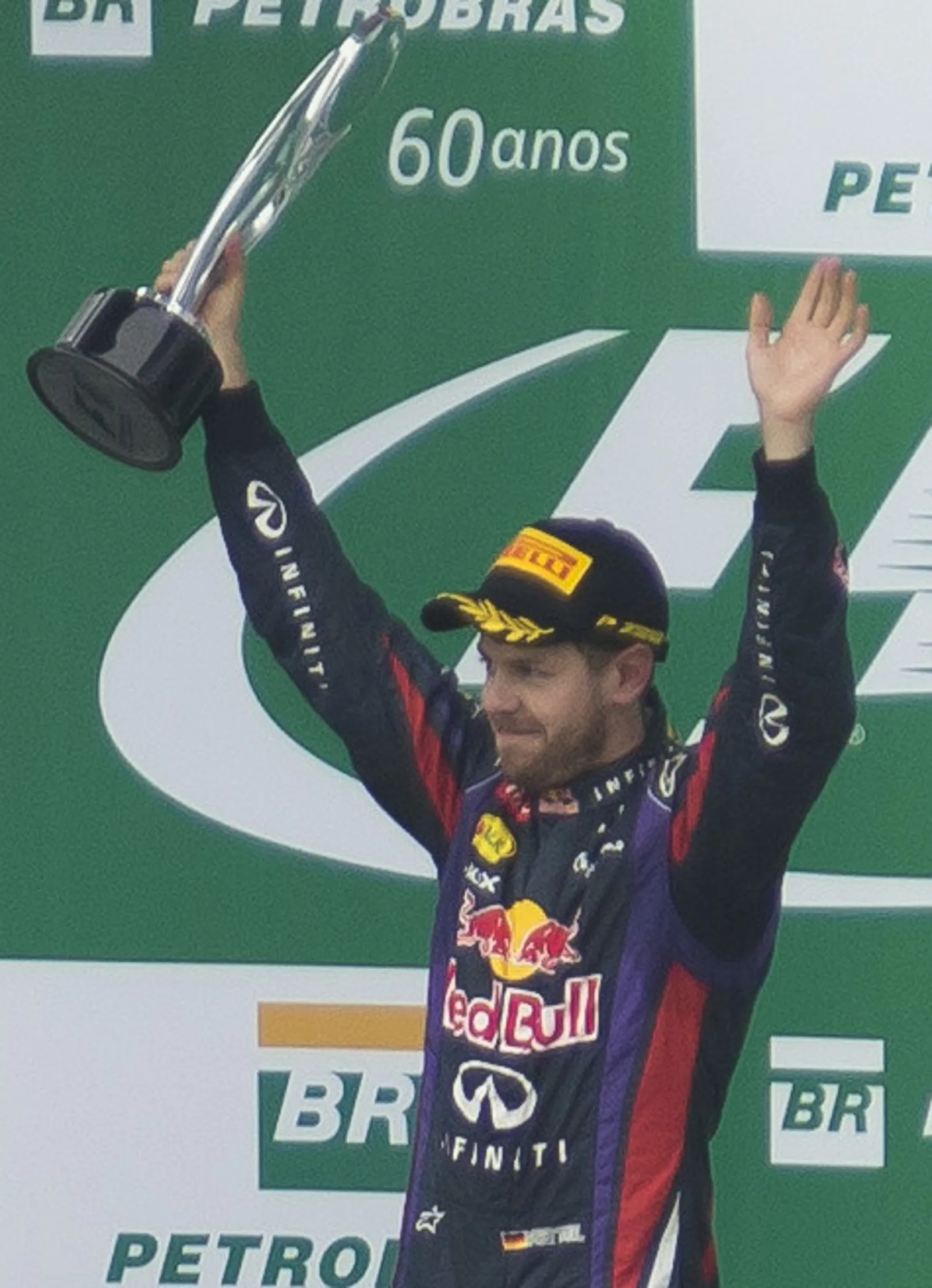
Thirteen wins, nine in a row at the end of the year and a 155-point margin that gave Sebastian Vettel his fourth consecutive crown.
Vettel's fourth straight title, settled in India, came with a then-record 155-point margin over Alonso, who was second. Red Bull Racing defended its constructors' crown at the same race, and 2013 was the final season of the 2.4-litre V8 engine formula.
The 2013 FIA Formula One World Championship was the 67th season of the sport's top class, contested over nineteen Grands Prix. Vettel's fourth straight drivers' crown arrived in India, and Red Bull's constructors' title was settled at the same race. It was also the last year of the 2.4-litre V8 engine formula.
The season was one of the most dominant championship victories in the sport's history. Vettel won the title by a then-record 155 points, and his nine consecutive wins broke the single-season record. His 13 wins in total tied Michael Schumacher's season record.
What happened across the 2013 season?
Vettel won 13 races and the drivers' title by 155 points, the largest margin on record at the time. Fernando Alonso finished second for Ferrari with two wins, while Kimi Raikkonen had opened the year by winning in Australia. Mercedes finished second in the constructors' table, and Lotus finished fourth.
The early rounds were settled by a few strong performances. Raikkonen won the season-opening Australian Grand Prix for Lotus, and Vettel responded in Malaysia, where he defied team orders and passed his teammate Mark Webber late in the race. Alonso won in China, and Vettel took Bahrain, with Raikkonen second and Romain Grosjean third.
Malaysia also produced an awkward moment for Mercedes. Lewis Hamilton's podium came with a share of controversy, because team orders were used to help him keep third place, and Hamilton said afterwards that Nico Rosberg was the driver who had really deserved it. The moment showed how quickly a result could become a debate about the team's priorities.
Monaco and Britain went to Rosberg, although his string of bad luck elsewhere limited his points. Vettel's British Grand Prix ended with a gearbox failure, which narrowed the gap for a time. Alonso then won Spain, and Hamilton's only win of the year came in Hungary.
Vettel's run really began in the second half of the year. He won Germany, and after Hamilton's Hungarian win he took Belgium after Raikkonen retired from the race. Italy, Singapore, Korea, Japan, India, Abu Dhabi, the United States and Brazil followed, and that run of nine straight victories gave him an unbeatable position.
Nine straight wins at the end of the year turned a title race into a record runaway.
Which teams and drivers changed in 2013?
Hamilton left McLaren for Mercedes, Sergio Perez joined McLaren, and Nico Hulkenberg moved to Sauber. Michael Schumacher retired for the second time after 2012, and HRT disappeared from the grid after failing to find a buyer. Those moves reshaped the front of the field and the midfield teams alike.
Hamilton's move ended a fourteen-year association with McLaren. He said he was motivated by a new challenge, and he preferred the idea of building a struggling team into a winner to cruising around with a great one. The move was a clear statement about where he saw his future in the sport.
The swap pulled Perez from Sauber to McLaren, while Hulkenberg left Force India for Sauber. Adrian Sutil returned to Force India after a season out of the sport, and Kamui Kobayashi lost his seat after three seasons with Sauber. He turned to the World Endurance Championship instead.
At the back of the grid, Marussia and Caterham also reshuffled. Charles Pic left Marussia for Caterham, Timo Glock left Marussia, and the team turned to Max Chilton and Luiz Razia. Razia was then replaced by Jules Bianchi, a change that would matter greatly to the team's future.
Raikkonen missed the final two races of the season after a back operation, and Heikki Kovalainen took his place in the team. Webber's final season marked the end of a career that brought him nine Grand Prix wins, and Vettel and Webber had been the core of Red Bull's title effort.
What changed in the calendar and the governance of the sport?
The calendar was tighter than planned. The Grand Prix of America was removed after its contract was nullified, and the schedule settled at nineteen races. Bernie Ecclestone had said that twenty races was the maximum viable, and the provisional calendar was approved on 28 September 2012 around that limit.
Europe lost its race. The European Grand Prix was discontinued from 2013, and the Valencia Street Circuit closed on 12 March 2013. The German Grand Prix stayed on its alternating arrangement with the Nurburgring hosting in 2013, while a Russian race at Sochi was contracted but later delayed to 2014.
The governance of the sport also changed. The Sixth Concorde Agreement expired at the end of 2012, which made a seventh necessary. Decisions on the regulations now needed a 51% majority rather than 70%, and the technical and sporting working groups gave way to a single Strategy Working Group.
What rule changes shaped the 2013 season?
The DRS was restricted to designated zones, the force majeure rule was removed from scrutineering, and the curfew was extended to eight hours. Entry fees now depended on points scored, and the double-DRS system and stepped nose were addressed directly in the technical rules.
The DRS change was aimed at safety. From 2013 the system could be used only in its designated zones during free practice and qualifying, rather than whenever a driver chose, and the FIA planned two DRS zones at every circuit where it was feasible.
The force majeure rule was scrapped after a dispute in Abu Dhabi in 2012, when Vettel was excluded for insufficient fuel. From 2013 stewards would measure the fuel left in a car stopped on track and penalise the shortfall, instead of accepting a claim that the car had stopped for mechanical reasons.
The curfew rules were tightened as well. Team personnel were barred from the circuit for eight hours before the first session, rather than six, and each team was limited to two exceptions across the year.
Entry fees changed too. Instead of a fixed fee, teams paid a basic $500,000 plus $5,000 for each point scored in the previous season, and the reigning constructors' champion paid $6,000 per point. Red Bull's 460 points meant an entry fee of $3,260,000.
Technical rules tightened in other areas. The double-DRS system developed by Mercedes was banned, front wings faced a demanding test with a tolerance of 10 mm under a 100 kg load, and the minimum car weight rose to 642 kg (1,415 lb). Teams were also allowed to cover the stepped nose with a modesty plate.
The grid also shrank. With HRT left off the provisional entry list, the field fell to twenty-two cars, and the team's absence removed one of the sport's smaller operations from the championship.
Why did the tyres dominate the debate?
Pirelli faced criticism early in the season over the wear of some tyres, and some argued that tyre management had become too important to race strategy. The company announced new designs after the Canadian Grand Prix, which led to a dispute about how the tests had been carried out.
The testing that led to the new designs became a formal complaint. Ferrari and Red Bull objected to a Mercedes test, and the FIA referred it to its International Tribunal as the teams arrived in Montreal. The governing body had cleared an earlier Ferrari test, because it used a 2011 car, which was not a breach of the rules.
The British Grand Prix brought explosive punctures, and Pirelli received permission to introduce an entirely new tyre specification for Hungary. The FIA also banned teams from swapping the left and right tyres, a practice that had been used to extend tyre life.
Which races shaped the title fight?
Alonso's wins in China and Spain kept Ferrari in contention early on, but Vettel's form after the summer break decided the title. Vettel won nine straight races from Belgium onwards, which turned a close contest into a runaway title.
Alonso's five second places kept him in the top two of the standings for much of the year. Hamilton had a mixed season, with a win in Hungary, a podium that came with team orders in Malaysia, and a retirement in Japan. Those results left Mercedes in a tighter battle with Ferrari than their car speed suggested.
| Grand Prix | Winner | Note |
|---|---|---|
| Australia | Kimi Raikkonen | Season-opening win for Lotus |
| Malaysia | Sebastian Vettel | Defied team orders to pass Webber |
| China | Fernando Alonso | Ferrari win |
| Bahrain | Sebastian Vettel | Raikkonen second, Grosjean third |
| Spain | Fernando Alonso | Second win of the year |
| Monaco | Nico Rosberg | Mercedes win |
| Canada | Sebastian Vettel | Red Bull win |
| Britain | Nico Rosberg | Vettel out with a gearbox failure |
| Germany | Sebastian Vettel | Win at the Nurburgring |
| Hungary | Lewis Hamilton | Hamilton's only win of the year |
| Belgium | Sebastian Vettel | Raikkonen retired |
| Italy | Sebastian Vettel | Hamilton missed Q3 |
| Singapore | Sebastian Vettel | Consecutive win |
| Korea | Sebastian Vettel | Consecutive win |
| Japan | Sebastian Vettel | Hamilton retired after a puncture |
| India | Sebastian Vettel | Title clinched; Red Bull constructors title |
| Abu Dhabi | Sebastian Vettel | Consecutive win |
| United States | Sebastian Vettel | Consecutive win |
| Brazil | Sebastian Vettel | Ninth consecutive win |
Who won the 2013 Drivers' Championship?
Vettel won the drivers' title in India, becoming the third driver to win four consecutive championships. He finished with 397 points, a total that stood as a record until 2018, while Alonso took the runner-up spot with 242 points. The margin of 155 points was then a record.
Vettel's championship was confirmed at the same race as Red Bull's constructors' title, which gave the team its fourth consecutive constructors' championship. The four titles came from a long run of consistent results, because the points went to the top ten finishers in every race. Vettel's record run was also an achievement in its own right, and the Laureus World Sports Awards named him Sportsman of the Year, the second racing driver to receive that honour.
What the 2013 season left behind
The season closed the era of the 2.4-litre V8. It was also the last year for Cosworth as an engine manufacturer, because the company decided against building an engine for the new regulations. The new formula arrived the following year, and the sport's technical direction changed with it.
Hamilton's move to Mercedes was among the most significant changes of the year. He left a team he had raced for over fourteen years, and the decision reshaped the top of the grid for the seasons that followed.
Mark Webber left Formula One after his last season, finishing third in the drivers' standings with 199 points. Vettel's position at the top of the sport was the defining feature of 2013, and it set the stage for the next chapter in the sport's history.