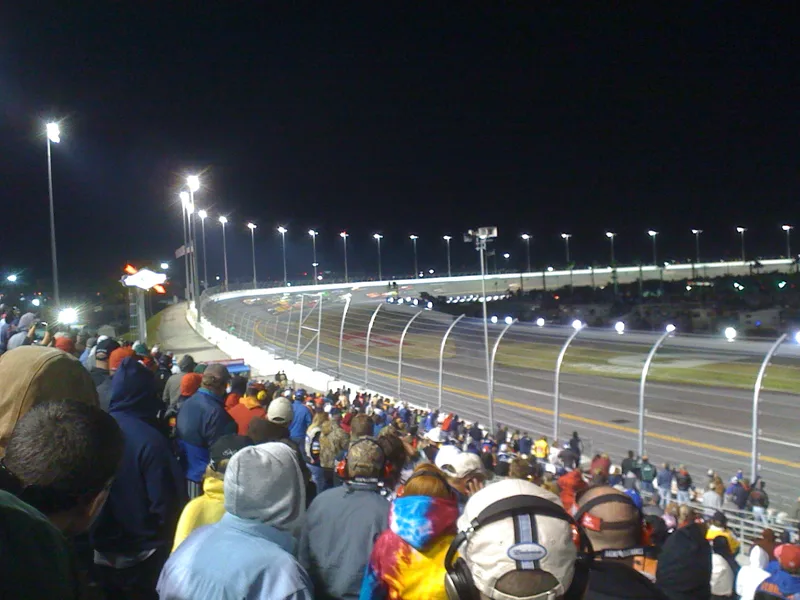
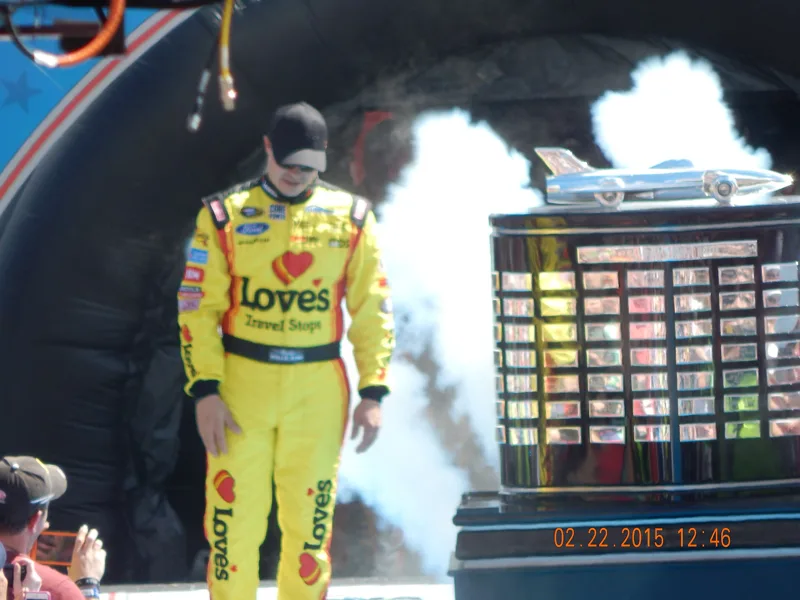
Kyle Busch beat Tony Stewart in the closest finish in the race's history, after five cautions, 26 lead changes and a crash that rolled a car onto its roof.
Busch took his first Shootout win at his sixth attempt, edging Tony Stewart by 0.013 seconds. The finish was the closest in the race's history, following five cautions and twenty-six lead changes among thirteen drivers in the 82-lap event.
The 2012 Budweiser Shootout opened the 2012 Cup season with an exhibition race at Daytona International Speedway on February 18, 2012, in front of 82,000 people. Kyle Busch of Joe Gibbs Racing won the 82-lap event, his first Shootout victory at his sixth attempt, by 0.013 seconds over Tony Stewart. It was the closest finish in the race's history.
What was the Shootout and how was the field set?
The Shootout began in 1979 as the Busch Clash, created by Busch Beer brand manager Monty Roberts to promote the beer brand. It invites the fastest drivers from the previous season, and the 2012 field was drawn from the top 25 in the 2011 standings plus previous Daytona winners.
Thirty-three drivers were eligible, including previous winners of the Daytona 500 and the Coke Zero 400. Kurt Busch, the 2011 winner, arrived as the defending champion. The 2012 race was scheduled for 75 laps, run in two segments of 25 and 50 laps with a ten-minute pit stop between them.
During that stop teams could change tires, add fuel and make normal chassis adjustments, but they could not change springs, shock absorbers or rear-ends. Caution laps and green-flag laps both counted toward the total.
Five cautions, twenty-six lead changes and a finish decided by 0.013 seconds, the tightest in the race's history.
Why did NASCAR change the cars before 2012?
Two-car tandem drafting had dominated restrictor-plate races during 2011, and NASCAR responded by making drafting harder. Radiators were reduced from five liters to two liters, the air intakes were moved toward the car's fascia, and the restrictor plate was cut by 1/64 inch (0.4 mm).
Cars were also required to run softer springs and a smaller rear spoiler, which were meant to make them harder to turn. Sprint Cup director John Darby said NASCAR wanted teams to have more options with drafting and hoped the gap between tandem speeds and pack speeds would narrow.
How did practice and the draw shape the field?
The first practice lasted 45 minutes, and Matt Kenseth was fastest with a time of 44.607 seconds, just five-thousandths of a second ahead of Jeff Burton. The second session was scheduled for 60 minutes but was cut to ten by rain. McMurray set the best time in it at 45.524 seconds, with twelve drivers taking part.
The first session also produced a costly accident. Tony Stewart and Kurt Busch collided near the end, starting a chain reaction that involved A. J. Allmendinger, Brad Keselowski and Kyle Busch. Four of them had to switch to backup cars, and Stewart was treated for minor injuries at the infield care center before being released.
Starting positions were drawn by lot, a method unique to the race. Martin Truex Jr. drew pole, with Kyle Busch, Keselowski, McMurray and David Ragan next. Kurt Busch started sixth, Greg Biffle seventh, and Dale Earnhardt Jr. and Allmendinger took eighth and ninth. Stewart drew 15th, and Truex said the pole was icing on the cake after years away from the race.
How did the early laps unfold?
McMurray got a better start than Truex, but Dale Earnhardt Jr. was out front at the end of the first lap. Waltrip, Menard, Kahne, Burton, Ragan, Kenseth and Montoya were caught up in a multi-car collision between turns one and two, which brought out the first caution and the pace car.
The race restarted with Earnhardt leading Harvick and Truex. Harvick took the lead with help from McMurray, and McMurray passed him on the back straightaway on the 17th lap. McMurray and Truex then traded the lead several times, and McMurray reclaimed first place on the 23rd lap by passing Truex.
On the 25th lap Gordon passed Edwards, and a second caution followed. After the stops Biffle, helped by Edwards, passed Gordon for the lead on the 28th lap. Bowyer was hit by Truex and spun into the infield, which brought out a third caution and sent most of the leaders to pit for fuel and tires.
What decided the middle of the race?
When racing resumed Montoya moved to the front with drafting aid from McMurray, and McMurray got back in front. Truex passed McMurray on lap 44 with assistance from Earnhardt, and Harvick was in front by the 47th lap. Kyle Busch hit the wall with minor damage to the front of his car, then took the lead briefly before Gordon took over at the front.
The fourth caution came on lap 55. Ambrose made contact with the left rear of Logano's car, which set off a multi-car crash that caught Earnhardt, Harvick, Kenseth and Truex. Harvick and Logano drove to their garages and retired from the race.
Biffle led the lap 62 restart, but Gordon took the lead back, with Johnson moving into second. On lap 74 Kyle Busch lost control in turn four after contact with Gordon, who hit the wall. Kyle Busch's car slid 800 m (2,600 ft) on its left side and rolled onto its roof, bringing out the fifth and final caution. The wreck also caught up Kurt Busch, Johnson, Allmendinger, Edwards and McMurray.
How did the closest finish in the race's history happen?
The race restarted on lap 81 for a green-white-checker finish, extending it to 82 laps. Stewart led Ambrose, Bowyer and Keselowski at the restart, until Ambrose, with help from Keselowski, passed him for the lead.
On the final lap, Stewart regained the lead with help from Kyle Busch. Kyle Busch then passed him on the outside in the last 100 yd (91 m) through the tri-oval to take the win. The margin of victory was 0.013 seconds, the closest finish in the event's history.
Ambrose finished third, Keselowski fourth and Hamlin fifth. Biffle, Newman, Bowyer, Edwards and Montoya completed the top ten. Only 13 of the 25 starters completed the event.
Final classification
| Position | Driver | Notes |
|---|---|---|
| 1 | Kyle Busch | Joe Gibbs Racing; first Shootout win at his sixth attempt; $198,550 |
| 2 | Tony Stewart | Stewart-Haas Racing; led the final restart before losing it on the last lap |
| 3 | Marcos Ambrose | Richard Petty Motorsports; passed Stewart for the lead on the restart |
| 4 | Brad Keselowski | Helped Ambrose pass Stewart |
| 5 | Denny Hamlin | Completed the top five |
| 6 | Greg Biffle | Led the lap 62 restart |
| 7 | Ryan Newman | Completed the top ten |
| 8 | Clint Bowyer | Spun into the infield on a third-caution incident |
| 9 | Carl Edwards | Completed the top ten |
| 10 | Juan Pablo Montoya | Collected in the first-caution accident |
What did the drivers say after the race?
Kyle Busch celebrated in victory lane and earned $198,550. He said he had spun out several times without actually spinning out, and that the race had been fun to drive once nobody was turning him around. Stewart, who finished second, said he had enjoyed racing at Daytona again more than he had in a long while.
Ambrose said the race was more fun and more entertaining for the fans, and that the drivers were more in control of their cars. Ragan, who was involved in the largest accident, said he had simply got into the back of Menard, and that he had been pushing in a crowded pack.
Harvick blamed the accident on drivers with little experience of pack racing, arguing that tandem racing had made it too easy to stay attached to another car. Menard believed the pack style could suit the Daytona 500 and called it chaotic but exciting.
Did the engine change after the race?
Four days after the race, NASCAR increased the engine pressure relief valves from 25 psi (1.7 bar) to 28 psi (1.9 bar). Some drivers had complained of overheating while running in packs, and the change was intended to address that problem.
The race had a television audience of 7.46 million viewers. Fox carried the broadcast in the United States, and TSN2 carried it in Canada, with Mike Joy calling the race and Darrell Waltrip and Larry McReynolds providing analysis.