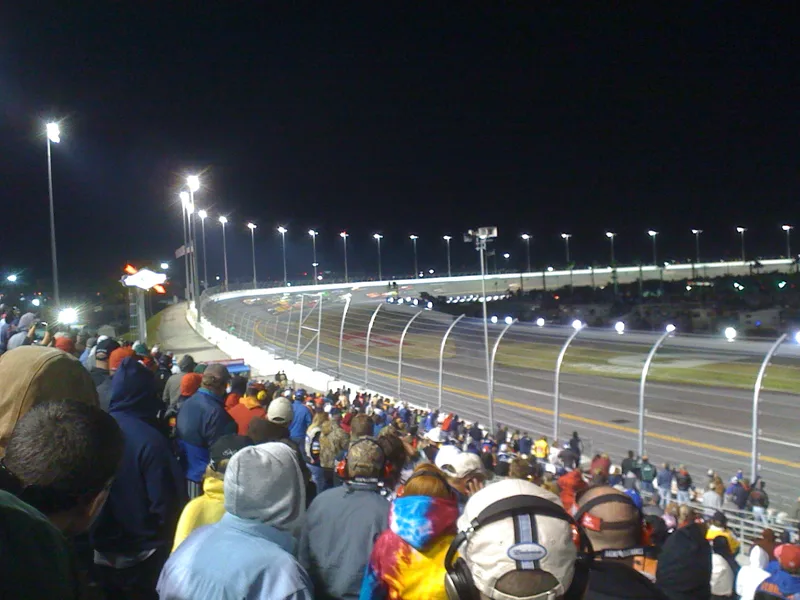
Brian Vickers won the 2003 Busch Series championship by 14 points at Homestead, while Kasey Kahne took his first NASCAR win in the final race.
The 2003 Ford 300 was the season finale of the Busch Series, run at Homestead-Miami Speedway. It went to Kasey Kahne, and Brian Vickers took the title by 14 points over David Green. Vickers was 20 years old, the youngest champion in the series' history at that point.
The 2003 Ford 300 closed out the 2003 NASCAR Busch Series season at Homestead-Miami Speedway in Florida. Kasey Kahne won it for his first NASCAR victory, while Brian Vickers claimed the championship by 14 points over David Green. It was the ninth running of the event.
What was at stake going into the race?
Six drivers still had a chance at the 2003 Busch championship. Brian Vickers led the standings with 4507 points, 22 ahead of David Green, who was looking to win multiple titles. Ron Hornaday Jr. sat 39 points back, and Jason Keller was 70 back.
Vickers was 20 years old and hoped to become the youngest Busch champion in the series' history. He had raced for his father's team, Clyde Vickers, in the two seasons before this one, and then he was placed in the No. 5 car, which Ricky Hendrick had once owned. Green, the 1994 champion, was chasing a rare second title.
Scott Riggs had been the points leader going into Rockingham, but a crash there dropped him to 85 points back. Bobby Hamilton Jr. had trailed the leader by 369 points after the 24th race at Bristol, and he had since won twice at Memphis and Phoenix to get back into contention.
The season had been unusually close. The points lead changed 17 times over the 33 races, and it changed seven times in the final eight. Late in the season the lead changed hands again and again, and the battle stayed tight in the closing laps.
A championship decided by 14 points and a first NASCAR win for Kasey Kahne in the season's final race.
How was the grid set?
Greg Biffle won the pole with a time of 30.437 seconds. That lap was the fastest in qualifying for the final race of the season. Ron Hornaday and Martin Truex Jr. were forced to the back of the field, with Hornaday using a backup car and Truex needing an engine change.
Starting at the rear did not keep Truex out of contention. By the final restart he was second, with 21 laps left to run.
How did the race begin?
Biffle led the first lap, with Bobby Hamilton Jr. pressing him closely. The first caution came out on the same lap that Riggs's title hopes ended, when he was hit in Turn 3 and crashed out. The early crash removed one of the six title contenders from the fight.
Jon Wood, on only his second Busch start, bumped Riggs from behind, and Ashton Lewis then hit Wood from behind, sending him spinning.
Riggs then hit the outside wall, came back across the track, and was hit again by two FitzBradshaw Racing cars, driven by Casey Atwood and Tim Fedewa. That damage took him from first in the standings to sixth in only two races.
David Green had problems of his own. A flat right rear tire on lap nine cost him positions, and he was black-flagged for skipping the access road to pit road. The pass-through penalty put him two laps down in 40th.
Who led during the middle of the race?
Hamilton Jr. took the lead from Biffle on lap 31, and a debris caution on lap 34 let him lead the restart. Jamie McMurray took over on lap 72 and was clear at the front for a long stretch of green-flag racing.
Riggs returned around lap 90 but retired after about two laps. At lap 104 Ashton Lewis spun near pit road, and debris from his car was followed by Matt Kenseth rear-ending Derek Hayes. That brought the third caution on lap 105, while Ron Hornaday was the leader.
Hornaday believed his car had run out of fuel, but he held his position until he could pit. Brian Vickers came down pit road with unrepaired left-front damage, and the caution left him a lap behind in 20th when racing resumed on lap 118 under McMurray.
How did the final laps unfold?
Kahne and Kenseth were the main contenders late in the race. McMurray took the lead with 44 laps to go, but a tire went flat with 35 laps to go, and Kenseth's car then lost power with 28 laps to go. That handed the lead to Kahne.
Scott Wimmer's engine blew on the next lap, bringing the sixth caution and a restart with 21 laps left. Martin Truex Jr. was second on the restart, making his 15th Busch start and his sixth for owner Dale Earnhardt Jr. Meanwhile, David Green cut Vickers' margin to 14 with about 15 laps to go.
Kahne stayed in front on the final restart, and Truex could not catch him. The finish settled a race that had been defined by repeated cautions and late tire trouble.
Who won, and why did it matter?
Kahne won the race in his 54th Busch start, his first NASCAR victory, in a race decided by late restarts and tire trouble. Kahne had reached his 54th Busch start before reaching victory lane at Homestead, which made the win a long time coming for him.
Truex finished second, and Hamilton Jr., Jason Leffler and Ashton Lewis completed the top five. Harvick, Bliss, Mears, Green and Waltrip rounded out the top ten. Green finished ninth, but that was not enough to overturn Vickers.
Vickers won the championship by 14 points over Green, 46 over Hornaday, 49 over Bobby Hamilton Jr., 109 over Jason Keller and 175 over Scott Riggs. He became the youngest Busch champion at 20 years old, a record that held until Chase Elliott, aged 18, broke it in 2014.
What happened to the drivers afterwards?
Several drivers moved up to the Cup Series. Kahne, Vickers and Riggs all made the step in 2004, and Kahne went on to drive for five different Cup owners, among them Ray Evernham and Richard Petty. He won 18 Cup races before retiring in 2018.
Vickers won three Cup races for three different owners before retiring in 2016. Riggs never won a Cup race and retired in 2013. Hornaday won Truck titles in 2007 and 2009, and he ended his career with the most Truck Series championships in the series' history, four in total, before retiring in 2014.
Truex, arguably, had the most successful career of the group. He won the Busch title in both 2004 and 2005, scored 34 Cup wins with several owners, and took the 2017 Cup championship before retiring after the 2024 season.
The Busch Series did not see a title fight this close again until 2013, when Austin Dillon beat Sam Hornish Jr. by three points.
Final standings at a glance
| Driver | Points behind Vickers | Notes |
|---|---|---|
| Brian Vickers | Champion | Youngest Busch champion at 20 |
| David Green | 14 | Ninth in the race, 1994 champion |
| Ron Hornaday Jr. | 46 | Two Truck titles before 2003 |
| Bobby Hamilton Jr. | 49 | Wins at Memphis and Phoenix |
| Jason Keller | 109 | Runner-up in 2000 and 2002 |
| Scott Riggs | 175 | Crashed out in Turn 3 |
What was Homestead's role in NASCAR?
The speedway was the season finale for all three of NASCAR's national series from 2002 through 2019. Those weekends were branded Ford Championship Weekend, and the Busch race was one of the three season finales held there in those years.
The track has also promoted several other series, including the IndyCar Series and the WeatherTech SportsCar Championship, which shows how varied its racing calendar has been.