
Michael Schumacher took pole and victory at Spa, his tenth win of 2002, while Rubens Barrichello completed a Ferrari one-two in a race shaped by engine failures.
Schumacher took the 2002 Belgian Grand Prix from pole on 1 September, his tenth victory of the year. Barrichello took second for Ferrari and Montoya third for Williams, a result that rewrote the single-season wins tally.
Michael Schumacher won the 2002 Belgian Grand Prix from pole position, giving Ferrari a one-two finish at Spa-Francorchamps. The result was his tenth victory of the season, which broke Nigel Mansell's record for most wins in a single season. The race was watched by 91,000 spectators and was decided as much by mechanical failures as by pace.
What was the background to the Belgian Grand Prix?
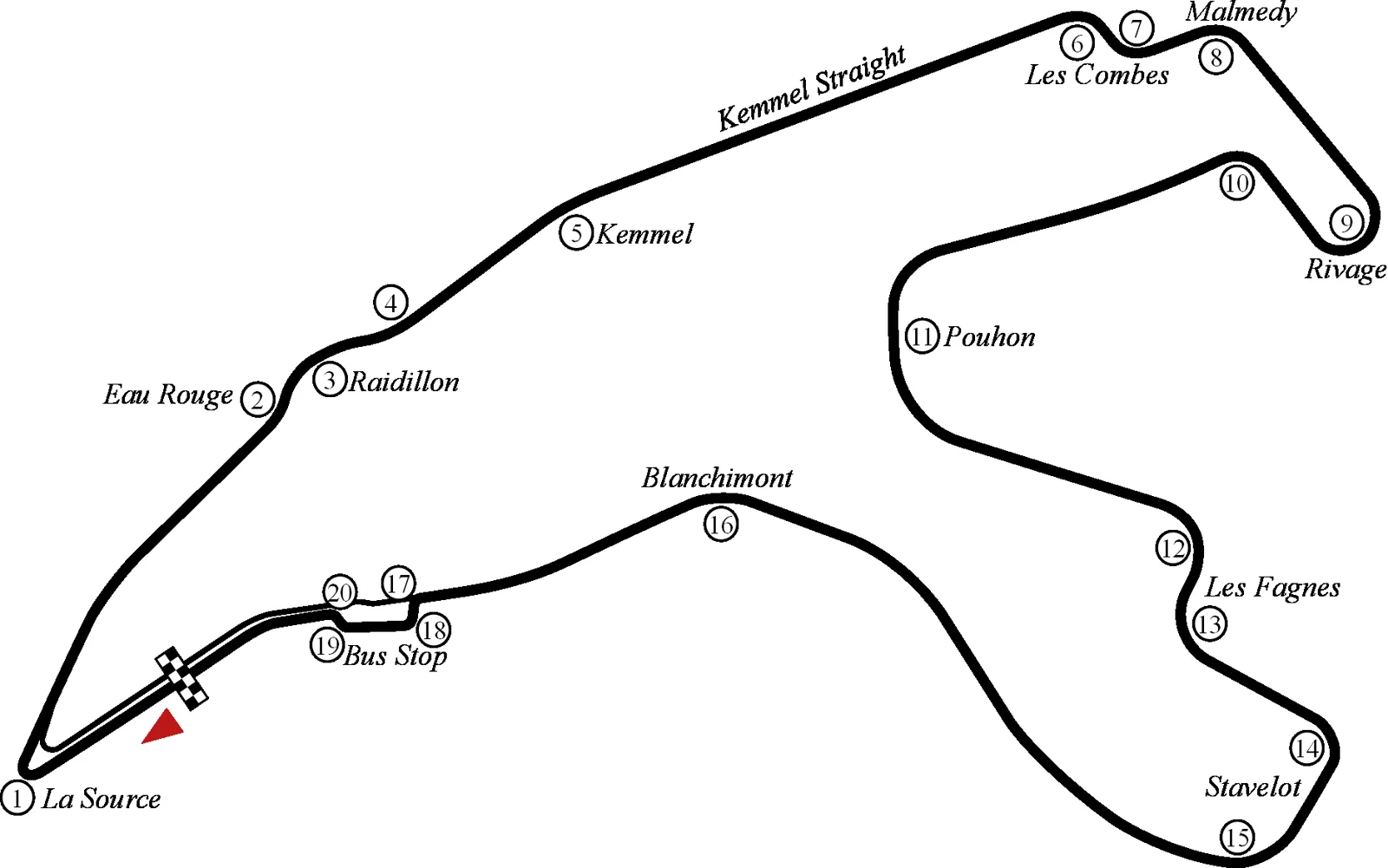
The race was the 14th of 17 events in the 2002 world championship and the 49th time the Belgian Grand Prix had counted towards the title. The 21-turn circuit measures 6.968 km (4.330 mi), and Schumacher had already won the race five times before this one.
Both championships were already decided. Schumacher had won the drivers' title at the French Grand Prix three races earlier, and Ferrari had secured the constructors' title at the Hungarian Grand Prix two races after that. The battle for second in the drivers' standings was still open, with Barrichello, Montoya, Ralf Schumacher and Coulthard all in contention.
Schumacher was chasing ten victories in one year, a total no driver had reached before, and that would surpass Mansell's old mark. He said he had the best memories of Spa from his career, and that he always enjoyed returning there.
Arrows pulled out late on 30 August, because its lawyers were unsure the sale of the team could be completed before qualifying. Anthony Davidson replaced Alex Yoong at Minardi for the second race in a row, and Yoong returned for the final three races of the season.
The circuit was altered for the Grand Prix. The exit of the Bus Stop chicane was changed for a faster run into La Source, and the pit entrance was moved to just before the Bus Stop chicane end. The track was resurfaced between La Source and Les Combes and between Blanchimont and the Bus Stop, and the kerb at the top of Eau Rouge was flattened to make the corner quicker.
There was little formal testing. Ferrari's test driver, Luca Badoer, shook down three F2002 cars at the Mugello circuit, while Jaguar's Eddie Irvine ran front suspension components at Silverstone for 50 km (31 mi). Mercedes and Toyota both introduced revised V10 engines, and most teams began to focus on their 2003 cars as the season moved towards its close.
A pole, a record-breaking tenth win and a Ferrari one-two made Spa a race that settled the 2002 season's question of who was fastest.
How did practice unfold at Spa?
Two one-hour practice sessions were held on Friday and two 45-minute sessions on Saturday. Fog delayed the first session by an hour, which cut it to half an hour because the medical helicopter could not land at nearby hospitals while the fog lasted.
Barrichello was fastest in the first session at 1:49.009, and Raikkonen set the best time of the second at 1:47.196 in the final ten minutes. Montoya ran off the circuit three times during that session, and Barrichello spun into the gravel at Malmedy with seven minutes left.
Michael Schumacher set the track's first sub-1:45 lap at 1:44.951 in the third session on Saturday morning, a little under a minute before the end. Raikkonen went quickest in the final session at 1:44.870, after switching to a new set of tyres, which demoted Schumacher to second.
Several drivers had problems. Panis suffered an engine failure into Les Combes and a new Honda V10 had to be fitted in 42 minutes, Villeneuve removed a bargeboard after hitting a kerb, and Massa locked his brakes into Malmedy. None of these incidents caused a withdrawal from the weekend.
How did qualifying settle the grid?
Michael Schumacher took pole with 1:43.726, the first lap under 1:44 on the circuit. It was his 48th career pole and his fifth of the season, and he had changed his gearbox before the session so that a spare Ferrari was ready if needed.
Raikkonen qualified second, 0.424 seconds behind, which was the first time he had started from the second row in front of the grid. Barrichello took third on a harder Bridgestone compound, after a Minardi affected his best lap, and the Williams pair took fourth and fifth.
Schumacher aborted his second run when oil was laid on the track by Panis's car, which prompted oil flags. Montoya was held up by Raikkonen at the Bus Stop and then ran onto the escape road, while Coulthard qualified sixth on a harder Michelin compound that left him short of grip.
Trulli was seventh and Irvine eighth, the Jaguar's best qualifying of the season, and Salo and Button completed the top ten for Toyota and Renault. De la Rosa took eleventh after locking his front wheels, and Villeneuve was twelfth in a car that was slippery in the corners. McNish was thirteenth after a tyre pressure mistake, and Fisichella finished fourteenth in a spare Jordan after a tyre wall impact.
Panis qualified fifteenth in a spare BAR after a second engine failure, and Sato, Massa and Heidfeld took sixteenth to eighteenth. The Minardis of Webber and Davidson were nineteenth and twentieth, and all twenty entrants made the race under the 107 per cent rule that applied during qualifying.
After qualifying, the FIA delegate Charlie Whiting agreed at a drivers' briefing to ban painted advertisements on the track, after the Grand Prix Drivers' Association raised concerns about the hazard in wet conditions.
What happened at the start of the race?
Schumacher made a clean start and kept the lead into La Source, while Raikkonen had a poor getaway. Barrichello pushed Raikkonen wide and passed him on the inside for second into the first corner, which caused a traffic jam behind them.
Ralf Schumacher chose to go around both cars but was blocked by Raikkonen, and Montoya passed him. Coulthard was least affected by the jam and moved into fifth at Les Combes, while Trulli ran wide at the hairpin after pressing the neutral button by accident. Heidfeld made the best start and gained three places on the opening lap.
By the end of the first lap Schumacher led Barrichello by 2.2 seconds, with Raikkonen, Montoya, Coulthard and Ralf Schumacher behind. Raikkonen ran wide at Pouhon on lap two and regained control only after a broadside, and Montoya took third from him. By lap five the Ferraris were nine seconds ahead of the rest, and Webber retired at Eau Rouge with a gearbox failure.
Behind the leaders, Massa passed his teammate Heidfeld for fifteenth at Les Combes, and Villeneuve considered a move on Fisichella at La Source but was too far back. Fisichella then appeared to make two manoeuvres that kept Villeneuve behind him, and Villeneuve eventually took thirteenth on the inside at La Source.
How did the pit stops shape the middle of the race?
The first round of stops began on lap 15. Schumacher pitted on lap 16 in 8.6 seconds and rejoined second behind Barrichello, while Barrichello was held at his stop for 10.2 seconds after a fuel nozzle malfunction. He fell behind Montoya, Raikkonen and Coulthard as a result.
Fisichella was the only driver to make a one-stop race work for him, but he pitted from sixth on lap 22 and dropped to fifteenth. The order after the first stops was Schumacher, Barrichello, Montoya, Coulthard, Raikkonen and Trulli, and the rest of the race was largely processional. Schumacher's lead over his teammate grew to 25 seconds, and Montoya was almost a minute behind by lap 30.
The second round of stops started on lap 28. Schumacher made his second stop two laps later and came back just behind Barrichello, but he retook the lead when Barrichello made his second scheduled stop at the end of lap 31. Ralf Schumacher, leaving the Williams pit, pressed the wrong button on his steering wheel, which cost him time and dropped him to ninth.
From lap 36 the retirements came thick and fast. Raikkonen's engine failed on the way to Les Combes, with smoke pouring from the rear of his McLaren, and Trulli stopped at Blanchimont with an engine issue the following lap. Massa's engine failed on the start-finish straight, de la Rosa's suspension broke at high speed, and Fisichella's engine failed on lap 40 with smoke and flames. Panis followed on the next lap.
How did the race finish?
Schumacher slowed in the final laps in response to a series of engine problems, but he was still the first to cross the line. His lead over Barrichello had shrunk from 25.8 seconds to 1.9 seconds, and the win was his tenth of the season and 63rd of his career. It also broke Mansell's record for most wins in one season.
Barrichello finished 1.977 seconds behind, and Ferrari recorded its 50th consecutive podium finish, a run that stretched back to the 1999 Malaysian Grand Prix. Montoya took third, nearly nine-tenths of a second ahead of Coulthard in fourth, and Coulthard had gone faster in the closing laps once his second stop had given him more grip on the track.
Ralf Schumacher finished fifth, and Irvine took sixth. That result gave Jaguar its first points since the opening race in Australia. Salo came home seventh, a fraction over half a second behind Irvine, and Villeneuve recovered from a slow start to finish eighth. McNish took ninth despite a wheel sensor failure, and Heidfeld was tenth in a car that had improved its handling and reliability. Sato was the final finisher in eleventh.
Eleven of the twenty starters completed the race. Five engine problems hit Honda during the weekend, and its race team said it had a great deal of work to do before the Italian round at Monza.
What did the drivers and teams say afterwards?
Schumacher said the race looked like a perfect one from the outside, although the team had not expected such a comfortable result given the changing temperatures. Barrichello called it a good weekend despite problems with the set-up in Friday practice, and he was pleased to extend his lead over Montoya in the standings.
Montoya described the race as pretty hard, especially at the start, because of the pressure McLaren had put on him. He said his late battle with Coulthard had been close, and that Coulthard had benefited from drafting on the straights.
Mansell said he had no issue with Schumacher taking his record, and that the Ferrari was both fast and reliable. Ferrari's sporting director, Jean Todt, called the race a dream, with everything working perfectly for the team. Coulthard said that his car had lacked grip in the middle sector, which prevented him from closing on Montoya.
McLaren's Ron Dennis said the lower asphalt temperatures explained why the team's qualifying form had not carried into the race. Raikkonen said his engine failure was not the way he wanted to end the weekend. Fisichella described his engine failure as very scary, since his one-stop strategy had been working until the car gave up.
What did the result mean for the championship?
Schumacher maintained his lead in the drivers' championship with 122 points, 71 ahead of Barrichello and 78 ahead of Montoya. Ferrari extended its constructors' lead to 87 points over Williams and 116 over McLaren, with three races remaining in the season.
The result also meant that Ferrari had consolidated a position that had been effectively settled for weeks. For Schumacher the record was the most important outcome, and for the rest of the field the championship battle for second place was now the only real contest left.