Jim Rathmann and Rodger Ward traded the lead through the closing laps, while a collapsed spectator scaffold killed two people.
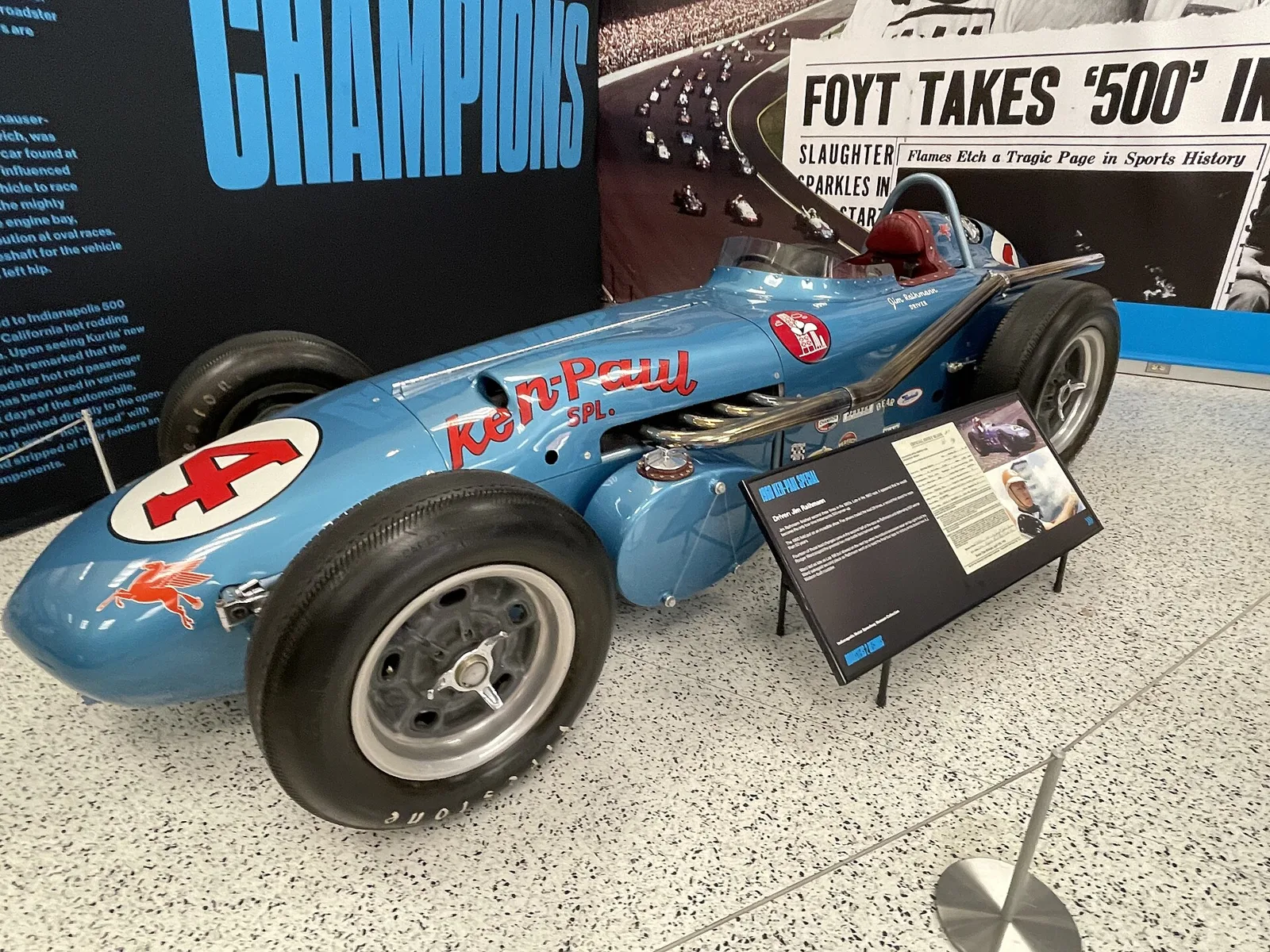
Jim Rathmann won the 1960 Indianapolis 500 on 30 May 1960, beating Rodger Ward by 12.75 seconds. The race set a then-record of 29 lead changes, and a homemade spectator scaffold collapsed on the parade lap, killing two people. Its 33-car field was the last made up entirely of front-engined cars.
The 1960 Indianapolis 500 was the 44th running of the race, held on 30 May 1960 at Indianapolis Motor Speedway in Indiana. Jim Rathmann won it by 12.75 seconds after a long battle with Rodger Ward. The race is also remembered for its record 29 lead changes and for a scaffold collapse in the infield that killed two spectators.
Who was on the grid?
Qualifying was planned for four days, but rain cancelled the third. Eddie Sachs won the pole on Pole Day, 14 May, at a track record of 146.592 mph. Jim Hurtubise's four-lap average of 149.056 mph was the fastest in the field, and it came on the final day of time trials.
Hurtubise came close to the 150 mph barrier on Sunday 22 May. His new one-lap record of 149.601 mph, set on lap 3, was the headline figure of the final day.
Dempsey Wilson replaced Jimmy Daywalt in the #23 entry after carburation tests, and that car was moved to the rear of the starting grid. Chuck Rodee was the first alternate, in the #89 car. The field of 33 cars was made up entirely of front-engined machines, and every entrant ran Firestone tyres.
29 lead changes, a worn tyre and a 12.75-second margin decided the 1960 race.
What happened at the infield scaffold?
Two spectators, Fred H. Linder, 36, and William C. Craig, 37, were killed when a homemade scaffold collapsed during the parade lap. As many as 82 people were hurt, and about 22 were seriously injured. The structure had been erected privately, not by the Speedway.
About 125-130 patrons had paid $5 to $10 each to watch the race from a platform 30 ft tall. It was partly anchored to a pick-up truck in the infield of turn 3. Platforms of this kind had long been a feature of the infield, and although the track sometimes tried to curtail them, enforcement was inconsistent and they were not banned outright before 1960.
As the field drove past on the parade lap, people on the platform leaned and waved at the cars. The structure became unstable and tipped forward, crushing people beneath it while those on top either fell or leapt clear. Linder and Craig died from broken necks.
The Speedway banned homemade scaffolds afterwards, and that rule still applies. The state fire marshal and other officials scrutinised the track for allowing structures built without permits, inspections or safety rules. Some reports also criticised bystanders who did little to help, although many people in the crowd were unaware of what had happened.
Why is the 1960 race called a two-man duel?
The race is often described as the finest two-driver contest in its history. Rathmann and Ward traded the lead repeatedly, and the 29 lead changes set a record that stood until 2012. Rathmann took control for good on lap 197 and pulled away.
The opening stages had four contenders at the front. Rodger Ward led lap 1 from the outside of the front row, but polesitter Eddie Sachs took the lead on lap 2. Troy Ruttman and Jim Rathmann also held the lead before the first caution, on lap 47, when Duane Carter spun in turn 3 without hitting the wall.
Several incidents followed. Jim McWithey came into the pits on lap 66 without brakes and finally stopped in the infield grass at turn 1. Eddie Russo hit the wall on lap 88 and was taken to hospital with a scalp wound and a concussion. The green flag returned on lap 100, but the caution came back almost at once. The race went green for good on lap 110, after the fourth and final caution period of the afternoon.
Ward stalled his engine twice during his first pit stop, which cost him track position, and he then charged back toward the front. Shortly after the halfway point Eddie Sachs and Troy Ruttman both dropped out, leaving Rathmann and Ward to fight over the lead.
Tony Bettenhausen pitted for a routine stop at about lap 124 and reported a smoking engine, but he rejoined the track. A single lap on, he was back in the pits with fire coming from a failed engine. He climbed out as the car coasted to a stop, and the safety crew put the fire out. No one was injured.
Johnny Thomson had blown a right rear tyre around lap 145, though that happened as he pulled into his pit stall for a routine stop. Ward and Rathmann made their final scheduled pit stops on lap 148. With 48 laps to go, Rathmann led Ward, and Thomson was ten seconds back in third. Thomson later narrowed the gap to about 8 seconds.
Rathmann had a reputation for charging hard to take the lead and then easing the pace once he had it. Ward knew this and allowed Rathmann to pass him for the lead, hoping the pace would slow so that his tyres would last. Ward feared he had already worn his tyres out after his earlier pit stall problems.
Who won the 1960 Indianapolis 500?
Jim Rathmann won by 12.75 seconds, taking the lead for good on lap 197 after Rodger Ward eased off with cords showing in his right front tyre. Ward finished second, and Paul Goldsmith, who started 26th, took third. The margin was the second-closest finish in the race's history at the time.
With under ten laps left, Ward looked quicker and moved ahead on lap 194, when fewer than six laps remained. A few moments later he saw the cords and backed off. Because of his experience as a Firestone tyre tester, he nursed the car to the finish without pitting to change it.
Johnny Thomson's engine began losing power on lap 172, and he finished fifth. Goldsmith held off Don Branson by about a car length, so Branson took fourth. Rodger Ward had won the race in 1959 and again in 1962, but he often regarded this 1960 run as his personal best.
Rathmann's chief mechanic was Takeo "Chickie" Hirashima. Some published claims named Smokey Yunick instead. Rathmann also set the fastest lead lap, at 1:01.59.
Results at a glance
| Finish | Driver | Notes |
|---|---|---|
| Winner | Jim Rathmann | Margin 12.75 seconds; fastest lead lap 1:01.59 |
| Second | Rodger Ward | About 12 seconds behind; cords seen in right front tyre |
| Third | Paul Goldsmith | Started 26th on the grid |
| Fourth | Don Branson | About a car length behind Goldsmith |
| Fifth | Johnny Thomson | Engine lost power on lap 172 |
Race-day conditions reached a high of 24 degrees Celsius (75 degrees Fahrenheit), with wind speeds up to 24 km/h (15 mph). Climate historians regard this as the traditional weather for the race.
Did the race count towards the world championship?
Yes, though it was the last time it did. The Indianapolis 500 had counted towards the FIA World Championship of Drivers from 1950 through 1960. Rathmann earned 8 points for winning, and he finished eighth in the final season standings despite racing in no other world championship round.
The race struggled to attract the regular Grand Prix field, particularly because it fell the day after the Monaco Grand Prix. The United States had no Grand Prix when the championship was announced, and Pop Meyers, the Speedway's vice president and general manager, lobbied for the 500 to represent the country. Cars at Indianapolis were not necessarily built to Formula One rules, and drivers also earned separate points for the AAA or USAC national championships.
How was the race broadcast?
The race was carried live on the IMS Radio Network, with Sid Collins as chief announcer and Fred Agabashian as driver expert for the second year. Luke Walton reported from victory lane afterwards. For the first time the network reached South Africa, through tape-delayed rebroadcasts.
Why does the 1960 race still matter?
The race is remembered for its two-driver duel and record 29 lead changes, and it was the final 500 run with an all front-engined field of 33 cars. It was also the last year points counted towards the world championship, and the scaffold ban that followed still applies.
Johnny Rutherford attended the race as a first-time spectator and claims to have witnessed the collapse. His future wife, Betty Hoyer, was a student nurse who attended the scene.
Jimmy Bryan made his final Indianapolis 500 start in 1960 and retired after 152 laps with a fuel system problem. He died on 19 June after a crash during the championship race at Langhorne.