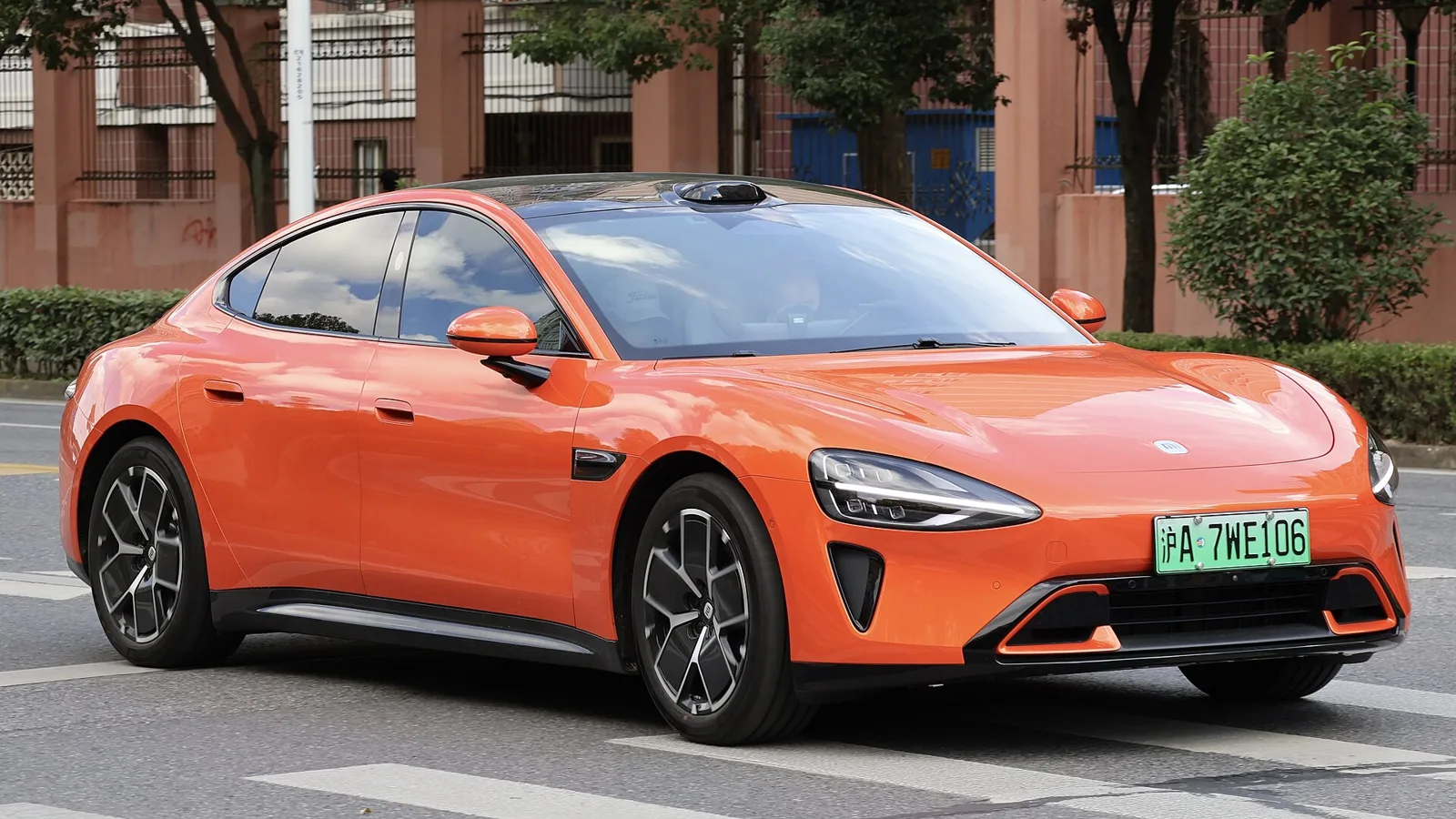
A sanctions phone call in 2021 led Xiaomi into cars, and the range now runs from the 215,900 yuan SU7 to the 990 hp YU7 GT.
The Xiaomi SU7 is a full-size electric sedan, the first car from the Chinese electronics company Xiaomi, released in Beijing on 28 March 2024. It was benchmarked against the Porsche Taycan and Tesla Model S, and matters because a consumer-electronics firm went from announcing a car division to unveiling a production car in under three years.
In January 2021, the founder of a company best known for phones took a call telling him that the United States had sanctioned his business. At the emergency board meeting that followed, someone asked what would happen to its 30,000 or 40,000 staff if the phone business could not continue. Less than three years later the company unveiled an electric sedan benchmarked against the Porsche Taycan.
What is the Xiaomi SU7?
The Xiaomi SU7 is a full-size four-door electric sedan, the first vehicle Xiaomi developed. It was announced on 28 December 2023 and released on 28 March 2024 in Beijing, the day orders opened. It is built at the company's plant in the Chinese capital and comes in four versions: SU7, SU7 Pro, SU7 Max and SU7 Ultra.
The name needs explaining. According to Xiaomi, SU stands for Speed Ultra, and the name may also echo the Chinese word for speed, su. Lei Jun, the founder, said the team settled on a pronunciation that sounds like calling a friend, roughly "Suchee". The 7, he explained, is a common series number in China, and the car is about the same size as a BMW 5 Series.
Production began in December 2023, and display cars reached stores the following day, with many shops needing renovation to fit a sedan inside. At the launch press conference on 28 March 2024, the chairmen of Nio, XPeng, Li Auto, Great Wall Motor and BAIC Group turned up, a sign of how seriously the industry took the newcomer.
Xiaomi benchmarked its first car against the Porsche Taycan and the Tesla Model S, then followed it with a version that peaks at 1,330 kW.
Why would a phone company build a car?
Because sanctions forced a rethink. After the January 2021 call, Lei Jun was urged by friends in the car business, including the heads of Nio and XPeng, to enter the industry, and he came to see the move to smart electric vehicles as inevitable. On 30 March 2021 Xiaomi announced a wholly owned electric vehicle subsidiary.
The money was large from the start. The initial investment was set at 10 billion yuan, with an expected total of 10 billion US dollars over the next 10 years, and Lei Jun took on the role of chief executive of the new business. Xiaomi Automobile Co Ltd was formally established on 1 September 2021. The recruitment drive drew roughly 380,000 job applications, and the hires included Li Tianyuan, a European-based Chinese designer who built his career at BMW.
Manufacturing took longer to arrange. In November 2021 Xiaomi signed an agreement with Beijing's municipal government for a two-phase factory, with 150,000 vehicles a year planned for each phase, 300,000 in all. The company was granted a production permit by China's National Development and Reform Commission in August 2023. In July 2024 it gained an independent car-making qualification, having earlier used credentials belonging to BAIC Group, and the same month the group spent 840 million on Beijing Yizhuang New Town to build a car plant.
How does the SU7 take on the Taycan?
Xiaomi benchmarked the SU7 against the Porsche Taycan and the Tesla Model S. The car was developed under the codename MS11 by a design team led by Sawyer Li, who was recruited from BMW. Lei Jun says he rejected three design proposals over durability concerns.
The hardware reads like a performance-sedan list. Higher-end models add adaptive air suspension, shutters that open and close in the grille, and a rear wing that moves between four positions. The company claims a drag coefficient of 0.195, the lowest in the world, though that figure excludes the rooftop LiDAR module. Luggage space is 571 litres in the boot plus 105 litres under the bonnet.
The cabin is where a phone maker's habits show. A 56-inch augmented-reality head-up display projects navigation on to the windscreen, a 7.1-inch instrument cluster folds away when the car is switched off, and a 16.1-inch 3K touchscreen runs on a Qualcomm Snapdragon 8295 chip. The software, HyperOS, is based on Android and is shared with Xiaomi phones, wearables and home devices. A Xiaomi phone or tablet can be mirrored directly, a Mi Band connects, and a robot vacuum from the same ecosystem can be integrated. Apple's CarPlay works, with fewer functions.
Small touches reinforce the point: two wireless charging pads, slots in the doors for an upright phone, a glovebox sized for a 14-inch laptop, tablet mounts and charging ports for each rear seat and an optional 4.7-litre fridge in the rear of the centre console.
SU7 versions compared
| Version | Drive and output | Battery | Launch price |
|---|---|---|---|
| SU7 Standard | Rear-wheel drive, 220 kW (299 PS) | 73.6 kWh LFP, 400 V | 215,900 yuan (US$30,408) |
| SU7 Pro | Rear-wheel drive, 220 kW (299 PS) | 94.3 kWh LFP, 400 V | 245,900 yuan (US$34,633) |
| SU7 Max | All-wheel drive, 495 kW (673 PS) | 101 kWh NMC, 800 V | 299,900 yuan (US$42,239) |
| SU7 Ultra | Peak 1,330 kW (1,808 PS) | Cell-to-chassis NMC, 897 V | 529,900 yuan (US$73,000) |
Other numbers fill in the picture. The standard car weighs 1,980 kg, covers 0-100 km/h in 5.28 seconds, is limited to 210 km/h and is rated at 700 km on the CLTC test cycle. The Pro stretches the rating to 830 km, though its 110 kg of extra weight stretches the sprint to 5.7 seconds. The Max, with a 220 kW induction motor at the front and a 275 kW permanent-magnet motor at the rear, reaches 100 km/h in 2.78 seconds and 265 km/h flat out at a weight of 2,205 kg. Xiaomi quotes all of these figures.
What is the SU7 Ultra, and what does it prove?
The SU7 Ultra is the road-legal four-door race car Xiaomi positions at the top of the range. Xiaomi unveiled it on 29 October 2024 at 814,900 yuan (US$114,000), then launched it on 27 February 2025 at 529,900 yuan (US$73,000), a much lower price. The company aimed to sell 10,000 in 2025, with deliveries from 3 March.
The project had a rocky start. In September 2021 Xiaomi planned a pure electric performance car to benchmark against Porsche and Tesla, and in December the Ultra project began. Then in February 2022, during a 21-day meeting, it was cancelled to protect the success of the first model, the SU7. It was revived that May.
The car itself leans heavily on carbon fibre: 17 aerodynamic components, a roof of 1.7 square metres that saves 12 kg, and a rear wing 1,560 mm wide that helps produce a claimed 285 kg of downforce. A 24-carat gold Xiaomi badge sits on the nose. Inside, Alcantara covers 5 square metres and the audio system has 25 speakers. The chassis, made of 90.1% high-strength steel and aluminium, has an FIA-grade roll cage, 21-inch wheels with Pirelli P Zero 5 tyres, and carbon ceramic brakes with six-piston Akebono calipers at the front. Xiaomi says it stops from 100 km/h in 30.8 metres and can repeat a stop from 180 km/h ten times without losing performance.
The battery matters most. Developed with CATL, the pack uses Qilin 2.0 cells in a cell-to-chassis design with 77.8% volumetric utilisation, operates at 897 V and peaks at 1,330 kW, or 800 kW at 20% charge. It can accept up to 490 kW, which Xiaomi says takes a charge from 10% to 80% in 11 minutes. A Racing Package and a Nurburgring Limited Edition are to follow after an official lap record on the Nordschleife.
How safe is Xiaomi's first car?
The SU7 posted a top crash-test result and, separately, became the centre of a fatal accident and a recall. In March 2025 the C-NCAP programme published its results, and at that point the car had the highest overall score of any vehicle tested to the 2024 standards, 8.7 percentage points above the average.
The tested car was an SU7 Max with the Xiaomi Pilot Max driver-assistance system, bought without announcement from an ordinary store using the test agency's money. Its vulnerable road user score was 13.14 points above average, and every sub-score except whiplash sat in the 80th percentile.
Driver assistance is the sensitive area. Xiaomi Pilot has 16 functions as standard and runs on a single NVIDIA Drive Orin X chip. Higher-end versions get Xiaomi HAD, a supervised system using two chips with 508 TOPS, a Hesai LiDAR, three radars, 11 cameras and 12 ultrasonic sensors.
At 22:44 on 29 March 2025, an SU7 hit a guardrail on a highway in Anhui and caught fire, killing three college students. According to Xiaomi, the driver-assistance function was engaged and the car was travelling at 116 km/h. The fallout was serious enough that the reveal of the YU7, planned for Auto Shanghai in April, was delayed until May.
On 19 September 2025 Xiaomi Auto filed a recall plan with the State Administration for Market Regulation covering 116,887 standard SU7 cars made between 6 February 2024 and 30 August 2025. The regulator said the highway assist function might be insufficient at recognising, warning about or handling extreme situations, raising collision risk if the driver did not step in.
One detail from the software side stands out. A car observed in October 2025 was running Android 12, released in October 2021, with security patches from July 2022 and a Linux 5.4 kernel. The SU7 draws on international suppliers including Bosch, Brembo, Continental, ThyssenKrupp, ZF Friedrichshafen, Benteler, Schaeffler and Nexteer.
Is the YU7 the car that takes on Tesla?
The YU7 is Xiaomi's first SUV and second car, and it is expected to become the main danger to Tesla's Model Y in China's premium electric crossover segment. The Tesla has led that segment since its introduction there in 2021. The YU7 launched on 26 June 2025, earlier than the July date first given.
It is a 5.0-metre mid-large SUV on the Modena platform shared with the SU7, available as YU7, Pro and Max. Xiaomi says development included 539 days of road testing over 6,490,000 km, and 10,620,000 km across 653 test cars. The Max covered 3,944 km in a 24-hour endurance run at over 210 km/h. More than 40 aerodynamic changes cut drag by 78 counts to 0.245 Cd, adding 59 km of CLTC range, and the clamshell aluminium bonnet, at 3.11 square metres, is claimed to be the largest on a mass-produced car.
Practicality is a selling point: 678 litres of boot space, 1,758 litres with the rear seats down, and a 141-litre front boot. A 1.1-metre HyperVision display replaces conventional dials, and a magnetic wireless button can be stuck to any of nine points in the cabin to trigger more than 130 functions. Xiaomi has opened its accessory ecosystem to BYD, GAC Toyota and Zhengzhou Nissan.
The standard YU7 has a 235 kW rear motor, while the Pro adds a 130 kW induction motor at the front for a total of 365 kW. Both use a 96.3 kWh FinDreams LFP pack, with CLTC ranges of 835 km and 770 km respectively, a 10-80% charge in 21 minutes and a top speed of 240 km/h. All variants carry Xiaomi HAD with a 128-line Hesai LiDAR and an NVIDIA Thor-U chip rated at 700 TOPS.
The 738 kW GT
The YU7 GT, launched in China on 21 May 2026, pairs a 288 kW front motor with a 450 kW rear motor for a combined 738 kW (990 hp). Xiaomi quotes 0-97 km/h (60 mph) in 2.92 seconds, a top speed of 300 km/h and up to 705 km of CLTC range from a 101.7 kWh pack. In April 2026 a Track Package version, with its rear seats removed and a roll cage fitted, set an SUV lap record at the Nurburgring Nordschleife of 7:34.931, beating the Audi RS Q8's 7:36.69. The record was broken again the next month at 7:22.755, and on 22 June the GT set what was described as the first Nurburgring lap record for an autonomous vehicle, at 10:29.483.
What does it mean for buyers and rivals?
For buyers in China, the SU7 put sports-sedan numbers on a price list starting at 215,900 yuan, and the Ultra made 1,330 kW available for 529,900 yuan. Those are launch prices in China, where the cars debuted.
For rivals, the issue is the ecosystem. Xiaomi sells the car as part of a set of devices, from phones and tablets to wearables and robot vacuums, and has begun sharing its accessory standard with other carmakers. The group has a market capitalisation of about US$135.2 billion as of 2025, and it has already shown it can build a high-end car as well as a cheap one.
Many of the headline claims, from the drag coefficient to the braking figures, are Xiaomi's own, and the safety story includes both a top crash result and a recall.
Where this goes next
The last SU7 before its facelift left the production line in February 2026, ending that run. Xiaomi has also listed a SkyNomad series with two upcoming range-extended SUVs, the mid-size N70 and the flagship full-size N90 Max, and a Vision Gran Turismo concept.
Several plans were announced but depend on delivery. When the SU7 was introduced the company said larger-battery Pro versions of 132 kWh and 150 kWh would be shown later in 2025, and the Ultra's Racing Package and Nurburgring Limited Edition are tied to an official Nordschleife lap record. Capacity is also a plan: Xiaomi has mapped out a two-phase factory with 300,000 cars a year in total, and its second factory in Yizhuang was scheduled to reach completion by July 2025.
_Private_Xiaomi_SU7_%E6%B2%AAA7WE106_2024-11-24.jpg)