From a 2016 London launch and a New York listing to a battery-swap network of thousands of stations, NIO has tied its cars to a charging model few rivals match.
NIO is a Shanghai electric vehicle maker founded in 2014 and branded in 2016. It sells SUVs and sedans, runs one of the largest battery-swap networks, and listed on the New York Stock Exchange in 2018. Its battery-swap network is one of the main reasons it stands apart.
NIO Inc. is an electric vehicle maker based in Shanghai. It launched its brand in London in 2016, listed in New York in 2018 and built one of the largest battery-swapping networks anywhere. The range now runs from the ES8 family SUV to the ET7 and ET9 sedans, with the Onvo and Firefly brands added for mass-market buyers.
Where did NIO come from?
The company was founded in 2014 and took its present name two years later. It began by designing and selling electric sedans and SUVs, and it has since branched into chips, smartphones and energy products, so the business now reaches well past the car itself.
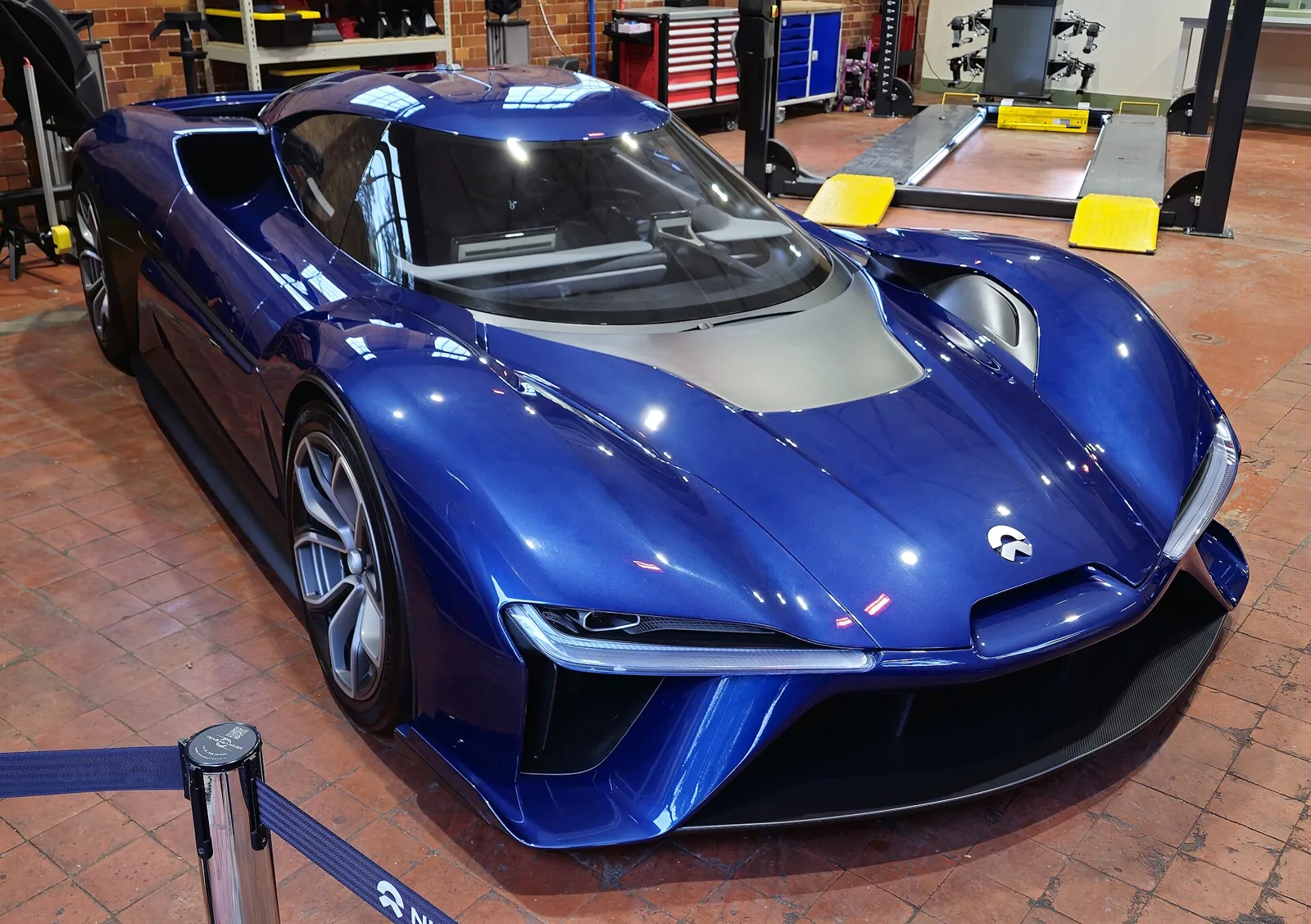
The brand was unveiled on 21 November 2016 at a gallery in London. The company drew money from a group that included Lenovo and TPG Capital alongside Tencent, Temasek and Sequoia Capital, and the EP9 electric sports car, the first model, was shown on the same day.
Self-driving work started early as well. In October 2016 the firm won California's permission to test autonomous cars, issued by the state's motor vehicles department, and it began testing on public roads with an eye on Level 3 and Level 4 systems.
A Shanghai EV maker that tied its cars to a battery-swap network and built its own driving chips.
Which cars did NIO launch first?
The ES8, a seven-seat electric SUV, was announced in December 2017, and customers received it from June 2018. It was the first family vehicle in the line-up.
The five-seat ES6 SUV came in December 2018 and reached buyers from June 2019. Late in 2019 the company showed the EC6, a five-seat coupe-SUV, and its deliveries started in September 2020.
Sedans followed. The ET7 appeared in January 2021, and the smaller ET5 came out at the December 2021 Nio Day event. The ET7 also became the first car to carry the Aquila driving system.
How did the battery-swap network grow?
NIO runs automated stations where an owner drives in and swaps a depleted pack for a charged one in under five minutes. The scheme covers both outright battery upgrades and short-term rentals, and it sits inside a broader energy business.
The first station opened in May 2018 in Shenzhen's Nanshan District and initially served only the ES8. A first phase finished in November 2018 with 18 stations at 14 sites along the G4 expressway linking Beijing with Hong Kong and Macau, and a January 2019 phase added eight stations on the G2 route from Beijing to Shanghai.
By March 2021 the group had completed its two-millionth swap in Suzhou and was running 193 swap stations. It hit its target of 700 stations in December 2021, and by December 2022 it had 1,305 stations spread across China's provinces, handling tens of thousands of swaps each day.
Outside China, the first European station opened in Norway in 2022, and seven were operating in Germany by August 2023. The network passed 100 million swaps in February 2026, and the latest tally is 3,989 stations worldwide, most of them still in China.
How did NIO's money and listing develop?
NIO went to the New York market in September 2018, seeking a float worth roughly US$1.8 billion. It collected about US$1 billion by selling American depositary shares at $6.26 each, and the stock began trading under the ticker NIO.
Trouble came quickly. By 2020 the shares were down 62% from the IPO price, and the Hefei city government took a 25% stake and arranged loans from six regional banks to shore up its battery, engine and control-system suppliers.
In April 2020 the firm drew roughly US$1 billion from investors in China and moved its main assets into a new subsidiary, NIO China, based in Hefei. Output rose by 81% over the next year, and the valuation reached roughly US$100 billion.
August 2020 brought the Battery as a Service programme. A joint battery-asset company was formed with CATL, a Hubei investment group and a unit of Guotai Junan International Holdings, and each partner paid in 200 million yuan, roughly US$32 million, for a quarter of the venture. The programme cut the price of an NIO car by roughly a quarter.
What is NIO's driver-assistance system?
NIO Pilot is an SAE Level 2 driver-assistance package that debuted on the ES8. Over-the-air updates in 2018 and 2019 added lane keeping, adaptive cruise control, lane departure warnings, automatic emergency braking, highway pilot, slow-traffic assistance and automatic lane changes.
Counting them, the array holds twenty-three sensors: a trifocal camera at the front, five radars, twelve ultrasonic units and a camera that watches the driver. NIO was one of the first makers to put Mobileye's EyeQ4 vision processor into a production car.
A serious setback came in August 2021, when a 31-year-old driver died after his ES8 hit a stationary construction vehicle. The system was still in beta and was not built to spot static obstacles, and the handbook told drivers to take over near roadworks. The family later claimed NIO could have changed or held back vehicle data kept on its servers.
The more ambitious plan was Aquila. Announced in November 2019 with Mobileye, it aimed to put SAE Level 4 automated driving into a consumer car by 2022. Aquila uses 33 sensors, among them 11 high-resolution cameras, a lidar unit, five radar units and 12 ultrasonic sensors, and deliveries of the ET7 with Aquila began in the first quarter of 2022.
What chips does NIO design itself?
The Adam autonomous driving computer arrived with the ET7 in 2021, and cars began shipping with it in early 2022. Adam combines four Nvidia Drive Orin processors to deliver 1,016 tera-operations per second, a standard yardstick for driver-assistance computing.
The Shenji NX9031 is NIO's own autonomous chip. It was announced at Nio Day 2023, and the company said its design reached tape-out in July 2024. The first car to use it was the ET9 sedan, introduced in March 2025, and it packs 32 cores arranged in a big.LITTLE layout that mixes high-performance and efficiency cores.
NIO credits the NX9031 with about 615 kDMIPS, roughly the output of four Nvidia Orin-X processors in Adam. The chip carries 64GB of LPDDR5x memory, meets the ISO 26262 ASIL-D safety standard, holds more than 50 billion transistors and is made on Samsung's 5 nm process.
The chip business has also attracted outside money. In February 2026 its subsidiary, Anhui Shenji Technology, closed a first equity round that raised over RMB 2.2 billion. The automotive version was later renamed NX9031X, and a midrange NX9031U was shown for robotics work.
Which brands sit under the NIO group?
Alongside the NIO brand, the group now runs two further brands. Onvo was introduced in May 2024 as a mass-market label. Its name stands for On Voyage, while its Chinese name suggests a joyful path, and its first model, the L60, began deliveries in September 2024 and is pitched against the Tesla Model Y.
Firefly was announced in December 2024 as the group's small-car label. Its first car reached China in April 2025 and Europe in August 2025, and it is positioned against small cars from Smart and Mini.
Onvo was first run by Alan Ai, a senior vice president, who handed the job to Shen Fei in April 2025, after early sales targets were missed. William Li has said Onvo cars are expected to find buyers in export markets as well.
How did NIO expand into Europe and other markets?
European expansion began in May 2021, with Norway slated for first deliveries that September. In the third quarter of 2021 the company handed over 24,439 ES8, ES6 and EC6 cars, up about 100% on the year before, and it aimed to be in 25 countries and regions by 2025.
Mavel, a maker of electric-drive systems, gained a Series A round led by NIO Capital in August 2023. The company also won a contract to provide electric cars for Oslo taxi services that month.
In December 2023 William Li said a new brand would target the family-car market in the lower price segments, around 200 thousand yuan, or roughly EUR25 thousand. Later that month NIO gained full production qualification and bought the JAC factories that had built its cars, paying 3.2 billion yuan.
Did NIO race in Formula E?
NIO's team was one of the original Formula E entries, first racing as Team China Racing. In the inaugural season its leading driver, Nelson Piquet Jr., took the drivers' title after winning at Long Beach and Moscow, while the team finished fourth in the constructors' table.
From the second season teams could design their own powertrains, and NIO built its NEXTEV unit. The results then slid to ninth, sixth and eighth. When the team was sold to Lisheng Racing for season six and renamed NIO 333 Racing, it had its weakest campaign, and the squad left the series after 2022-23.
The track-only EP9 also took five electric-car lap records, at the Nurburgring Nordschleife, Circuit Paul Ricard, the Circuit of the Americas and the Shanghai International Circuit.
What are NIO's side businesses?
NIO has reached into products around the car. Nomi is the in-car digital assistant on a round AMOLED screen, and the Nomi Mate 2.0 picks up driver habits and can adjust the seat, steering wheel height and cabin temperature.
The Nio Phone went on sale in September 2023 with a Snapdragon 8 Gen 2 chip and a 6.81-inch curved screen. Nio Life, the design and lifestyle arm, opened in 2018 with a capsule range made with Hussein Chalayan. Nio Power covers the swap stations, home charging and fast chargers.
Who leads NIO?
William Li founded the company and serves as its chief executive. In June 2021 the Bloomberg Billionaires Index put his net worth at US$7.11 billion, and he has co-founded or invested in more than 40 businesses across the internet and car industries.
Kris Tomasson, an American industrial designer, is vice president of design, and Hui Zhang runs the European operation as vice president of NIO Europe, covering the German and UK sites. Lihong Qin is also listed as a co-founder.
What are the key NIO figures?
| Item | Detail |
|---|---|
| Founded | 2014, Shanghai headquarters |
| Brand launch | 21 November 2016, Saatchi Gallery, London |
| First model | EP9 electric sports car, unveiled 21 November 2016 |
| NYSE listing | September 2018, about US$1 billion raised |
| Q3 2021 deliveries | 24,439 ES8, ES6 and EC6 cars |
| Swap stations | 3,989 globally (as of July 2026) |
| Swaps completed | Over 119 million |
| Production milestones | 100,000 on 7 April 2021; one million on 6 January 2026 |
| Adam computer | Four Nvidia Drive Orin processors, 1,016 TOPS |
| NX9031 chip | 615 kDMIPS, 5 nm, first used in ET9 |