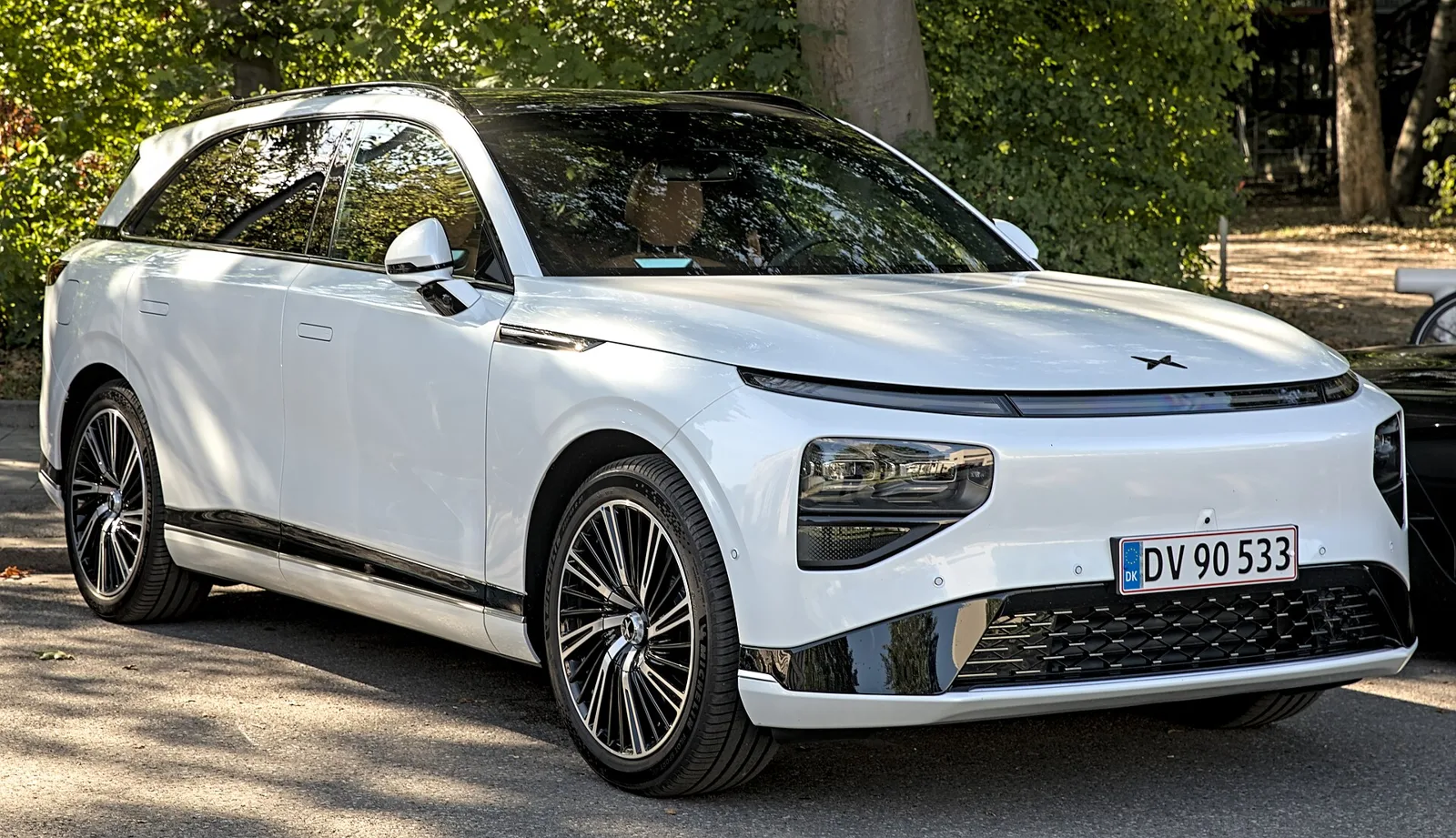
A Guangzhou electric carmaker that listed in New York and Hong Kong, built its own chips and robots, and is now pushing into robotaxis.
Guangzhou-based XPeng builds electric vehicles and was founded in August 2014. It listed in New York in 2020 and in Hong Kong in 2021, works with Volkswagen, and delivered 429,445 vehicles in 2025 across more than 60 countries and regions.
XPeng is a Chinese electric vehicle maker based in Guangzhou, with offices in Mountain View, California and Munich. The company calls itself a global AI mobility technology company, and it builds much of its own driver-assistance, operating system and powertrain technology.
Its story has moved quickly: a 2014 start-up, a first model in 2018, a New York listing in 2020, a first positive quarter of profit in late 2025 and a 2026 push into robotaxis and humanoid robots. The Volkswagen partnership and overseas growth have shaped its later years.
Who founded XPeng and who backed it?
The company was set up in August 2014 by Xia Heng, also known as Henry Xia, and He Tao, who had both held senior posts at the carmaker GAC Group. Early backers included He Xiaopeng, the founder of UCWeb and a former Alibaba executive, and Lei Jun, the founder of Xiaomi. Alibaba, Foxconn and IDG Capital were prominent investors.
Alibaba's vice president Joseph Tsai joined the corporate board after a 2018 funding round. A third round in November 2019 brought in US$400 million, and Xiaomi joined as a strategic investor.
A 2014 start-up that listed in New York, struck a Volkswagen partnership and has begun mass production of a robotaxi.
How did XPeng go public?
A July 2020 round raised US$500 million, with Sequoia Capital China among the investors. On 27 August 2020 the company raised US$1.5 billion in an initial public offering on the New York Stock Exchange, and its shares climbed more than 40 percent on the first day of trading.
By May 2021 He Xiaopeng owned 23 percent of the shares and Alibaba Group held 12 percent. On 7 July 2021 XPeng also debuted in Hong Kong, becoming the first US-listed Chinese firm with a dual primary listing.
The Hong Kong listing made the shares eligible for Stock Connect, an investment channel between Hong Kong and mainland China. The company also said the move would give it some security if it were ever removed from the US market.
What were XPeng's first cars?
Production of the G3 SUV, the first model, started in November 2018, and the car debuted in December 2018 at the Consumer Electronics Show in Las Vegas. The second model, the P7 four-door electric sedan, premiered at the 2019 Auto Shanghai show and reached buyers in June 2020.
A fleet business arrived in May 2019, when the company set up a vehicle-for-hire operation with its own cars in Guangzhou. The P7 became its first flagship export in 2021, with Norway the first overseas market in August that year.
Why was the P5 important for driver assistance?
The P5 subcompact sedan was a technology milestone. It became able to read traffic lights in August 2021, and it reached the market in September 2021 as the first production car to carry lidar for its driver aids. It was the first XPeng vehicle to carry lidar at all.
The P5 was the first step in XPeng's lidar-based approach, which the company later moved away from in part of its range.
What happened with the US self-driving permit?
The US unit XMotors.ai was granted a permit to trial self-driving cars under the California Department of Motor Vehicles from September 2018. California withdrew that permit in February 2020 after a required disengagement report was not sent in, and XPeng Motors then obtained a fresh testing licence in March 2020.
How did XPeng's finances change in 2025?
XPeng delivered 429,445 vehicles in 2025, up 126 percent on the previous year, including 45,008 in overseas markets, a 96 percent rise. In the fourth quarter of 2025 it recorded its first positive quarterly net profit, of RMB0.38 billion, on full-year revenue of RMB76.72 billion.
Full-year gross margin reached 18.9 percent. The company reports a footprint of 60 countries and regions as of late 2025.
The first quarter of 2026 was weaker on profit. Deliveries reached 62,682 vehicles, revenue came to RMB13.03 billion and gross margin was 20.6 percent, though the period closed with a net loss of RMB1.78 billion. April and May 2026 brought 31,011 and 32,158 deliveries respectively.
Where is XPeng selling outside China?
XPeng's overseas push covers Europe, Southeast Asia and Australia. In September 2024 it partnered with the Salvador Caetano Group to launch in Spain and Portugal, and in February 2025 it entered the United Kingdom through International Motors Ltd, offering the right-hand-drive G6 from GBP 39,990.
Singapore received the G6 in July 2024, with a first showroom opened in November. Malaysia's first dealership opened at Glenmarie, Kuala Lumpur, on 27 August 2024, and Indonesia's brand launch came in January 2025, followed by knock-down assembly in Purwakarta in July 2025.
Australian sales began in late 2024 through the third-party distributor TrueEV. After TrueEV entered receivership and began litigation against XPeng in March 2026, the company announced its own dealership network in the country.
Who are XPeng's Volkswagen partners?
The Volkswagen Group announced an investment of US$700 million in XPeng on 26 July 2023, buying a 4.99 percent stake. The two companies plan to develop two Volkswagen-brand electric models for China's mid-size segment in 2026, and the investment set the terms for everything that followed.
The partnership widened through several agreements. In February 2024 the two firms agreed a joint development deal covering platform and software work, which they said would shorten development cycles by more than 30 percent.
In April 2024 they agreed to develop a new electronic and electrical architecture based on XPeng's design, to be applied to Volkswagen's CMP platform for China, with mass production starting in 2026. In August 2025 the collaboration was extended to ICE and PHEV platforms in China.
XPeng's first-half 2025 report disclosed a profit of RMB1.72 billion from technology licensing fees paid by Volkswagen.
How does XPILOT driver assistance work?
The driver aids combine three sensor types: lidar, radar and cameras. Lidar builds a three-dimensional picture by timing how long laser pulses take to return, radar tracks the speed and position of objects, and cameras supply basic semantic information about the scene.
The P5 introduced lidar to the range in 2021. In late 2024 the P7+ became the first XPILOT vehicle with a vision-only sensor suite and no lidar, relying on 4D mmWave radars, which measure altitude, and LOFIC camera sensors, which handle glare better. In 2025 earlier lidar-equipped models were refreshed and had their lidar removed.
What is VLA 2.0 and the robotaxi plan?
The 2025 AI Day marked a change of direction, with XPeng now calling itself a global embodied intelligence company. Showcased items were VLA 2.0, a robotaxi, a next-generation IRON humanoid and changes to the flying car programme. In March 2026 the company said the VLA 2.0 intelligent driving system had officially rolled out.
Reuters said in May 2026 that the company had started building its first robotaxi model in Guangzhou, on the GX platform. The car is due for pilot runs in the second half of 2026, with fully driverless service in early 2027.
How does XPeng's battery strategy work?
XPeng's batteries were initially developed by CATL, China's largest battery manufacturer. The company later added LFP options alongside its original NMC batteries, which avoid expensive cobalt, beginning with the rear-wheel-drive P7 and the G3 SUV in early 2021. Both chemistries remain on offer, giving buyers a choice.
In 2025 most vehicles gained battery options capable of 5C charging, which can take a battery from 10 to 80 percent in about 12 minutes.
What charging network does XPeng run?
XPeng offers free lifetime charging, similar to the model Tesla has used around the world. Its own network had passed 1,000 stations in China, and customers can also reach about 200,000 third-party stations in major cities. The company also set early targets, such as 2,000 super-fast stations by 2025.
At the end of March 2026 XPeng ran 3,455 of its own charging stations, 2,398 of them ultra-fast. Its sales network that month comprised 733 stores in 256 cities.
Does XPeng make its own chips?
Yes. The chip effort began with recruitment in late 2020, and Marvell was first contracted that year for backend design and SoC work. That deal was cancelled in 2022 over concerns about delays, and Socionext then took over SoC integration. XPeng announced a successful tape-out in August 2024.
Turing, the company's first self-designed computer chip, arrived in June 2025 in the G7. The design packs 40 Cortex-A78AE CPU cores, a pair of NPUs and 64 GB of LPDDR5x-8533 memory, and it delivers 750 TOPS of sparse compute.
The company is willing to supply Turing to other carmakers, and it has agreed to fit the chips in certain Volkswagen models for China that launch in 2026.
Where are XPeng cars built?
XPeng's 2025 annual report says its cars are mainly built at plants in Zhaoqing and Guangzhou in Guangdong province, with most made in a wholly owned factory in Zhaoqing. Plants in Wuhan and in Guangzhou are still being built, according to the same report.
European-market models come from Graz in Austria, where the work is done with Magna Steyr.
How did XPeng's European sales begin?
XPeng first announced in late 2020 that it would deliver the G3 SUV to Norway, and by 2021 it had sold 211 G3 SUVs there. It also planned to sell the P7 in Europe, while acknowledging that breaking into the market would be hard without local infrastructure.
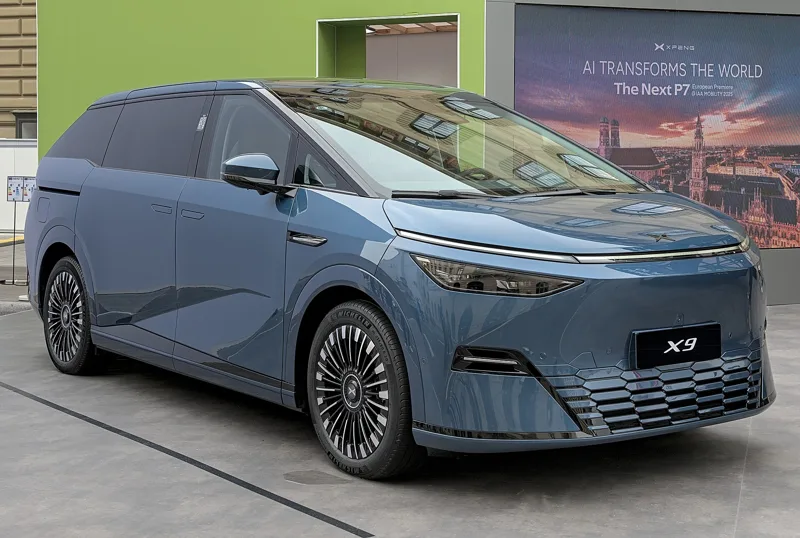
At the IAA Mobility show in Munich in 2023, the company said it would enter Germany from 2024, with further European markets to follow. In 2025, at Milan Design Week, it announced sales of the G6 and G9 in Italy.
What is the Iron humanoid robot?
XPeng unveiled Iron, its first humanoid robot, at its 2024 AI Day on 8 November 2024. Iron stands 5'8'' and weighs 70 kilograms, with more than 60 joints and 200 degrees of freedom, and it already helps assemble the P7+.
A June 2026 Reuters report said He Xiaopeng would take personal charge of the robotics unit, with mass output of Iron targeted before the end of 2026. Initial uses are expected in XPeng retail stores, with wider commercialisation from 2027.
What about XPeng AeroHT and flying cars?
AeroHT began as a start-up in Dongguan, Guangdong, in 2013, dedicated to flying cars. XPeng invested in 2020, renamed it XPeng AeroHT, and the subsidiary has since released the Voyager X1 and Voyager X2, which are electric vertical take-off and landing aircraft.
In 2024 the subsidiary unveiled the Land Carrier, a 6x6 range-extended electric carrier van for eVTOL craft. XPeng's chairman said in March 2025 that the first mass production of the flying land aircraft carrier was expected in 2026.
Which XPeng vehicles are coming next?
XPeng's upcoming line-up includes the Mona codenamed D11T, a station wagon, the Mona D11, a subcompact SUV, and the Mona L05, a mid-size coupe SUV offered as battery-electric or range-extended. Those three cover the wagon, subcompact SUV and mid-size coupe SUV segments.
The G6, unveiled at the 2023 Shanghai Auto Show, and the G9 are already on sale in several overseas markets.
Does XPeng publish sustainability figures?
The company releases ESG reports on its investor relations and ESG pages, which sit alongside its other investor material. Its 2025 report, published in April 2026, said cars made in 2025 would cut lifecycle emissions by more than 6 million tons against conventional cars.
Seven XPeng affiliates hold ISO 9001 quality certification, according to the same report.
What IP and data disputes has XPeng faced?
In July 2018 US prosecutors charged a former Apple engineer with taking secrets from the tech giant's self-driving car work, in a bid to win a role at XPeng. He entered a guilty plea in federal court in August 2022, and XPeng's 2025 annual report said the alleged taking happened before he joined the company.
Tesla sued a former employee, Cao Guangzhi, in March 2019, accusing him of taking Autopilot software code to XPeng. XPeng ran an internal investigation and in November 2020 gave its software code to a neutral third party for comparison. A court-appointed neutral party concluded the code did not use Tesla's intellectual property, and the parties moved to settle.
In December 2021 XPeng was fined 100,000 yuan (US$15,716) for the illegal collection of facial data from 430,000 visitors to its stores.
What are XPeng's key milestones?
XPeng has moved from a 2014 start-up to a listed, export-minded electric carmaker within about a decade. The table below sets out the milestones that matter most, from the first model to the robotaxi plans of 2026, and the dates follow the company's own launches and funding announcements.
| Year | Milestone |
|---|---|
| 2014 | Co-founded in August by Xia Heng and He Tao |
| 2018 | G3 SUV production starts in November |
| 2020 | New York IPO on 27 August raises US$1.5 billion |
| 2021 | Hong Kong debut on 7 July; P5 becomes the first production car with lidar for ADAS |
| 2023 | Volkswagen invests US$700 million for a 4.99 percent stake |
| 2025 | 429,445 vehicles delivered; Turing chip launched |
| 2026 | Robotaxi mass production begins at the Guangzhou headquarters |