A 2023 launch that grew into an electric and range-extended family minivan, with seven seats, driver assistance tiers and a 740 km maximum range.
The XPeng X9 is a seven-seat electric minivan from XPeng, first revealed in 2023 and delivered from January 2024. It uses the SEPA 2.0 platform, comes with battery and range-extender options, and was launched in Australia in July 2026.
The XPeng X9 is a seven-seat minivan from Chinese electric vehicle maker XPeng, sold as both a battery electric car and a range-extended model. It sits on the SEPA 2.0 platform, with three rows of seats arranged 2-2-3.
The X9 was first shown in 2023 and has been updated twice since, with a 2025 revision and a 2026 facelift that brought a range-extended version alongside the electric car. Markets across Asia and Australia have received it since 2024.
When did the XPeng X9 go on sale?
The X9 was revealed on 24 October 2023 at XPeng's 1024 Tech Day. It then appeared at that year's Guangzhou show, where pre-orders opened on 17 November. Customer deliveries started on 1 January 2024, after more than 30,000 pre-orders.
The car was built on the Smart Electric Platform Architecture 2.0. The first cars were all electric, and the range-extender version was planned later around a new system.
A seven-seat minivan with starship-inspired styling, a 0.227 drag coefficient and driver assistance that grew by software update.
What does the X9 look like?
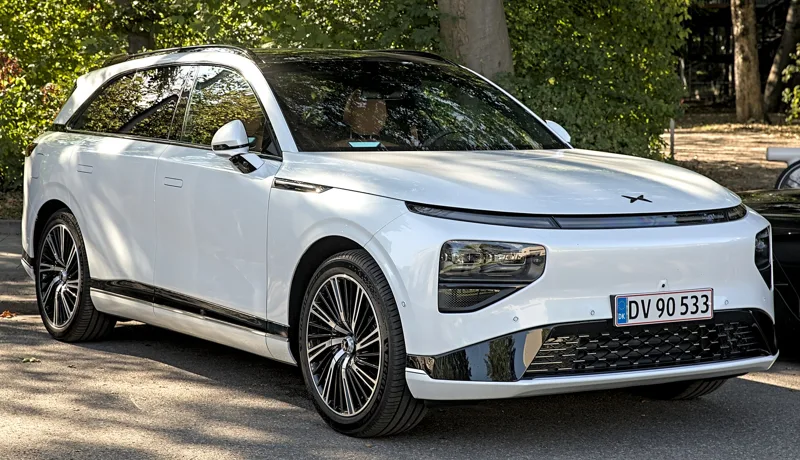
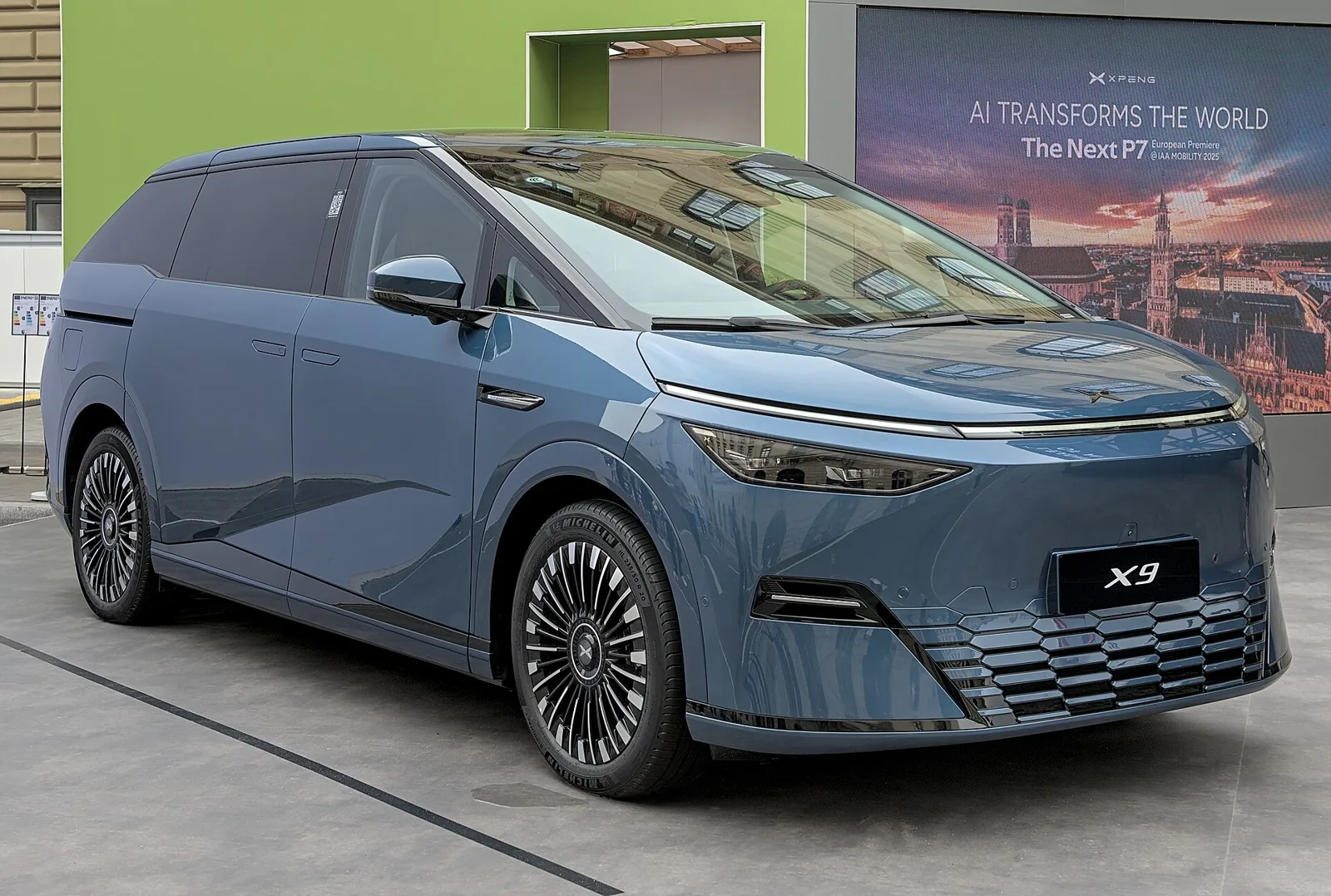
The X9 has a closed front with a lower air intake covered by a body-colour hexagonal pattern. Its split headlights sit above a light bar that runs across the top of the bumper, and LiDAR units are placed in the lower corners of the bumper where fog lights usually sit.
XPeng says the design was inspired by starships. The windshield is highly sloped with a 21-degree A-pillar angle, and the roof has a floating look with black-painted pillars. The rear has a 23-degree sloped rear window, which helps the car reach a drag coefficient of 0.227 Cd.
The windows sit flush with the pillars, creating a smooth surface that XPeng claims is a first for an MPV. The power sliding doors carry a sharply creased character line placed low on the door, and the wheels can be fitted with optional aerodynamic flat covers.
At launch the paint choice was Nebula White, New Moon Silver, Starship Grey or Midnight Black. Later model years added further colours.
How is the X9 built?
The chassis is made from 2,000 MPa steel and six large aluminium castings. The castings are produced on a 12,000 ton die casting machine, and together they make the chassis 83% high-strength steel and aluminium.
The front suspension is a double wishbone and the rear is an independent multilink. Both use dual-chamber air springs, which allow 90 mm (3.5 in) of ride height adjustment as standard. The setup allows a floor entry height of 37 mm (1.5 in).
Rear-wheel steering comes as standard, giving 5 degrees of steering angle at the back. The combination gives the X9 a turning radius of 5.4 metres (18 ft).
What driver assistance does the X9 have?
At launch the car came standard with XPILOT, an advanced driver assistance system that supports supervised autonomous driving on highways. XPILOT uses a single Nvidia Orin X chip with 254 TOPS, and its sensors comprise three mmWave radars, 11 cameras and 12 ultrasonic sensors.
Higher trims were fitted with XNGP, which handles urban streets as well as motorways under driver supervision. It uses two 126-line Robosense LiDAR sensors in the front bumper and a second Orin X chip, for a total of 508 TOPS.
XNGP was first limited to select cities. OTA updates later allowed it to be used anywhere in China by the end of 2024.
The 2025 version changed the setup. It came standard with the LiDAR-less Hawk Eye ADAS first seen on the P7+, so the two bumper LiDARs were replaced by decorative blanking panels, and teal indicator lights were added in places including the side mirrors.
What is the X9 interior like?
Behind a two-spoke steering wheel sits a 10.25-inch digital cluster, and a floating 17.3-inch infotainment screen covers the centre of the dashboard. That screen runs XPeng's XOS Tianji software, powered by a Qualcomm Snapdragon 8295 system-on-chip.
The centre console has two 50W wireless charging pads with active cooling, two round cupholders and a 10.8 L refrigerator that can heat or cool between 0 and 50 degrees C. The refrigerator cools from 45 to 18 degrees C within five minutes. The front row also has a digital rearview mirror and an individual sunroof.
The second row uses captain chairs. The standard seats are heated and power adjustable, and an optional zero-gravity recline mode offers 18-way power adjustment with leg support and massage. Rear passengers also have a 21.4-inch ceiling-mounted 3K display with 100% DCI-P3 colour coverage.
The third row has two cupholders, a separate climate zone and power headrests with recline of up to 176 degrees. It folds flat into the cargo area, and cargo room runs between 755 litres (26.7 cu ft) with the third row up and 2,554 litres (90.2 cu ft) with it folded.
The audio is a 23-speaker 2180 W 7.1.6 surround system, and climate control is five-zone as standard. A ring of ambient lighting runs across the ceiling above the second and third rows.
What changed in the 2025 update?
The 2025 version was revealed on 8 April 2025, with pre-orders on the same day and a launch on 15 April. XPeng claims 496 component changes, with 35% of the components and design altered, though the exterior received only minor changes.
The exterior changes were limited to two new 19 and 20-inch wheel options with anti-spinner hub logos, soft-close front doors and three new paint colours: Matte Starship Grey, Nebula Purple and Galaxy Blue.
Inside, the second-row seats now have a permanent 165 mm (6.5 in) aisle between the captain chairs. The front two rows gained 14-way power adjustment, heating, ventilation and 10-point massage, and the zero-gravity mode can run even when all seats are occupied.
The third row gained standard heating. XPeng made 56 changes to improve noise, vibration and harshness, and some of them can be applied to older models by OTA update. The active suspension also received a 6D AI anti-motion sickness algorithm that aims to reduce pitching and body roll.
The battery packs were enlarged for 2025. The smaller battery rose to 94.8 kWh with 5C charging, and the larger reached 105 kWh with 3C charging. The maximum configurable range is 740 km (460 mi).
What powertrains does the X9 offer?
The standard drive unit is a 315 hp (235 kW) front permanent magnet synchronous motor. A 181 hp (135 kW) induction motor at the rear can be added for all-wheel drive, giving a total of 496 hp (370 kW).
At launch the battery choices were an 84.5 kWh lithium iron phosphate pack from Eve Energy and a 101.5 kWh NMC pack from CALB. The 800V silicon carbide architecture supports 3C DC fast charging, which adds 300 km of range in 10 minutes.
Depending on battery and motor combination, the launch car had CLTC ranges of 610 km (379 mi), 640 km (398 mi) or 702 km (436 mi). The 2025 packs raised the figures, with the smaller battery reaching 650 km (404 mi) and the larger 740 km (460 mi) for front-wheel drive.
The range-extender version uses the Kunpeng Super Range Extender, first announced in November 2024. A 1.5-litre turbocharged petrol engine produces 110 kW (148 hp; 150 PS), and it works with an LFP battery pack weighing 445 kg (981 lb) and a 282 hp (210 kW) front motor. Top speed is 180 km/h (112 mph).
XPeng says it tested the system on more than 1,000 vehicles over 800 days, covering 20 million km (12 million mi) in 20 countries.
What did the 2026 facelift add?
The 2026 model year brought restyled front and rear bumpers. The first version to arrive was the range-extended EREV, which pairs a turbocharged 1.5-litre engine with a high-voltage oil-cooled generator and an 800V coaxial electric motor.
The EREV produces a combined torque of 465 N m and accelerates from 0 to 100 km/h in 8 seconds. Its appearance matches the pure electric version, which launched in March 2026.
The 2026 EV has an 800V system and dual-chamber air suspension. The entry model has a single front motor producing 235 kW (315 hp), and the 4WD variant has two motors with a combined output of 370 kW (496 hp). Batteries are a 94.8 kWh LFP pack or a 110 kWh NMC pack, depending on trim, with a CLTC range of 650 to 750 km.
Where is the X9 sold?
The X9 debuted in Hong Kong on 17 May 2024, alongside the Xpeng G6, with support for Cantonese voice recognition. Its right-hand drive Hong Kong version lacks the soft-close front doors of the global 2025 car.
Thailand was the first export market to receive a shipment, with 300 right-hand drive units marked by a ceremony in February 2025. The model launched there on 28 November 2024 with a single variant using the 101.5 kWh pack, and the range changed as Premium and Executive trims were added.
Malaysia launched the car on 5 March 2025 with three variants, and local CKD assembly started on 5 June 2026 at a plant in Malacca. Singapore saw its debut at the 2025 Singapore Motor Show on 9 January 2025, with front-wheel drive only.
Indonesia launched the X9 on 23 July 2025, with local assembly, and it received a facelift on 28 June 2026. Australia followed on 22 July 2026 with two variants, FWD Standard Range and AWD Performance.
How safe is the X9?
The X9 achieved a five-star rating in China's C-NCAP testing, with 86.6% overall. The tested car was the top trim with the larger battery and front-wheel drive, fitted with the optional XNGP urban system with two LiDARs.
Its active safety score of 97.68% was the second highest in that category, behind the Aito M9. The occupant protection score was 86.18%, and pedestrian protection reached 69.92%.
Sales have also been strong. On 10 June 2025, XPeng announced that the X9 had passed 30,000 worldwide deliveries.
What are the XPeng X9 specifications?
| Specification | Detail |
|---|---|
| Platform | SEPA 2.0 with 800V silicon carbide architecture |
| Seating | Seven seats in a 2-2-3 layout |
| Front motor | 315 hp (235 kW), permanent magnet synchronous |
| Rear motor (AWD) | 181 hp (135 kW), induction; 496 hp (370 kW) combined |
| Launch batteries | 84.5 kWh LFP (Eve Energy) or 101.5 kWh NMC (CALB) |
| 2025 batteries | 94.8 kWh LFP with 5C charging; 105 kWh NMC with 3C charging |
| Maximum range | 740 km (460 mi) CLTC, from 2025 |
| Drag coefficient | 0.227 Cd |
| Turning radius | 5.4 metres (18 ft) with 5 degrees of rear steering |
| Cargo volume | 755 litres (26.7 cu ft) to 2,554 litres (90.2 cu ft) |
| C-NCAP | Five stars, 86.6% overall |