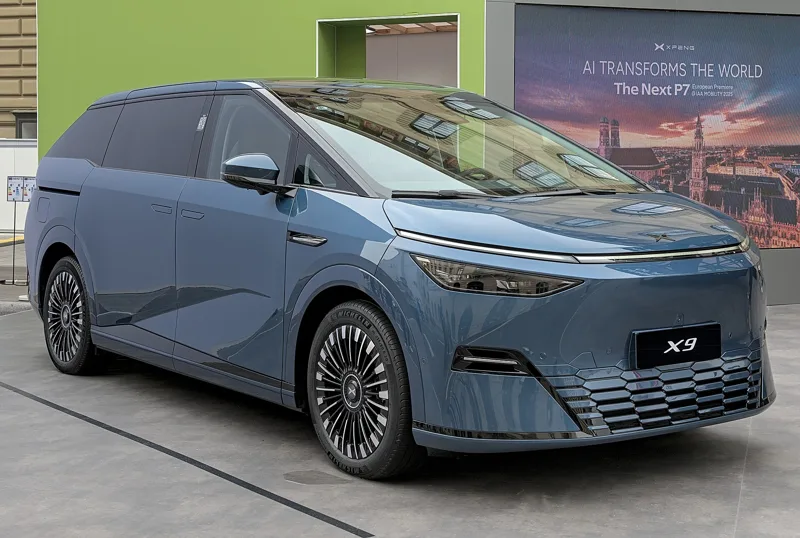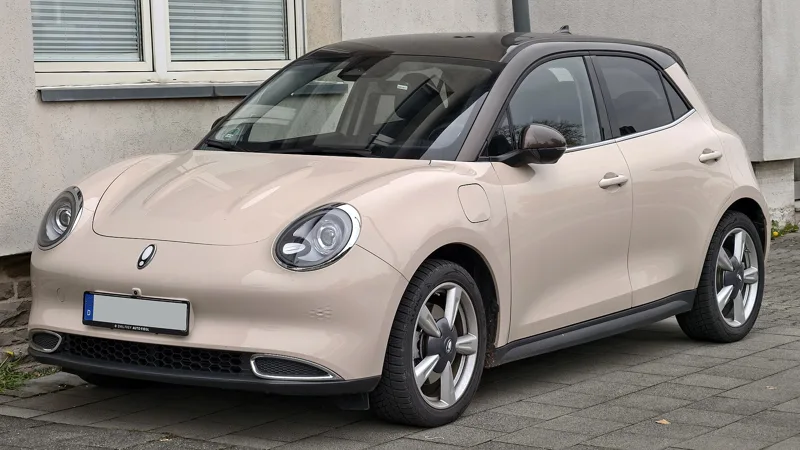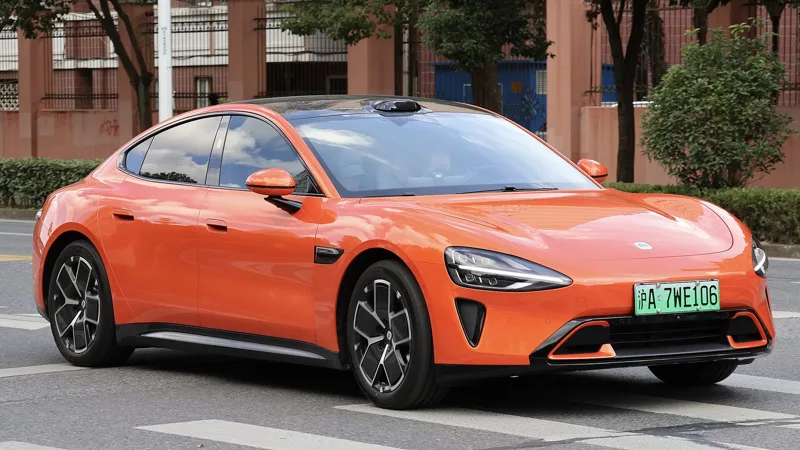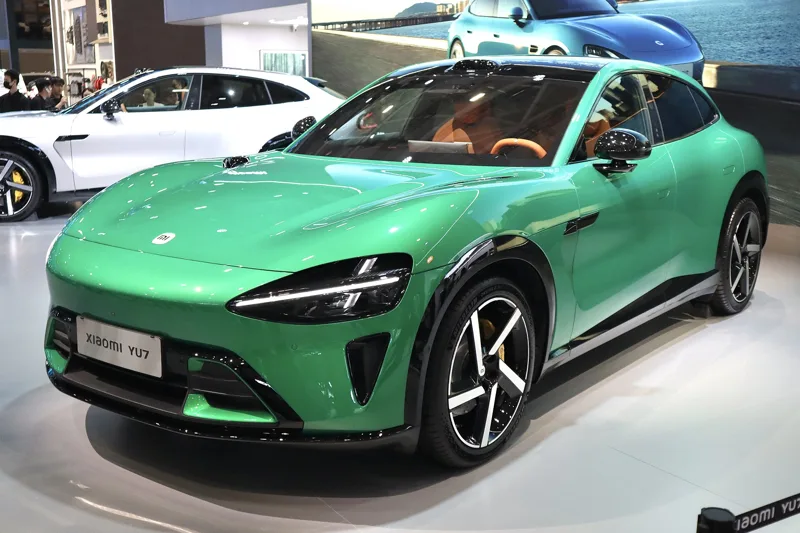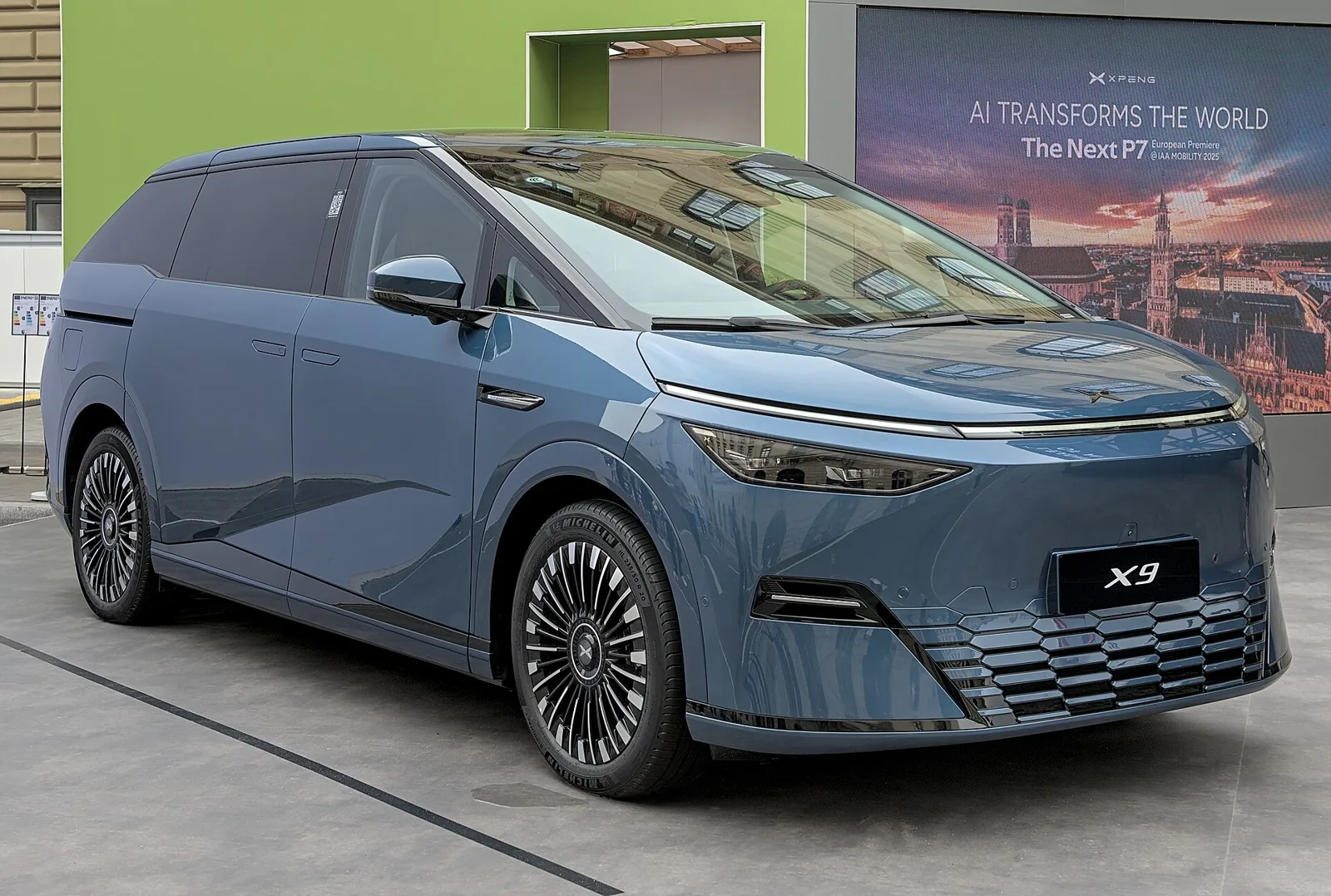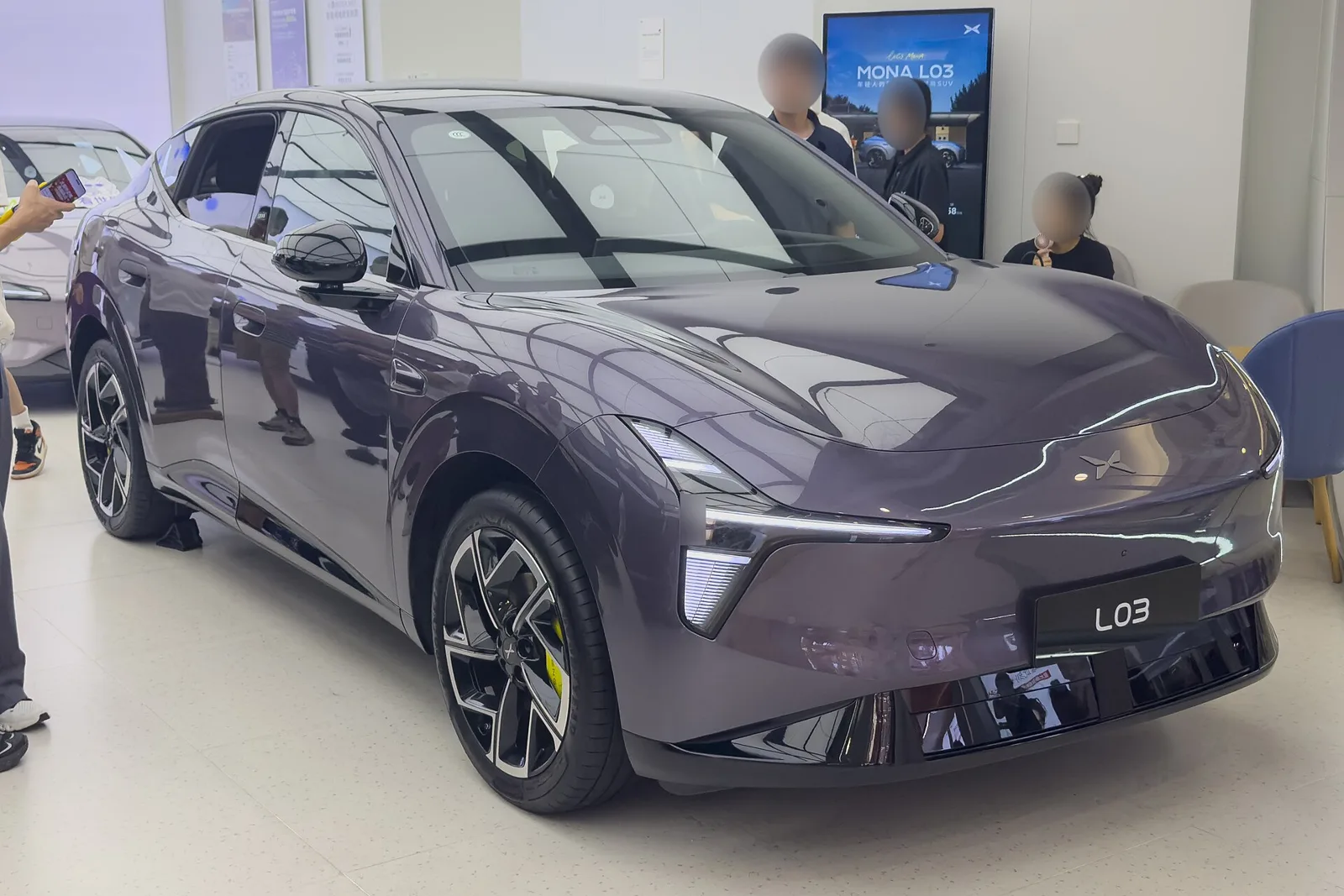
A G7 that took 10,000 pre-orders in 46 minutes, a G9 refreshed for 5C charging and the Mona L03 coupe SUV with a range-extender option.
The XPeng G7 and G9 are mid-size electric crossovers launched in 2025 and 2022, and both now offer 5C charging. The Mona L03 is a smaller coupe SUV that debuted on 25 June 2026 in battery electric and range-extender forms, priced from a speculated 150,000 yuan.
XPeng collected 10,000 pre-orders for the G7 in 46 minutes, and the first 10,000 deliveries followed 41 days after launch, on 13 August 2025. Those figures belong to the G7, which sits beside the older G9 crossover and the newer Mona L03 coupe SUV.
XPeng G7: from 2023 roadmap to June 2025 launch
The XPeng G7 is a mid-size five-seater electric crossover, unveiled in January 2025 and launched that June. It is the first vehicle to carry XPeng's own Turing AI chips and an augmented reality head-up display developed with Huawei.
Its story starts in an August 2023 product roadmap, which described a B+ segment SUV with at least 570 km (350 mi) of range for the third quarter of 2024. Exterior pictures appeared on 9 January 2025, the day MIIT listings revealed the basic specifications. A 7 June event detailed the Huawei display, and on 11 June the G7 went on sale for pre-order, with the first deliveries promised for the third quarter.
The G7 took 10,000 pre-orders in 46 minutes and reached 10,000 deliveries 41 days after launch.
XPeng G7 design, screens and space
Its wheelbase matches that of the smaller G6, while overall it stands 1 mm (0.039 in) longer than the flagship G9. Its second-generation X-Face styling, shared with the P7+ sedan, brings split headlights with light-bar daytime running lights above a module that leads into an air curtain. Frameless windows, flush handles and soft-close doors are fitted front and rear. The C-shaped taillights and frameless mirrors carry teal indicators that show when the car is driving itself. Buyers choose 18 or 20-inch wheels and one of six colours: Starry Grey, Crescent Silver, Nebula White, Dark Night Black, Cloud Beige or Interstellar Green.
Inside there is almost nothing on the dashboard but the steering wheel with its column shifter, a 15.6-inch touchscreen and concealed vents with wood accents. Where earlier XPeng models had an instrument cluster, the G7 puts an 87-inch panoramic augmented reality head-up display in the driver's line of sight. Built with Huawei XHUD, it uses a 1920 by 1080 LCoS panel rated at 12,000 nits of brightness, 1800:1 contrast and 85% NTSC gamut coverage. Think of it as navigation painted onto the road: it gives lane-level guidance at complex junctions and roundabouts, and it can outline vehicles, pedestrians and lane markings when visibility is poor.
The centre console has two 50-watt active-cooled wireless charging pads, and rear passengers get an 8-inch control screen and a charging pad in the fold-down armrest. Seats are Nappa leather with power adjustment, heating, ventilation and an 8-point massage. Other equipment includes a 2.18 m2 (23.5 sq ft) panoramic sunroof, a 20-speaker 7.1.4 sound system, a 9-inch 1080p digital rear-view mirror and a password-protected glovebox. Interiors come in Mystic Blue, Warm Orange, Aura Grey or Deep Space Grey. The rear cargo area holds 819 L (28.9 cu ft), rising to 2,277 L (80.4 cu ft) with the seats folded, and a drainable frunk sits up front. Every G7 has continuous damping control.
XPeng G7 driver assistance: Max versus Ultra
Both ADAS packages use three millimetre-wave radars and 11 cameras, and neither has LiDAR. The standard Max system relies on two Nvidia Orin-X chips totalling 508 TOPS, while the Ultra is the first use of XPeng's own Turing AI chips, at 750 TOPS each for a total of 2,250 TOPS. The Turing chips also run the cabin's infotainment. XPeng claims they will let the car support Level 3 autonomous driving, with a trial expected in the second half of 2025.
XPeng G7 powertrain, range extender and 2026 update
The electric G7 is rear-wheel drive only, with a 218 kW (292 hp; 296 PS) permanent magnet synchronous motor built in-house and 450 N m (332 lb ft) of torque. Two LFP batteries from CALB are offered, at 68.5 and 80.8 kWh, and the 800V power electronics support 5C charging for a 10 to 80 percent top-up in 12 minutes.
In January 2026 XPeng added a range extender on the same rear motor. A 1.5-litre turbocharged four-cylinder from Dong'an Power makes 148 hp (110 kW; 150 PS) at 5,500 rpm and 220 N m (162 lb ft) from 2,500 to 4,000 rpm, but it only generates electricity and never drives the wheels. A 55.8 kWh LFP battery from EVE Energy and a 60 L (15.9 US gal) tank give a CLTC electric range of 430 km (267 mi) and a combined 1,704 km (1,059 mi), and silicon carbide electronics again allow 5C charging in 12 minutes.
The 8 January 2026 update also made the front light bar a single uninterrupted strip, added Starry Purple paint and new wheels, and gave the range-extender car a longer bumper, a larger lower grille and combined cabin and engine noise cancelling. Infotainment moved to Tianji AIOS 6.0, and the ADAS now supports AEB and AES at up to 130 km/h (81 mph).
XPeng G9: the first XPeng designed for the world
The XPeng G9 is a battery electric mid-size crossover shown at the Guangzhou Auto Show in November 2021 and launched in China in the third quarter of 2022. It was the fourth XPeng product after the G3, P7 and P5, and the first conceived from the start for China and overseas. It meets five-star design standards under Chinese and European assessment programmes, as well as the EU's Whole Vehicle Type Approval. According to XPeng, more than 85 percent of the car is reusable and over 95 percent recyclable.
It shares the P7's platform, so the wheelbase falls between 3 and 3.10 metres (118.1 and 122.0 in). XPeng aims it at the Tesla Model Y, the Nio ES7 and the Li One; the Li One has a 3,010 mm wheelbase, inside that range. The G9 uses XPeng's centralised electrical architecture and XPilot 4.0 driver assistance. Its 800 volt silicon carbide platform suits the company's X-Power superchargers, which can add up to 200 km (124 mi) of range in 5 minutes. Two Nvidia Drive Orin chips totalling 508 TOPS run the car, and the hardware is capable of Level 4 driving. An 8 million pixel front camera and 2.9 megapixel cameras cover the sides, front and rear, with lidar sensors set into the headlights. The platform is also shared with Volkswagen's ID. Unyx 08.
XPeng G9 range, power and charging
At launch the G9 came with rear-wheel drive or dual-motor all-wheel drive. The base car had a 308 hp (230 kW; 312 PS) rear motor and a 78.2 kWh LFP battery from EVE Energy, good for 570 km (354 mi) of CLTC range and 3C charging from 10 to 80 percent in 20 minutes at a 260 kW peak. A 98 kWh NMC pack from CALB lifted range to 702 km (436 mi) at a 315 kW peak. The all-wheel-drive car adds a 235 hp (175 kW; 238 PS) front induction motor for 536 hp (400 kW; 543 PS), and XPeng claims 0 to 100 km/h (62 mph) in 3.9 seconds.
The 6 March 2025 refresh changed the driveline most. Both batteries became CALB LFP packs capable of 5C charging, and a 10 to 80 percent charge takes 12 minutes. Output rose to 346 hp (258 kW; 351 PS) for rear-drive and 567 hp (423 kW; 575 PS) for all-wheel-drive cars, and the base range grew by 55 km (34 mi) to 625 km (388 mi) on the CLTC cycle. The car also gained a Midnight Knight aesthetic package, soft-close doors, a Moon Shadow-Coffee interior and a Qualcomm Snapdragon 8295P infotainment chip. Its driver assistance moved to the Turing system first used on the P7+, dropping LiDAR in favour of three 4D millimetre-wave radars and 11 cameras with LOFIC technology.
On 8 January 2026 the G9 received a matte New Moon Silver paint, AIOS 6.0 software whose new driver-assistance interface also reaches earlier cars by over-the-air update, and room for up to three Turing chips for 2250 TOPS. That lets it run XPeng's latest VLA model, with AEB and AES working at up to 130 km/h (81 mph).
XPeng L03: the Mona coupe SUV below the G6
The XPeng Mona L03 is a battery electric and range-extended coupe SUV and the second model in the Mona series after the M03. XPeng filed it with MIIT on 9 April 2026, and it sits below the G6. The L03 debuted on 25 June 2026, pre-sales started on 2 July and the market launch was set for 16 July. Speculation puts the starting price at 150,000 yuan. The G6 is 81 to 103 mm (3 to 4 in) longer and 50 mm (2 in) taller at the same width, so the L03 is slightly smaller.
The L03 keeps the M03's design language, including T-shaped headlights, with a mesh-style bumper, an active air intake and a rounded waistline. XPeng says the electric version has a drag coefficient of 0.228 Cd, cut by 22 aerodynamic optimisations including active grille shutters, worth up to 59 km (37 mi) more range. A ROAM package, which XPeng says was designed by a Gen Z product manager for younger buyers, adds Aurora Purple, Star Dusk Purple or Smoked Plum Jam paint, a body kit, a black ducktail spoiler, 20-inch wheels and two-tone Viola Purple or Cherry Blossom Mist upholstery with orange stitching, a faux suede headliner and cat pawprint sill inserts.
XPeng L03 features and cabin
Cameras sit in the front bumper, fenders, rear and mirrors, and the mirrors are frameless. Wheels are 18 inches or optionally 20 inches, with 225/60 and 245/45 tyres respectively. The VLA 2.0 vision-based assistance system comes with one Turing chip of 750 TOPS on every car, rising to two chips and 1500 TOPS on Ultra SE models, together with 11 cameras and 12 ultrasonic sensors.
A 15.6-inch 2.5K central touchscreen and a 26.8-inch windshield head-up display are standard, powered by a Mediatek MT8676 chip. The console has twin 50W wireless pads. Front seats are heated, ventilated and have memory, and the passenger seat adds a zero-gravity recline with a 4-way legrest and 14-point massage. There is a 1.31 m2 (14.1 sq ft) panoramic sunroof, a 1000W+ 20-speaker sound system and a heat pump in the dual-zone climate control. Accessory mounts include five quarter-inch thread holes, 8 magnetic points and 3 fragrance holders. Luggage space is 539 L (19.0 cu ft), growing to 1,640 L (57.9 cu ft), and electric versions add a 102 L (3.6 cu ft) frunk.
XPeng L03 range, batteries and range extender
Every L03 has a rear Luxshare motor rated at 94 hp (70 kW; 95 PS) continuous and 245 hp (183 kW; 248 PS) peak, with 280 N m (207 lb ft) and a top speed of 180 km/h (110 mph). European rear-drive cars make 241 hp (180 kW; 244 PS), and a Europe-only all-wheel-drive version adds a second motor of 141 hp (105 kW; 143 PS) for 382 hp (285 kW; 387 PS).
The range-extender model has a 1.5-litre naturally aspirated four-cylinder of 91 hp (68 kW; 92 PS) that does not drive the wheels. With a 37.2 kWh LFP battery it covers 315 km (196 mi) on electric power in the CLTC test and 1,330 km (826 mi) in total, and it charges from 10 to 80 percent in 15 minutes. European figures on the WLTP cycle are 215 km (134 mi) electric and 1,017 km (632 mi) in total with the 42 L tank.
In China the electric L03 has a choice of two CALB LFP packs, 56 or 69 kWh, rated at 525 or 625 km (326 or 388 mi) on the CLTC cycle, and both charge from 10 to 80 percent in 19 minutes. XPeng claims a drivetrain efficiency of 92.3%. European cars use 58.3 and 71.2 kWh packs. The smaller one is rear-drive only and rated at 445 km (277 mi) on the WLTP cycle; the larger offers 520 km (323 mi) in rear-drive form and 440 km (273 mi) with all-wheel drive. Suspension is MacPherson struts at the front and a five-link independent rear with adjustable dampers, and the turning radius is 5.25 m (17.2 ft).
Where the XPeng L03 is sold
XPeng launched the L03 in select European markets in July 2026, alongside China, and a United Kingdom launch is scheduled for 2027. Thailand received it on 18 August 2026 in Standard Plus, Long Range Plus and Long Range Ultra trims. In Australia, the L03 is expected by the end of 2026.
XPeng G7, G9 and L03 compared
| Detail | G7 | G9 | L03 |
|---|---|---|---|
| Body | Mid-size five-seater crossover | Mid-size crossover | Coupe SUV |
| Shown | January 2025 | November 2021 | 25 June 2026 |
| Battery | 68.5 or 80.8 kWh LFP | LFP from CALB after 2025 refresh | 56 or 69 kWh LFP in China |
| 10-80% charge | 12 minutes | 12 minutes (after 2025 refresh) | 19 minutes |
| Power | 218 kW rear motor | 346 hp rear-drive, 567 hp all-wheel drive | 245 hp peak |
| Range extender | Added January 2026, 55.8 kWh battery | - | 37.2 kWh battery |