From a 34 mm air restrictor to a 36 mm one, via banned paddle-shifters and returning centre differentials, the World Rally Car rules decided what the cars became.
World Rally Car rules from 1997 to 2021 let manufacturers turn ordinary hatchbacks into turbocharged four-wheel-drive rally cars. Three rulebooks, in 1997, 2011 and 2017, changed engines, restrictors and differentials, and shaped the Citroen Xsara WRC, the Ford Focus RS WRC and the Toyota Yaris WRC.
Some of the best rally cars of the 2000s were built from road cars that had neither a turbocharged petrol engine nor four-wheel drive. The Peugeot 206, the Peugeot 307, the Citroen Xsara and the Skoda Fabia all went rallying at the top level without a road-going version that offered either.
That was the quirk of the World Rally Car rules, which ran from 1997 to 2021 and produced three very different generations of machine. A few lines of regulation reshaped engines, gearboxes and team fortunes across that span, and the Citroen Xsara WRC, the Ford Focus RS WRC and the Toyota Yaris WRC each belong to a different chapter.
What is a World Rally Car?
The World Rally Championship's top-class cars were built to FIA regulations, and the category arrived in 1997 as the successor to Group A in the manufacturers' championship. Group Rally1 took its place in 2022.
The change removed a chore that Group A had imposed. Manufacturers no longer had to build homologation specials, road-going versions of their rally cars, to win approval. The base model did not have to share the competition car's characteristics, which is why a front-wheel-drive, naturally aspirated hatchback could become a four-wheel-drive turbocharged weapon.
A front-wheel-drive, naturally aspirated hatchback could become a four-wheel-drive turbocharged rally weapon.
World Rally Car rules, 1997 to 2010
The first rulebook required a production car with a minimum run of 2500 units. From there, builders could raise engine displacement up to 2.0L, add forced induction with anti-lag, fit four-wheel drive and a sequential gearbox, alter the suspension layout and mounting points, change the aerodynamics, lighten the car to a minimum of 1230 kg and stiffen the chassis. The maximum width was 1770 mm, with front and rear tracks capped at 1550 mm.
Power was held down by a 34 mm air restrictor ahead of the turbocharger, which limited airflow to about 10 cubic metres a minute. The target was 220 kW (300 hp), though some engines were believed to make 330 to 340 hp. With the ceiling fixed, engineers chased width instead: more than 220 kW (300 hp) was typically on tap from 3000 rpm all the way to the 7500 rpm limit, and even at the 2000 rpm idle speed used in stage mode the engines gave slightly more than 150 kW (200 hp).
The electronics grew just as fast. The best cars of 2004 carried ABS, an electronically controlled clutch, paddle-shift, traction control, three active differentials, ride height control tied to GPS, electronic dampers and active suspension. For 2005 the maximum width went from 1770 mm to 1800 mm. In 2006, aiming to cut costs, the rules demanded mechanical front and rear differentials, left the centre differential active, and banned active suspension and water injection. A manufacturer also had to keep the same engine for two rallies, with limits on swapping suspension, steering, turbochargers and gearboxes.
The rules after 2010
From 2011 the regulations tightened. The new regime borrowed from Super 2000 cars, fitted with a different aero kit, and allowed smaller models: the old 4 m minimum length disappeared. The engine became a 1600 cm3 direct-injection turbocharged global race engine with a 33 mm restrictor and a maximum boost of 2.5 bar (36 psi) absolute, limiting torque to about 400 N.m (300 lb ft).
Exotic materials such as titanium, magnesium and ceramics were banned unless the base car used them, and carbon fibre and aramid fibre were tightly restricted. Gear changes had to use a mechanical linkage, so paddle-shifters were outlawed until they returned in 2015. There was no centre differential, only mechanical front and rear differentials and a clutch to disconnect the rear axle under handbrake use, a move intended to cut costs and make cars more spectacular to watch.
The 2017 rules kept the 1.6-litre engine but opened the restrictor from 33 mm to 36 mm, lifting output from 230 to 280 kW (310 to 380 hp). Manufacturers got more aerodynamic freedom, including big brake-cooling ducts inside fairings that formed wider wheel arches, and active centre differentials were allowed again. The new cars were reserved for manufacturers' teams, while 2011-specification cars could still enter in 2017.
Three rulebooks compared
| Period | Engine | Air restrictor | Power or torque | Minimum weight | Centre differential |
|---|---|---|---|---|---|
| 1997 to 2010 | Up to 2.0L turbo | 34 mm | Target 220 kW (300 hp) | 1230 kg | Active from 2006, with front and rear mechanical; all three could be active before |
| 2011 to 2016 | 1600 cm3 direct-injection turbo | 33 mm | About 400 N.m (300 lb ft) or less | 1200 kg empty; 1350 kg with crew | None |
| 2017 to 2021 | 1.6 L turbo | 36 mm | 230 to 280 kW (310 to 380 hp) | 1360 kg with crew and spare wheel | Active allowed |
The Citroen Xsara WRC
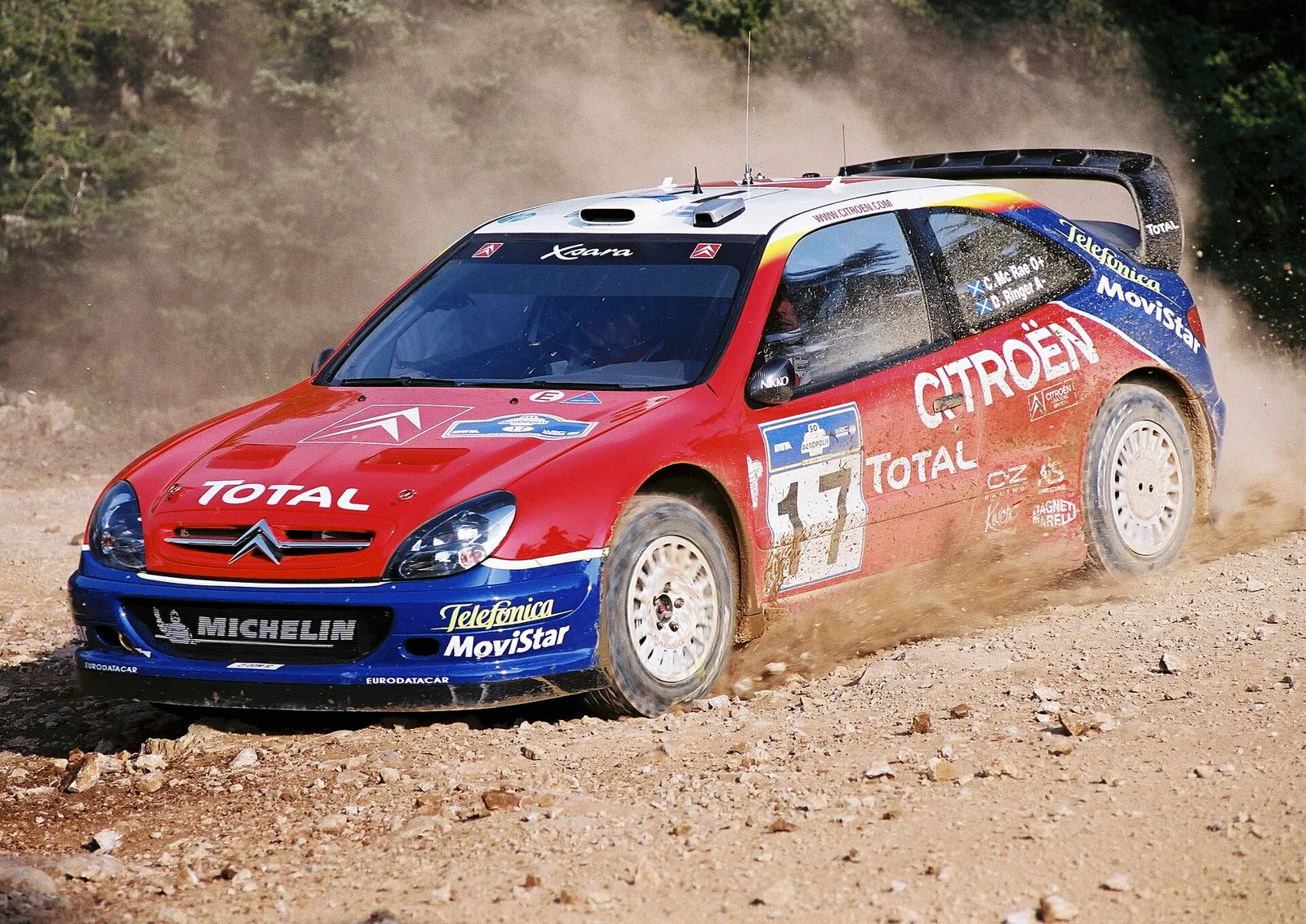
The Citroen Xsara WRC was built by Citroen Racing for the Citroen World Rally Team and based on the Xsara hatchback, though under the skin it had very little resemblance to it. Few cars have done better in the championship. Its roots lay in the two-wheel-drive, naturally aspirated Xsara Kit Car, which took overall wins on the Catalunya and Corsica events in 1999 and was rated the best in its class until the FIA raised the minimum weight for 2000 and stripped it of its edge.
Dates for its debut vary between the 2001 season and the 2002 Monte Carlo Rally, where Sebastien Loeb lost victory after a penalty for an illegal tyre change. He then won the Rallye Deutschland.
Citroen's first full championship season came in 2003, when former champions Colin McRae and Carlos Sainz joined Loeb. The Xsara won four rallies, and Loeb and Sainz both reached the final round, Wales Rally GB, with a chance at the drivers' crown. Richard Burns blacked out and withdrew, Sainz crashed on day one, and Citroen chose to go for the manufacturers' title, winning it by 15 points. Loeb finished second and lost the drivers' title by a single point to Petter Solberg.
The payoff came afterwards. Loeb won his first drivers' championship in 2004 and defended it in 2005, taking a record ten rallies that year. He won 28 rallies in the car and three consecutive drivers' titles from 2004 to 2006, while Citroen took manufacturers' titles in 2003, 2004 and 2005. Jesus Puras, Sainz and Francois Duval also won in it. The C4 WRC replaced the Xsara in 2007, but privateers kept using it, and Solberg drove a 2006-specification car for most of 2009.
The Xsara found a second life elsewhere. Kenneth Hansen won the European Rallycross title in one every year from 2000 to 2005, and in September 2014 Nabil Karam took an Xsara to the World RX of France, ending 34th of 37 after the heats.
The Ford Focus RS WRC
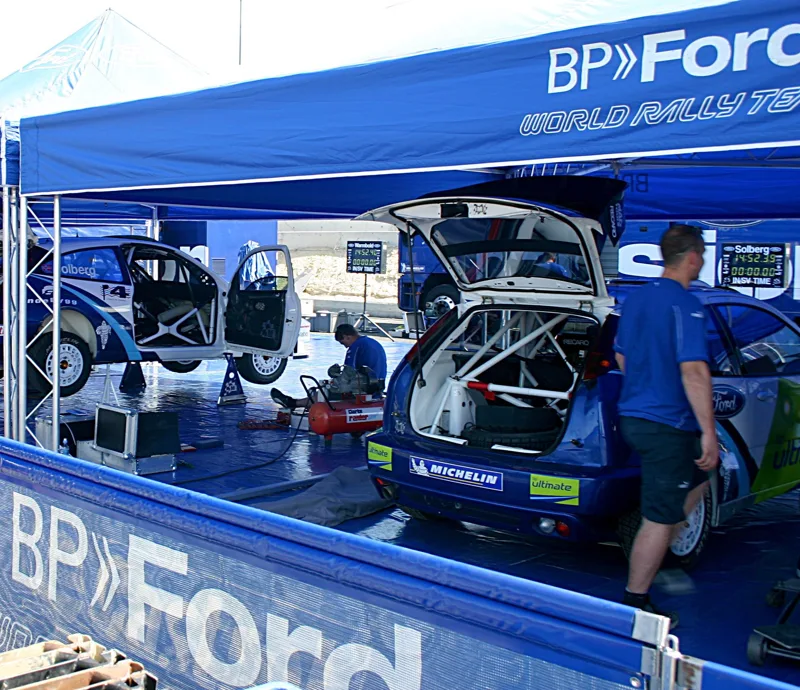
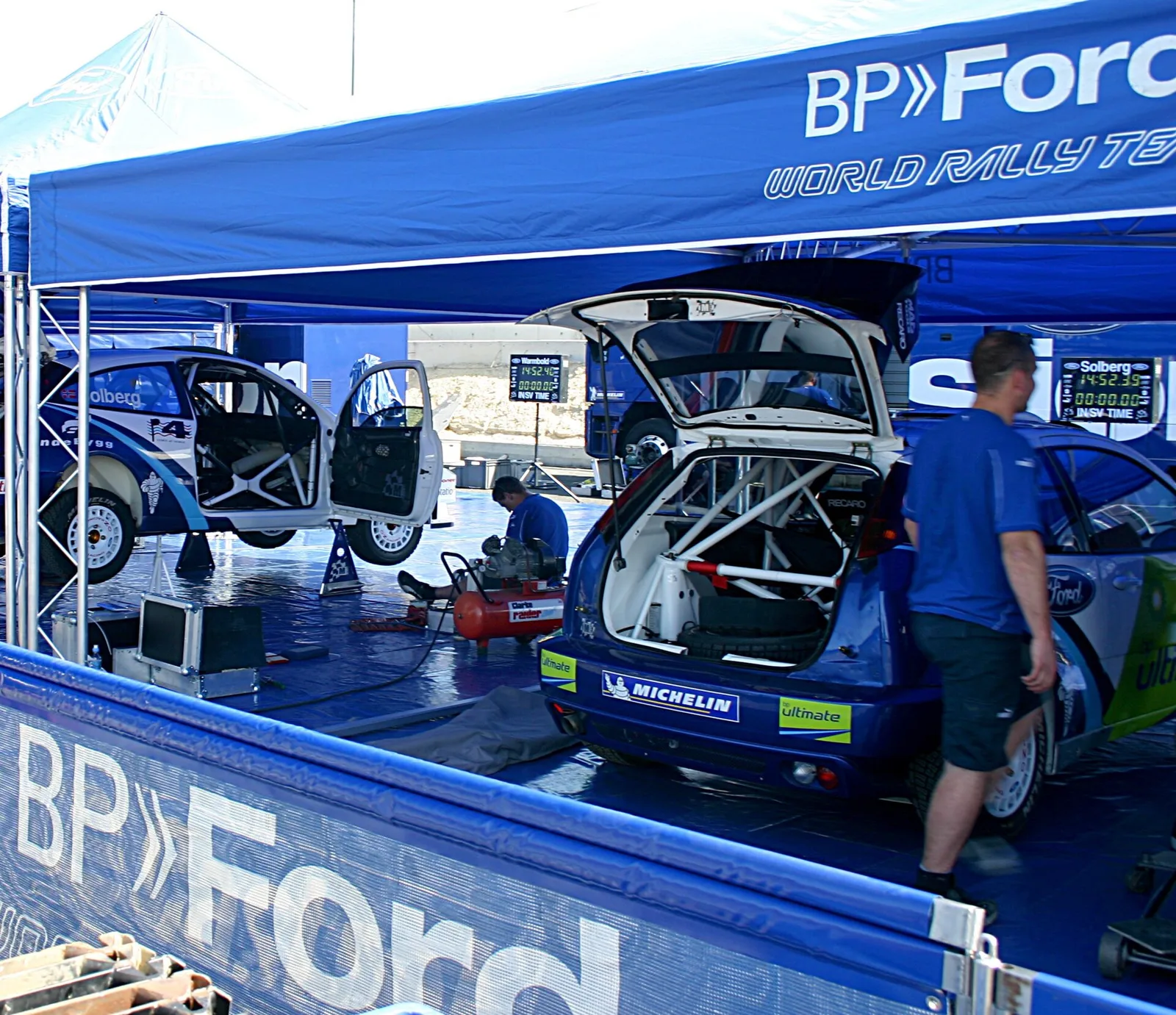
Ford Europe and M-Sport created the Focus RS WRC for the Ford World Rally Team, working from the Focus hatchback. RS stands for Rally Sport and WRC for World Rally Car. It competed from 1999 to 2010 and took 44 world rally wins and two manufacturers' titles, in 2006 and 2007, before the Fiesta RS WRC replaced it. In all it started 173 events and collected 142 podiums.
Under the bodywork it was nothing like the road car, sharing only the basic shape and parts of the shell. The road Focus drove its front wheels; the rally car sent power to all four through an active centre differential designed by M-Sport, a five-speed sequential gearbox with electro-hydraulic shifting, and a multi-disc carbon clutch. The engine rules explain a detail: the standard 2.5-litre unit of the Focus ST or road RS was not allowed, so the car used a heavily modified 2.0-litre Duratec. The 2009 car's engine, a 1998cc four-cylinder with 16 valves, an 85 mm bore and an 88 mm stroke, breathed through a turbocharger fitted with the required 34 mm inlet restrictor.
A decade of evolutions
The first Focus, built in 1999 to replace the Escort WRC, debuted at Monte Carlo with Colin McRae and Simon Jean-Joseph. It set many fastest stage times, but an illegal water pump got both cars excluded. McRae gave it its first win two events later at the Safari Rally Kenya, over 15 minutes clear of Didier Auriol's Toyota. Despite coming close often, the car never won a title in that period, and McRae lost the 2001 crown by 2 points after crashing out of the last round.
For the second half of 2003 Ford released a redesigned Focus RS WRC 03 with a lighter shell and a more aerodynamic front, and Markko Martin won two world rallies in it. The 2004 car, an evolution, won three, but by 2005 it was no longer competitive and Ford went winless. The Focus RS WRC 06, introduced at the last rally of 2005, used a Duratec engine developed by the French specialist Pipo Moteur. With Marcus Gronholm and Mikko Hirvonen it won eight rallies in 2006 and gave Ford its first manufacturers' title since 1979.
The 2007 car followed. Ford's technical director Christian Loriaux said its changes were mainly to save weight and improve efficiency, driveability and bottom-end performance. It won first and second at Rally Finland on its debut, and Ford defended the manufacturers' title. In 2008 Jari-Matti Latvala drove it to victory in Sweden and became the youngest world rally winner ever. The 2008 version took only one victory, at Rally Japan, and the 2009 version, which debuted with a one-two in Sardinia, was the last Focus-based WRC car.
The Toyota Yaris WRC
Toyota had left the championship at the end of 1999 to concentrate on Le Mans prototypes and Formula One, so the Yaris WRC was its first championship car since then. It was designed by Toyota Gazoo Racing WRT, and based on the XP130 Yaris, itself built on the Vitz. Its drivers were Sebastien Ogier, Elfyn Evans, Ott Tanak, Kalle Rovanpera and Takamoto Katsuta.
Testing and development started in March 2014, three years ahead of the 2017 debut, with four-time world champion Tommi Makinen overseeing development and operations. Makinen and Juho Hanninen drove the car in its first public appearance in May 2016, testing in Palokka-Puuppola.
The results arrived quickly under the 2017 rules. Toyota won the 2018 manufacturers' championship with a three-car team. Tanak and co-driver Martin Jarveoja took the 2019 drivers' and co-drivers' titles, Ogier and Julien Ingrassia won them in 2020, and in 2021 the team completed a sweep of manufacturers', drivers' and co-drivers' crowns.
What replaced the World Rally Car
The World Rally Car era ended with the 2021 season, when Group Rally1 took over. Toyota had pencilled in a GR Yaris WRC, derived from the 2020 GR Yaris road car, for 2021 but opted to stay with the existing rally car, and the Yaris WRC's true successor, the GR Yaris Rally1, did not race until 2022.