A 65 cm steam toy for a Chinese emperor, a petrol handcart in Vienna and a three-wheeler in Mannheim: each has a claim, and each wins a different test.
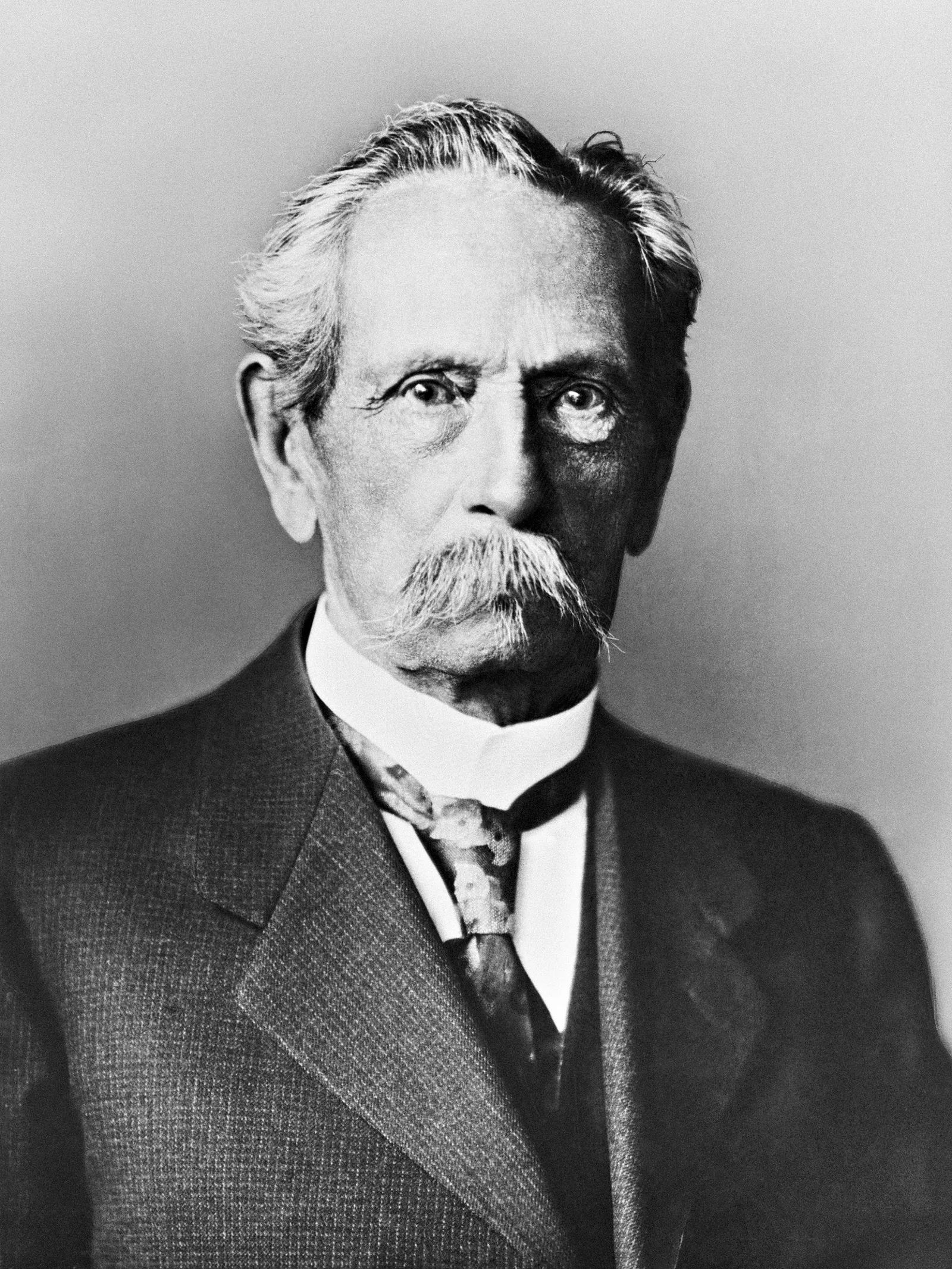
Carl Benz is usually credited with inventing the car: his Patent-Motorwagen was patented on 29 January 1886 and sold from 1887 and 1888. Ferdinand Verbiest built a steam model around 1672, and Siegfried Marcus ran a petrol handcart in 1870, but neither produced a practical, marketable car.
One contender for the first self-propelled vehicle is a toy built for a Chinese emperor around 1672, only 65 cm (25.6 in) long. Its designer was a Flemish Jesuit astronomer named Ferdinand Verbiest, and the thing could not carry a driver, a passenger or a single parcel.
Ask who invented the car and the answer shifts with the question you put. If the test is self-propulsion, Verbiest has a claim. If it is the first petrol-driven vehicle, Siegfried Marcus does, with a handcart in 1870. If it is a practical machine that was patented, driven in public and then sold, the name is Carl Benz.
Who invented the car: three tests, three answers
No single machine passes every test, and the dates make the problem plain. A steam model from the 1670s, a petrol handcart from 1870 and a patented three-wheeler from 1886 are all called the first car by somebody. The disagreement is mostly about the word "car", and each camp defines it differently.
Benz holds the strongest position on the broadest definition. The Benz Patent-Motorwagen is regarded by many as the first practical car, and the first modern car, meaning a practical, marketable machine for everyday use, is dated to 1886, when Benz built petrol-powered cars and made several identical copies. Hence the mainstream answer: Benz, with the caveat that earlier men got parts of the idea first.
On each test of what a car is, a different name wins, and only Benz passes the tests that matter for the car as people used it.
Ferdinand Verbiest's steam car: the toy for the Kangxi Emperor
Verbiest is better known as an astronomer than an engineer. He arrived in China as a Jesuit missionary, and in 1669 the Kangxi Emperor set a public test between European and Chinese astronomy. Verbiest passed all three parts, predicting the length of a shadow, the positions of the Sun and planets, and the time of a lunar eclipse, and was put in charge of both the Mathematical Board and the observatory.
The vehicle came from the same busy mind. Around 1672 he designed a steam-propelled trolley as a toy for the emperor, which is perhaps the earliest working steam vehicle. He described it in a manuscript called Astronomia Europea, finished in 1681 and printed in 1687 in Germany after a friar carried it to Europe. In that work he first used the Latin word motor in its present meaning.
How a steam toy ran without a steam engine
Steam engines were not yet known in the 1670s, so Verbiest borrowed a different principle: the impulse turbine. A ball-shaped boiler made the steam, which escaped through a pipe at the top and blew against a simple open turbine, rather like a water wheel. The turbine drove the rear wheels. Think of a garden pinwheel spun by a kettle's jet of steam, and you have the right picture.
On one filling of coal, Verbiest wrote, the vehicle could keep moving for more than an hour. At 65 cm (25.6 in) it was effectively a scale model rather than a car, and it was never designed to hold people.
Was it ever built?
Here the claim gets shaky. Nothing else on record verifies that his model was built in his lifetime, and no authentic drawing exists, although he had access to the finest metalworkers in China, who were busy making his astronomical instruments. In 2021 students at Ingolstadt's Technische Hochschule tested the idea by building a model from his written description, using only design options feasible at the time apart from a pressure valve added for safety. Heated with coal, it travelled several metres, showing the concept works. A model of the vehicle is displayed at the Autoworld Museum in Brussels.
One famous replica is a trap. The Italian maker Brumm produced a 1:43 scale model in 2002, 9 cm (3.54 in) long, which scaled up would suggest a vehicle nearly 4 metres (13 ft 1 in) in length. Comparison with the research of Horst Hardenberg shows it copies something else: a three-wheeled steam turbine car from the late 18th century (presumably 1775), made by a German mechanic who had been inspired by Verbiest. That original was probably lost when the Technische Hochschule in Karlsruhe was bombed during World War II.
Siegfried Marcus and the first petrol car
Marcus is the claimant with the most turbulent history, and the dates behind his cars are still contested. Born on 18 September 1831 in Malchin, he began work at 12 as an apprentice mechanic, joined Siemens and Halske at 17 and moved to Vienna in 1852. By 1860 he had his own workshop making mechanical and electrical equipment. He held 131 patents in 16 countries, among them ignition devices and a telegraph relay system.
His first vehicle, built in 1870, was a simple handcart with an engine designed for liquid fuels. To start it, the operator lifted the drive wheels off the ground and spun them. It made Marcus the first to propel a vehicle by petrol, though it has been called a cart rather than a car. He was not satisfied with it and took it apart. A model of the vehicle was displayed at the Vienna Exhibition of 1873.
The 1875 car that was not
For decades his second car was dated to 1875. Even The Times repeated that in 1950, describing a first journey of 7.5 miles from Vienna to Klosterneuburg and calling it the first petrol-powered road vehicle. Research in 1968 and 1971 disproved the date: the car was built in 1888 or 1889, which is after the Benz three-wheeler was already patented.
The 1875 date had been published by Ludwig Czischek-Christen for Austria's displays at the 1900 Paris Exposition. When patent lawyers asked him for evidence, his own investigation turned up decisive proof that the car dated from 1888. The Encyclopaedia Britannica still cites 1864 for the first Marcus car, with a ten-year gap to the second, but some authorities call this the Marcus myth and say early writers confused the 1888/89 car with the 1870 handcart.
The surviving car has been in the Vienna Technical Museum since 1918 and has been driven just two times, one of them on a trip to a display in Sweden. It is not known whether Marcus ever used it at all, and he never developed it. In 1938 John Nixon of The London Times drew a line between the two men: Marcus experimented, while Benz took the concept to production. Nixon called the Marcus cars impractical, and his vehicles had no influence on how cars developed.
Magneto, torpedo boats and an erased name
His lasting credit lies in the ignition. In 1883 Marcus received a German patent for a low-voltage magneto ignition, his only automotive patent, and the same system paired with a rotating brush carburettor made his engine design innovative. Torpedo boats of the German Navy were using that engine by 1886. In 1887 he began working with the Moravian company Marky, Bromovsky and Schulz, which offered two-stroke engines and, once the Otto patent fell in 1886, four-stroke versions built to Marcus's design. A 1904 book called The Motor stated that Marcus was widely credited with inventing the benzine motor.
Marcus was of Jewish descent, and under the Nazis his name and memorabilia vanished, particularly in Austria. In 1937 the Austrian Harand Movement, which campaigned against racial hatred, issued stamps of prominent Jews, Marcus among them, crediting him with the petrol-driven car. When Germany occupied Austria in March 1938, the memorial outside the Vienna Technical University came down. On 4 July 1940 the Reich Ministry of Public Enlightenment and Propaganda told Daimler-Benz that the encyclopedias Meyers Konversations Lexikon and Brockhaus would name Daimler and Benz, not Marcus, as the creators of the modern automobile. After the war the monument was rebuilt and his hidden car went back on display.
The Benz Patent-Motorwagen: the first car in practice
Benz started work in 1884, and in spring 1885 the prototype moved by its own engine for the first time. At first it ran only a short distance in the factory grounds. Its range grew through 1885, and in the closing months Benz drove it on quiet roads and after dark. Before the year ended he felt sure enough to prepare a patent application, helped by progress in litigation that challenged Nicolaus Otto's four-stroke patent.
He filed on 29 January 1886, and the patent, number DRP37435, was granted on 2 November 1886. The machine ran on three wheels, with a one-cylinder four-stroke engine that drove through belts. A flywheel steadied the engine's output: horizontal and with a single belt in the first vehicles, vertical with two belts in later ones.
Why Nr. 2 counts as the first practical car
The original, called Nr. 1, was a motorised velocipede developed between 1884 and early 1886. It was rebuilt as Nr. 2, a motorised Stanhope gig, and the evidence points to this second version as the first practical car. It had two gears and better brakes, its controls could all be reached by the driver, and it was less top-heavy, with stronger wooden wheels shod with iron tyres. A newspaper report of 3 July 1886 is recorded by Mercedes-Benz as his first public outing, with the company director Max Rose beside him. Worby Beaumont's 1900 book gave it a top speed of 10 miles an hour.
The naming of the early cars varies. Mercedes-Benz's own records use Nr. 1 and Model 1 interchangeably for the velocipede and the 1895 rebuild, dating each to 1885 to 1886, and calls all the other three-wheelers Model 3, dated 1886 to 1894.
From first sale to Bertha Benz
Benz made his first sale in 1887 to Emile Roger, a bicycle maker who became his French agent. The sale seems to have been semi-private, so Mercedes-Benz dates public sale, and therefore production, as starting in 1888. His memoir captioned a photograph of the Model 2 as his first production car, quoting 1.5 hp, two speeds up to about 16 km/h and a price of 3,000 marks. In September 1888 he showed a vehicle in Munich, where a newspaper pictured him at the wheel with his wife Bertha.
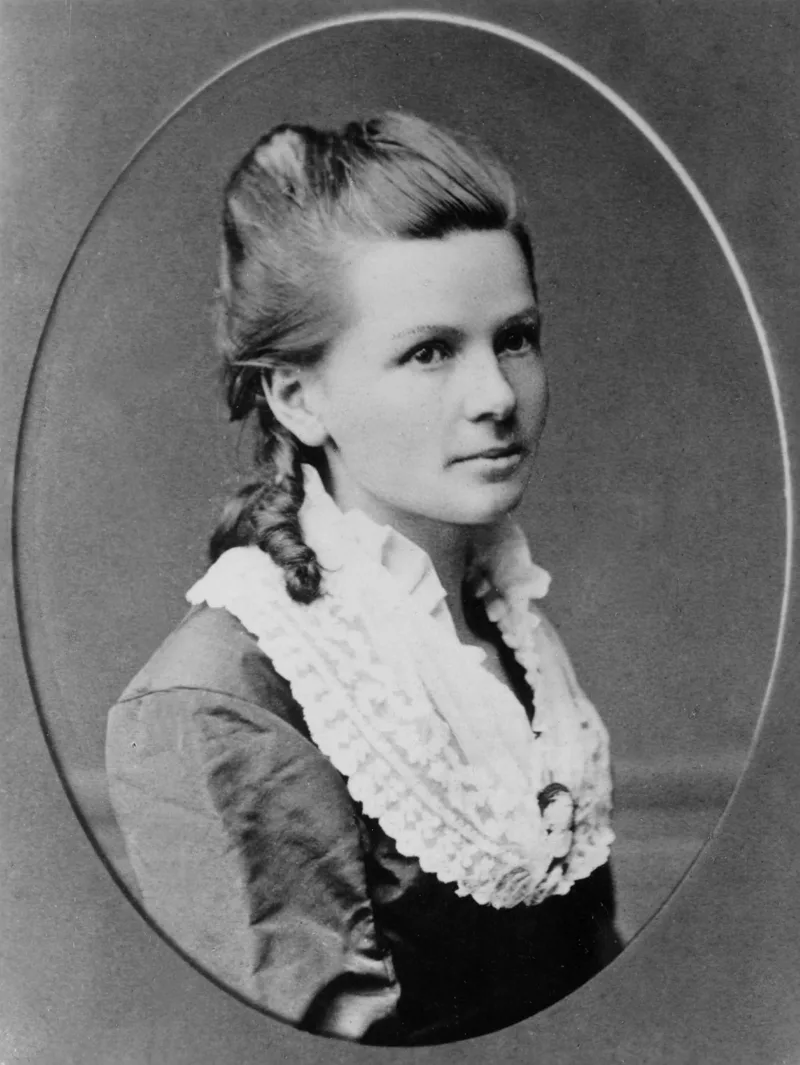
Bertha had already made the trip that proved the idea. In August 1888 she drove from Mannheim to Pforzheim and back, the first long-distance journey by motor car. A Bertha Benz Memorial Route has commemorated it since 2008. Her journey also exposed a weakness on hills, which led to a larger engine and a second set of belts instead of the reduction gearbox, along with the switch to a vertical flywheel in the Model 3. The two-belt Model 3 is unlikely to have been produced before 1890.
Management changed too. Directors Max Rose and Friedrich Esslinger gave way in 1890 to Friedrich von Fischer and Julius Gauss, which left Benz more time and money to develop his vehicle and brought in a professional sales operation. Production of the three-wheeler stopped after Benz perfected two-wheel steering and began four-wheel models in late 1892. The later cars carry names such as Viktoria and Velo.
Around 1895 the sales manager at Benz had the surviving parts of Nr. 1 sought out to recreate its first form. The rebuild is not an accurate copy, but it went to the Deutsches Museum in Munich in 1906, headed a procession of historic vehicles in 1925 with Benz at the controls, and remains in the museum.
First car claims compared
| Claimant | Date | Power | What was built | Standing of the claim |
|---|---|---|---|---|
| Ferdinand Verbiest | Around 1672 | Steam, impulse turbine | A model 65 cm (25.6 in) long, a toy for the Kangxi Emperor | Possibly the first working steam-powered vehicle; no authentic drawing, build not verified elsewhere |
| Nicolas-Joseph Cugnot | 1769 to 1771 | Steam | An experimental artillery tractor | Design proved impractical and was not developed in France |
| Siegfried Marcus | 1870 | Petrol | A handcart, started by spinning the drive wheels | First vehicle propelled by petrol; dismantled by Marcus |
| Siegfried Marcus | 1888/89 | Petrol | A second car, now in Vienna | Not known whether he used it; no influence on later cars |
| Carl Benz | 1885 to 1886 | Petrol, single-cylinder four-stroke | Patent-Motorwagen Nr. 1 and Nr. 2, three wheels, belt drive | Patent filed 29 January 1886; Nr. 2 is the first practical car |
| Carl Benz | 1887 to 1888 | Petrol, single-cylinder four-stroke | Model 2, 1.5 hp, 3,000 marks | First sale in 1887; public sale from 1888 |
Steam, electric and gas: the other first car claims
Benz and Marcus were not working in a vacuum. A clockwork carriage came from Hans Hautsch of Nuremberg in 1649. Steam carried the early running: Nicolas-Joseph Cugnot built what is described as the first steam automobile able to carry people in 1769, and demonstrated an artillery tractor in 1770 and 1771, though it proved impractical and was not developed in France. William Murdoch had a working model steam carriage in Redruth by 1784, and Richard Trevithick ran a full-sized vehicle on the roads of Camborne in 1801.
Steam road vehicles in Britain then met a legal obstacle. The Locomotives Act 1865 required a man with a red flag to walk ahead of any mechanically powered vehicle on a public road, and the rule was repealed in 1896 for anything under 3 tons, after lobbying by motorists who had watched light motor cars develop in France and Germany.
Early engines also ran on gas. Francois Isaac de Rivaz built a hydrogen and oxygen engine in 1806, and in 1826 Samuel Brown tested a hydrogen-fuelled engine by driving a vehicle up Shooter's Hill. Etienne Lenoir's one-cylinder hydrogen-gas car covered some 9 km (5.6 mi) from Paris to Joinville-le-Pont in 1860, in about three hours.
Electric candidates came early as well. Anyos Jedlik built a tiny motor-powered model car in 1828, Thomas Davenport followed in 1834, and in 1835 Sibrandus Stratingh and Christopher Becker made a small-scale electric car. Gustave Trouve demonstrated a working three-wheeled electric car in November 1881, Thomas Parker built one in London in 1884, and some regard the Flocken Elektrowagen of 1888 as the first actual electric car.
In the United States, J.W. Carhart built a steam vehicle in Racine, Wisconsin, in 1871, which led the state to offer a US$10,000 prize in 1875. In the race that followed, on 16 July 1878, only two of seven registered vehicles started, and the Oshkosh entry took 33 hours and 27 minutes to cover the 323 km (201 mi) route, averaging 9.7 km/h (6 mph). George B. Selden filed a patent covering an engine and a four-wheeled car on 8 May 1879.
From Benz to mass production
The word "invention" gets blurrier once the cars multiply. In Stuttgart in 1889 Gottlieb Daimler and Wilhelm Maybach designed a vehicle from scratch as an automobile, rather than as a horse-drawn carriage with an engine fitted. They formed Daimler Motoren Gesellschaft in 1890, and in 1926 it merged with Benz and Cie to form Daimler-Benz.
Britain's first four-wheeled petrol car was built by Frederick Bremer in Walthamstow in 1892, and Frederick William Lanchester made another in Birmingham in 1895, the man who also patented the disc brake. Ransom E. Olds launched Oldsmobile in 1897 and followed with the Curved Dash model in 1901. His factory pioneered an assembly line built on identical, interchangeable parts, and thousands of cars had left it by 1903. Production likely peaked from 1903 to 1905 at up to 5,000 a year, and although estimates vary, about 19,000 Oldsmobiles were built, the last in 1907.
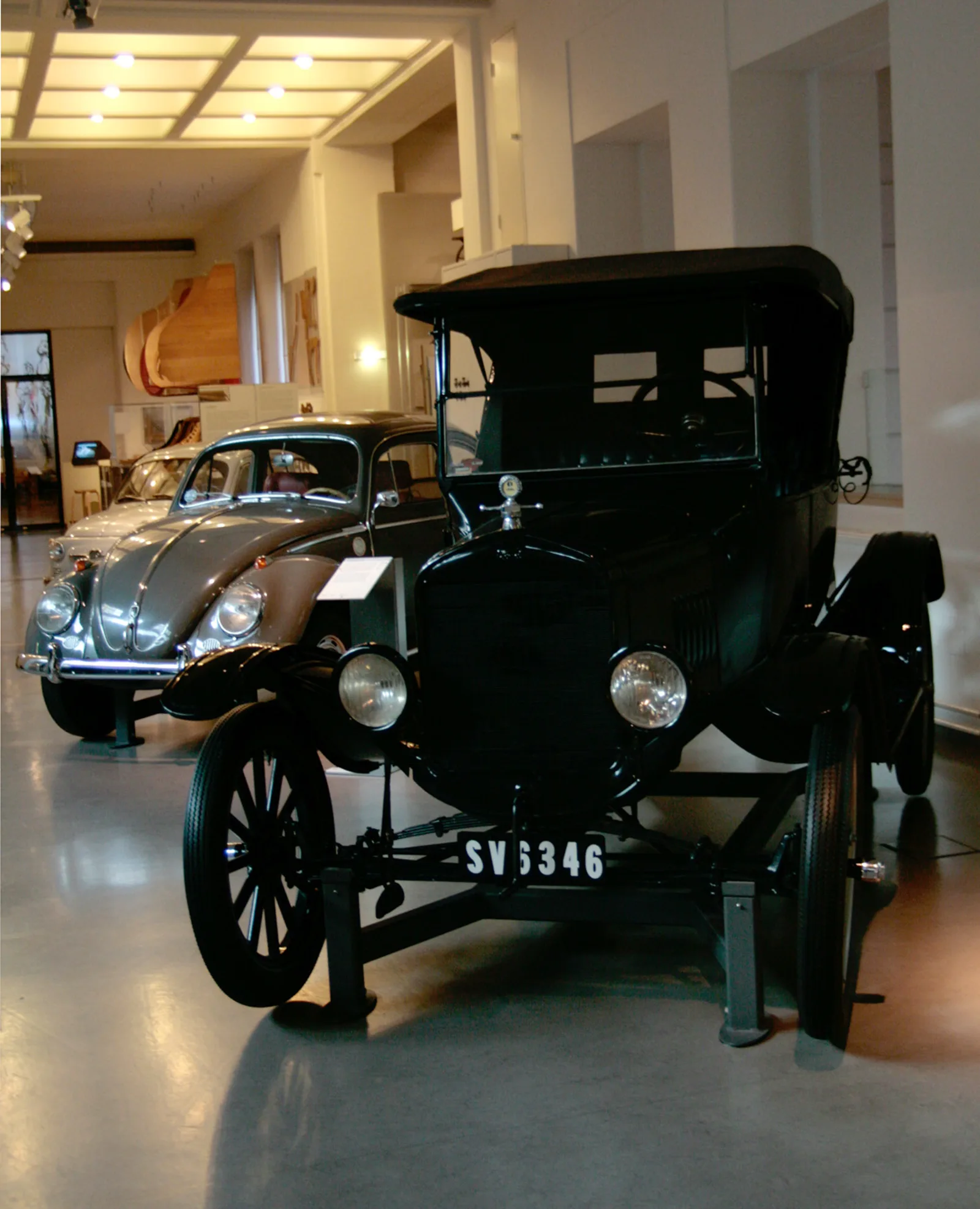
The breakthrough in volume came with Ford. The Model T arrived in 1908 at a relatively modest price, and from 1913 a moving assembly line let Ford cut the Model T's price by almost 50%, and the car became the first to be affordable on a mass scale.