Wheel-speed sensors, a control unit and hydraulic valves release and reapply brake pressure many times a second, keeping the tyres rolling so you can still steer.
ABS is an anti-lock braking system that stops a car's wheels locking under braking. Sensors measure each wheel's speed, and a control unit uses hydraulic valves to release and reapply brake pressure, sometimes 15 times per second, so the tyres keep rolling and the driver can still steer.
Brake pressure can be released and reapplied as often as 15 times a second by some anti-lock systems, far faster than any driver's foot. Skilled drivers once did this by hand, pumping the pedal at the edge of grip.
What is ABS?
ABS, the anti-lock braking system, is a safety anti-skid system used on aircraft and on cars, motorcycles, trucks and buses. It prevents the wheels from locking during braking, which keeps the tyres in rolling contact with the road and lets the driver keep more control of the vehicle.
It automates two old driving techniques, threshold braking and cadence braking, which skilful drivers practised before ABS became common. The system works much faster and more consistently than most people could. It has become standard in almost every car.
ABS does by valve what skilful drivers once did by foot: release the brake just before the wheel locks, and reapply it just after.
Why do wheels lock in the first place?
A brake's peak force is often greater than the grip the tyre can offer. When too much hydraulic pressure drives the wheel torque past the available friction between tyre and road, the wheel locks and the tyre skids. Without ABS, the braking effort itself can break the tyre loose.
Speed makes the demand larger. Kinetic energy grows with the square of velocity, so an object moving at 10 m/s carries 100 times the energy of the same mass at 1 m/s, and the theoretical braking distance at the limit of traction is up to 100 times as long. Friction brakes turn that energy into heat.
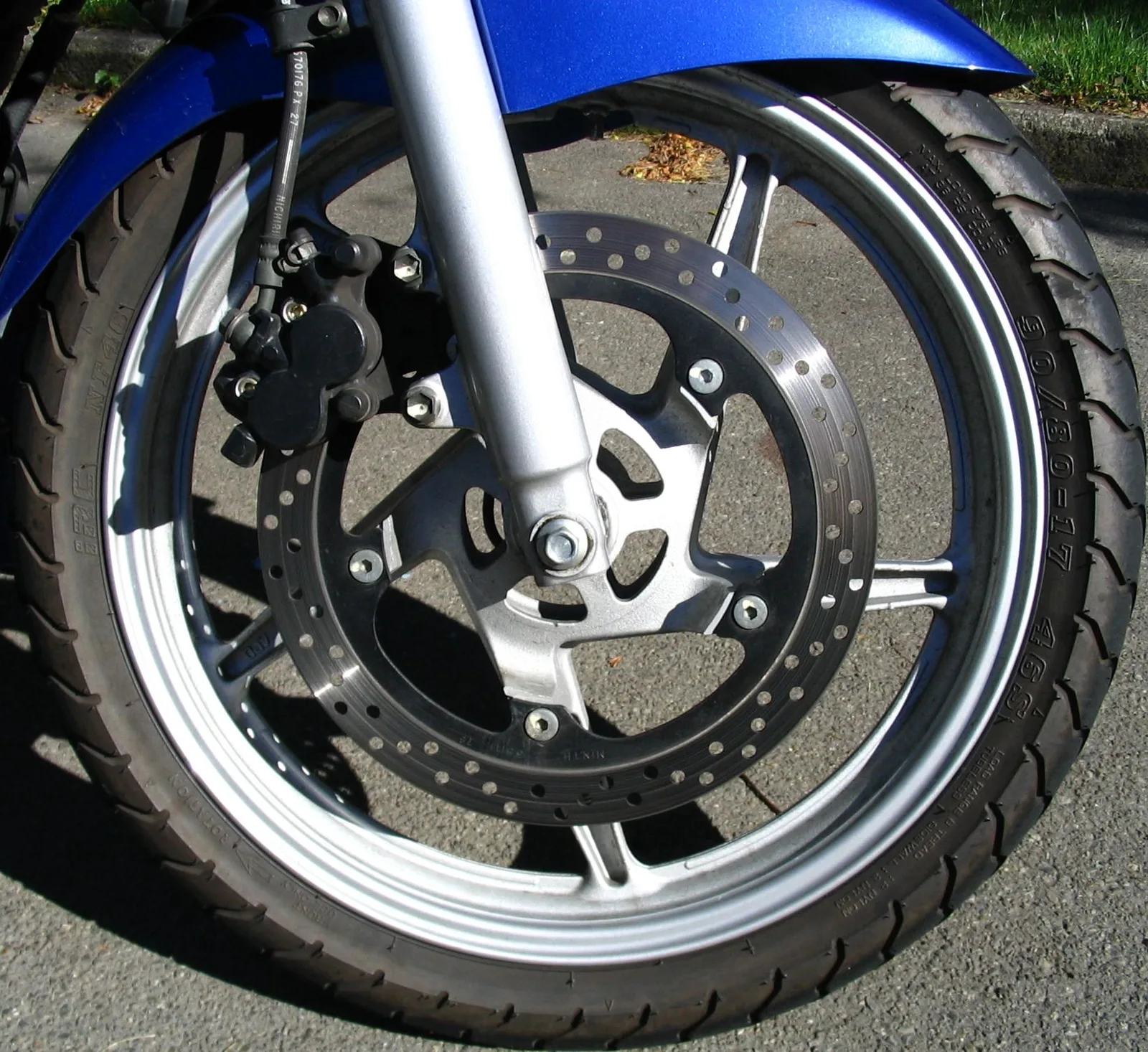
On a modern car with hydraulic brakes, the pedal pushes against the master cylinder, and ultimately a piston presses the pad against the disc. In a drum design, a cylinder pushes the shoes against the drum. Either way, the force delivered is controlled by pressure in the line, and ABS works by managing that pressure wheel by wheel.
How do wheel-speed sensors and a pulsing hydraulic valve stop wheels locking?
A control unit watches the rotational speed of each wheel. When one turns significantly slower than the vehicle is moving, which signals that it is about to lock, the unit commands valves to cut hydraulic pressure at that brake, and the wheel spins up again. If a wheel turns much faster than the others, pressure is restored and the wheel slows.
A typical set-up has one central electronic control unit, a speed sensor at each of four wheels, and a minimum of two hydraulic valves in the brake circuit. The cycle repeats continuously, and a driver can feel it as pulsation through the brake pedal. Because of the speed of the cycle, the wheels of an ABS car are practically impossible to lock, even in panic braking.
There is one subtlety. In a corner, the two wheels nearer the middle of the bend turn more slowly than the outer pair. The control unit is programmed to disregard speed differences below a critical threshold, so an ordinary turn does not trigger it. The same logic is why virtually all road vehicles use a differential.
Modern ABS sets pressure for each of the four wheels separately, using sensors on the hubs and a dedicated micro-controller. The controller itself is sometimes called the CAB, short for Controller Anti-lock Brake.
What are the main components of an ABS?
Four parts make up the system: the wheel speed sensors, the valves, a pump and a controller. The sensors report each wheel's speed, the controller decides what to do, the valves adjust the pressure at each brake, and the pump restores pressure after the valves have released some. Each plays a distinct part in the cycle.
The sensors work by magnetism. One design uses a magnet and a Hall-effect sensor, and another uses a variable reluctance sensor with an electromagnetic coil. Either way, the rotation of the wheel or differential disturbs a magnetic field around the sensor, and the fluctuations generate a voltage. That reliance on rotation means a sensor can become inaccurate at slow speeds.
On some systems the valve in each brake line has three positions. In position one it is open, so pressure from the master cylinder passes straight to the brake. In position two it blocks the line, isolating that brake so the pressure cannot rise further even if the driver pushes harder on the pedal. In position three it releases some pressure from the brake.
How should you brake in an ABS car?
Let the system do the modulating. Skilful drivers once pumped the brakes or held them at the threshold by feel, and ABS does both faster and more effectively. Because some valves hold the pressure in the line however hard you push, the system is not asking you to ease off.
Expect the pedal to pulse, as the control unit releases and reapplies pressure, and do not mistake it for a fault. ABS generally shortens stopping on dry roads and some slippery ones. On loose gravel or snow, though, braking distance may grow significantly, even as steering control still improves.
What does the ABS warning light mean?
Should any part of the system develop a fault, a warning light will usually come on in the instrument panel, and the ABS stays disabled until the fault is rectified. The brakes themselves still work, but without the anti-lock function, and it is the anti-lock function that the light is reporting on.
Mechanically, the most common trouble is in the valves. The majority of problems in the valve system come from clogging, and a clogged valve cannot open, close or change position. A sensor that reads inaccurately at slow speed is another place where readings can go astray.
What is the difference between three-channel and four-channel ABS?
A four-channel system gives each of the four wheels its own brake line, so it can apply a different pressure at each one. A three-channel system has a sensor on every wheel but controls the two rear brakes as a single unit. The difference shows up when grip varies from side to side.
Take an emergency stop with the left wheels on asphalt and the right wheels on ice. A wheel on ice locks at lower pressure, so the ABS senses the right-hand wheels are close to locking and cuts force at the right front. A four-channel system also eases off the right rear. A three-channel system would reduce force on both rear wheels. Both help avoid lock-up and loss of control.
How does electronic brakeforce distribution work with ABS?
Electronic brakeforce distribution, or EBD, varies the force applied at each wheel based on road conditions, speed and load. It is always coupled with ABS. It aims to maximise stopping power while keeping the vehicle controllable, and it does so by giving each wheel more or less pressure as needed.
Typically the front end carries more weight under braking, so EBD gives less pressure to the rear brakes to stop them locking and causing a skid. In some systems, EBD gives more pressure to the rear brakes during the first moment of braking, before the weight has shifted forward.
EBD is described as a subsystem of ABS that controls how well the rear wheels use the grip available. It takes load off the hydraulic proportioning valve, and it is tuned for grip use, stability, wear, heat stress and pedal effort. It also works with ESC, where ABS prevents lock-up and EBD applies suitable brake force to help stability control work smoothly.
How do ABS, EBD, traction control and ESC compare?
| System | Job | Relationship to ABS |
|---|---|---|
| ABS | Prevents wheels locking under braking | The base system |
| EBD | Varies braking force at each wheel with road, speed and load | Always coupled with ABS; a subsystem of it |
| Traction control | Restores grip when a tyre spins under acceleration | Can be implemented with ABS equipment |
| ESC | Brakes individual wheels, up to three, to steer the car where the driver intends | An evolution of ABS with a steering angle sensor and a gyroscopic sensor added |
How did ABS develop?
The concept predates the modern systems. In 1908, J.E. Francis brought out a regulator to prevent slip on rail vehicles. In 1920, the French pioneer Gabriel Voisin experimented with modulating hydraulic pressure on aircraft brakes, using a flywheel and valve. Testing showed a 30% improvement in braking performance, because pilots could apply full brakes at once instead of creeping up to the skid point.
The German engineer Karl Wassel patented a system for modulating braking power in 1928, but never built a working product, and Robert Bosch produced a similar patent eight years later. Aviation got there first in practice. Dunlop's Maxaret anti-skid system was in common aviation use across the UK by the early 1950s, cutting stopping distances by as much as 30% in icy or wet weather and extending tyre life.
A 1958 test of the Maxaret on a Royal Enfield Super Meteor motorcycle improved stopping distances in most runs, by as much as 30% on slippery surfaces, yet Enfield's technical director saw little future in it and it never reached production. A fully mechanical design saw brief car use in the 1960s, on the Ferguson P99 racer, the Jensen FF and an experimental Ford Zodiac, and was dropped as costly and unreliable.
The first fully electronic ABS came in the late 1960s for the Concorde. The modern system followed in 1971, invented by Mario Palazzetti, known as "Mister ABS", at the Fiat Research Center. Called Antiskid, its patent was sold to Bosch, which named it ABS.
Cars arrived quickly. Chrysler and the Bendix Corporation introduced a computerised, three-channel, four-sensor, all-wheel system called Sure Brake on the 1971 Imperial, the first production car with four-wheel computer-operated ABS. Ford's Sure-Track rear-wheel system went on the Lincoln Continental Mark III and Thunderbird in 1969 as an option, and General Motors offered Trackmaster on its rear-drive Cadillacs from 1971. Nissan's Denso-developed EAL, on the President, was Japan's first electronic ABS.
Mercedes-Benz offered a Bosch four-wheel multi-channel system on the W116 from 1978, and ABS has been standard on all its cars since 1984. In Norway the Honda Prelude, whose importer specified ABS as standard, became the first car delivered in Europe so equipped. Ford then put a Teves electronic system on every 1985 Scorpio, and the model won European Car of the Year for 1986. Lincoln followed Mercedes in 1993.
Where this goes next
The wheel speed sensors are sometimes put to indirect use in tyre pressure monitoring, which spots under-inflation from differences in wheel rotation speed. ESC is rapidly increasing in popularity because the price of vehicle electronics has fallen so far.