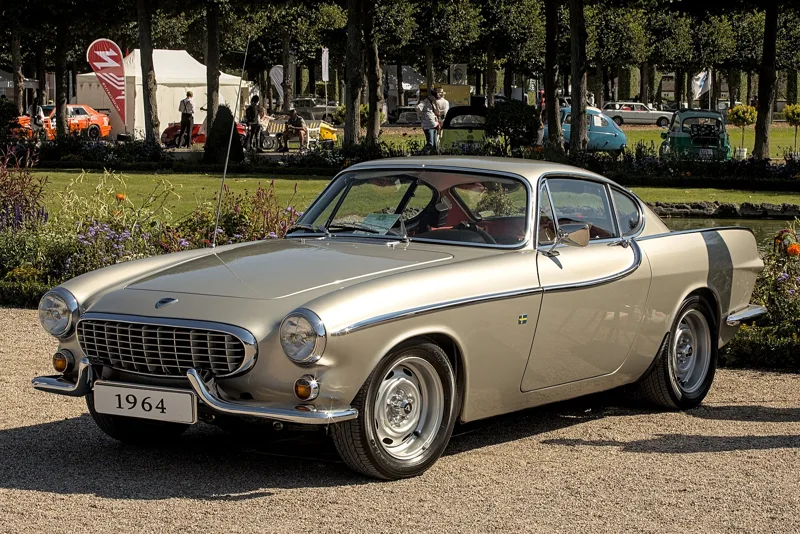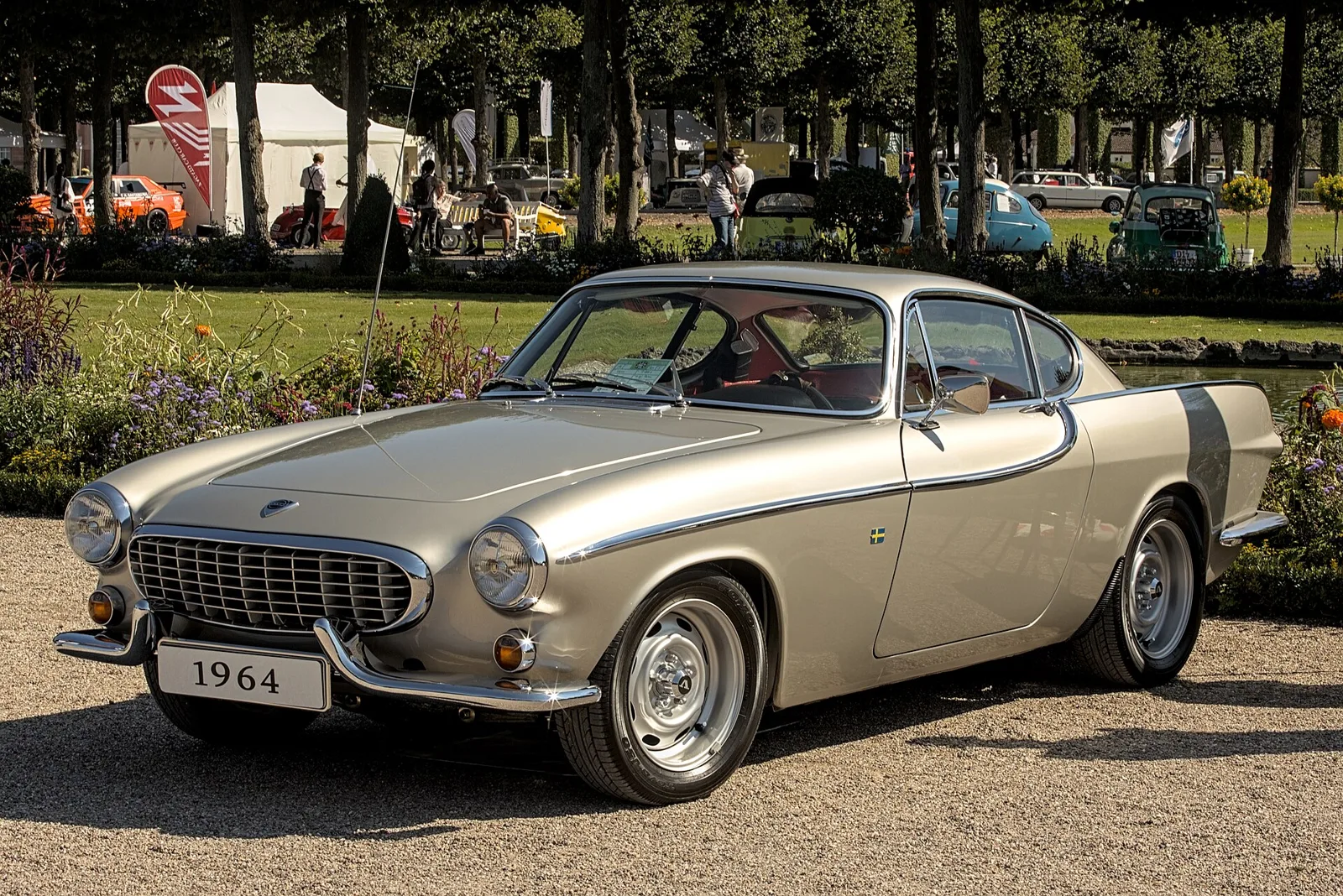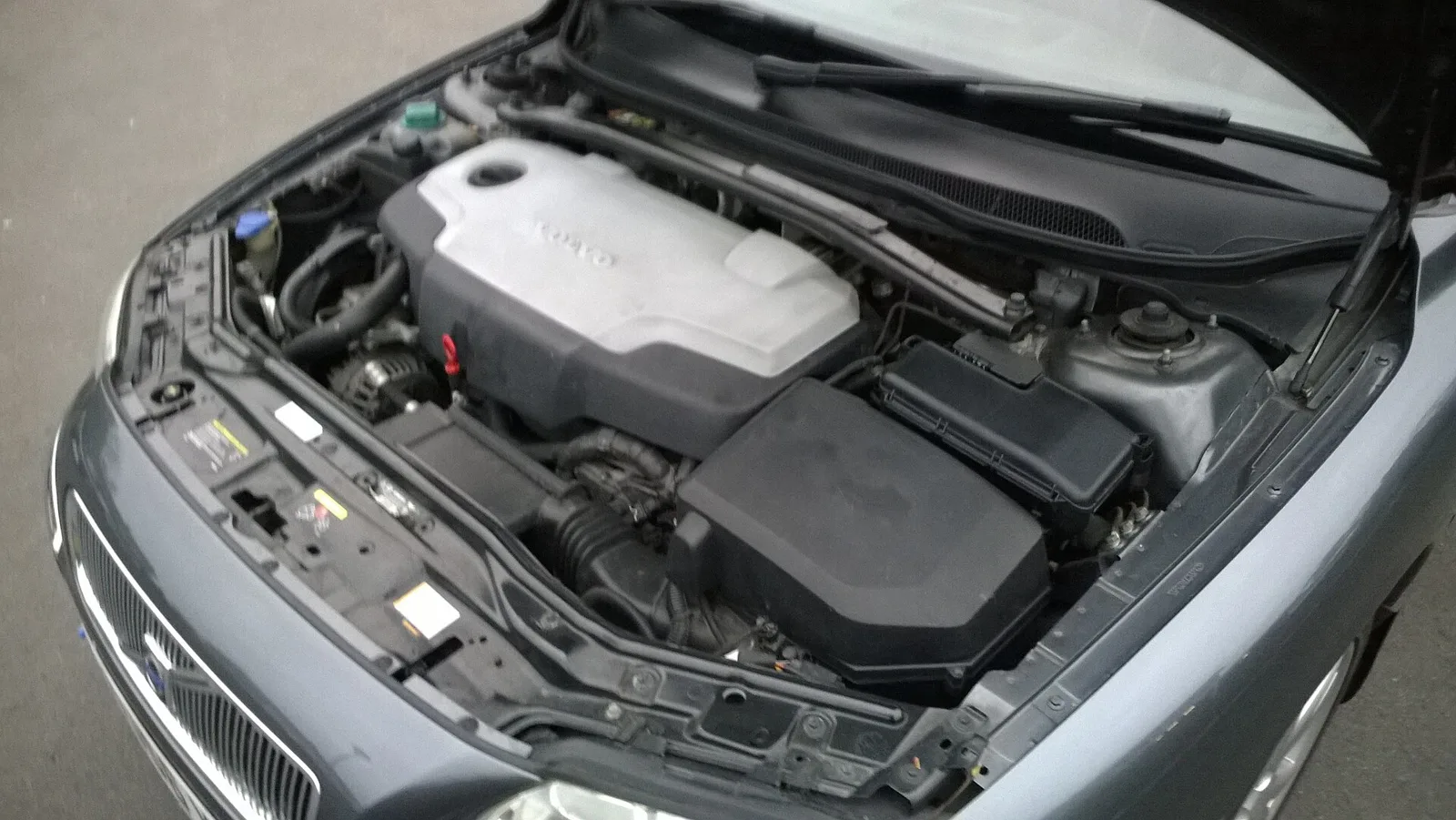
One engine ran for 4,890,993 km in a 1966 P1800S. The other put a turbo, common rail injection and 20 valves into Volvo's passenger cars.
The B18 is a 1.8 litre pushrod petrol four that Volvo built from 1961 to 1968 and that was bored out to the 2.0 litre B20 in 1969. The D5 is a 2.4 litre five-cylinder turbodiesel with 20 valves, introduced in 2001 and built until 2017.
A Volvo P1800S built in 1966 has covered more than 4,890,993 km on the engine it left the factory with, which makes it the highest-mileage car on record. The engine was a B18, a 1.8 litre four-cylinder that Volvo made from 1961 to 1968. Four decades after the B18 appeared came the D5, a turbocharged five-cylinder diesel that first reached the market in 2001. Between them the two engines show how far car engineering moved in that time, and what stayed constant: Volvo's habit of stretching one good design across many models.
Volvo B18 engine: a pushrod four built to last
The B18 is an inline four with overhead valves. In a pushrod engine the camshaft sits low in the block, and long rods carry its motion up to rocker arms that open the valves. It is a simple layout and tends to be seen as a brake on high revs, yet the B18 can turn 6,500 rpm. It also has a reputation for being very durable.
Each cylinder has two valves, and the crankshaft is held by five main bearings, which is two more than in the earlier B16. Bore is 84.14 mm and stroke 80 mm, giving 1,778 cc. The cylinders are not evenly spaced: the centres run 105 mm and 108 mm apart (4.13 and 4.25 in), with the wider gap between the middle pair.
A pushrod four from 1961 outlived most of the cars around it, and a 2001 diesel was gone by 2017.
Where the B18 was used
The list is long and surprising. Among cars it served in the PV544, the P210 Duett, the 120 (the Amazon), the P1800 and the 140 series. The L3314 and the Bandvagn 202, both military vehicles, used it too. Volvo Penta fitted it to a range of sterndrive marine units, and outside Volvo it found homes in the Facel Vega Facel III and the Marcos 1800 GT.
The family has four members. The B18A has one carburettor. The B18B has two, sidedraft SU or Zenith/Stromberg types, with raised compression. The B18C goes back to a single carburettor, lowers the compression and adds a mechanical rpm regulator, which suited it to the petrol versions of the BM 320 tractor and to driving the elevator of the PS-15 radar. The B18D has two carburettors and lower compression.
A racing head and a misleading family tree
In 1971 the Swedish engineer Gunnar Axelsson created a head with two overhead camshafts for the B18 family, and competition Volvos ran it for several years. At the start of 2014 the firm Grainger and Worrall said it had teamed up with Axelsson to make it again. It expected the base engine to give 190 bhp and a high-output version 225 bhp.
A V8 muddies the story. Volvo showed the Philip concept in 1952 with a 3.6 litre V8 that came to be called the B36. Its bore and stroke matched the B18 exactly, so some people say the four is simply half the V8. The cylinder heads argue otherwise. The V8 has crossflow heads, where gas enters one side and leaves the other, while the four has a reverse-flow head, so for the most part they are separate designs.
Volvo B20 and B30: more cylinders and more bore
The B20 is a B18 with a wider bore, 88.9 mm, which brought displacement to 1,986 cc when it appeared in 1969. Because the design is nearly unchanged, most parts swap between the two, apart from running changes. The B20 went into the 120, 1800, 140, C202 and 240, into the Bofors Haubits FH77 howitzer and into a modified form for the one-off 1969 Volvo GTZ concept. Production lasted until 1981.
It came in five forms. The B20A (one carburettor) and B20B (two carburettors, higher compression) both started in 1969, and the B20D, with two carburettors and lower compression, followed in 1971. Fuel injection arrived with the B20E in 1970, a high-compression engine, and the B20F in 1972, a low-compression one built to reduce emissions. Both injected engines had bigger valves and ports. In 1974 and 1975 they moved from electronic D-Jetronic to mechanical K-Jetronic injection. In 1974 the flywheel gained two bolts, six becoming eight, and the connecting rods were enlarged. The B20A returned for the C202 from 1977 to 1981.
The B30 is the same engine with two further cylinders. This 3.0 litre six was introduced for the 1969 model year to power the newly launched Volvo 164.
Volvo D5 engine: a five-cylinder turbodiesel
The D5 was developed by Volvo Cars for its own passenger cars, using the Volvo Modular diesel engine as a base. It displaces 2.4 litres and is a five-cylinder unit built entirely of aluminium, with 20 valves and two overhead camshafts per head. A turbocharger of the VNT type, a variable nozzle turbine, feeds it. Every version bar one late variant also has common rail direct injection and cooled exhaust gas recirculation, or EGR.
Those terms are simple in principle. A variable nozzle turbine has adjustable vanes that alter the gap through which exhaust hits the turbine, so the turbo can respond across a wider range of speeds. Common rail injection keeps fuel under pressure in a shared line so the engine's computer can time each squirt precisely. EGR sends a little exhaust back into the intake, which lowers combustion temperatures and so cuts emissions.
Three generations of D5
The first generation dates from 2001. In 2005 the second brought a slightly shorter stroke, a lower compression ratio and a water-cooled VNT turbo with a bigger compressor, its vanes moved by an electric servo motor. Volvo also revised the EGR system, added a throttle valve, reshaped the ports and fitted a newer common rail with better injectors.
The third generation of 2009 lowered compression again. It brought a two-stage turbo arrangement, coded D5244T10, a further improved EGR system, reworked ports and a common rail running at higher pressure with piezoelectric injectors.
Cars with small engine bays, namely the C30, S40, V50 and C70, got a special D5, the D5244T8 and T13. It makes 180 PS and 400 N-m of torque, or 350 N-m with an automatic gearbox. To fit the space it uses a different intake and exhaust, a smaller charge air cooler and a smaller radiator.
Emissions, tuning and the marine D3
Few 2400cc engines meet the Euro 6 emissions standard. The exceptions are the 2016 model year XC70 AWD D5 with automatic and the 2015 D5 AWD and 2016 D6 AWD Twin Engine editions of the V60 plug-in hybrid, whose engines were badged D87PHEV and D97PHEV.
From 2009 Volvo and Polestar offered software upgrades for many D5s. They leave official emissions and fuel figures untouched and typically add a little over 10% to power and torque. The D5244T4 was first, with torque rising from 400 to 450 N-m and power from 185 to 205 PS. The D5244T5, mechanically the same, could have the same upgrade, and later engines followed.
Volvo Penta sells the D5244T for boats as the D3, and in large part it is the same engine: crankshaft, pistons, camshafts, valves, block, head, turbo, injectors and high-pressure pump are shared. What changes is the plumbing around it, with a water-cooled intercooler and exhaust manifold, a heavier crankwheel cast as a single piece, a seawater pump and a heat exchanger. The control unit has its own software, with a torque curve for marine use and a simplified starting routine. Outputs range from 110 hp at 3,000 rpm up to 220 hp at 4,000 rpm, driving a duoprop I/O unit.
Volvo D3 and D4: shrinking the D5
In 2010 Volvo launched a family of two-litre engines built on the third-generation D5 and sharing all its features. There were three codes, D5204T, D5204T2 and D5204T5, and they were sold as D3 or D4 depending on output. A Bosch CP4 injection pump with two heads helps these engines produce around 400 N-m even at low revs.
The bore is unchanged from the D5, but a 77 mm stroke reduces displacement to 1,984 cc, a figure that keeps the engine below a two-litre threshold that matters in many countries. The lower-powered engines are D3s and the stronger D5204T is the D4. In April 2011 the D5204T2 was replaced by an upgraded D3 that used Volvo Environment Diesel (VED) technologies to reduce emissions and fuel use, with power and torque largely as before. In April 2012 Volvo announced a more mildly tuned D5204T7 of 136 PS, sold as a D3, and the 163 PS version took the D4 name.
Why the D5 badges can mislead
D5 is a brand name rather than a technical code. The engines all share a five-cylinder block, but the badge did not always follow the hardware. In the S60 before 2005 the D5244T was called a D5, while the D5244T5 was labelled 2.4D as a software-detuned D5244T4 for the 2005 to 2009 range. In the S60 D4 AWD automatic, from 2016 to 2018, even the D5244T21 was badged D4. The 2016 XC60 AWD sold the 190 PS D5244T21 as a D4 and the 220 PS D5244T20 as a D5, while the two-wheel-drive XC60 used D4 for another engine altogether, the four-cylinder D4204T developed with Ford and PSA.
The Volvo engines compared
| Engine | Fuel | Layout | Capacity | Years |
|---|---|---|---|---|
| B18 | Petrol | Inline four, pushrod, two valves per cylinder | 1,778 cc | 1961 to 1968 |
| B20 | Petrol | Bored-out B18 | 1,986 cc | 1969 to 1981 |
| D5 | Diesel | Five-cylinder, 20 valves, double overhead camshafts | 2.4 litres | 2001 to 2017 |
| D3 and D4 | Diesel | Two-litre D5 derivative | 1,984 cc | From 2010 |
Two ways to build an engine family
Seen side by side, the two engines show the same instinct at work. Volvo grew the B18 outwards: a wider bore gave the B20, two extra cylinders gave the B30, and different carburettors or injection systems gave the sub-variants. It grew the D5 by shrinking it, with a shorter stroke producing the two-litre D3 and D4, and it reworked the turbocharging and injection across three generations.
Emissions run through both stories. The low-compression B20F of 1972 was built for lower emissions, and each D5 generation changed its EGR system, injection and turbocharging. Even so, only a few 2400cc vehicles met the Euro 6 standard.
When did Volvo stop building the D5?
Volvo introduced its new Volvo Engine Architecture in autumn 2013. From then the five-cylinder D5 was gradually retired, together with the V70, XC70 and original XC60, and production of D5-type engines stopped in 2017.