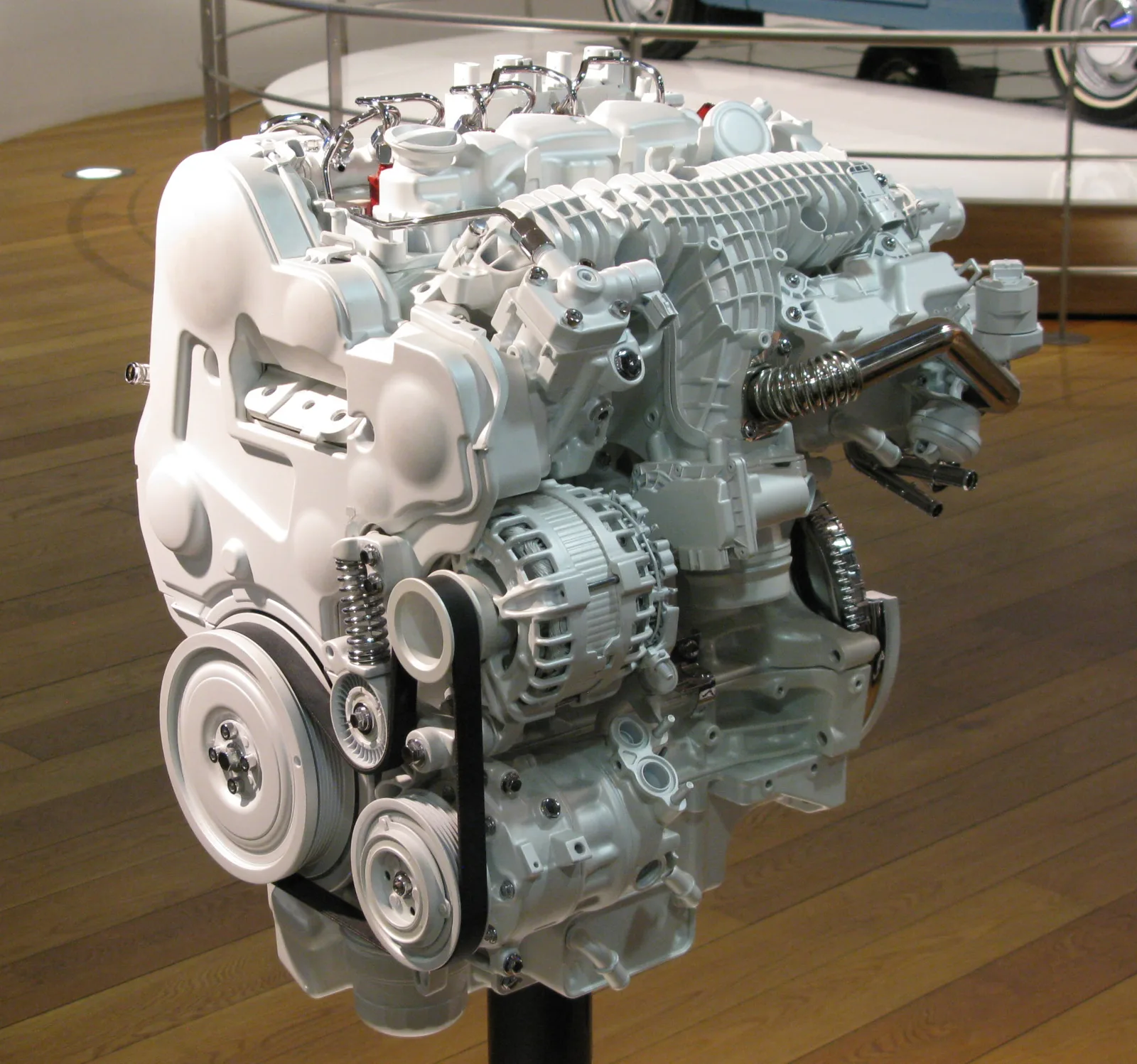
Launched in 2013, the VEA family ran from a 1.5 litre three-cylinder to supercharged and plug-in hybrid 2.0 litre fours, and it ended with diesel production in 2024.
Launched in 2013, this family spans three- and four-cylinder units across petrol and diesel. Built in Sweden, China and Malaysia, it powers Volvo models under the Drive-E name.
The Volvo Engine Architecture, or VEA, is a family of straight-three and straight-four petrol and diesel engines. Volvo builds them in Skovde in Sweden, Zhangjiakou in China and Tanjung Malim in Malaysia, where Proton produces them, and Volvo markets the whole range under the Drive-E name.
Where did the Volvo Engine Architecture come from?
Development of the new family began in 2006, and the decision to produce four-cylinder engines alone was finalised in 2007. The goal was leaner, thriftier engines with a lower environmental footprint, meant to suit each model in the line-up, and the company invested roughly 2 billion SEK in upgrading its Skovde plant and tooling for the VEA.
The first cars with the new engines reached customers in the autumn of 2013, starting with the S60 II and V60. Volvo started retiring the five-cylinder and six-cylinder petrol units at the same time, along with any four-cylinder engines bought from other manufacturers.
Nearly every older unit had disappeared by the close of 2015, leaving a handful of non-VEA engines for certain models. The phase-out was almost complete in 2016, when just two variants of the five-cylinder diesel remained, for the 60-series models.
The engines are among the few ever put into production as twincharged units, alongside the Lancia Delta S4 and the concept Jaguar CX-75.
One engine family for every Volvo model, from a 1.5 litre three-cylinder to a supercharged 2.0 and a plug-in hybrid.
How did the family spread across plants?
Skovde remained the home of the engine, but production soon spread. The Zhangjiakou plant in China began building VEA engines in 2016, and from 2022 Tanjung Malim in Malaysia has produced them under Proton.
Geely files its three-cylinder engines under a separate G-power heading, while Volvo keeps the Drive-E name for the whole family.
How is a VEA engine code read?
A broadly used VEA engine code runs to seven or eight characters, and hybrid models can carry a second, seven-character code. Mild hybrids use six-character codes, and certification documents use codes of six to eight characters. Each variant then gains a two-character MP or HP suffix to set performance apart.
The first letter gives the fuel type, with B for petrol and D for diesel. The second character gives the cylinder count, three or four. Digits three and four give the approximate displacement in decilitres, which can be rounded either way, so 19 stands for about 2.0 litres.
The fifth character gives the valves per cylinder, which is four across the family. The sixth character shows whether the engine is turbocharged, with T for turbo, and the seventh and eighth characters identify the individual variant.
Why did hybrid systems arrive so early?
In December 2014 Volvo introduced its first hybrid VEA with the XC90 T8. It used an electric rear axle drive, known as ERAD, for both electric propulsion and all-wheel drive. The petrol engine was linked to a crankshaft integrated starter generator, or CISG, which started the engine and recovered energy when slowing down.
The same starter generator reduced lag at low revs by acting as an extra supercharger. Volvo calls this type of hybrid implementation Twin Engine.
With the 2016 launch of the S90 flagship, Volvo unveiled the PowerPulse anti-lag system for its top diesel engines. A small tank of compressed air could be released into the turbocharger to speed spool-up, which reduced turbo lag.
What was the three-cylinder story?
Volvo began testing three-cylinder variants in mid-2014, and it had planned to introduce them in 2015. Because they were smaller and less powerful, they were meant to serve as the base engines of the range. In 2015 no three-cylinder engines were released, and four-cylinder 1.5 litre variants took the base role instead on some models.
The first production VEA three-cylinder arrived in the second half of 2017, in the LEVC TX, where it worked as a range extender. Volvo had slated the first three-cylinder car for 2018, in the XC40 under the T3 designation, but the car saw only limited release.
The three-cylinder engines therefore arrived later than planned, and the car that was meant to carry them in 2018 saw only limited release.
How did emissions rules change the engines?
Stricter laws led to extra emissions equipment from the second half of 2017, for the 2018 model year. Diesel engines gained an SCR catalyst to cut NOx, and petrol engines received a particle filter. Volvo calls those changes VEA GEN2.
GEN2 lifted the rating to Euro 6c, and certain engines reached Euro 6d-TEMP. The upgrade arrived gradually, and hybrids in particular kept Euro 6 specification until mid-2018. From model year 2019 all engines carried Euro 6d-TEMP certification, and a few had been dropped.
All diesel engines now use AdBlue, and every petrol engine carries a particle filter.
What are VEA GEN3 and the mild hybrid system?
Since 2017 Volvo has worked on a sweeping revision of the whole range, labelled VEA GEN3. The petrol and diesel variants carry VEP GEN3 and VED GEN3 designations, and the update belongs to the effort to hybridise every engine.
The mild hybrid variants use a 48V network that is separate from the high-voltage battery system. A belt-driven integrated starter generator, or BISG, recovers kinetic energy when the car slows and stores it in a 48V lithium-ion battery. Under heavy load or rapid acceleration the BISG adds power, which Volvo describes as P0 hybridisation.
The badging changed with the new hybrids. Volvo introduced B badges for hybrid vehicles, moving away from the earlier T and D naming. T numbering had started in 1994 with the T-5, and D numbering arrived in 2002 with the D5 engine.
What did the 1.5 litre three-cylinder deliver?
The three-cylinder petrol family was built around a 1,477 cc unit with a bore of 82 mm and a stroke of 93.2 mm. Its compression ratio of 10.5:1 came with turbocharging, an intercooler and direct injection, and the belt-driven water pump and integrated balancer shaft set it apart from the four-cylinder units.
The B3154T range extender was rated at 82 PS (60 kW; 81 hp) at 4000 rpm and 188 lb-ft (255 N-m), and it recharged the high-voltage battery rather than driving the car directly. Volvo credited it with roughly 300 miles of extra range.
The B3154T2 was the automatic-car variant, delivering 163 PS (120 kW; 161 hp) at 5500 rpm, with 195 lb-ft (265 N-m) of torque between 1500 and 3000 rpm. It was paired with the AW8G30 gearbox and appeared in the XC40 as the T3.
The B3154T5, known as the BB, produced 180 PS (132 kW; 178 hp) at 5800 rpm. Its front electric motor, the EFAD, supplied 82 PS and 160 N-m (120 lb-ft), with a 9.7 kWh battery, and it was the Twin Engine version fitted to the XC40 T5.
How strong were the 2.0 litre petrol engines?
The 2.0 litre petrol units had a 1,969 cc capacity, the same 82 mm bore and 93.2 mm stroke as the three-cylinder, and a compression ratio of 10.3:1. Turbocharging and direct injection were standard, while the more powerful versions also carried a Roots-type supercharger.
The B4204T9 and B4204T27 show the top of the petrol range. The T9 developed 302 PS (222 kW; 298 hp) at 5700 rpm, and torque came in at 400 N-m (300 lb-ft). The T27 lifted power to 320 PS (235 kW; 316 hp), still at 5700 rpm, with unchanged torque. Both combined a turbo with a supercharger.
Its 245 PS (180 kW; 242 hp) arrives at 5500 rpm, and 350 N-m (260 lb-ft) of torque comes with it. Its compression ratio was raised to 10.8:1, and it was fitted to the V40, S60, V60, XC60, S80, V70 and XC70 models across several years.
The B4204T28 plug-in hybrid made 318 PS (234 kW; 314 hp), with a rear ERAD motor supplying 87 PS (64 kW; 86 hp). Its battery grew from 9.2 kWh in the 2016 and 2017 model years to 10.4 kWh from 2018.
The highest petrol output in the family is the B4204T43, a Polestar-tuned unit with 367 PS (270 kW; 362 hp) at 6000 rpm and 470 N-m (350 lb-ft) between 3100 and 5100 rpm. It appeared in the S60 and V60 Polestar models of 2017 and 2018.
What were the diesel 2.0 engines like?
The 2.0 litre diesel shared the 82 mm bore and 93.2 mm stroke of the petrol engines, but its compression ratio was 15.8:1. Injection pressures reached 2500 bar, driven by a belt-driven fuel pump, and some variants used Variable Nozzle Turbine turbochargers.
The D420T2 peaked at 235 PS (173 kW; 232 hp) at 4000 rpm, while torque of 480 N-m (350 lb-ft) ran from 1750 to 2250 rpm. A belt-driven starter generator adds 14 PS (10 kW; 14 hp) to its twin turbochargers, and it was offered in the XC60 and XC90 B5 AWD.
Volvo ended diesel production, and the last diesel-equipped vehicle was built in March 2024. The diesel engine family thus lasted about eleven years, from the first VEA diesels in 2013.
How do the main VEA versions compare?
| Version | Years | Engine | Output | Torque |
|---|---|---|---|---|
| B3154T2 | 2020 onward | 1.5 L three-cylinder, turbo | 163 PS (120 kW; 161 hp) at 5500 rpm | 195 lb-ft (265 N-m) |
| B3154T5 Twin Engine | 2020 onward | 1.5 L three-cylinder, hybrid | 180 PS (132 kW; 178 hp) at 5800 rpm | 195 lb-ft (265 N-m) |
| B4204T11 | 2015-2019 | 2.0 L turbo | 245 PS (180 kW; 242 hp) at 5500 rpm | 260 lb-ft (350 N-m) |
| B4204T9 | 2015-2018 | 2.0 L turbo and supercharger | 302 PS (222 kW; 298 hp) at 5700 rpm | 300 lb-ft (400 N-m) |
| B4204T27 | 2016-2022 | 2.0 L turbo and supercharger | 320 PS (235 kW; 316 hp) at 5700 rpm | 300 lb-ft (400 N-m) |
| B4204T28 | 2016 onward | 2.0 L plug-in hybrid | 318 PS (234 kW; 314 hp) at 5700 rpm | 300 lb-ft (400 N-m) |
| D4204T11 | 2016-2018 | 2.0 L twin-turbo diesel | 225 PS (165 kW; 222 hp) at 4250 rpm | 350 lb-ft (470 N-m) |
| D420T2 | 2020-2024 | 2.0 L twin-turbo diesel | 235 PS (173 kW; 232 hp) at 4000 rpm | 350 lb-ft (480 N-m) |
What is the legacy of the Volvo Engine Architecture?
The VEA gave Volvo a single modular family that covered its range from the three-cylinder base models to high-output petrols and diesels. Its hybrid systems began with the XC90 T8 in 2014.
The family also shows how emissions rules shape an engine after launch. GEN2 added SCR and particle filters, and GEN3 added the 48V mild hybrid, so the design was reworked several times without a complete replacement.
Volvo has now ended diesel production, with the last diesel-equipped vehicle built in March 2024. The programme aimed to fit one engine family to every Volvo model, and the Drive-E name still marks that effort.