In the Lexus RZ and Tesla Cybertruck, nothing but wires and software connects your hands to the front tyres.
Steer-by-wire steers a car's wheels with sensors, control units and motors instead of a mechanical steering column. The Lexus RZ 450e and Tesla Cybertruck use it, and it is kept safe by redundant sensors, power and actuators under ISO 26262 level D, though failures and hacking remain concerns.
When you turn the wheel of a Tesla Cybertruck, no shaft carries your effort to the front tyres, and when you turn the optional yoke of a Lexus RZ 450e, the same is true. Electronics read your hands and electric motors do the steering. The idea is old, but a car that had it on sale back in 2013 was later fitted with conventional hydraulic steering after a poor reception.
What is steer-by-wire?
Steer-by-wire lets a car turn part or all of its wheel set with no steering column physically joining the driver to them. That makes it different from electric power steering, which assists the driver but still depends on the column to pass part of the effort to the wheels.
The driver holds a steering wheel, a yoke or some other controller. It feeds one or more electronic control units, which read the input and command actuators at the road wheels. A typical system has a steering angle sensor, a feedback motor behind the wheel or yoke, the control units, the road-wheel actuators and duplicated electrical and data links.
The feeling in your hands is manufactured. A feedback motor imitates road feel and the resistance of the wheels, and it can change with speed or a chosen driving mode. Because the feel is electronic, the system can also alter the steering ratio, the effort required and how firmly the wheel returns to centre.
Steer-by-wire turns the steering system from a bicycle chain into a games controller, with the extra duty that the response has to be right every time.
How does a car steer with no steering column?
Think of the difference between a bicycle chain and a games controller. With a chain, pedalling force reaches the rear wheel through metal. With a controller, you press a stick, a processor reads it and something else responds on screen. Steer-by-wire turns the steering system from a chain into a controller, with the extra duty that the response has to be right every time.
Designs divide into two groups. Some keep a fallback: the car steers electronically in normal driving, but a clutch or similar device can tie the wheel back to the rack if a fault appears. The others remove the mechanical link altogether. Those no-column systems depend more heavily on duplicated sensors, controllers, power supplies, communication paths and road-wheel actuators, since there is nothing mechanical to fall back on.
Steer-by-wire is one member of the wider drive-by-wire family, which also covers electronic throttle control, brake-by-wire and shift-by-wire. Swapping linkages for electronics removes a long parts list, among it the column, the shafts behind it, hydraulic pumps and hoses, drive belts and vacuum servos.
What does steer by wire give you?
The case for removing mechanical links runs through the whole drive-by-wire family. It cuts complexity and simplifies assembly, service and tuning. The effort needed to move the controls can be reduced and shaped by haptic technology. Designers gain freedom in where to put the controls, and cabin noise falls because there is no acoustic path from the road into the controls. With fewer openings in the floor, crash behaviour improves.
There is a software dividend as well. Because driver inputs can be overridden, a car can intervene through systems such as electronic stability control, adaptive cruise control and lane assist. Automation of driving functions becomes easier when the steering is already an electronic channel.
The cost shows up in energy use. Each by-wire function adds actuators, and the steering needs motors to produce the torque that turns the wheels plus a transducer to create road feel. That means somewhat greater energy consumption.
Is steer by wire safe?
Safety depends on how the system fails. A fault in a by-wire system can create a hazardous situation, and the Institute for Motor Vehicles at Aachen University has studied the risks, in collaboration with Mercedes-AMG and others, on a concept vehicle called SpeedE. The scenarios include losing control of acceleration, braking or steering.
The industry answer is redundancy. Early by-wire designs kept a mechanical backup. The modern approach dispenses with it and leans on duplicated input sensors, communication networks and power supplies, and on redundant steering actuators at each wheel. Other ingredients include paired processors running in lockstep, modular units where an identical module covers for a failed one, multi-sensor fault detection, the ability to isolate a damaged system, and communication that tolerates faults. If steering fails at one wheel or even two, the car can compensate using torque vectoring through the others.
These requirements are written down. ISO 26262 demands fail-operational and fail-safe behaviour, and the safety level specified for drive-by-wire is level D.
Security is a separate worry. Researchers demonstrated in 2011 and again in 2013 that systems in cars on sale could be hacked, allowing outside control of functions such as the horn, wipers, accelerator, brakes and transmission. Modern standards, including ISO/SAE 21434 and UN regulations 155, 156 and 157, call for dedicated cryptographic modules that encrypt communication between the control units and the drive system components.
Servicing needs care too. After work that touches steering geometry, suspension alignment, the steering actuators or their sensors, a car may need calibration or a diagnostic check before the system behaves as intended.
What happened to the first steer-by-wire car?
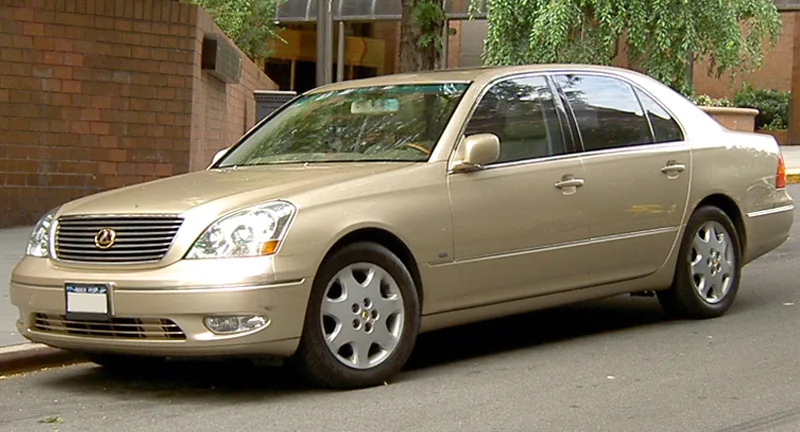
Steer-by-wire without a continuous column first reached a production car in the 2013 Infiniti Q50. It had a backup column, separated from the steering wheel by a clutch that connected the wheel to the steering rack if the electronic sensors or actuators failed. After a negative reception, the Q50 was retrofitted with traditional hydraulic steering. The technology stayed on the QX50 and QX55, and was still offered on the Infiniti Q60 coupe as late as 2022, the year that model was discontinued.
Before that, steer-by-wire had been the stuff of one-offs and concepts: the early-1990s Saab Prometheus, the 1996 Mercedes F200, the 2001 SKF Filo built on an Opel Zafira, the 2003 General Motors Hy-wire, the 2005 GM Sequel and the 2007 Mazda Ryuga. Racing has tested it too. A steer-by-wire Porsche Cayman GT4 with a Schaeffler Paravan system finished second in its class and 29th overall at the 2020 24 Hours of Nurburgring, and a Mercedes-AMG GT3 with the same system finished 16th overall the next year.
The Lexus RZ and its steering yoke
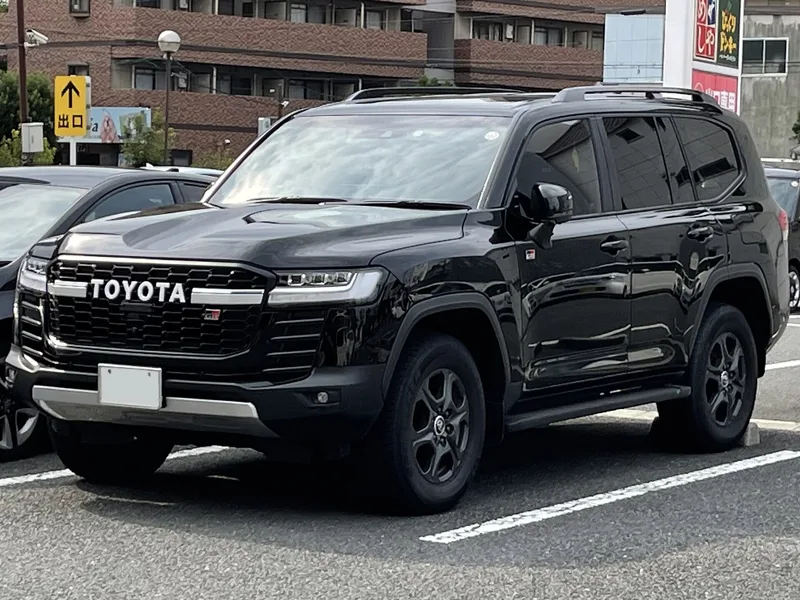
The Lexus RZ, previewed by the LF-Z Electrified concept in March 2021 and unveiled in production form on 20 April 2022, is a battery-electric luxury crossover built by Toyota for Lexus. It shares the e-TNGA platform with the Toyota bZ4X and Subaru Solterra, carries a 71.4 kWh battery, has an estimated EPA range of 320 to 360 km (200 to 225 mi) and charges at up to 150 kW.
It went on sale in 2022, as a 2023 model year car in North America. The first grade, the RZ 450e, has Direct4 all-wheel drive and optional steer-by-wire.
Lexus brands the system One Motion Grip in some markets. Instead of a wheel the driver gets a yoke, and nothing physical joins it to the rack. Where the yoke points tells a motor on the rack how far to turn, and a second motor pushes back through the yoke to supply feel. The effort changes with driving conditions, and the total rotation is limited to 300 degrees, so no hand-over-hand cranking is needed.
Motor Trend judged the yoke itself to be a novelty but called the steering system a brilliant piece of engineering that could improve driving. Whatever the verdict, the option was not offered on US-spec cars, which received a conventional steering wheel instead.
Tesla Cybertruck steer by wire
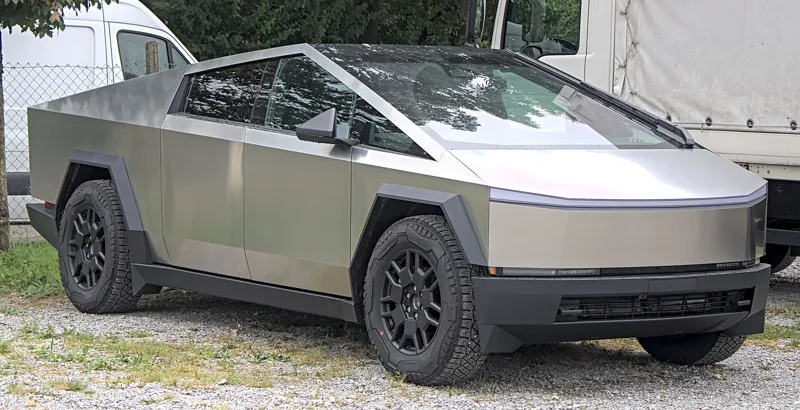
The Cybertruck, delivered to customers from November 2023, uses steer-by-wire with a steering wheel rather than a yoke. No manoeuvre needs a full turn of the wheel: it travels 340 degrees lock-to-lock, which is 170 degrees each way. The rear wheels also steer, by up to 10 degrees, to reduce the turning circle. The system is speed sensitive and damped to stop the steering whipping about on rough ground.
As of 2024 it was the only production battery-electric vehicle with a no-column system. It has also drawn heavy criticism for production quality, appearance and safety problems, and publications have called it an automotive flop in response to disappointing sales. As of 2026 Tesla sells it across North America, in South Korea and in three Gulf states, Qatar, the UAE and Saudi Arabia. Elsewhere, type approval rules block road registration in many countries, even though private imports into the European Union and United Kingdom are possible.
Which cars use steer-by-wire now?
| Vehicle | What it uses | Status |
|---|---|---|
| Infiniti Q50 | Electronic steering with a clutch-connected backup column | Offered from 2013; retrofitted with hydraulic steering after negative reception |
| Infiniti Q60 | Same approach | Offered as late as 2022, then discontinued |
| Lexus RZ 450e | Yoke, no physical link, 300 degrees of rotation | Optional; not offered in US-spec cars |
| Tesla Cybertruck | Wheel, 340 degrees lock-to-lock | In production as of 2024 |
| Rolls-Royce Spectre, Lotus Eletre, GMC Hummer EV, Chevrolet Silverado EV | Rear-axle steer-by-wire with conventional front steering | In production as of 2024 |
Rear-axle steering, the gentler version
A more modest version of the technology has been on sale for decades. Mechanical four-wheel steering has been in production cars since the mid 1980s, and computer-controlled versions followed in the late 1980s. Interest faded in the 1990s and few models carried it by the early 2000s, but it reappeared in the late 2000s and 2010s.
In the 2020s the list of brands offering rear-axle steering runs from Ferrari, Lamborghini, Bentley and Rolls-Royce through Porsche, Audi, BMW, Mercedes-Benz and Lexus to Cadillac, General Motors, Genesis and Acura. A Rolls-Royce turns its rear wheels opposite to the front at low speed and slightly in the same direction at higher speed, which gives a tighter turn in town and extra stability on the road.
Not every attempt succeeded. Quadrasteer, developed by Delphi and offered from 2002 on some General Motors trucks, was well received but dropped in 2005. It had reached only 17 percent of sales of the same model, partly because buyers did not know it and partly because of a $1000 mark-up.
Where this goes next
As of 2023, planned production vehicles with no-column steer-by-wire included the Lexus RZ 450e, the Nio ET9, the Toyota bZ4X and the Geely Super Van. Lotus, Mercedes-Benz and Peugeot planned to offer such cars in the mid to late 2020s. These are plans, and the Infiniti story shows how a feature can be withdrawn.
The Lexus RZ received an update announced in June 2025 with battery and motor improvements and a new F Sport version.
What it means for buyers and drivers
If you are offered a steer-by-wire car, the useful questions are the ones the engineering raises. Does it keep a mechanical fallback, as the early Infiniti did, or depend entirely on duplication? What does the maker say about its safety level and cyber security? How does it feel with the steering ratio the car chooses? Who calibrates the system after alignment or suspension work?