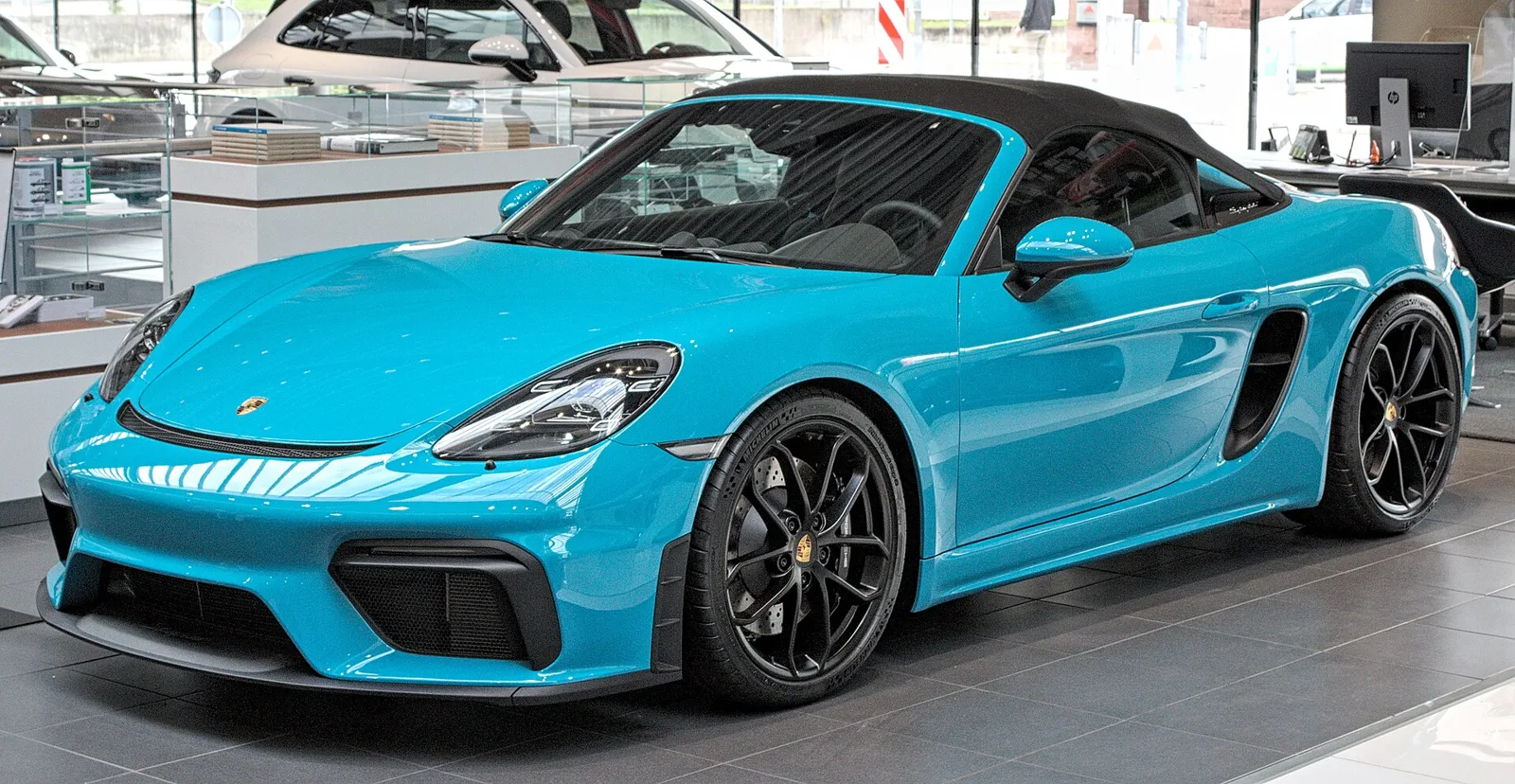
How a roadster designed in 1992 stimulated a commercial turnaround, and how a V8 off-roader became Porsche's best-selling model.
The Porsche Boxster, designed in 1992 and launched in 1996, stimulated a commercial turnaround after Porsche was in dire straits. The Cayenne followed in 2002 as the first four-door Porsche and is now its best-selling model, with 102,889 deliveries in 2024.
In October 1991, following a trip to Tokyo's motor show, Porsche was in dire straits, with a poor-selling 928 and a heavily updated 944 coming. From that low point grew a two-seat roadster that, from its debut in 1996 until the Cayenne arrived in 2003, was the company's biggest volume seller. The Cayenne, a four-door off-roader, then went on to become Porsche's best-selling model.
Porsche Boxster history: a rescue project
Development of a successor to the 928 and the newly released 968 began in February 1992. By June, four proposals built on collaboration between the 986 and 996 design teams were on the table, and Harm Lagaay chose the one by Grant Larson and Pinky Lai. Porsche decided in August to turn it into a show car for the 1993 North American International Auto Show. The Boxster Concept drew wide acclaim in January 1993, and Larson's production exterior was frozen that March.
Problems followed in the second half of 1993, when some components would not fit and the bonnet had to be lengthened, requiring another design freeze. By the end of the year, prototypes in 968 bodies were testing the mid-engine powertrain, proper prototypes arrived in 1994, pilot production started late in 1995, and series production followed in mid-1996. Larson drew on the 356 Cabriolet, the Speedster and the 550 Spyder, and the result stimulated a commercial turnaround for Porsche. Consultation with Toyota helped as well: Porsche began sharing parts widely between models and cut its costs.
The name joins boxer, for the flat engine, with Speedster. The 986 Boxster went on sale in late 1996 with a 2.5-litre flat-six, was heavily influenced by the 1993 concept, and was Porsche's first road vehicle designed from the start as a roadster since the 914. It reached customers before the 996, sharing that car's bonnet, wings, headlamps, cabin and engine layout. Production took place at the former 928 facility in Stuttgart, with Valmet Automotive building cars under contract in Uusikaupunki, Finland.
Larson's design, inspired by the 356 Cabriolet, Speedster and 550 Spyder, stimulated a commercial turnaround for Porsche.
How does a mid-engine layout work?
Picture carrying a heavy bag close to your body rather than at arm's length. Putting the engine between the seats and the rear axle works the same way: the mass sits near the middle of the car, which gives a low centre of gravity, almost ideal weight balance and neutral handling. The 911 kept its engine at the back, in the classic rear-engine layout.
All 986 and 987 Boxsters used the M96, a water-cooled flat-six that was Porsche's first water-cooled engine not mounted at the front. It had a troubled start. Early engines suffered cracked or slipped cylinder liners, which a minor redesign and tighter control of the casting process fixed in late 1999. Porous engine blocks were another problem, since they allowed coolant and oil to mix. Porsche chose to bore out the affected sleeves and insert new ones rather than scrap the block.
Boxster and Cayman generations
| Generation | Years | Notes |
|---|---|---|
| 986 Boxster | 1996 to 2004 | 2.5-litre flat-six; 2.7 and Boxster S 3.2 from 2000 |
| 987 Boxster and Cayman | 2005 to 2012 | Base 2.7-litre at 176 kW (239 PS); S 3.2-litre at 206 kW (280 PS); last with hydraulic steering |
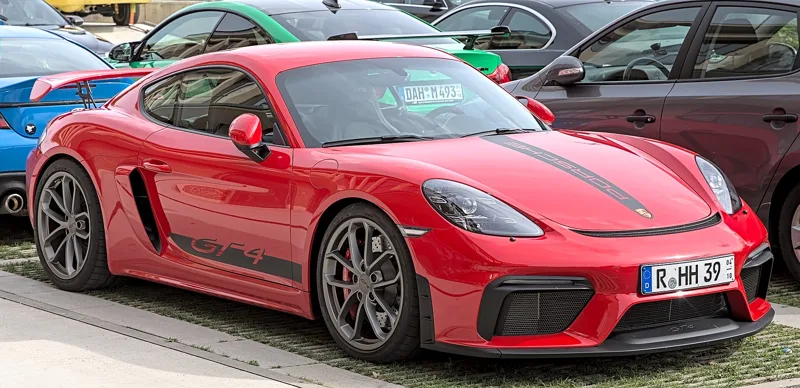
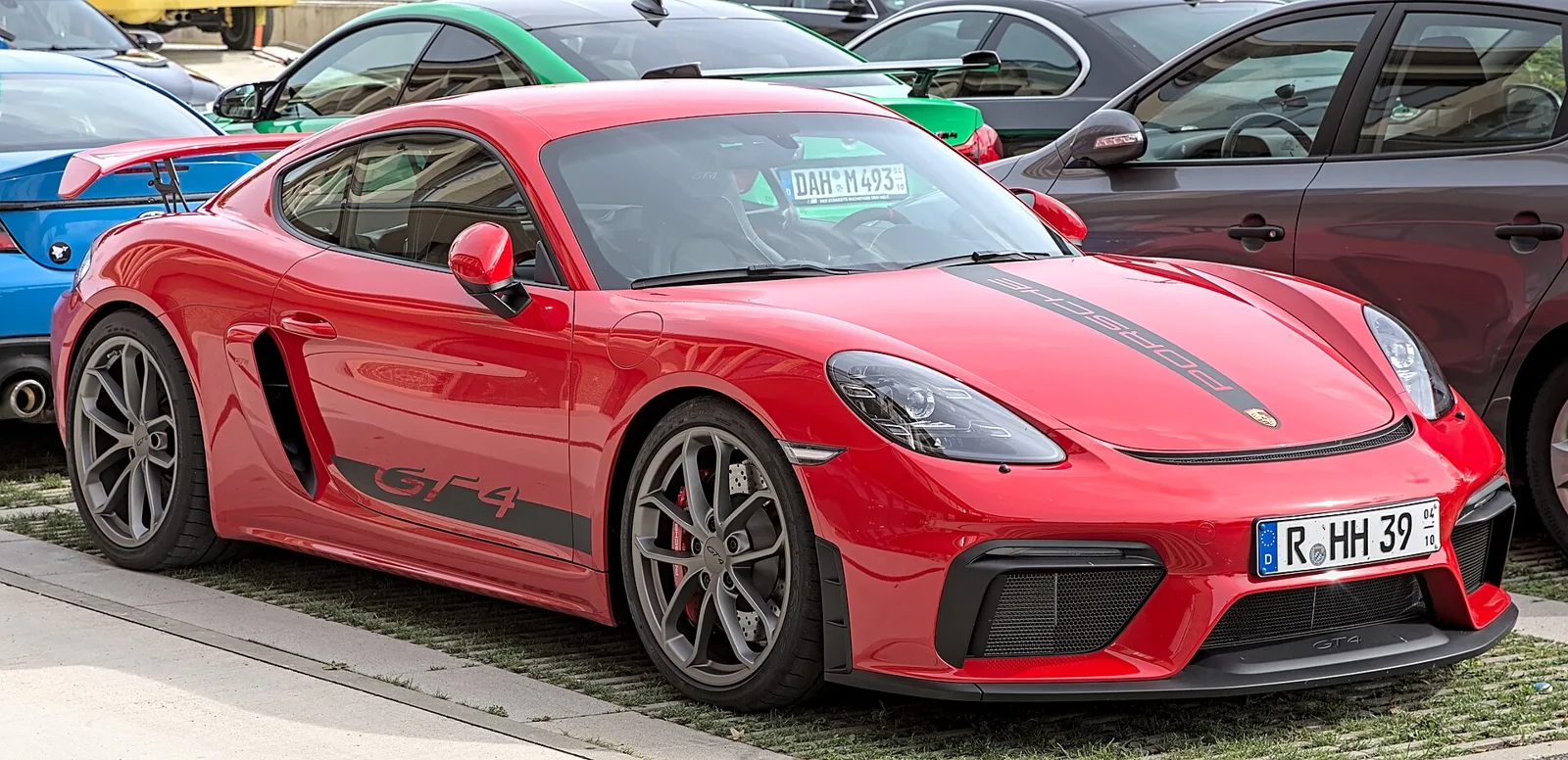
| 981 Boxster and Cayman | 2012 to 2016 | New 2.7-litre; 40 per cent stiffer chassis; GT4 in 2015 |
| 718 Boxster and Cayman (982) | 2016 to 2025 | Turbocharged flat-four replacing flat-sixes |
The 986 and 987 in more detail
In 2000 the base Boxster moved to a 2.7-litre engine and the new Boxster S arrived with 3.2 litres, and both got more power and fresh styling in 2003. A minor facelift in 2002 swapped the plastic rear window for a smaller glass one, and added a glove compartment, electro-mechanical bonnet and boot releases, clear indicators and tweaked bumpers. A 50th Anniversary Edition of the 550 Spyder, built on the Boxster S in 2004, was limited to 1,953 units, marking the 550's debut in 1953.
The 987 debuted at the 2004 Paris Motor Show alongside the 997 911 and went on sale in 2005, with larger intake vents and wheel arches that could take wheels up to 19 inches. The base engine in 2005 was a 2.7-litre flat-six and the Boxster S used a 3.2. In 2007 the base car gained VarioCam Plus and the S moved to 3.4 litres, which put the Boxster and the Cayman on equal power. The 2008 facelift enlarged the base engine to 2.9 litres, added direct fuel injection to the S, made a 6-speed manual standard and offered a 7-speed PDK dual-clutch gearbox. The 987 was the last generation with hydraulic steering.
Porsche Cayman vs Boxster
The Cayman arrived in 2005 as a 2006 model, a coupe derived from the Boxster, styled in its first form by Pinky Lai. The Cayman S went on sale in late 2005 and the base car in July 2006. The two share a mid-engine platform, front wings, boot lid, doors, headlights, taillights and the forward part of the interior, with styling cues from the 356/1, the 550 Coupe and the 904 Coupe. The suspension is the same in principle, but with revised settings because the fixed roof makes the chassis stiffer. The Cayman's hatchback gives access to luggage areas above and behind the engine.
The Cayman S used a 3.4-litre flat-six with a 6-speed manual transaxle, while a 2.7-litre with a 5-speed was standard on the base model, and a Tiptronic automatic was available on both. By the 987.2 of February 2009, both Caymans kept a 7 kW (10 PS) power advantage over the Boxster, and a limited-slip differential became a factory option. The Cayman R of 2011 was the pinnacle of the generation. It was 55 kg lighter, thanks to lightweight wheels, aluminium doors from the 997 GT2, GT3 and Turbo, carbon seats, and by deleting the air conditioning, rear wiper, entertainment system and storage compartments. It led the way to the Cayman GT4.
The name comes from the caiman, a relative of the alligator, and when the car reached dealers Porsche adopted four caimans at Stuttgart's Wilhelma Zoo. In 2009 it sued Crocs, whose clog was also called Cayman, and won an injunction against Crocs Europe preventing use of the name in Germany. Cayman production was in Finland by Valmet until 2012, then in the former Karmann plant at Osnabruck.
The 981 and the 718
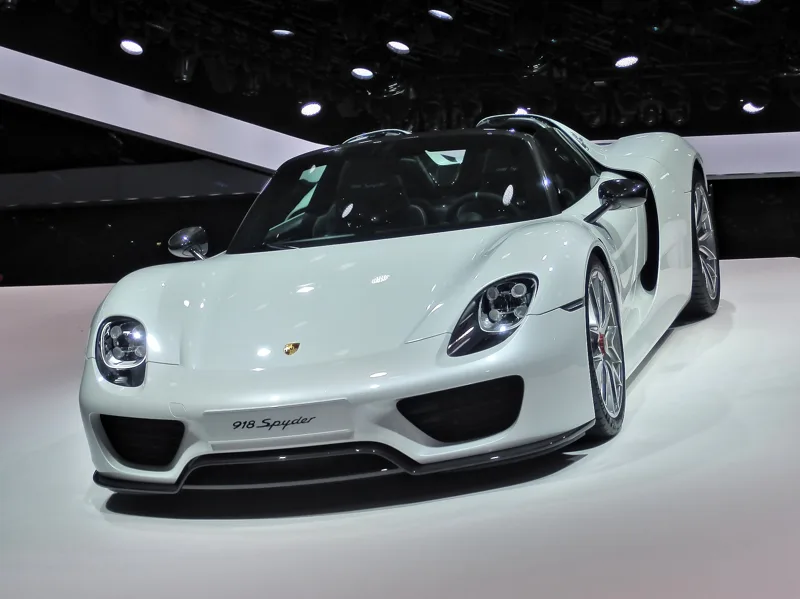
Porsche announced the 981 Boxster at Geneva on 13 March 2012, and it followed the design language of the 991 911 and the 918. It was 40 per cent more torsionally rigid, had a front track 40 mm (1.6 in) wider, a rear track 18 mm (0.7 in) wider and a wheelbase 60 mm (2.4 in) longer, yet weighed up to 35 kg (77 lb) less than the 987. The base car had a new 2.7-litre flat-six and the S a revised 3.4. Porsche claimed fuel savings of 15%. A GTS followed in March 2014 with 11 kW (15 PS) more, and in 2015 the Cayman GT4 appeared with the 991.1 Carrera S engine rotated 180 degrees and brakes and suspension parts from the 991.1 GT3. A total of 2,500 were built across 2015 and 2016.
The Type 982 arrived in 2016 as a 2017 model and revived the 718 name and swapped naturally aspirated flat-sixes for small turbocharged flat-fours. The Cayman was priced below the Boxster, in line with Porsche's higher pricing for roadsters.
Why did Porsche make an SUV? The Cayenne arrives
The Porsche Cayenne has been built since 2002 as an E-segment luxury crossover. Its first generation, the Type 9PA, was the first V8-engined Porsche since the 928 was dropped in 1995, the first Porsche off-roader since the Super and Junior tractors of the 1950s, and the first four-door production Porsche. Underneath it is related to the Volkswagen Touareg and Audi Q7, sharing platform, frame, doors and electronics. Manfred Gotta coined the name.
Reception at launch was mixed, but the car turned out quick and well-handling for an SUV, with powerful engines. Over eight model years, Porsche built 276,652 of the first generation. Because the Cayenne had proved commercially successful, Porsche designers assessed other body styles in December 2002: a coupe-like SUV, an open-top version and a longer-wheelbase three-row car. The convertible was abandoned over concerns about headroom, boot space and rear design, the coupe-style SUV led to the Cayenne Coupe, and the three-row idea presaged the later Porsche K1.
Today the Cayenne is Porsche's best-selling model. Deliveries reached 102,889 in 2024, an 18% increase on 2023.
First-generation Cayenne engines and performance
| Version | Power | Quoted performance |
|---|---|---|
| Base 3.2-litre VR6 | 184 kW (250 PS) | 0-100 km/h in 9.1 s (manual) |
| S 4.5-litre V8 | 250 kW (335 hp) | 6.9 s to 60 mph; 241 km/h (150 mph) |
| GTS 4.8-litre V8 | 298 kW (405 PS) | 6.1 s to 100 km/h; 253 km/h (157 mph) |
| Turbo | 331 kW (450 PS) | 5.6 s to 100 km/h |
| Turbo S 4.5-litre twin-turbo | 383 kW (521 PS) | 5.0 s to 60 mph; 269 km/h (167 mph) |
| Diesel 3.0-litre V6 TDI | 177 kW (240 PS) | 8.2 s to 60 mph |
Cayenne GTS, Turbo S and special editions
The S used a 4.5-litre V8 with wet-sump lubrication and variable valve timing. For 2008 to 2010 it moved to a 4.8-litre direct-injection V8 with 283 kW (385 PS). The 2008 to 2010 GTS revived the GTS badge, the first modern Porsche to wear it, with a specially developed sports chassis, lowered suspension, a sports exhaust, 21-inch wheels and a wide-body kit. A Turbo S built in 2006 took on the Mercedes-Benz ML 63 AMG, and a later 2008 Turbo S with 410 kW (550 hp) reached 60 mph in 4.7 seconds. The Cayenne Diesel arrived in February 2009.
Several limited versions followed. The Cayenne S Titanium Edition appeared for 2006 only. The Cayenne S Transsyberia began as a rally vehicle, and a road version celebrated Porsche's win in the rally: Porsche aimed to make 600 worldwide but built far fewer, 102 for the USA and 17 for Canada. In May 2009 a Porsche Design Edition 3 based on the GTS was limited to 1,000 units, with a chronograph. In April 2022 Porsche showed an open-top Cayenne concept to mark the model's 20th anniversary.
Second and third generation Cayenne
The second-generation Cayenne, the 92A, was unveiled at the Geneva Motor Show in March 2010. Porsche shut the Leipzig plant in December 2009 for two to three months of retooling. The car was almost 250 kg (551 lb) lighter than before, mostly through dropping the low-range transfer case, and used more aluminium and magnesium. Engines included a 3.6-litre VR6 with 221 kW (300 PS), a 4.8-litre V8 in the S with 294 kW (400 PS), and the Turbo with 368 kW (500 PS). The S Hybrid arrived in 2010 with a 3.0-litre V6 and electric motor, rated at 193 g/km of CO2.
In July 2014 a facelift added the Cayenne S E-Hybrid, a plug-in with an electric range of 18 to 36 km (11 to 22 mi) on the NEDC cycle. Porsche said no premium SUV had been plug-in before it, and the maker became the first with three production plug-in hybrids. The facelift also replaced the S and GTS 4.8-litre V8 with a twin-turbocharged 3.6-litre V6. On 1 May 2017 a Cayenne S Diesel set a Guinness World Record by towing a 265-tonne Air France Airbus A380 for 42 metres. Model-year 2013 to 2016 diesel Cayennes are caught up in the Volkswagen emissions scandal.
Porsche revealed the third generation on 29 August 2017, and customers got it from 2019. It uses the Volkswagen Group MLB platform that also carries the Touareg, Audi Q7 and Q8, Bentley Bentayga and Lamborghini Urus, and it no longer shares door design with the Touareg. A mid-cycle refresh followed in 2023.
What this means if you are buying a Boxster, Cayman or Cayenne
Early Boxsters are the ones to ask about. M96 liner failures and porous blocks hit the first engines, and the fix came in late 1999. The 987.2 adds a limited-slip differential option and direct injection on the S, and the 987 is the last with hydraulic steering. The 981-era GT4 was limited to 2,500 cars, and Cayman R cars came in limited numbers. On the Cayenne, the S Hybrid and the GTS are distinct models, and the diesel Cayennes of 2013 to 2016 are among those affected by the emissions scandal.
Where this goes next
In May 2025 Porsche North America said global production of all 718 Boxster and Cayman variants, including RS models, would end in October of that year. Chief executive Oliver Blume has confirmed full-electric replacements, placing their arrival in the "medium term". The fourth-generation Cayenne, shown in November 2025 with production starting in February 2026, is the first Cayenne with only a battery-electric powertrain. Sold as the Cayenne Electric, it is built on the Premium Platform Electric architecture that the second-generation Macan also uses.