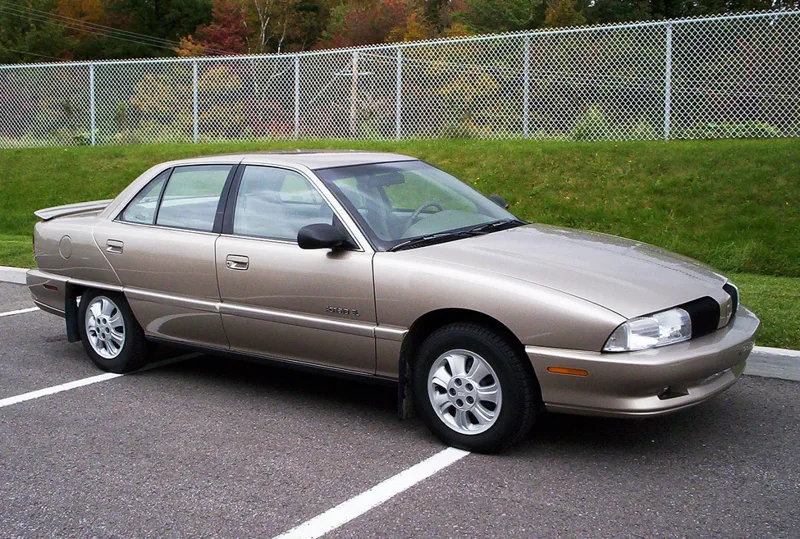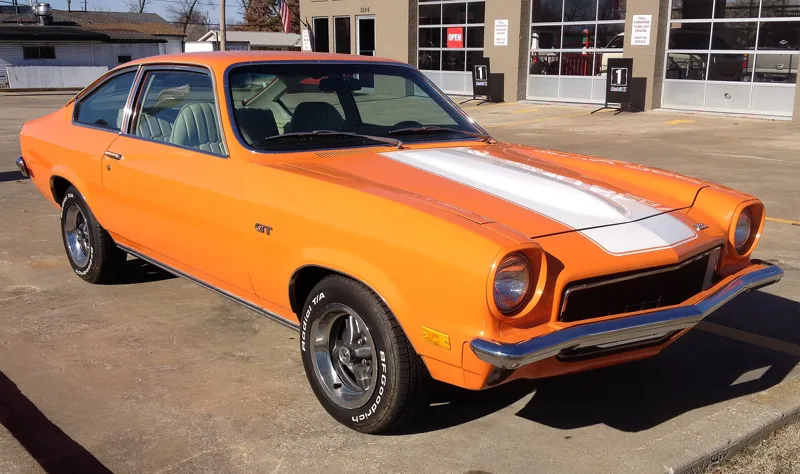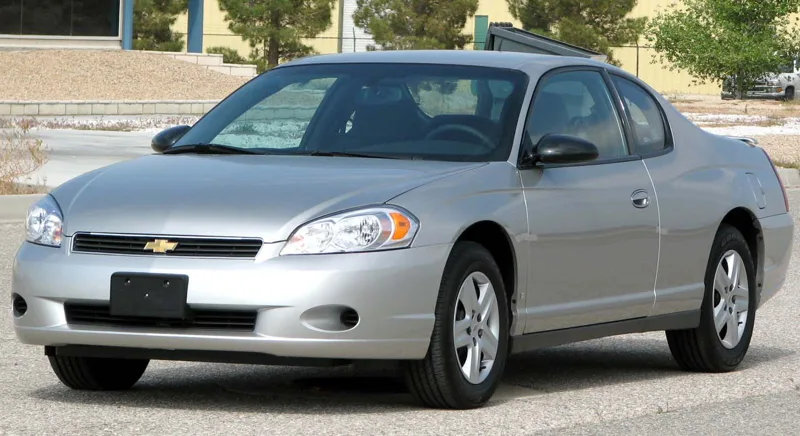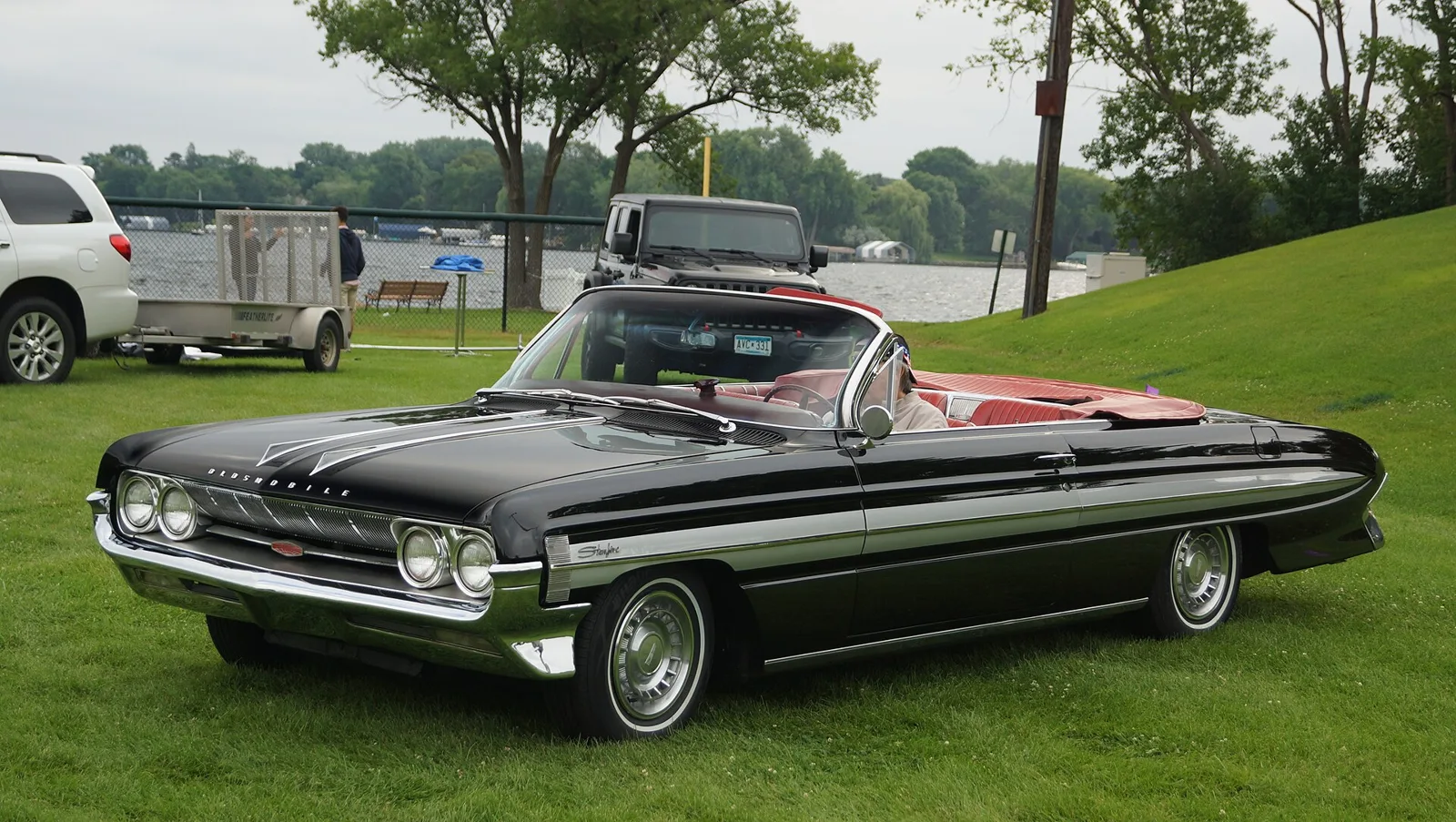
A jet-fighter dream car, a 375 hp grand tourer and a rebadged Monza, set against the entry-level Special that came before them.
The Oldsmobile Starfire was a nameplate used in three runs: 98 convertibles from 1954, a separate grand tourer from 1961 to 1966 and a Chevrolet Monza-based subcompact from 1975 to 1980. The Series 60 was Oldsmobile's entry-level car from 1939 to 1948.
The first Oldsmobile Starfire was a fibreglass dream car named after a jet fighter. The last was a badge-engineered Chevrolet Monza. In between, the name returned twice, each time on something quite different, while a plain-trimmed model called the Series 60 had already spent a decade as Oldsmobile's entry-level car.
What was the Oldsmobile Starfire?
Oldsmobile used the Starfire name in three separate runs: on a top-level 98 convertible from 1954 to 1957, on a personal luxury model from 1961 to 1966, and on the brand's first subcompact from 1975 to 1980. It began as a 1953 concept car.
Oldsmobile was one of the most popular brands of its day, and the company saw a chance to benefit from the Space Race. Rocket terminology already worked for it, thanks to the Rocket V8. The Starfire name fitted, and it was meant to carry the same halo status as the Buick Skylark and the Cadillac Eldorado.
The 1953 dream car
The name first appeared on a one-off dream car at the 1953 Motorama show, honouring the Lockheed F-94 Starfire jet fighter. This four-passenger convertible had a fibreglass body, an overhead-valve Rocket V8 of 200 hp (150 kW), bucket seats all round and a wraparound windshield.
Later that year came the 98 Fiesta, a limited-production luxury convertible that borrowed ideas from the concept. Fiesta is Spanish for festival or party. As the top trim for the Oldsmobile 98, it introduced a 12-volt electrical system able to run power window lifts, a power hood and front seat adjustment. Under the bonnet was the 303 cubic inch (5.0 L) engine with a Quadri-Jet four-barrel carburettor, and the styling echoed the concept with hints of the Cadillac Eldorado.
The Fiesta's engine was a special tune of the Ninety-Eight unit, up 5 horsepower to 170 hp (130 kW) through smoother manifolds and compression raised from 8.1:1 to 8.3:1. To keep it lively, Oldsmobile fitted a four-speed Hydramatic and a faster rear axle ratio, as the car's 4453 lb shipping weight was 336 lb above a standard Ninety-Eight convertible. At US$5,715 ($68,772 in 2025 dollars) it cost nearly twice as much as that standard car, at US$2,963 ($35,656 in 2025 dollars), and over $700 more than the Buick Roadmaster Skylark. Only 458 were built, against 7,521 standard convertibles. The 1953 Packard Caribbean sold at a similar price.
The 98 Starfire of 1954 to 1957
From 1954 to 1956 the Starfire name marked the luxury convertibles of the 98 DeLuxe line, as Holiday marked the hardtops. They were the dearest Oldsmobiles on offer, at US$3,249 ($38,952 in 2025 dollars), and 6,800 left the line in 1954. The 1955 car gained a 200bhp engine with dual exhausts. Options included tinted glass, a power-adjustable front seat, a signal-seeking radio, leather, power windows, power steering and power brakes. It remained the priciest Oldsmobile at US$3,276 ($39,373 in 2025 dollars), with 9,149 built.
The 1956 cars took on the look of the concept, with a large gaping grille that had minimal decoration and bumper guards, and the automatic transmission became standard with a park position on the selector. For the 1957 model year every 98 was called a Starfire 98, sharing standard features with the coupes and sedans, and the name left the 98 series in 1958.
A jet-fighter dream car, a grand tourer and a Monza in Oldsmobile clothing all carried the Starfire name.
What was the 1961 Oldsmobile Starfire?
In January 1961 Oldsmobile split a performance-minded grand tourer convertible off into its own model line. It used the body and wheelbase of the Super 88 and Dynamic 88, and from 1961 to 1965 it was the dearest Oldsmobile, aimed at the growing personal luxury market.
1961 and 1962
Standard equipment was lavish: leather bucket seats, a console with tachometer and a floor shifter for the Hydra-matic, brushed aluminium side panels, and power steering, brakes, windows and driver's seat. No other full-size American production car had offered an automatic with a console-mounted floor shifter before. At $4,647 ($50,067 in 2025 dollars) it cost more than even the larger Ninety-Eight models. Its 394 cubic inch Skyrocket V8, the most powerful Oldsmobile engine that year, used a Rochester four-barrel carburettor to make 330 hp (246 kW) at 4600 rpm. Only 1,500 of the 1961 cars were sold.
The 1962 model added a two-door hardtop, with a roofline styled like a convertible's and shared with other 88 coupes, and power rose to 345 hp (257 kW). That year was the best of the generation.
From 1963 to 1966
| Year | Coupe sales | Convertible sales |
|---|---|---|
| 1961 | None built | 1,500 |
| 1962 | 34,839 | 7,149 |
| 1963 | 21,489 | 4,401 |
| 1964 | 13,753 | 2,410 |
| 1965 | 13,024 | 2,236 |
| 1966 | 13,019 | Discontinued |
For 1963 Oldsmobile swapped the sculpted sides for a flatter, more conventional shape with a roofline exclusive to the Starfire, squared off, with a concave rear window, and the convertible fell 38%. The 1964 car looked much the same. It was lighter, but overall length reached 215.3 inches (5,468.6 mm), and sales dropped by 36% for the coupe and 45% for the convertible.
By 1964 the Starfire shared its bodyshell with the cheaper Jetstar I hardtop coupe, a direct rival to the Pontiac Grand Prix. The Jetstar had the same 345 hp (257 kW), 394 cubic inch (6.5 L) Ultra High Compression Rocket V8, but cost over $500 less thanks to a vinyl interior and options lists that held many Starfire standards, among them Hydra-Matic, power steering and brakes. Front seat belts became standard under federal law.
All Oldsmobiles were restyled for 1965, and the Starfire coupe kept a modified form of its special roofline with an inversely curved rear window. A new 425 cubic inch (7.0 L) Rocket V8 with a Rochester four-barrel made 375 hp (280 kW) at 4800 rpm, the strongest engine in the range, used only in the Starfire and Jetstar I. The three-speed Turbo Hydra-Matic replaced the fluid-coupling Hydra-Matic that Oldsmobile had fitted since 1940, and a Hurst-shifted four-speed manual arrived as an option that few buyers chose.
In 1966 only the coupe remained. The Starfire moved downmarket, priced like the former Jetstar I. Morroceen vinyl replaced leather, and power windows, power seats, Turbo Hydra-Matic, power steering and power brakes all became options. The 425 V8 still made 375 hp (280 kW; 380 PS), but the Toronado, with 385 hp (287 kW; 390 PS), took over as the strongest Oldsmobile. For 1967 the Starfire vanished. The Delta 88 Custom took its place at a base price of $3,522 ($34,007 in 2025 dollars), almost the same as the 1966 Starfire, with similar trim, and it even borrowed the brushed fender trim with its faux vents.
What was the 1975 Oldsmobile Starfire?
The second-generation Oldsmobile Starfire was a subcompact four-seater introduced in September 1974 for the 1975 to 1980 model years. It was Oldsmobile's entry-level car and a badge-engineered Chevrolet Monza, identical but for badges and the grille.
The wheelbase measured 97.0 inches (2,460 mm) and the width 65.4 inches (1,660 mm). The shape resembled the Ferrari 365 GTC/4, and the car joined the Chevrolet Monza, Buick Skyhawk and Pontiac Sunbird in being among the first with newly approved quad rectangular halogen headlamps. For 1975 and 1976 the standard engine was Buick's 231 cubic inch (3.8 L) V6 with a two-barrel carburettor, making 110 hp (82 kW) at 4000 rpm. An SX model was available, and a GT arrived in mid-1975.
The car was rear-wheel drive with a live rear axle. Control arms, coil springs and an anti-roll bar looked after the front, and a torque-arm layout with coil springs the rear. It was the first GM product with a torque-arm rear suspension, a design later used on the third and fourth generations of the Camaro and Firebird. Variable-ratio power steering was standard, as were power-assisted brakes, with front discs and rear drums. A Borg-Warner five-speed manual with overdrive became optional in 1976, and front rotors were vented from that year.
Engines and updates
For 1977 the front end gained a split grille of vertical slots, like the previous year's base Cutlass, and a 140 CID (2.3-liter) aluminium-block four with a two-barrel carburettor became standard. It was the first four in an Oldsmobile since the 1922 Model 43. The Buick V6 became optional on the base car and standard with the GT package, and a Chevrolet 305 (5.0-liter) V8 followed later that year. The Vega-derived four ended with the 1977 model year.
For 1978 the standard engine was Pontiac's 151 CID (2.5-liter) Iron Duke four, which produced 85 hp (63 kW) at 4400 rpm through a two-barrel carburettor. Late that year Oldsmobile added the Starfire Firenza package: rallye suspension, a front air dam, a rear spoiler and flared wheel openings that widened the car to 67 in. A face lift for 1979 replaced the quad rectangular headlamps with twin rectangular ones, and the rear gained a blunt body panel with new taillamps. The V8 and the five-speed were dropped at the end of 1979.
Why the 1975 Starfire ended
The 1980 model year was the last. Production stopped on 21 December 1979, when Oldsmobile handed H-body production to Chevrolet and Pontiac in return for a larger allotment of the new front-wheel-drive X-bodies. The rear-drive H-body cars, Starfire included, gave way in spring 1981 to front-drive J-cars designated as early 1982 models, among them the Oldsmobile Firenza. In total, 125,188 H-body Starfires were built in six model years.
What was the Oldsmobile Series 60?
The Oldsmobile Series 60, called the Special, was a full-size car built from the 1939 to the 1948 model years. As Oldsmobile's entry-level model on the GM A-body platform, it carried more standard equipment than the same platform in a Chevrolet or Pontiac, where such items were optional. At first it had a flathead six, with the senior models using a flathead eight.
The 66 badge also traded on U.S. Route 66, the national highway established in 1926. With this generation, all GM vehicles grew wider so that three passengers could sit on a front bench and three on a rear one. Deleting the running boards freed that room, and the floor-mounted gearshift moved to the steering column for the Hydramatic automatic.
1939 to 1940
Naming at Oldsmobile was in flux in the late 1930s. From 1932 to 1938 there were two series: the F, with a straight-six, and the L, a longer car with a straight-eight. In 1939 the Series 60 replaced the F, and the Series 70 replaced the L. The 60 used the A-body and the 70 used the B-body. The Series 60 also mirrored the naming of the more upscale Buick Series 40, the Buick Special, as that brand's entry-level model.
The Series 60 was trimmed accordingly, and its parts and components were closely related to Chevrolet and Pontiac. General Motors had used alphanumeric designations that changed every year since the 1910s, but after the war Oldsmobile standardised them so that the first number meant the chassis platform and the second the number of cylinders.
The 1939 Oldsmobiles offered an Automatic Safety Transmission, a semi-automatic that still needed a clutch to engage the planetary gearbox before shifting itself. The Hydramatic, a fully clutchless automatic, followed in the 1940 model year. Four bodies made up the 1939 range: a business coupe with no back seat, a club coupe whose rear passengers used two jump seats that folded away, and two sedans, the two-door and the four-door, with full rear seats and a shared roofline. The wheelbase was 115 inches, and the front seatbacks were rounded and padded to protect rear passengers. A 216CID, 90 hp (67 kW) six powered it.
The even larger C-body arrived at Oldsmobile for 1940 with the only straight-eight, and was named Series 90 to set it apart from the earlier Series 80 (there was no Series 80 that year). Names arrived for the first time: Special for the 60, Dynamic for the 70 and Custom Cruiser for the 90. The 60 gained a convertible and a station wagon, optionally wood-bodied, of which 633 were built, listed at US$1,042 ($23,946 in 2025 dollars). The club coupe now had a full rear seat, though without the two-door sedan's roomier roofline, and a deluxe equipment package was new.
1941 to 1948
In 1941 both engines were offered in each series, so the second digit denoted the cylinders: the Special 60 became the 66 and the 68. The wheelbase grew to 119 in. The 66 used a 238 in3 (3.9 L) straight-six and the 68 a new straight-eight of 257CID with 110 hp (82 kW), 4.2 L. All came with a three-speed column shift or the optional four-speed Hydramatic, on either engine. Column shift and wider, running-board-less torpedo styling let three people sit comfortably in front. Only two cars offered an eight on the GM A-body from 1941 to 1948: the Oldsmobile Special 68 and the Pontiac Deluxe Torpedo Eight.
The 1941 range ran from a three-passenger business coupe through a six-passenger club coupe, a two-door sedan and a four-door bustle-back sedan to a wood-bodied wagon for eight and a three-seat convertible. Apart from the convertible and wagon, all came in standard or deluxe trim. The wagon was listed at US$1,176 ($25,742 in 2025 dollars). Oldsmobile kept the Special 60 at the foot of a three-series range for 1942, when wartime restrictions halted production early, adding a six-passenger fastback club sedan. All 1942 Oldsmobiles carried a small B44 badge on the grille to mark the company's 44th anniversary; it was not a model designation. Production did not restart until 1945.
In 1946 the Special 60 was again the cheapest Oldsmobile and had only six-cylinder power. The business coupe and two-door sedan were dropped. Interiors were tan mixture cloth, tyres were 6.00 x 16 inches, leather was offered on convertibles and dual windshield wipers were standard. Technical features included electro-hardened aluminium pistons, full-pressure lubrication and an automatic choke with a fast idle mode.
The eight returned in 1947, with 66 and 68 versions of every body style, power of 100 hp for the six and 110 for the eight, and a 37 ft (11 m) turning circle. In 1948 the 66 and 68 became the Dynamic 66 and 68, sharing the Dynamic name with the Series 70. They were the smallest Oldsmobiles, and offered the greatest variety of bodies. The Series 60 designation was retired after 1948. Its L-head six was then enlarged to 257 cu in (4.2 L) and used only in the Oldsmobile 76, discontinued in 1950. A limited number were built in 1950, and only five exist today.
Built in Australia and South Africa
General Motors-Holden's in Australia built the Series 60 from 1946 to 1948 and sold it as the Oldsmobile Ace. Its local bodies were different from the scuttle-back original, and these were the last GM cars with suicide doors hinged at the back. Kits of the cars also went to South Africa for local assembly.
How do the Starfire and Series 60 differ?
They are opposites. The Series 60 was the bottom of the range, a six- or eight-cylinder family car trimmed in entry-level fashion and closely related to Chevrolets and Pontiacs. The Starfire, in its first two lives, was the top of the range, the most expensive Oldsmobile on sale in 1954 to 1956, and again from 1961 to 1965, with leather and power equipment as standard. Only the 1975 Starfire was entry-level, and by then it was a Monza with Oldsmobile badges.
How did the Series 60 and the Starfire end?
The Series 60 designation was retired after 1948, and its last engine ran in the Oldsmobile 76 until 1950. The Starfire ended with production on 21 December 1979, and front-drive J-cars including the Firenza replaced the rear-drive H-body cars in spring 1981.