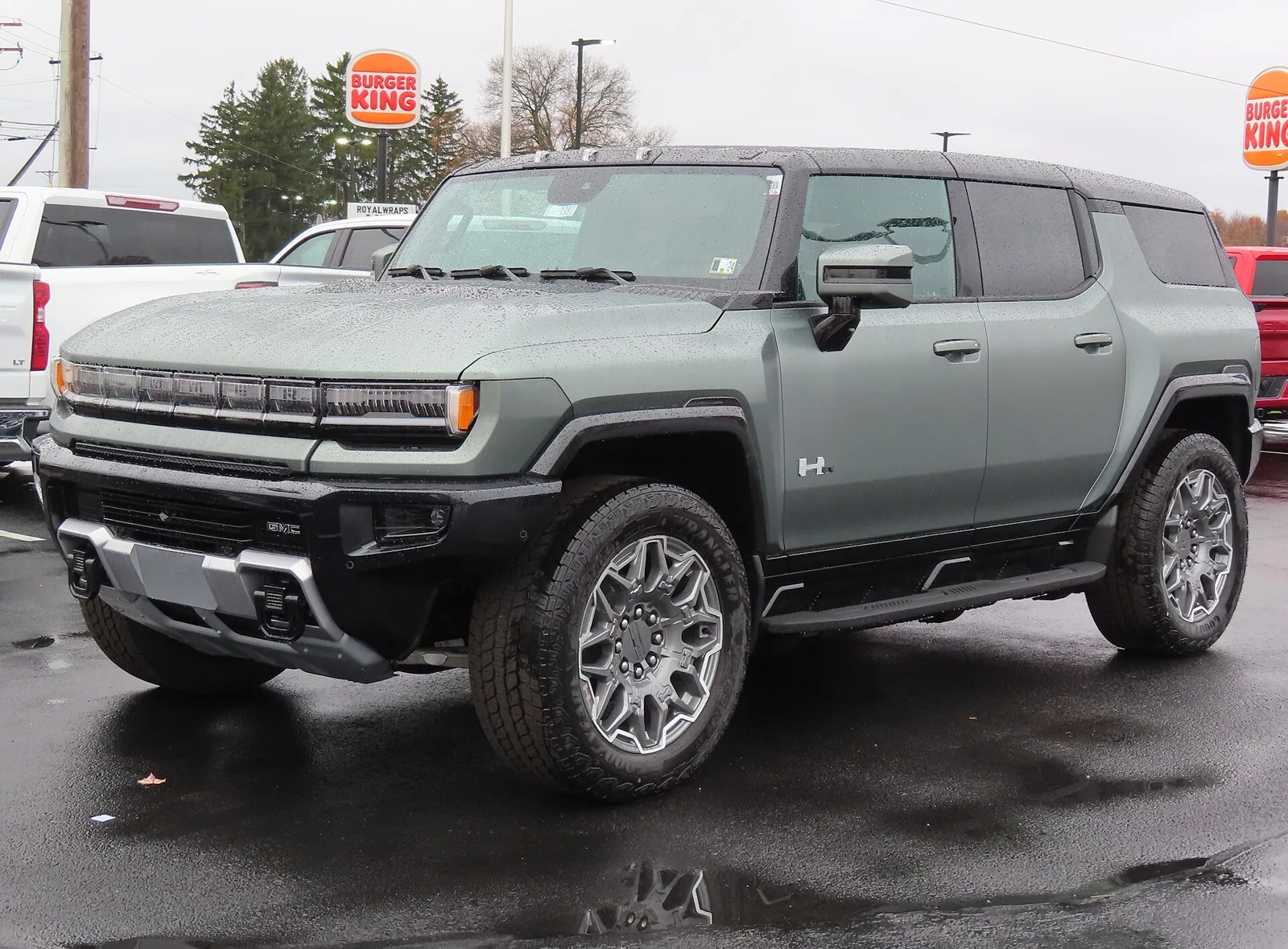
A truck built to follow tank tracks became a General Motors brand, closed in 2010 and returned as a 4,500 kg electric GMC pickup.
Hummer began in 1992 when AM General sold a civilian version of the M998 Humvee as the H1. General Motors bought the name, added the H2 and H3, then shut the brand in 2010. The name returned in 2020 as the electric GMC Hummer EV, a pickup and an SUV built in Detroit.
The first two civilian Hummer H1s ever sold went to Arnold Schwarzenegger. He had watched an army convoy roll past while filming Kindergarten Cop in Oregon, decided ordinary people ought to be able to buy one, and lobbied until AM General agreed.
That 1992 sale began a brand story with more turns than most: a military truck dressed for the road, a General Motors line-up of three models, a shutdown in 2010 after a Chinese buyer fell through, and a comeback in 2020 as an electric GMC pickup that weighs roughly 4,500 kg (10,000 lb). Hummer history is a tale of one idea stretched very far.
How the Hummer H1 became a civilian Humvee
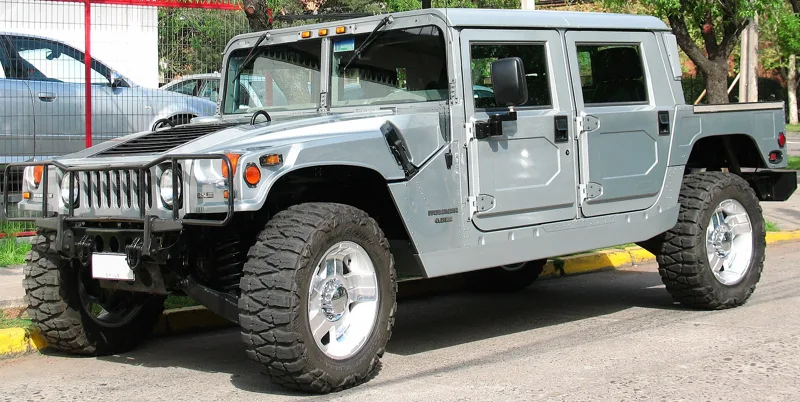
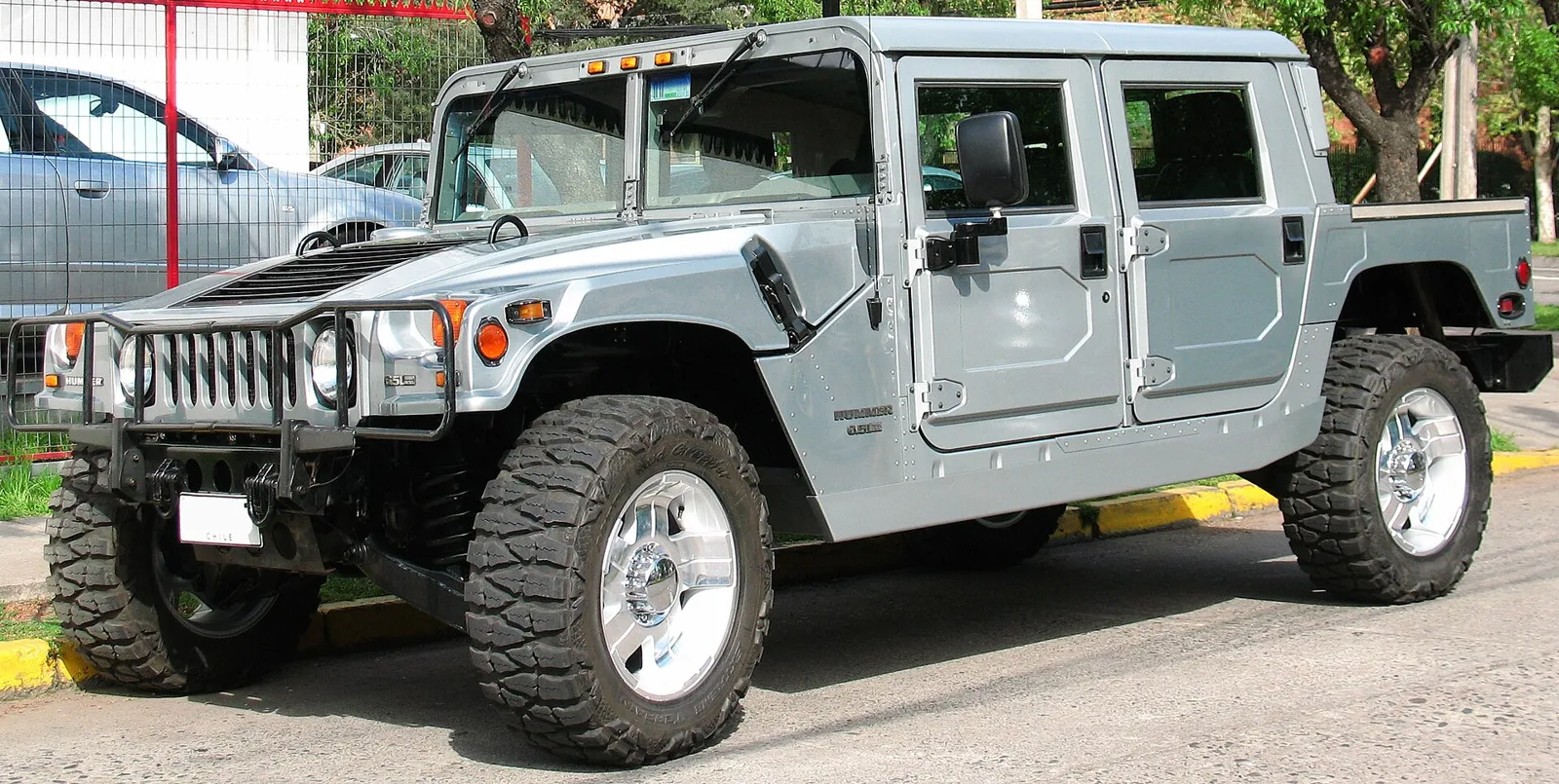
AM General had been thinking about a civilian Humvee since the late 1980s. The military truck, formally the High Mobility Multipurpose Wheeled Vehicle, won AM General a contract for 55,000 units on 22 March 1983, and it became a familiar sight in photographs from the Gulf War. Once that war ended, the company reworked the M998 version for the showroom with a 6.2-litre GM diesel V8.
The structure and most of the mechanicals stayed as they were. What changed was the finish: gloss paint, air conditioning, sound insulation, better upholstery, a stereo, wood trim and a range of convenience packages. The cabin still took its cues from semi-trucks.
The ownership story behind the truck is tangled. AM General designed it, while still part of American Motors, to a US military specification issued in 1979. Renault had taken a controlling interest in American Motors by 1982, and because US regulations barred foreign governments from owning defence contractors, AM General was sold to Ling-Temco-Vought in 1983. Chrysler acquired American Motors in 1987.
All of it was built at Mishawaka, Indiana, in a plant that opened in 1984 for the Humvee and began turning out H1s in 1992. Military and civilian trucks shared one assembly line, though the civilian ones were painted and finished in a separate building. Brakes, axles, frame and the major body panels, including the hood, tailgate and quarter panels, were common to both.
A truck wide enough to follow tank tracks became a road car, a General Motors brand and, in 2020, a 4,500 kg electric pickup.
What made the H1 so wide and so hard to stop
The H1 is 86.5 in wide for a reason that has nothing to do with showroom presence. The original Humvee had to be able to follow in the tracks that tanks leave behind, so the axles were set a long way apart.
Ground clearance is the clever part. The standard figure is 406 mm (16 in), and the engineers reached it by lifting the driveline into a wide channel running down the middle of the cabin rather than letting it hang beneath. Think of a raised spine with the seats on either side. The cost is space: despite the huge interior volume, the H1 seats only four.
Other tricks add to the height. Inboard brakes and portal gears let the half shafts sit higher, the radiator is mounted high and slopes over the engine beneath a forward-hinged hood, and the air intake is raised so the truck can wade through water at waist level. The H1 can ford 762 mm (30 in) and climb a 559 mm (22 in) step, with approach and departure angles of 72 and 37.5 degrees. A Central Tire Inflation System lets the driver run softer tyres off-road and firmer ones on the road.
Five engines and three automatic gearboxes were offered over the years, from a 5.7-litre gasoline V8 to the 6.2 and 6.5-litre GM diesels, with the 6.5 also available with a turbocharger.
The 2006 H1 Alpha and the end of the original
The last version was the most serious. The Alpha swapped the 6.5-litre diesel for a 6.6-litre Duramax turbodiesel and a five-speed Allison automatic, and it made 300 hp (220 kW) and 520 lb-ft (705 N-m). Fitting it took 23 engine component changes and a body lift of 2.0 in (51 mm). Cooled exhaust gas recirculation and an internal oil cooler meant 40% more heat rejection, so the cooling system was reworked too.
The update programme began in late 2002, and the first trucks were built in early 2005 and classed as 2006 models. There was no 2005 model year H1.
It did not last. General Motors announced that 2006 would be the final model year for the H1, and the Alpha programme was cancelled in May 2006 because sales of a vehicle priced at nearly $129,000 had not improved. Production ended that June, and new emission rules for diesel engines due in 2007 sat behind the decision. Only 448 Alphas were built between January and May 2005, followed by 281 from September 2005 to May 2006. The final H1s managed about 10 mpg-US (24 L/100 km).
The military side carried on, with Humvees built until 2018, and in 2017 VLF Automotive was contracted to assemble about 100 H1s from AM General kits. Sold as the Humvee C-Series, they were meant for Africa, Europe, the Middle East and China.
How General Motors built the Hummer brand
General Motors bought the Hummer name from AM General in December 1999. AM General went on building the trucks, while GM took over marketing and distribution, renamed the original model the H1 and set about creating siblings.
The Hummer H2 arrived as a more civilised wagon on a modified GMC Sierra 2500HD chassis. AM General assembled it under contract from 2002 to 2009 in a second Mishawaka plant, as either an SUV or an SUT pickup. The H3 went further from the military template. It was the smallest Hummer, built by General Motors rather than AM General on the GMT355 platform it shared with the Chevrolet Colorado and GMC Canyon, though GM said only 10% of the components were common.
GM also gave the brand a look of its own. Dealerships wore an oversized half Quonset Hut roof, themed on the military origins. By 2006 Hummers were sold through importers and distributors in 33 countries. GM began building the H3 at its Port Elizabeth plant in South Africa on 10 October 2006. The first trucks built there were left-hand drive only; right-hand drive versions followed, and they were exported to Australia, where Hummers were sold only through special dealerships.
Avtotor assembled the H2 in Kaliningrad from 2006 to 2009 for five Russian dealers, and third parties stretched the H2 into limousines carrying 14, 16 or even 22 passengers.
Hummer H1 vs H3 compared
| Feature | Hummer H1 | Hummer H3 |
|---|---|---|
| Built by | AM General, Mishawaka | General Motors, Shreveport and Port Elizabeth |
| Civilian production | 1992 to 2006 | 2005 to 2010 |
| Based on | M998 Humvee | GMT355 platform shared with Colorado and Canyon |
| Engines | 5.7-litre gasoline V8 up to 6.6-litre turbodiesel V8 | 3.5 and 3.7-litre straight-five, 5.3-litre V8 from 2008 |
| Most powerful engine | 300 hp (220 kW) | 300 hp (224 kW) |
| Ground clearance | 406 mm (16 in) | 246 mm (9.7 in) |
| Water fording | 762 mm (30 in) | 690 mm (27 in) |
| Approach and departure angles | 72 and 37.5 degrees | 37.4 and 34.7 degrees |
| Stability control | Not standard | Standard |
| Side airbags | Not standard | Side-curtain bags optional until 2008, then standard |
The two trucks share a badge and little else. The H1 is a military design softened for the road, while the H3 is a compact GM pickup platform given heavy reinforcement for off-road work.
The H3 launched with a 3.5-litre straight-five making 220 hp (160 kW). A 3.7-litre unit with 242 hp (180 kW) replaced it in 2007, and the 2008 Alpha added a 5.3-litre V8 with 300 hp and 434 N-m (320 lb-ft). Its full-time four-wheel-drive system had two speeds, and the optional Adventure or Off Road package brought 33-inch tyres, differential lockers and 4:1 low-range gearing. It could tow up to 2,722 kg (6,000 lb) with the V8, and a pickup version, the H3T, ran for the 2009 and 2010 model years.
Its safety record was mixed: the Insurance Institute for Highway Safety rated it Acceptable in frontal offset and side-impact tests but Poor for rear-crash protection and head restraints.
Why was the Hummer brand discontinued?
High oil prices cut demand for big SUVs, and then GM went into bankruptcy. A sale to Sichuan Tengzhong collapsed in February 2010 when approval from the Chinese government did not arrive, and General Motors then closed the brand.
The warning came on 3 June 2008, when GM chief executive Rick Wagoner said Hummer was under review and could be sold, rebuilt or ended. Two Indian automakers, including Mahindra and Mahindra, quickly showed interest. On 1 June 2009, as part of the bankruptcy announcement, GM said Hummer would be discontinued; the next day it reported a deal with a buyer that CNN and The New York Times identified as Sichuan Tengzhong Heavy Industrial Machinery. The price was put at $150 million.
The deadline slipped from January to the end of February 2010 while the buyer waited for Beijing. On 24 February 2010 GM announced the deal had collapsed. A fresh attempt involving Raser Technologies failed on 7 April 2010, and GM offered heavy rebates to clear the remaining 2,200 vehicles. The last H3 left the Shreveport line on 24 May 2010, after a rental-fleet order had been filled.
Criticism had followed the brand for years. The H1 and H2 are far bigger than other SUVs. The H2 weighs about 2,900 kg (6,400 lb) and, because it is built to a gross weight above 8,500 lb, its fuel economy is neither published by the US EPA nor counted toward fleet averages. One version was estimated at 14 mpg-US (17 L/100 km) on the highway and 10 mpg-US (24 L/100 km) in the city. The H1 lacks side airbags and stability control, and as a Class 3 truck it is exempt from many federal safety rules.
Racing and one-off Hummers
Team Hummer Racing was created in 1993 under off-road racer Rod Hall, entering the stock classes of Best in the Desert and SCORE with specialised shock absorbers, tyres and safety gear. Hall won his class in an H3 at the 2005 Baja 1000, and the team collected 11 production-class wins there. Robby Gordon took a heavily modified two-wheel-drive Hummer to the Dakar Rally, finishing third in 2009, and in 2010 he finished eighth in a purpose-built tube-frame H3.
Electric experiments came early. A plug-in H3 built by Raser and FEV in 2009 claimed up to 100 MPG equivalent, and Schwarzenegger, by then governor of California, showed it at the State Capitol in Sacramento.
How the GMC Hummer EV brought the name back
By mid-2019 rumours said GM would revive Hummer as off-road vehicles reached record sales. Mark Reuss, GM's president, answered a question that summer with the words "We're looking at everything." The rumours firmed up after the 2019 strike, when GM committed to retooling its Detroit-Hamtramck plant for electric trucks on a platform called BT1.
GM's documents listed the Cadillac Escalade IQ, the Chevrolet Silverado EV and a third product for an unnamed "M-Brand". The Hummer project carried the internal name Project O, and on 21 November 2019 chief executive Mary Barra confirmed an electric pickup for the fall of 2021 without naming the brand.
The reveal came in stages. GM released short videos on 30 January 2020, followed by a Super Bowl advertisement starring LeBron James. The truck was unveiled on 20 October 2020 during the World Series, and the SUV on 3 April 2021 during the NCAA Final Four. Hummer did not return as a standalone brand but as a model within GMC, and GM put $2.2 billion into the Detroit-Hamtramck plant, also called Factory Zero. Truck production began on 17 November 2021 and the SUV followed on 30 January 2023.
GMC Hummer EV trims, range and weight
The first model, the Edition 1 pickup, had three electric motors producing 1,000 hp (750 kW; 1,000 PS) and an EPA combined range of 529 km (329 miles). It came with the Extreme Off-Road package, including 35-inch mud-terrain tyres, skid plates and rock sliders, and it sold out in the first 10 minutes of pre-orders.
Four-wheel steering gives it a party piece called Crab Walk, which sends the truck diagonally, and an Extract Mode raises the suspension six inches (150 mm) for 400 mm (15.9 in) of ground clearance.
Later trims widened the line. The EV3X pickup offers the same 1,000 hp, with an EPA range of 329 miles with the off-road package and 355 miles on 22-inch wheels, while the EV3X SUV makes 830 hp and quotes 298 and 314 miles in the same two settings. The EV2X, with dual motors, was put at 625 hp (466 kW; 634 PS) and at least 480 km (300 miles), and the base EV2 at the same output and at least 400 km (250 miles). Acceleration to 97 km/h (60 mph) takes around three seconds.
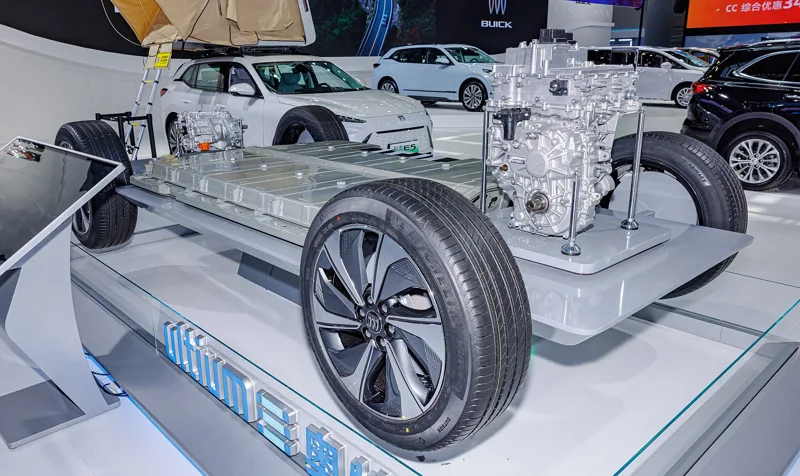
The truck weighs about 4,500 kg (10,000 lb), with the battery alone close to 1,400 kg (3,000 lb), and its gross weight rating of 4,700 kg (10,400 lb) makes it a Class 3 medium-duty truck in the United States. The SUV seats five, tows up to 3,400 kg (7,500 lb) and offers 1,020 L (35.9 cu ft) of luggage space behind the rear seats. The pickup has a longer wheelbase, a 1.5 m (5-foot) bed with a payload of 590 kg (1,300 lb) and a 320 L (11.3 cu ft) front trunk, which also stores the four removable roof panels.
It is built in Detroit with batteries from LG Chem in South Korea, in left-hand drive only. Autogroup International converts cars for right-hand-drive markets to the maker's standards. By the third quarter of 2022, 783 units had been delivered, and by October 2024 the total built stood at 14,039. A limited 2024 Omega Edition was capped at 550 pickups and 1,108 SUVs.
What a 10,000-pound electric truck means for buyers and other road users
The weight is the story. The truck is more than twice the weight of an average American car, and the Insurance Institute for Highway Safety checked that its equipment could cope before crash testing it, because it was about 1,600 kg (3,500 lb) heavier than any vehicle it had tested before. National Transportation Safety Board chair Jennifer Homendy has named heavy electric vehicles as more likely to kill or seriously injure other road users in a collision. GM replied that its customers' safety is a top priority regardless of propulsion or mass.
Licensing is a practical wrinkle. In the United States an ordinary licence is enough, but in Europe the truck sits 590 kg (1,300 lb) above the 3,500 kg (7,700 lb) limit for licences issued after January 1997, so a heavy goods licence may be required.
The environmental case is argued both ways. Critics note that buyers are expected to treat it as a second or third car, which undercuts the benefit of an electric drivetrain, and that its mass produces high levels of tyre and road-wear particles. Some have called it greenwashing, although others believe it may nudge more people into smaller electric vehicles. On the EPA test the Edition 1 returned 47 mpg-e combined, or 45 kWh/100 km.
The Hummer EV charger, batteries and racing sponsorship
GM planned for SUV models built from 2024 onward to carry a 19.2 kW onboard charger able to charge other electric vehicles, and it intended to begin producing the batteries in the United States. The EV2 was expected to reach customers in the spring of 2024, and GMC had committed to a multiyear sponsorship that began in January 2021, in which Chip Ganassi Racing competes in Extreme E with a Spark Odyssey 21 body styled as the Hummer EV.