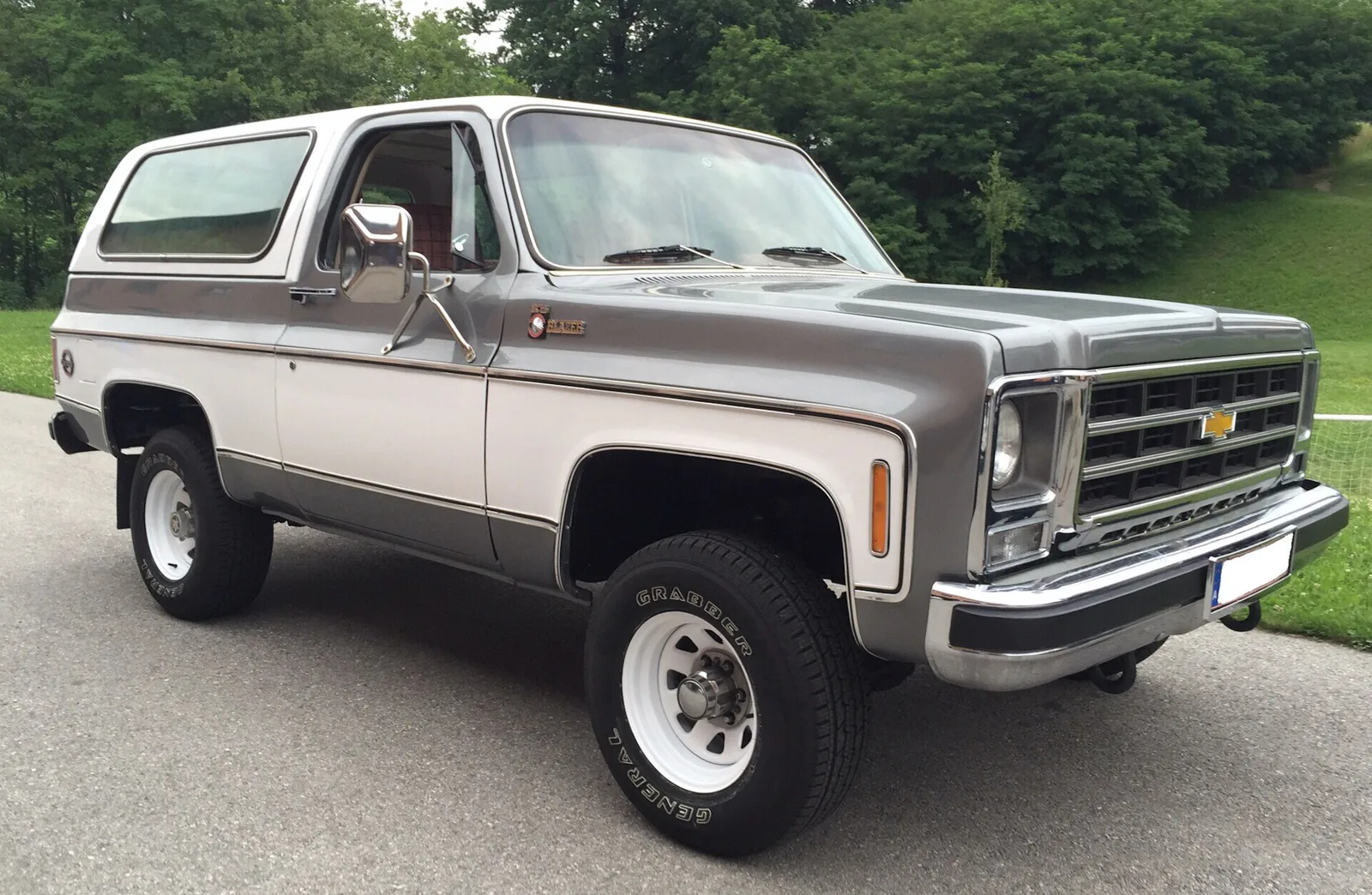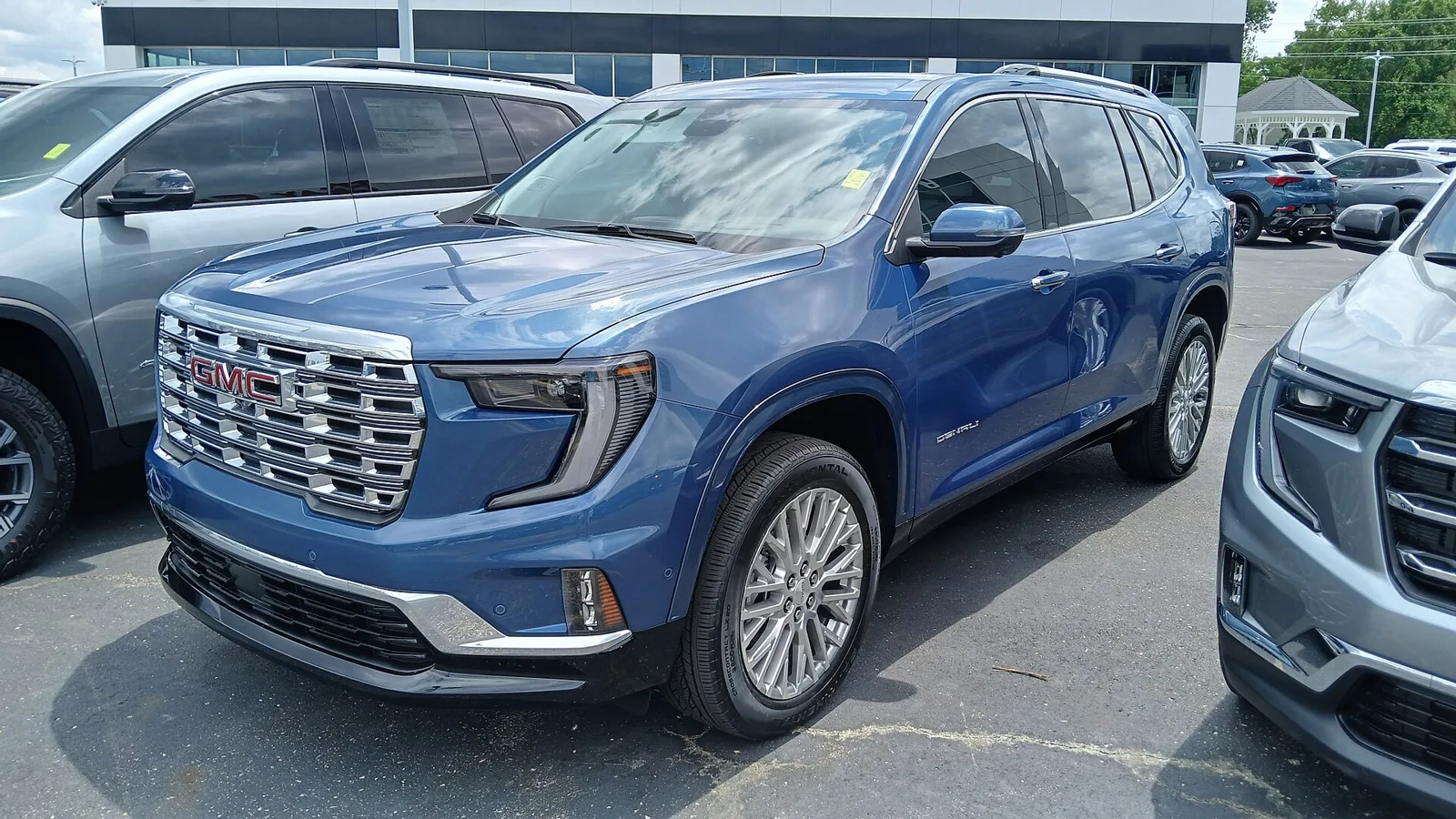
A body-on-frame Envoy that ended with a documentary, a compact Terrain that replaced a Pontiac, and an Acadia that has been resized twice.
The GMC Envoy was a body-on-frame mid-size SUV sold from 1998 to 2009, the Terrain is GMC's smallest crossover, and the Acadia is its three-row crossover. The Terrain and Acadia, both unibody, replaced the Envoy in the line-up.
The last vehicle to roll off the line at General Motors' Moraine Assembly in Ohio, on 23 December 2008, was a white GMC Envoy. HBO made a documentary about the plant's closing. The Envoy never got a direct successor. GMC moved its smaller SUVs onto unibody construction instead and introduced the Terrain and the Acadia, two crossovers that now define the brand's line.
What was the GMC Envoy?
The GMC Envoy was a mid-size SUV sold for the 1998 to 2009 model years in two generations. It used a nameplate GM Canada had previously carried. At first it was a trim of the GMC Jimmy, sold alongside the Chevrolet TrailBlazer; the second generation replaced the Jimmy outright.
The first generation, for 1998 to 2000, was the highest-trim Jimmy, offered only as a five-door. Like the Oldsmobile Bravada it had leather, a floor-mounted shifter and a mostly single-colour exterior. Extras not found on the regular Jimmy included a remote tailgate release, heated front seats, a Bose sound system and HID headlights. It had four-wheel ABS and front airbags as standard, but scored Poor in the IIHS frontal offset crash test.
The Envoy ended in a closing factory; the Terrain and Acadia took its place on unibody platforms.
How was the second-generation Envoy built?
The second-generation Envoy arrived in early 2001 as a 2002 model, using the body-on-frame GMT360 architecture. That chassis ended the link with GM's compact pickups and was designed for SUV use, with hydroformed frame rails that are fully boxed along their length.
Wheelbase grew to 113 inches, six more than the first generation, and an extended version sat on 129 inches, one inch shorter than the Yukon XL. The front suspension was a double-wishbone layout with Bilstein dampers, and the rear a five-link solid axle with optional load-levelling air suspension. Four-wheel disc brakes became standard.
The 4.2-litre Vortec inline-six replaced the 4.3L V6 and made 270 hp, 80 more than its predecessor. It was GM's first inline-six in North America since 1984, and Ward's named it one of its 10 Best Engines from 2002 to 2005. A 5.3L V8 with 290 hp was optional from 2003, and in 2005 it gained Displacement on Demand, which runs on four of eight cylinders at low load, lifting output to 300 hp.
Rear-wheel drive was standard, with the choice of permanent two-wheel drive or a Shift On-Demand 4x4 system that offered two-wheel drive, automatic four-wheel drive, and high and low range, the latter with a 2.69:1 reduction. Two rear axles were offered, a Posi-Trac limited-slip and an Eaton automatic locker. Motor Trend named the Envoy its Sport/Utility of the Year for 2002.
Which Envoy trims and variants existed?
The Envoy came in three trims. The SLE was the base car from 2002 to 2009, the SLT added luxury and convenience, and the Denali, offered from 2005 to 2008, topped the range. Two body variants stretched the line: the long Envoy XL and the unusual Envoy XUV.
The SLE came with full power equipment, keyless entry, cloth seats, OnStar, alloy wheels, a full-size spare and the 4.2-litre six with a four-speed automatic. The SLT added a six-disc CD changer, Bose audio, leather, heated front seats, a Driver Information Center, a dual-zone automatic climate system and driver memory settings. The Denali brought the 5.3L V8, a two-tone leather interior, chrome-plated wheels, a power moonroof and satellite radio.
The Envoy XL, built from 2002 to 2006, was sixteen inches longer in wheelbase and length, with a raised roofline over a third row. It bridged the gap between the Yukon and Yukon XL. Its derivative, the Envoy XUV, was sold in 2004 and 2005. It was a five-passenger vehicle with a retractable rear roof and a midgate like the Chevrolet Avalanche, which turned the rear into a plastic-lined cargo area that could be hosed clean. It echoed the 1960s Studebaker Wagonaire and the 2001 GMC Terracross concept, but sales fell far below projections and GM ended it before the end of the 2005 model year.
How did the Envoy change from year to year?
Changes were modest. For 2003 GMC sold options individually to cut the price, and side airbags became optional. A 22-gallon fuel tank arrived on all versions. In 2005 the Denali joined the range after the Oldsmobile Bravada was discontinued, and optional side-curtain airbags replaced side airbags, covering all three rows in the XL.
Stabilitrak stability control became standard for 2006, when the XUV was dropped. The XL was discontinued for 2007, making every Envoy a five-seater. Side-curtain airbags turned standard in 2008, and Bluetooth became an option for 2009, the final year. In 2012 GM recalled more than 258,000 SUVs from 2006 and 2007, including the Envoy, TrailBlazer, Rainier, Ascender and 9-7X, over short circuits in power window and door lock switches that posed a fire risk.
Moraine Assembly ended production on 23 December 2008, and Oklahoma City had closed too. Chevrolet later revived the TrailBlazer name, but no GMC counterpart followed, and the Envoy name remains retired. The Terrain largely took over its role.
What is the GMC Acadia?
The Acadia is a crossover SUV that GM builds for GMC. It reached showrooms in the United States, Canada and Mexico in 2006, badged as a 2007 model. The first generation shared the Lambda platform with the Saturn Outlook, Chevrolet Traverse and Buick Enclave, and it took over from the GMC Safari, the Envoy and the Pontiac Montana SV6.
It was GMC's first unibody vehicle and its first front-wheel-drive passenger vehicle since the 1973-78 Motorhome. Pontiac was meant to sell it; GMC took it over after the styling was essentially done. It seats eight, offers front- or all-wheel drive and can tow 5,200 lb (2,359 kg), placing it between the Terrain and the Yukon.
In December 2006, production and sales stopped briefly because engine mounts had no drilled holes to release water and some rivets in the load floor could be faulty; the assembly process was adjusted and sales resumed within days.
What powered the first Acadia?
The first Acadia used the LY7 V6, the engine introduced in the Cadillac CTS, rated at 205 kW (275 hp) and 350 N m (258 lb ft) and teamed with a GM-Ford six-speed automatic. The direct-injected LLT replaced it for 2009, making 215 kW (288 hp), and by the 2016 Acadia Limited the output stood at 231 kW (310 hp) with torque of 367 N m (271 lb ft).
The 2008 car had a 118.9-inch (3,020 mm) wheelbase, MacPherson strut front suspension and an H-linked rear. A head-up display was available and standard on the Denali, which arrived as a 2011 model and was the first GMC crossover to carry the badge. It added a honeycomb grille, HID headlamps and six-spoke 20-inch wheels. Unibody construction lowers the centre of gravity relative to truck-based GM SUVs, high-strength steel reinforces the structure, and six airbags include a rollover-detection system. OnStar was standard.
For 2013 GM unveiled a facelifted Acadia at the 2012 Chicago show, which took the body shell of the discontinued Saturn Outlook, with a new grille and liftgate. Forward Collision Alert and Lane Departure Warning arrived for 2014, standard on the Denali. The first generation lived on for the 2017 model year as the Acadia Limited, mostly for rental and fleet buyers, and production ended on 31 March 2017.
Why did the second Acadia shrink?
GM resized the Acadia to mid-size for its second generation, which made its official debut on 12 January 2016 at the North American International Auto Show. Showrooms received it in May 2016, as a 2017 model. Length fell from 200.8 in (5,100 mm) to 193.6 in (4,917 mm), and width from 78.9 in (2,004 mm) to 75.4 in (1,915 mm), cutting 700 pounds (320 kg).
The Acadia stayed above the Terrain, and the MSRP dropped to $29,995. It gained 5, 6 and 7 passenger layouts instead of eight seats, a 2.5-litre or 3.6-litre engine, and a GKN Driveline twin-clutch all-wheel-drive system for the All-Terrain package. It shares its platform with the Cadillac XT5. Fuel economy with the V6 rose to 18 mpg-US (13 L/100 km) city and 25 mpg-US (9.4 L/100 km) highway, and a reminder to check the rear seats was introduced to help prevent children being left in hot cars. The IIHS did not award it Top Safety Pick because both headlight setups were rated Marginal.
What was the Holden Acadia?
The Holden Acadia was the right-hand-drive version sold in Australia and New Zealand from 12 November 2018, built in Tennessee and marketed as a full-size crossover. It was chosen for export because it was smaller than the Chevrolet Traverse and Buick Enclave. A planned 2020 update was cancelled when Holden was phased out in 2020, and 5,157 were sold.
What changed in the Acadia from 2020?
The 2020 facelift brought a grille inspired by the 2019 Sierra 1500, a revised infotainment system, the new AT4 trim, a 2.0-litre turbo four and a push-button Electronic Precision Shift with a new nine-speed automatic. It went on sale in autumn 2019. Wireless smartphone mirroring and an Elevation Edition with 20-inch wheels followed for 2021.
For 2022 GMC dropped the 2.5-litre engine, making the turbocharged 2.0-litre LSY standard and leaving the 3.6-litre V6 as an option. The base SL trim and the five-passenger layout disappeared.
How big is the third-generation Acadia?
The 2024 Acadia was revealed at the 2023 North American International Auto Show and sized back up to full-size to compete better among three-row crossovers. It seats seven or eight and shares its wheelbase with the larger Yukon.
It rides on the VSS-S platform with the third-generation Chevrolet Traverse and has one engine, a 2.5-litre turbocharged four-cylinder with 245 kW (328 hp) and 442 N m (326 lb ft).
What is the GMC Terrain?
The Terrain is the smallest GMC, a crossover that sits below the Acadia. Its platform is common with the Chevrolet Equinox: Theta for the first generation, Delta for the later ones. It indirectly replaced the Pontiac Torrent when GM dropped the Pontiac brand.
The first Terrain appeared at the New York show in April 2009, as a 2010 model. Where the Torrent had been a rebadged Equinox, GM chose to differentiate the Terrain's look. It came in SLE and SLT trims, with a Denali added for 2013 and a low-end SL for 2015. Early models offered a 2.4-litre four and a V6 that grew from 3.0 to 3.6 litres for 2013. A 2016 refresh, shown at the 2015 New York show, brought new front and rear fascias, a power dome hood and LED daytime running lights, and the 2017 Nightfall edition replaced chrome with gloss black.
Did the Terrain ever run on natural gas?
Yes. In 2013 Nat G CNG Solutions of Houston and AGA Systems of Salt Lake City began offering a bi-fuel compressed natural gas version of the Terrain, and of the Equinox, using the 2.4-litre direct-injection engine. The US EPA had never before approved a direct-injection natural gas vehicle.
Nat G sold a two-seat cargo version with a combined range of 837 miles (1,347 km) and a five-seat passenger version with 775 miles (1,247 km). The companies claimed 31 mpg-US (7.6 L/100 km) on natural gas on the highway. Silver Eagle Distributors, the largest distributor of Anheuser-Busch products in the nation, was the launch customer with an initial order of up to 100.
In March 2022 GM recalled over 740,000 Terrains from 2010 to 2017 because the headlights were excessively bright, with a fix in October 2022 that cleaned the lights and applied a translucent decal. The 2010 Terrain was an IIHS Top Safety Pick with a roof that can withstand four times the vehicle's weight.
How did the second-generation Terrain change?
The second-generation Terrain was unveiled on 8 January 2017 as a 2018 model and went on sale that summer with three turbocharged four-cylinder choices, including a diesel. All models had a folding front passenger seat for loads up to eight feet long, and a seven-inch touchscreen with Apple CarPlay and Android Auto.
Changes followed quickly. In 2019 GMC added Dark Accent and Black Edition packages and adaptive cruise control; in 2020 it dropped the diesel and made automatic emergency braking and lane-centering standard; and in 2021 the 2.0-litre turbo was dropped for low demand, leaving the 1.5-litre as the only engine. A facelift shown at the 2020 Chicago show was cancelled in March 2020 after production issues and the COVID-19 recession, then went on sale in summer 2021 as a 2022 model with the new AT4 trim. The Denali and AT4 are all-wheel drive only. A 2023 update of the 1.5-litre brought a higher-pressure fuel system and electro-hydraulic braking, and 2024 was the generation's final year.
What is the third-generation Terrain like?
General Motors unveiled the third-generation Terrain on 12 August 2024, and production began on 14 October 2024 at San Luis Potosi in Mexico. Its more rugged, truck-like look aligns it with the rest of the GMC range, with C-shaped light signatures, a grille like GMC's larger trucks and standard 17-inch wheels.
Inside there is a 15-inch-diagonal infotainment screen, an 11-inch driver display, a column-mounted shifter, up to eight camera views and 5G Wi-Fi, but the folding passenger seat has gone. The powertrain is a 1.5-litre turbo with up to 174 hp, 184 lb-ft in front-drive form or 203 lb-ft with all-wheel drive, paired to a continuously variable transmission or an eight-speed automatic. It launched in Elevation trim with all-wheel drive only, with the AT4 and Denali arriving for 2026, and for 2027 the CVT was discontinued so that all models use the eight-speed automatic.
How do the three GMC models compare?
| Model | Years | Layout | Engines over time |
|---|---|---|---|
| Envoy | 1998 to 2009 | Body-on-frame, mid-size SUV | 4.2 L inline-six 270 hp; 5.3L V8 290 to 300 hp |
| Terrain | 2010 on | Unibody compact crossover | 2.4 L four and V6; later 1.5 L turbo, up to 174 hp |
| Acadia | 2007 on | Unibody three-row crossover | 3.6 L V6 275 hp; now 2.5 L turbo 328 hp |
What are the latest changes to the Terrain and Acadia?
The third-generation Terrain is the newest of the three. The AT4 and Denali trims reached it for 2026, both with all-wheel drive only, and for 2027 GM discontinued the continuously variable transmission in favour of the eight-speed automatic across the range.
The Acadia continues with its single turbocharged 2.5-litre engine and a wheelbase shared with the Yukon, while the Envoy nameplate remains retired.