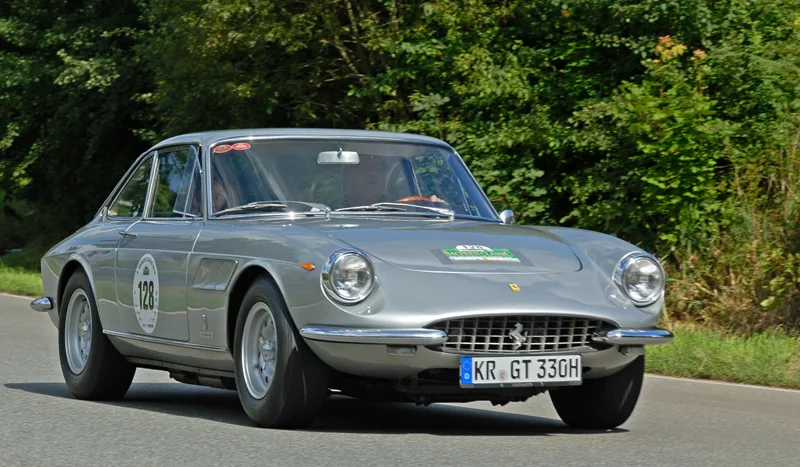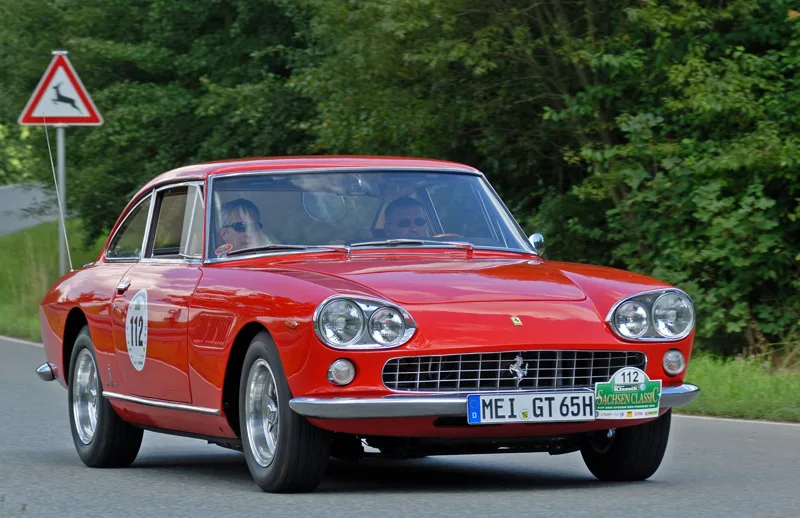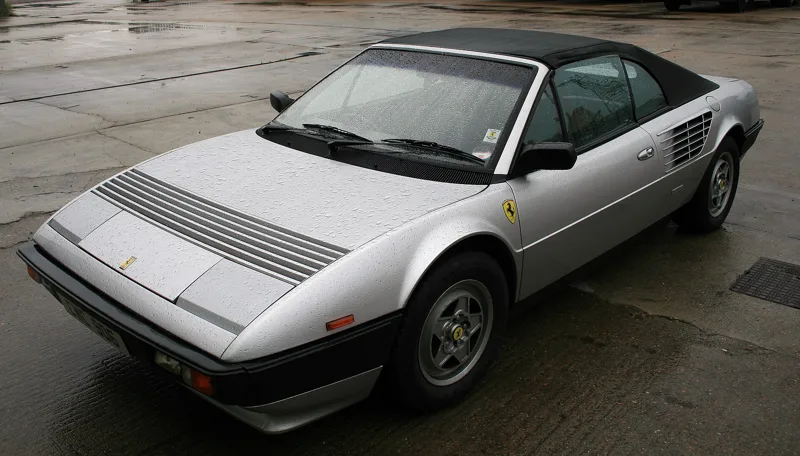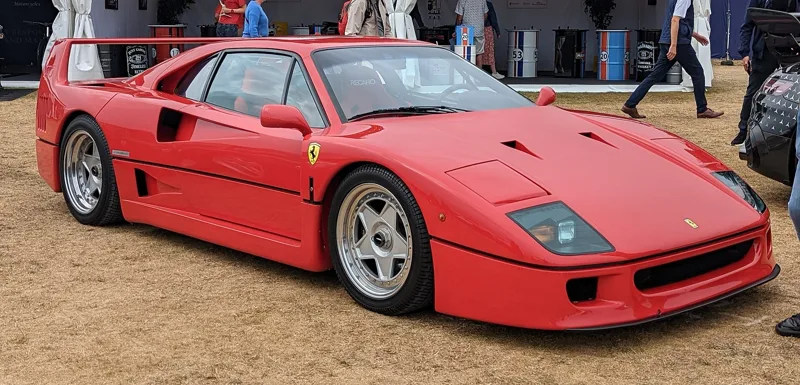
Four decades of 2+2 Ferraris: from the 1964 330 GT to the first automatic 400 and the 456 that restarted the line in 1992.
Ferrari's four-seat grand tourers began with the 330 GT 2+2 in 1964 and continued through the 365 GT4 2+2, 400, 400i and 412 until 1989. The 456 revived the formula in the early 1990s with a 5.5 L V12, and the 456M ended it in 2003.
Ferrari fitted an automatic gearbox to a car for the first time in 1976, with the 400, and yet it never officially sold that car in the United States. Enzo Ferrari believed that tightening environmental and safety rules and a 55 mph national speed limit meant the company's eight-cylinder cars would do the job there. The V12 four-seaters, from the 330 GT of 1964 to the 456 that ended in 2003, were therefore built for Europe, and grey importers brought many of them in anyway.
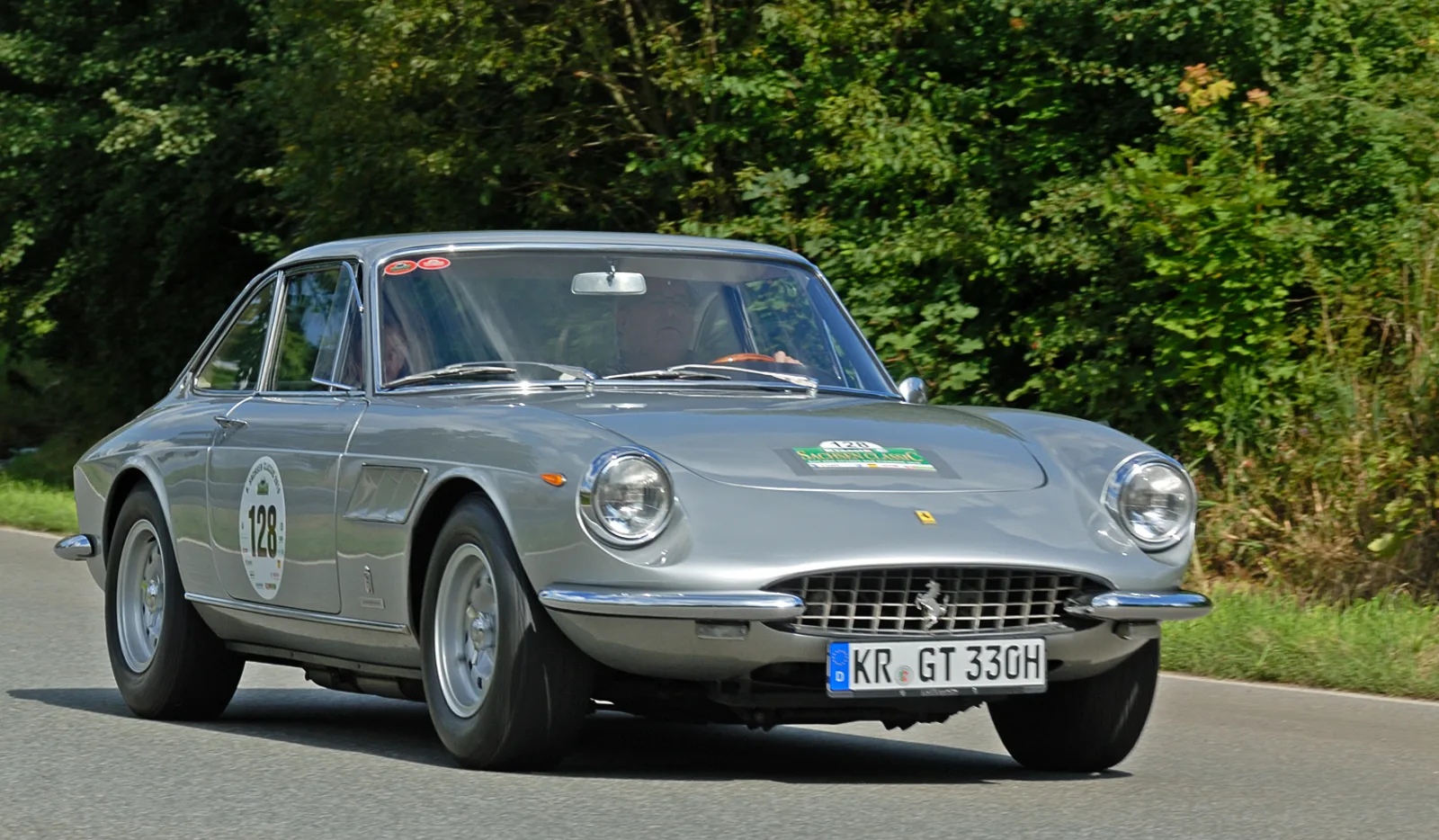
Ferrari 330 GT: the 2+2 that replaced the America
The 330 name was applied to a whole family of V12 cars from 1963 to 1968, in 2+2 coupe, two-seat berlinetta, spyder and race versions. It followed Ferrari practice: the number is the approximate displacement of each cylinder in cubic centimetres. All 330s used an evolution of the 4.0 L Colombo V12 of the 400 Superamerica, with an unusual 77 mm by 71 mm bore and stroke, wider bore spacing and an alternator in place of a generator.
The first was the 330 America of late 1963, essentially the outgoing 250 GT/E with the new 4.0 L Tipo 209 engine, which gave 300 PS (220 kW) at 6600 rpm. Only 50 were built before the real car replaced it in January 1964.
That car, the 330 GT 2+2, was first shown in Brussels. It was a different car from a re-engined 250: nose and tail were sharper, there were four headlights and the grille was broad. Power stayed at 300 PS (220 kW), the wheelbase grew by 50 mm (2.0 in), Koni adjustable dampers sharpened handling, and a dual-circuit Dunlop braking system put discs on all four wheels. In 1965 the Series II brought a five-speed gearbox instead of an overdrive four-speed, a return to twin headlamps, alloy wheels and optional air conditioning and power steering. Before then, 125 interim cars combined quad lamps with the five-speed. By the time the 365 GT 2+2 took over in 1967, 625 Series I (including the interim cars) and 455 Series II had been built.
The first Ferrari with an automatic gearbox was a four-seater that was never officially sold in America.
Odd 330s: Prince Bernhard, a shooting brake and the GTC
A one-off 330 GT 2+2 with a Ferrari 500 Superfast-style body was made for Prince Bernhard of the Netherlands and sold at a Bonhams Geneva auction in December 2003 for CHF 422,100. In 1967 the Ferrari importer Luigi Chinetti Jr. turned a 1965 Series II into a shooting brake, working with the American illustrator Bob Peak, and the car was built at Vignale in Turin. Painted metallic green with a gold roof, it was shown at the 50th Torino Motor Show. It failed to sell at Pebble Beach in 2017 against a $700,000 to $900,000 estimate and fetched $313,000 at the 2018 Petersen Museum sale.
The 330 GTC and GTS were closer to the 275 than the 2+2, sharing its short wheelbase and independent rear suspension. They were quieter and easier to drive than earlier Ferraris, probably the first in which a radio could actually be enjoyed. The Pininfarina-bodied GTC coupe was introduced at Geneva in March 1966 and the GTS spider at Paris that October, with about 600 coupes and 100 spiders built before the 365 versions arrived in 1968.
Four 330 GTC Speciale coupes by Pininfarina appeared in 1966, with bodywork borrowing from the 365 California, and Swiss specialist Felber built six or seven retro roadsters called the FF on 330 GTC underpinnings between 1974 and 1977.
Ferrari 330 LMB and 330 P: the race cars
The same engine powered racers. Ferrari built four 330 LMB prototypes in 1963, the letters standing for Le Mans Berlinetta, developed from the 250 GTO with a 390 hp (291 kW) four-litre engine at 7,500 rpm and a structure from the 250 Lusso. They raced little, because Ferrari was moving to mid-engined cars. One retired at Sebring, and at Le Mans two of three starters retired while Jack Sears and Mike Salmon brought their car home fifth. The mid-engined 330 P, P2, P3 and P4 followed in the mid-1960s; the P4 had 450 hp at 8000 rpm, weighed 792 kg and reached 320 km/h.
Ferrari 365 GT4 2+2: Fioravanti's three-box coupe
The Tipo F101 family ran from 1972 to 1989. The 365 GT4 2+2 debuted at the Paris Motor Show a year after the 365 GTC/4 it replaced. The name counts 365 cc per cylinder, four overhead camshafts and the 2+2 seating. Leonardo Fioravanti at Pininfarina drew a three-box shape, a clear break from the fastback predecessor, and it was the second Ferrari after the Daytona to wear the swage line splitting the body in two.
The tubular steel chassis was the GTC/4's with the wheelbase stretched 200 mm (7.9 in) to 2,700 mm (106.3 in). Pininfarina built the steel bodies, with fibreglass floors, in Turin and shipped them to Modena finished. Double wishbones and a hydraulic self-levelling rear axle looked after the ride. The V12 of 4,390 cc breathed through six side-draft Weber carburettors for 340 PS (250 kW) at 6200 rpm, and drove through a five-speed manual. Leather, electric windows and air conditioning were standard, and 524 were produced, including three prototypes.
Ferrari 400i and the first automatic
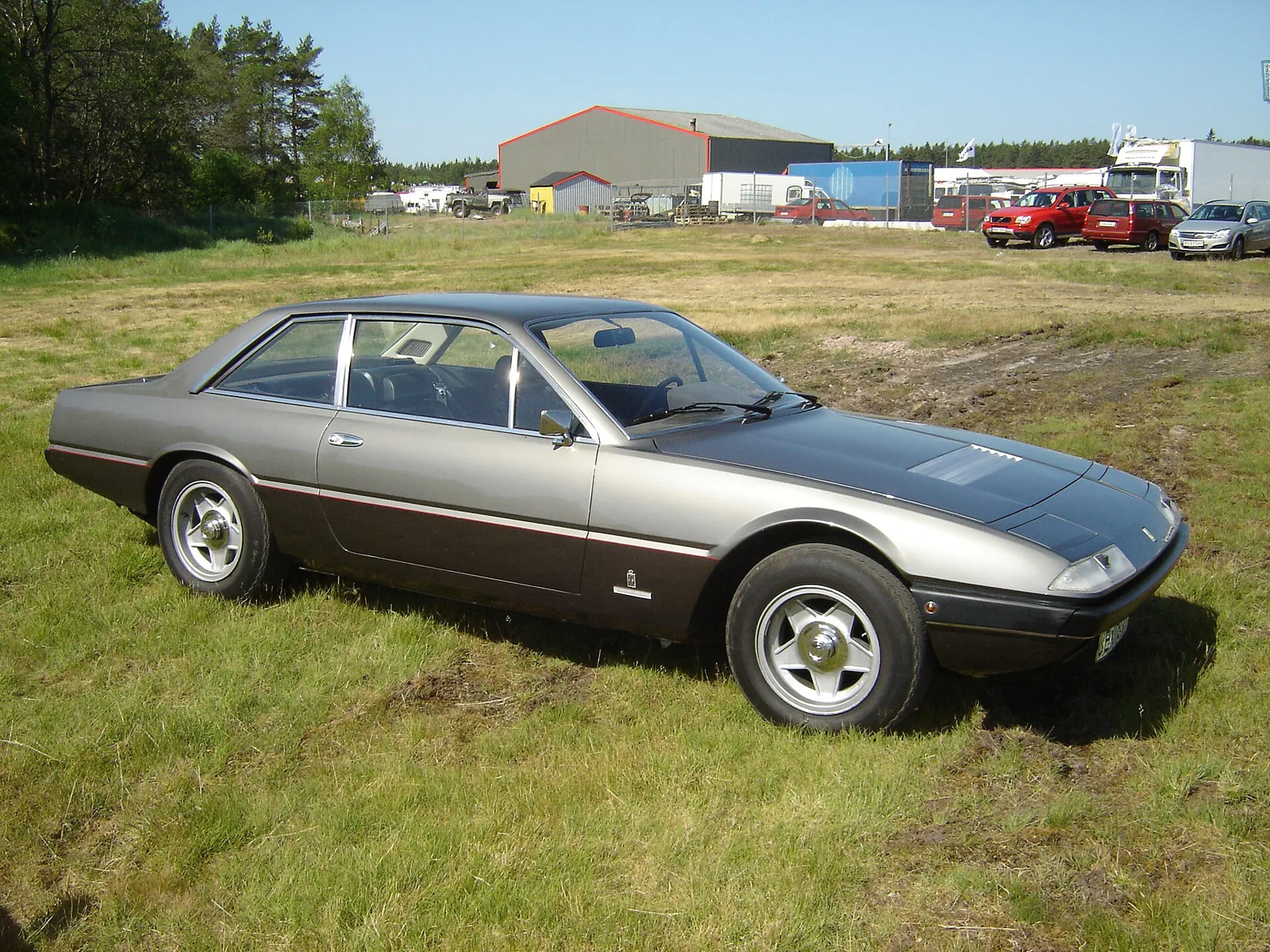
At Paris in 1976 Ferrari unveiled the 400, in two forms: the 400 Automatic with a General Motors three-speed THM400 gearbox, the first automatic in a Ferrari, and the 400 GT with a five-speed manual. The V12 was stroked to 4,823 cc, still giving 340 PS (250 kW), and the car reached 60 mph in 7.1 seconds. Five-stud wheels replaced knock-off hubs and the tail lights became double circular units. Of 502 built, 355 were Automatics and 147 GTs.
The 400 i of 1979 swapped carburettors for Bosch K-Jetronic fuel injection. Power dropped to 310 PS (228 kW; 306 hp), as in the injected 308s, but emissions improved enough to meet US standards and the top speed was 240 km/h (149 mph). New camshaft profiles and exhaust headers lifted output to 315 PS (232 kW) towards the end of 1982, when the interior was revised with new electronic switchgear and the exterior gained a narrower grille and Michelin TRX tyres. Production totalled 1305, with 883 Automatics and 422 GTs.
Despite its US-compliant engine, no version was ever imported officially. Coachbuilders such as Pavesi and Straman converted 400s to convertibles, and in 1981 Felber showed a shooting brake named the Croisette at Geneva.
Ferrari 412: end of a long run
Launched in April 1985, the 412 had its engine bored out by 1 mm to 4,943 cc, which gave the new name. Both manual and automatic gearboxes stayed, and exterior badges no longer showed which was fitted. Bosch ABS was offered for the first time on a Ferrari. A raised rear deck gave more luggage space, the bumpers were body-coloured, and side window trim turned black.
Of 576 built, 270 were manual. The 412 closed Ferrari's longest-ever production series in 1989, and the mid-engined Mondial was left as the single Ferrari with 2+2 seating until the front-engined V12 returned in 1992.
Opinions have been mixed. Enthusiasts regard it as a classic thanks to its Pininfarina lines and low production, but it ranked 18th in the BBC's Crap Cars book and Jeremy Clarkson was scathing about it on Top Gear. In CAR in August 1984, the writer L. J. K. Setright ranked its body among the most beautiful and elegant ever to leave Pininfarina.
Ferrari 456: the return of the V12 2+2
The 456 was introduced in October 1993, with production dated from 1992, and styled by Pietro Camardella at Pininfarina, drawing heavily on the 365 GTB Daytona. The GT used a six-speed manual, while from 1996 the GTA offered a four-speed automatic developed with FF Developments of Livonia, Michigan. That gearbox was the last conventional torque-converter automatic Ferrari ever offered.
The engine was a 5,473.91 cc (5.5 L) 65-degree V12 descended from the Dino V6, not from the 60-degree V12s of the 412 and Daytona, rated at 325 kW (442 PS; 436 hp). No regular production Ferrari road car had been stronger. Ferrari claimed 309 km/h (192 mph) for the 1,690 kg (3,726 lb) car, which made it the world's second fastest production four-seater after the Porsche 959, and 0-97 km/h in 4.8 seconds. The name came from the 456 cc per cylinder, a convention not used again until the 488 GTB.
A tubular steel space-frame carried aluminium panels welded on using a special filler called feran. Pininfarina built 1,435 bodies before production moved to Ferrari in 1996.
| Model | Introduced | Engine | Built |
|---|---|---|---|
| 330 GT 2+2 | January 1964 | 4.0 L V12, 300 PS (220 kW) | 625 Series I, 455 Series II |
| 365 GT4 2+2 | 1972 | 4,390 cc V12, 340 PS (250 kW) | 524 |
| 400 | 1976 | 4,823 cc V12, 340 PS (250 kW) | 502 |
| 400 i | 1979 | Fuel-injected V12, 310 PS (228 kW) | 1305 |
| 412 | April 1985 | 4,943 cc V12 | 576 |
| 456 | October 1993 | 5.5 L V12, 442 PS (325 kW) | 1,951 |
Ferrari 456M and the special 456s
The 456M, for Modificata, was shown at Geneva in March 1998. It brought better aerodynamics and cooling, a refreshed interior with three gauges instead of five, front suspension arms revised to reduce dive and 330 mm front discs from the 550 Maranello. A fixed spoiler replaced the old motorised one, the car grew 33 mm (1 in) longer, and its bonnet was the first commercial use of carbon fibre by Ferrari. Power stayed at 442 PS (325 kW). It was the last Ferrari with pop-up headlamps.
The 2002 Geneva show car, the 456 Bicolore Scaglietti, was commissioned by Michael Schumacher, who was then a Ferrari Formula One driver. It had grey roof, mirrors and wheels, grey leather trim with red stitching, a 354 km/h (220 mph) speedometer and cross-drilled Brembo brakes. Thirty were produced, ten with a manual gearbox.
Beyond the regular 2+2, customers could request unusual bodies. At least three four-door saloons were built for the Sultan of Brunei, and seven five-door estates called the Venice were commissioned by his brother, Prince Jefri Bolkiah, who bought six: the first Ferrari estates ever. Two Spyders were made for the Sultan, and the California firm R. Straman converted three cabriolets, one bought by the boxer Mike Tyson.
How many 456s were built, and how quick they were
Total 456 production reached 3,289: 1,951 original cars (1,548 GT and 403 GTA) and 1,338 456Ms (688 GT and 650 GTA). Ferrari's own figures for the GT were 309 km/h (192 mph) and 0-100 km/h in 5.2 seconds, with the GTA at 5.5. Car & Driver recorded 4.8 seconds to 97 km/h for a 1995 GT, a 13.3-second quarter-mile and 0.89 g of lateral acceleration. Road & Track found 5.1 seconds, and Motor Trend 4.9 seconds for a 1997 GTA.
The 5.5 L V12 took the International Engine of the Year prize for engines over 4 litres in both 2000 and 2001, and some regard it as one of Ferrari's more reliable engines.
Where this goes next
The 456 ran to 2003, and the 456M was replaced in 2004 by the 612 Scaglietti. The 550 Maranello of 1996 used a further development of the 456 engine and became the strongest naturally aspirated production Ferrari apart from the 456 itself.