From a 60 kW boost in 2009 to a completely new rulebook in 2026, with Audi and Honda among the builders.
An F1 power unit pairs a combustion engine with electric motor-generators that recover energy, a design descended from KERS, which began at 60 kW in 2009. The 2026 specification is entirely new. Audi builds its own unit in Bavaria, and Honda returns as Aston Martin's works partner.
The electric side of a Formula 1 power unit began in 2009 as a 60 kW boost that teams were free to ignore, and only four of them used it at any point that year. For 2026 the sport has a completely new specification, with Audi and Honda among the builders.
What is an F1 power unit?
A Formula 1 power unit is the combustion engine plus the electric machines that work with it. The name has been in use since the hybrid era began in 2014, when the sport settled on four-stroke, turbocharged 1.6-litre V6 engines with a 90-degree angle between the cylinder banks and twin overhead camshafts, paired with energy recovery.
Two electric motor-generators do the recovering. The MGU-K is connected to the crankshaft at a fixed ratio: it turns braking energy into electricity, then acts as a motor to return the energy as drive. The MGU-H sits on the shaft joining the turbocharger's exhaust turbine to its intake compressor, where it can tap energy that would otherwise leave through the exhaust. Picture a water wheel that turns a mill and, with a dynamo bolted to its axle, makes electricity as well.
Those are the arrangements of the 2014 to 2025 period. Engine specifications, including the control software and a maximum price of 15,000,000 euros per engine charged to teams, were frozen for most of that time, mostly from 2023. In 2026 a completely new specification came into effect.
Honda officially left after 2021 but kept supplying Red Bull until the end of 2025
Where did the electric boost come from?
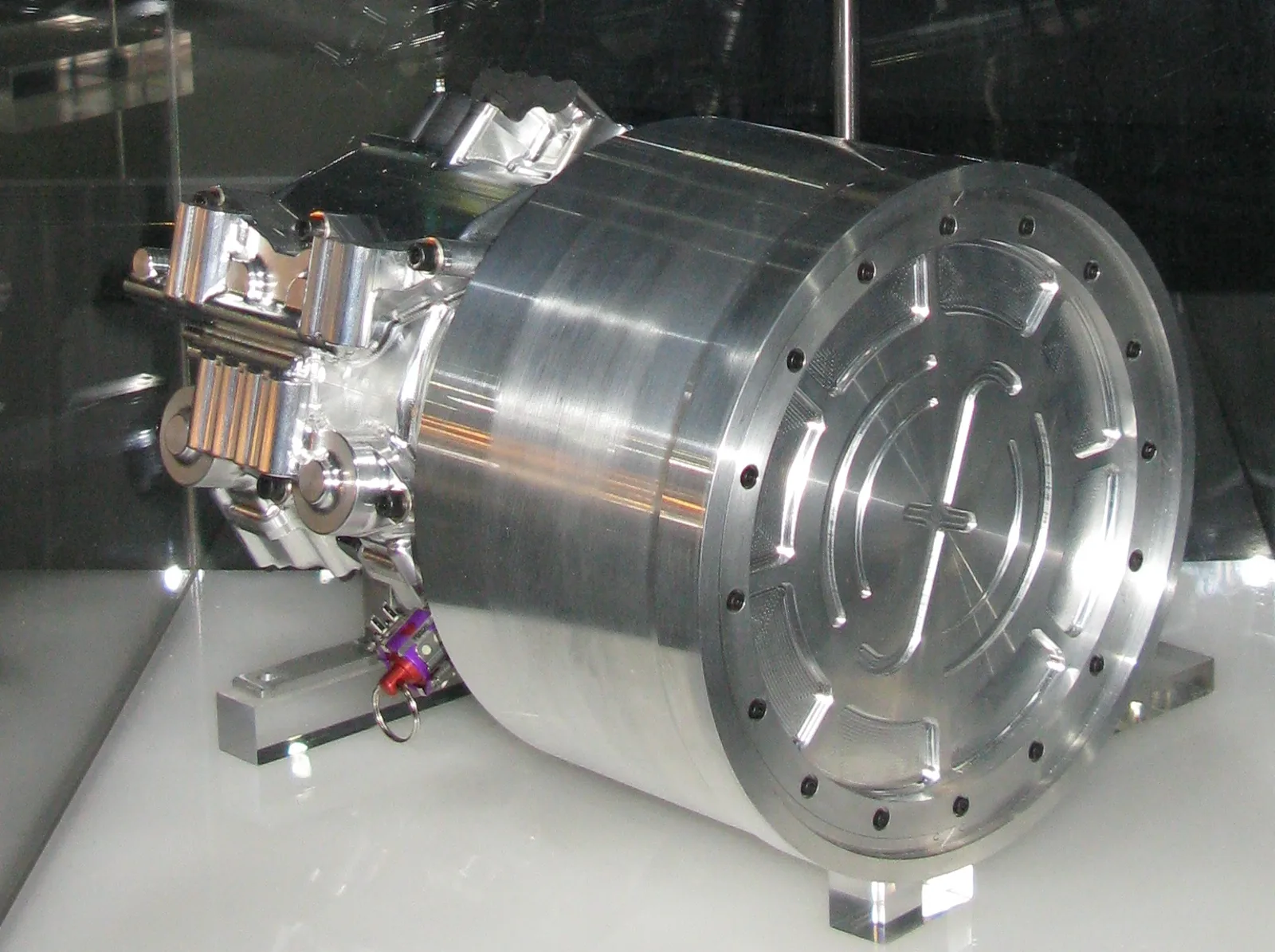
It came from KERS, the kinetic energy recovery system, which captures a moving car's energy under braking, stores it in a flywheel or high-voltage batteries and releases it under acceleration. The FIA allowed a 60 kW (80 bhp) system in the regulations for the 2009 season, and capacity doubled to 120 kW (160 bhp) from 2014.
The first system revealed was the Flybrid. It weighed 24 kg (53 lbs), held 400 kJ after internal losses and could deliver its 60 kW for 6.67 seconds. Its flywheel measured 240 mm (9.4 in) across, weighed 5.0 kg (11 lbs) and turned at up to 64,500 rpm. A flywheel stores energy as spin, in the way a potter's wheel keeps turning after the foot comes off the pedal. Teams could also store the energy electrically, in a battery or supercapacitor, and Williams built a flywheel of its own before dropping it for packaging reasons and developing an electrical system instead.
Early testing was not smooth. In July 2008 a Red Bull Racing KERS battery malfunctioned during its first test and the scare led to the team's factory being evacuated. Less than a week later a BMW Sauber mechanic received an electric shock from Christian Klien's KERS-equipped car at Jerez.
Take-up in 2009 was thin. Ferrari, Renault, BMW and McLaren all ran the system at some point, but Renault and BMW later stopped. Nick Heidfeld took the first podium with a KERS car, in Malaysia. Lewis Hamilton gave McLaren the first KERS win at the Hungarian Grand Prix on 26 July 2009, and took the first KERS pole at the next round, with Heikki Kovalainen second for the first all-KERS front row. On 30 August Kimi Raikkonen won in Belgium for Ferrari, the first time KERS was credited with directly delivering a victory.
In 2010 KERS was still legal but all the teams agreed not to use it. It returned for 2011 after the FOTA teams agreed to its use again and the minimum weight of car and driver rose by 20 kg to 640 kg, though it stayed optional and three teams chose to go without at the start of that season. The doubling to 120 kW (160 bhp) came in 2014, to offset the switch from V8 engines of 2.4 litres to turbocharged V6s of 1.6 litres.
Why did F1 engines shrink to six cylinders and cap their revs?
Because the old recipe had grown too costly and too far removed from anything a road car could use. Engines reached over 20,000 rpm in 2004 and 2005, but the price of exotic materials and production methods, and the view that the technology would hardly ever reach production cars, led to a cap of 19,000 rpm in 2007.
The cylinder count tells the same story. Sixteen was the high point, reached by the British Racing Motors V16, the Coventry Climax FWMW and the BRM P75. The limit then fell to twelve in 1972, and later to ten (2000), eight (2006) and six (2014). Revs fell in steps to 18,000 in 2009 and 15,000 for the 2014 to 2021 seasons. A cap on fuel flow, introduced in 2014, made a rev limit pointless, which is why it was scrapped in 2022. Hybrid-era engines typically turned about 13,000 rpm. A road engine of similar size usually stays below 6,000 rpm.
Engine limits through the eras
| Period | Cylinders | Revs |
|---|---|---|
| 2004 to 2005 | Ten, after the 2000 limit | Over 20,000 rpm reached |
| 2007 | Eight, from 2006 | Capped at 19,000 rpm |
| 2009 | Eight | Capped at 18,000 rpm |
| 2014 to 2021 | Six, in a 1.6-litre V6 | Capped at 15,000 rpm |
| 2014 to 2025 in practice | Six, plus electric recovery | About 13,000 rpm; cap lifted in 2022 |
How does an F1 engine survive such speeds?
Through lighter parts, better metals and careful design. On every stroke the piston accelerates from a near stop to almost double its average speed, roughly 40 m/s, and is brought to rest again. At the top of the stroke it is pulled around by about 95,000 m/s2, roughly 9,700 times standard gravity. Short strokes, long connecting rods and air-sprung valves keep the parts intact.
A short stroke keeps piston speed down for a given engine size, but it demands a wide bore, which makes combustion less efficient: the flame has to cross a flat, disc-shaped chamber that is far from the ideal sphere. Long connecting rods help in a different way. Tony Rudd found in the BRM 1.5-litre P56 V8 of 1961 and 1962 that an unusually long rod reduced secondary vibration, and the Coventry Climax FWMV Mk.III confirmed the idea in 1963.
The valves needed their own answer. Until the mid-1980s engines were held to around 12,000 rpm by metal springs that had to grow ever stiffer, soaking up so much power that the gain from higher revs almost vanished. Renault introduced pneumatic valve springs in 1986, and since the 1990s every manufacturer has used pressurised air. Think of swapping a steel coil for a bicycle pump that gets firmer the further it is pushed.
How efficient have F1 engines become?
Far more efficient than the old naturally aspirated designs, whose mean effective pressure stayed stuck near 14 bar (1.4 MPa) through the long years after the 1967 Ford Cosworth DFV. In the 2014 to 2025 turbo-hybrid era, brake mean effective pressure climbed to roughly 40 bar and more, helped by a fuel flow cap, lean burn and very high compression.
The fuel flow limit is the key idea. If a power unit can burn only so much fuel each hour, extra power has to come from wasting less of it, so the competition moved from revs to efficiency. Teams run mixtures much leaner than the 14.7:1 ratio of air to fuel by mass. Mechanical compression ratio is limited to 18:1, though the effective ratio after turbocharging is not. Honda said in 2023 that the 18:1 ceiling, once a distant goal, had begun to feel like a genuine constraint.
Progress shows in Honda's own numbers. Its RA621H of 2021 gained over 100 kW (130 bhp) in peak power on the RA615H of 2015, at the same fuel flow of 100 kg/h. Honda also says it uses the resonance of the intake to lower peaks in manifold pressure and leaves the turbocharger to build the pressure, which improves resistance to knock and allows more boost. The result is much less heat and noise than in 2014, and Stefano Domenicali has said the 2026 regulation will deliberately impose a louder exhaust note to please fans.
What are Audi and Honda doing with the 2026 rules?
Audi is building both a team and its own power unit, while Honda is back as the works partner of Aston Martin. Audi has competed as a constructor and power unit maker since 2026 after taking over Sauber. Honda officially left after 2021 but kept supplying Red Bull until the end of 2025, and now returns at full scale with its new partner.
Audi
Audi announced in August 2022 that it would become a maker of power units from 2026, the year of the regulation overhaul, and confirmed its link with Sauber that October. The Qatar Investment Authority bought a minority stake in November 2024. The team races as Audi Revolut F1 Team under a German licence, with three sites: the chassis department at the old Sauber base in Hinwil, Switzerland, a technology centre at Bicester Motion in Oxfordshire, and the power unit department at Neuburg an der Donau in Bavaria, run by the subsidiary Audi Formula Racing GmbH.
The company is not new to Grand Prix racing in spirit. Its predecessor Auto Union raced from 1935 to 1939, and Sauber, which debuted in 1993, used Ferrari engines from 2010. Nico Hulkenberg and Gabriel Bortoleto joined on multi-year contracts from 2025 and became the Audi line-up.
Audi used a Berlin launch in January 2026 to announce a five-year plan, with the aim of fighting for championships by 2030. The R26 debuted at the Australian Grand Prix, where Bortoleto qualified tenth and finished ninth for Audi's first Formula 1 points, while Hulkenberg could not start because of technical issues. Points returned at the British Grand Prix, then came more regularly, and by the Spanish Grand Prix Audi had 17 points. Jonathan Wheatley left as team principal in March 2026, and Mattia Binotto took over, later becoming chief executive as well. Allan McNish became racing director on 24 April 2026.
Honda
Honda has been in Formula 1 on and off since 1964. It won in Mexico in 1965, left after 1968, returned as an engine supplier in 1983 and won the constructors' title every year from 1986 to 1991. After a pull-out following 1992 and another return in 2000, it ran its own team before exiting in December 2008 because of the financial crisis.
The hybrid-era comeback began in 2015 with McLaren. The first units proved uncompetitive and the two split after three years. Toro Rosso took Honda engines in 2018 and Red Bull Racing in 2019, and Honda won its first hybrid-era race at the 2019 Austrian Grand Prix. Max Verstappen took the 2021 title with Honda power, and further titles followed in 2022, 2023 and 2024, even though the company had officially withdrawn after 2021 to focus on carbon neutral technologies. For 2026 it makes a full-scale return with Aston Martin as its works partner, enticed by more sustainable regulations. As an engine maker it has six constructors' and six drivers' championships and over 80 Grands Prix to its name.
What does racing hardware mean for road cars?
Less than the lap times suggest. The 2007 rev cap was justified partly by the view that extreme engine technology would hardly ever transfer to production cars, and road engines of similar size run below 6,000 rpm. The energy recovery side has travelled further, from London buses to the Fiat Panda.
A carbon-fibre flywheel developed for Williams was adapted for 500 double-decker buses from the Go-Ahead Group between 2014 and 2016, with an expected fuel efficiency gain of about 20%, and its developers won the Dewar Trophy in 2015. In 2011 Mazda announced i-ELOOP, which stores braking energy in a capacitor and, combined with its start-stop system, the company claims saves up to 10% of fuel. Fiat launched a mild-hybrid Panda with KERS technology in 2020. Not every idea survived: a hydraulic hybrid from Bosch and PSA claimed a 45% cut in fuel use but was abandoned in 2015.
Endurance racing took up the technology too. In 2011 Hope Racing entered Le Mans with a mechanical flywheel system, the first hybrid to compete there. Audi's R18 e-tron quattro used a flywheel, the Toyota TS030 Hybrid a supercapacitor, and the Porsche 919 Hybrid, introduced in 2014, a battery.
Where this goes next
The 2026 specification is only starting its run. Audi's declared target is to be fighting for championships by 2030, a plan it set out at the January 2026 launch, and its early results, 17 points by the Spanish Grand Prix, are the first evidence of how far it has to go. Honda returns as Aston Martin's works partner, drawn by the more sustainable regulations, and has everything to prove on its own after the Red Bull years.
The wider technical story is still being written. The engine freeze that ran from 2023 to the end of 2025 is over, and the new specification will now be developed in public. Domenicali's comment about a louder exhaust is a plan rather than a result, and the season that tests it is still in progress.