Seventy thousand fuel cell cars against twenty-six million plug-ins by the end of 2022. How a hydrogen car works, why most makers backed away, and where it still earns its keep.
A hydrogen car generates its own electricity from hydrogen in a fuel cell, refuels in minutes and emits only water, but hydrogen is costly, mostly made from natural gas and short of stations. Battery cars outsold fuel cell cars 26 million to 70,200 by the end of 2022, so hydrogen now looks strongest in heavy-duty and fleet use.
By the end of 2022, 70,200 hydrogen fuel cell cars had been sold worldwide, against 26 million plug-in electric cars. That gap explains why most makers that once chased hydrogen moved to batteries. Yet fast refuelling and long range still earn hydrogen a place somewhere.
What is a hydrogen fuel cell car?
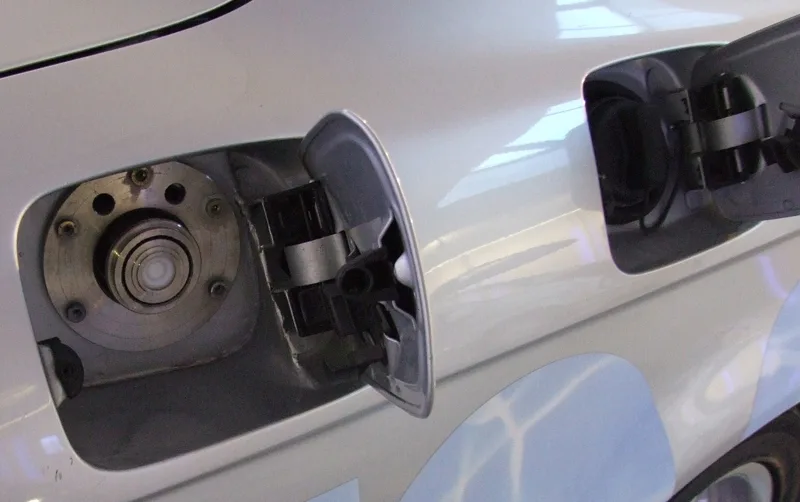
It is an electric car that makes its own electricity on board. A fuel cell combines compressed hydrogen with oxygen from the air and feeds an electric motor, sometimes helped by a small battery or supercapacitor. Water is the only thing out of the tailpipe, which is why most fuel cell cars count as zero-emissions vehicles.
A fuel cell is built from an electrolyte sandwiched between an anode and a cathode. In principle it behaves like a battery that is topped up with hydrogen instead of being recharged, so picture a battery EV with a nozzle in place of a plug. The idea is old. Humphry Davy demonstrated the concept in 1801, and William Grove made a working cell in 1842. The first road vehicle was the Chevrolet Electrovan of 1966, a two-seater that managed 120 miles between fills and 70 mph flat out, powered by a PEM fuel cell. The fuel cell stack and large hydrogen and oxygen tanks filled its rear, and only one was built because the project was judged cost-prohibitive.
The catch is where the hydrogen comes from. Fuel cells shift pollution rather than abolishing it, since most hydrogen is made by reforming natural gas. As of 2019 steam methane reforming, which emits carbon dioxide, produced 98% of it. Electrolysis of water and other routes exist, but they are currently expensive. The case for hydrogen cars depends on cleaner production and on uses where cheaper alternatives are limited.
Hydrogen shifts the pollution to wherever the hydrogen is made.
What is the Toyota Mirai really like?
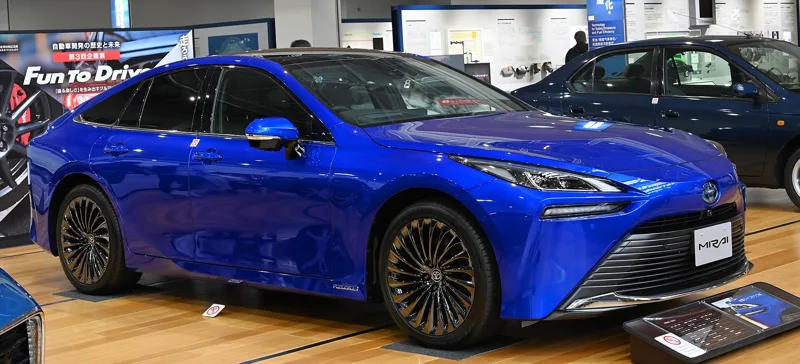
The Mirai is the car that defines the category. Toyota launched it in Japan at the end of 2014 as the first dedicated, mass-produced fuel cell car, and under the US test cycle a full tank is good for 502 km (312 mi), refilled in three to five minutes.
Underneath it is a hybrid in all but name. The first-generation stack delivers a maximum of 114 kW from 370 cells, and a 113 kW motor produces 335 Nm of torque. A small 1.6 kWh nickel-metal hydride battery covers low-speed running and sudden acceleration, charged by regenerative braking. At higher speeds the fuel cell alone powers the motor. Two carbon fibre tanks store hydrogen at 70 MPa, hold 5 kg between them and weigh 87.5 kg. Toyota quotes consumption of 0.8 kg per 100 km, and the car reaches 97 km/h (60 mph) in 9.0 seconds. A button marked H2O drains the water produced, about 240 mL for every 4 km.
Development took more than two decades. Toyota began work in 1992 and started limited sales of the FCHV in 2002. By 2011 an executive was saying every technical problem had been solved and that only the cost of mass production stood in the way. Test vehicles covered 1,600,000 km, from heat in Death Valley to cold in Yellowknife. The Mirai arrived at 6.7 million yen in Japan, with a government subsidy of 2 million yen, and at US$57,500 before incentives in the United States.
The second generation, unveiled in October 2019 and on sale in December 2020, moved to a rear-wheel-drive platform. In August 2021 one covered 1,360 km (845 mi) on a full 5.65 kg tank of hydrogen, a world record for such a car, and it earned five stars from Euro NCAP the following month. Another Mirai was driven 100,000 km in 107 days around Hamburg, consuming a little over a tonne of hydrogen.
How does a hydrogen car compare with a battery electric car?
A battery electric car stores energy in a battery pack and takes it from the grid or from a swapped battery. It has no fuel tank, clutch or transmission. A hydrogen car carries a tank and a fuel cell as well. Hydrogen's advantage is a long range on one refill, and its disadvantage is the chain of costs behind each kilogram.
Hydrogen's drawbacks run from production to the roadside. They include high carbon emissions when it is made from natural gas, heavy capital cost, large energy inputs in making and moving it, low energy content per unit of volume at ambient conditions, the need to compress it and the investment in refuelling infrastructure. Leaked hydrogen is invisible and highly flammable, and it has a global warming potential 11.6 times that of carbon dioxide.
Batteries have their own limits. Lithium-ion cells hold 0.9 to 2.63 MJ/L against 0.36 for lead-acid and 34.2 for petrol, which leaves a long way to go. The shortfall is partly offset because electric motors convert energy so well that battery cars travel roughly three times as far as similar-size combustion cars on the same stored energy. As of 2015 the batteries were a fairly large fraction of the vehicle's mass, charging could take significant time, and greenhouse savings depended on how the electricity was generated. Within one charge, though, an electric car is practical and can be recharged overnight.
How do battery electric and hydrogen cars stack up?
| Feature | Battery electric | Hydrogen fuel cell |
|---|---|---|
| Energy store | Battery pack; no tank | Compressed hydrogen in high-pressure tanks, plus a fuel cell |
| Refuelling | Plug in, often overnight; or battery swap | About three to five minutes at a hydrogen station |
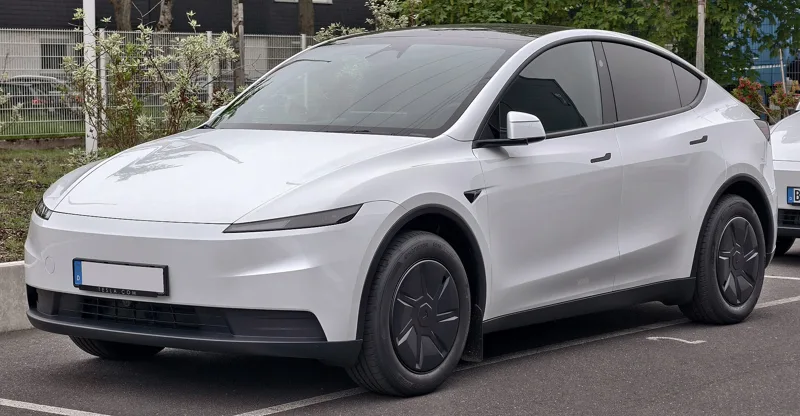
| Sales | 26 million plug-in cars by end of 2022; Tesla Model Y estimated at 3.4 million by September 2024 | 70,200 by end of 2022; Mirai 21,475 by November 2022 |
| US sales, 2023 | 380,000 | 3,143 |
| Infrastructure | Electricity grid and charging stations | Fewer than fifty public hydrogen stations in the US in 2020; many in California unable to dispense |
| Emissions story | Depends on how the electricity is generated | Depends on how the hydrogen is made; 98% came from natural gas in 2019 |
Are hydrogen cars dead?
As passenger cars, they have not died but they have shrunk. Daimler abandoned fuel cell development by 2017, citing falling battery costs and longer EV ranges. By 2020 only three car makers still had active programmes. Hydrogen's prospects in cars have narrowed compared with early expectations as battery vehicles advanced.
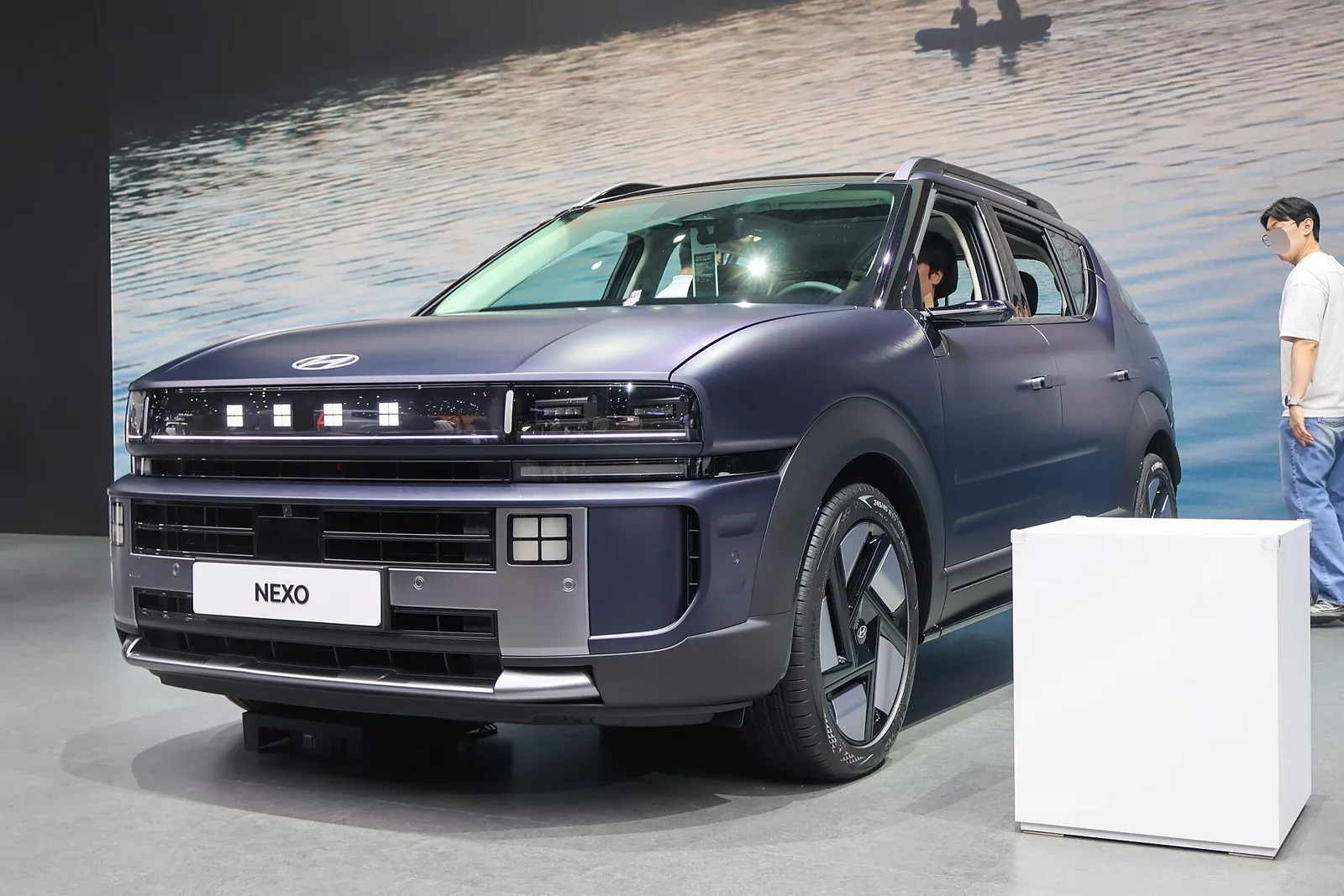
The retreat shows in the numbers. Honda's FCX Clarity began leasing in 2008 as the first fuel cell car designed for mass production, and Honda leased 45 in the US by 2014. The later Clarity ran from 2016 to 2021, and the CR-V e:FCEV was leased only in very small quantities in 2024. Hyundai's Tucson FCEV sold just 273 units by the end of May 2015, and its successor, the Nexo, was named the safest SUV by Euro NCAP in 2018. Hyundai pulled back every one of the 1,600 Nexos sold in the US in October 2024, because a faulty part created a risk of fuel leaks and fire. Toyota sold more than 10,000 Mirais by the end of 2019, yet its worldwide hydrogen sales fell to 1,702 in 2024 through November. The president of Honda Europe said in 2019 that his company's focus was hybrids and electric cars, with hydrogen a technology for the next era.
Cost and infrastructure are the stumbling blocks. Pat Cox, a former president of the European Parliament, estimated that Toyota would lose about $100,000 on each early Mirai, and Toyota made 5,680 hydrogen patents free to competitors in 2015 to stimulate the market. The US government stopped funding hydrogen cars in 2009. Japan had around 80 stations by May 2016, but the US had fewer than fifty public stations in 2020. A significant number of those in California cannot dispense hydrogen, and in 2024 Mirai owners there filed a class action over the lack of fuel.
Where does hydrogen still make sense?
Where vehicles work in fixed fleets and time matters. Fuel cell forklifts are the clearest example: about 50,000 are in use worldwide as of 2024. They run a full eight-hour shift on one tank, refuel in three minutes, last eight to ten years and work in refrigerated warehouses because cold does not degrade them.
Battery forklifts still dominate, though: 1.2 million were bought in 2021 alone. Buses show the same pattern with sharper edges. By 2020 there were 5,648 hydrogen buses, 93.7% of them in China. Many transit operators chose battery buses because they were cheaper to buy and run, even though hydrogen buses can refill quickly. Purchase prices for hydrogen buses have come down to levels comparable with diesel, but operating costs remain much higher. In 2022 Montpellier cancelled an order for 51 hydrogen buses after finding operation cost six times as much as electricity, and by 2025 most European hydrogen bus programmes had been cancelled or scaled back.
Heavy trucks are where forecasters see room. The International Energy Agency's 2022 net-zero scenario expects hydrogen to supply roughly 30% of heavy-truck energy by 2050, chiefly on long hauls, against around 60% for battery power. Hyundai shipped ten Xcient fuel cell trucks to Switzerland in 2020, and five hydrogen class 8 trucks began hauling zinc at Townsville in Queensland in 2022.
Trains and aircraft are mixed. Fuel cell Coradia iLint trains entered service in northern Germany in 2018, but in 2025 Alstom said it was halting hydrogen train development, and the Rhine-Main Transport Authority withdrew its 18 hydrogen trains after repeated technical issues. The International Energy Agency sees hydrogen at only 2% of rail energy demand in 2050, with 90% of rail travel electrified. Boeing has said fuel cells are unlikely to power large passenger jets, and as of 2019 they were judged unsuitable for large long-distance ships. One commentator believes hydrogen, burned directly or reacted into synthetic fuel, could keep classic cars on the road.
What should a buyer know before choosing a hydrogen car?
- Choice is thin. As of 2021 only the Mirai and the Nexo were publicly available in select markets, and hydrogen combustion cars are not sold at all.
- Check the stations first. The refuelling network, not the car, is the limit, and in California a significant number of stations cannot supply hydrogen.
- Look at the recalls. The 2024 Nexo recall covered all 1,600 sold in the US.
- Compare running chains. A battery car's emissions depend on how the electricity is made, and a hydrogen car's depend on how the hydrogen is made.
Where this goes next
Developers are working on technologies aimed at making clean hydrogen cheap enough to compete with the natural gas route, but none is yet cost-competitive. In June 2016 Nissan announced plans for fuel cell cars running on an ethanol and water blend that an onboard reformer would turn into hydrogen, claiming cheaper infrastructure than a hydrogen network.
.jpg)