From 4.5:1 tractors to 16:1 petrol cars and an engine that rewrites its own ratio mid-journey, all tied together by squeeze, fuel and knock.
Compression ratio compares a cylinder's largest and smallest volumes during compression. Higher ratios improve efficiency, but petrol engines knock if pressure and heat are too high for the fuel, so turbo engines run lower figures. Variable compression engines, such as the Infiniti QX50 unit, adjust between 8:1 and 14:1.
Somewhere in an Infiniti QX50 is an engine that changes its own compression ratio while you drive, sliding anywhere between 8:1 and 14:1 depending on how hard you press the pedal. It was the first variable compression engine to reach buyers, and the reason it exists says everything about why a higher compression ratio is not simply better. Squeeze petrol too hard and it goes off at the wrong moment. Squeeze it too gently and you waste fuel.
What is compression ratio?
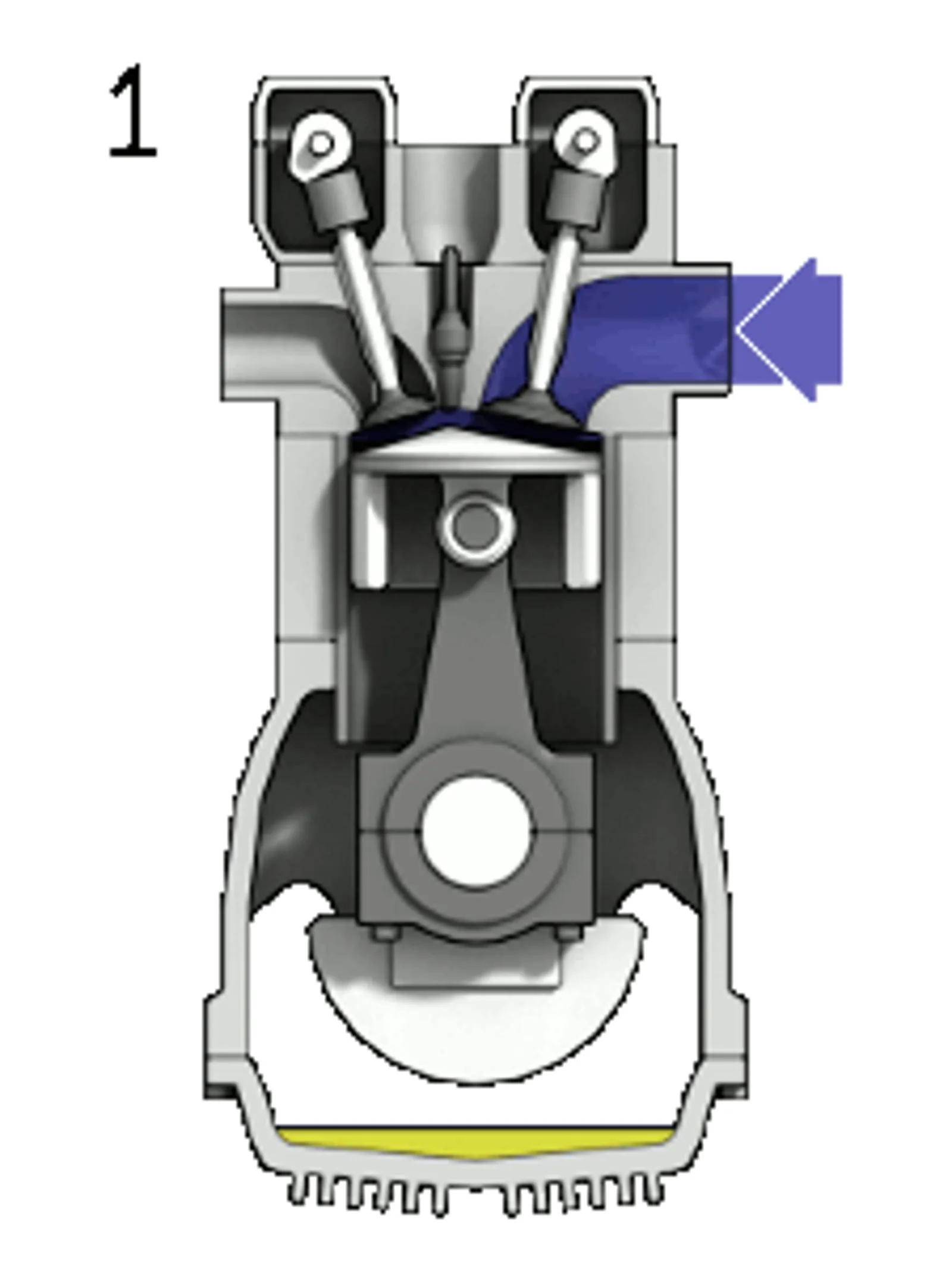
Compression ratio compares two volumes: the space in the cylinder with the piston at the bottom, and the space left when it reaches the top. This simplest version is the static compression ratio. Engineers calculate it by adding the displaced volume to the clearance volume, the small pocket that remains once compression is finished, and dividing by that clearance volume. The displaced volume follows from the bore and the stroke. Because the shape of the clearance space is complicated, it is usually measured directly, often by filling the cylinder with liquid and checking how much it takes.
A second figure, the dynamic compression ratio, adds gases entering and leaving the cylinder during compression.
The reason to chase a high figure is thermal efficiency. A combustion engine is a heat engine, and a higher ratio converts more of the energy in the same quantity of fuel into useful work. It also gives a longer expansion cycle, which brings more mechanical power and can lower exhaust gas temperatures.
Squeeze petrol too hard and it goes off at the wrong moment; squeeze it too gently and you waste fuel.
What compression ratios do engines actually run?
| Engine type | Typical compression ratio |
|---|---|
| Petrol passenger cars, past 20 years | 8:1 to 12:1 |
| Cars built 1955 to 1972 for high-octane leaded petrol | Up to 13:1 |
| Toyota Dynamic Force | Up to 14:1 |
| 2014 Ferrari 458 Speciale | 14:1 |
| Mazda SkyActiv, since 2012 | Up to 16:1 |
| Direct-injection diesel | Often 14:1 to 23:1 |
| Indirect-injection diesel | 18:1 to 23:1 |
| Racing engines on methanol or ethanol | Often 14:1 to 16:1 |
| Kerosene engines | 6.5 or lower |
Mazda reaches its top figure on ordinary unleaded petrol, 95 RON in the United Kingdom, by clearing exhaust gases from the cylinder more effectively so the chamber is as cool as possible before the intake stroke, and by adding direct injection. That is a clue to the central tension. The ratio an engine can tolerate depends on what happens to the fuel inside it.
Diesels sit higher because they have no spark plug. The squeeze itself has to heat the air enough to ignite the fuel. At the low end of the diesel range, 14:1, nitrogen oxide emissions fall but cold starting becomes harder, and when Mazda's Skyactiv-D became the first such commercial engine, in 2013, adaptive injectors were among the tricks used to ease the problem. Engines on liquefied petroleum gas or compressed natural gas can use higher ratios because those fuels have a higher octane rating, while fuels at the other extreme force low figures: a petrol-paraffin version of the Ferguson TE20 tractor ran at 4.5:1 on vaporising oil rated between 55 and 70 octane.
What is engine knock?
In a healthy engine the spark plug lights the mixture some 10 to 40 crankshaft degrees before the piston reaches the top of its stroke. A tiny kernel of flame, about the size of the plug gap, grows at an accelerating rate and sweeps through the chamber. Pressure builds smoothly and peaks a few degrees after the piston passes the top, so the push on the piston arrives just when the crank can make best use of it.
Knock is combustion from the wrong source. When unburned mixture beyond the edge of the advancing flame is held under enough heat and pressure for long enough, a pocket of it can explode almost instantly. A local shock wave forms around each pocket, cylinder pressure rises sharply and may exceed its design limit, and the characteristic metallic pinging is heard. The effects range from inconsequential to completely destructive. Knock is a separate event from pre-ignition, although pre-ignition can be followed by knocking.
Moderate knock sends tiny particles into the oil, where they cause abrasive wear on other parts before the filter traps them, and surfaces take on a sandblasted look. Severe knock can melt and push holes through a piston or cylinder head. Hypereutectic pistons, in particular, are known to shatter under such shock waves.
The phenomenon is old. A letter from Lodge Brothers, the spark plug makers, described it in November 1914, and examined again by Harry Ricardo between 1916 and 1919 as he looked for the cause of failures in aircraft engines.
Compression ratio and octane: why fuel decides the limit
Higher compression ratios make petrol engines prone to knock if the fuel has too low an octane rating. A higher octane number raises the combustion temperature at which the fuel tends to detonate. That is why cars built from 1955 to 1972 for high-octane leaded petrol could run up to 13:1. The additive behind that fuel, tetraethyl lead, was common until it was discontinued over toxic pollution, and manganese compounds serve the same purpose with petrol.
Fuel is only one lever. Detonation can also be prevented by retarding the ignition timing, enriching the air-fuel mixture, cutting peak cylinder pressure, reducing the throttle opening or boost, lowering the load, or adding a knock inhibitor. Because temperature and pressure are strongly linked, lowering the compression ratio itself helps, as do exhaust gas recirculation, careful design of the chambers and cooling system, and cooler intake air. Knock is less common in cold climates. Turbulence matters too. Pistons are often shaped to create squish turbulence, which mixes the charge violently, speeds up burning and cools the unburnt mixture, reducing knock greatly. Early side-valve heads lacked it and needed a much lower compression ratio for any given fuel.
When low-octane fuel meets a high compression ratio and the engine has no way to react, efficiency can drop or the engine can be damaged. Modern engines are built to react.
How do knock sensors protect an engine?
Because fuel quality, atmospheric pressure and ambient temperature vary so widely, every modern combustion engine carries mechanisms to detect knock. Piezoelectric sensors turn vibrations into an electrical signal, and a control loop watches for the pressure peak that marks a knocking combustion. When it appears, the ignition timing is retarded in steps of a few degrees. When the signal settles, the timing creeps forward again, holding the engine at its best operating point, the knock limit. Modern systems can adjust the timing for every cylinder individually, and depending on the engine they regulate boost pressure at the same time. An early example was the system on turbocharged Saab H engines, called Automatic Performance Control, which reduced boost if it caused knock.
Why do turbo engines run lower compression ratios?
A turbocharger or supercharger has already compressed the air before it reaches the cylinders, so the compression ratio of a forced-induction engine is often lower than that of a naturally aspirated one. The arithmetic is simple. Petrol can only take so much pressure during the compression stroke before it detonates rather than burns. More power means burning more fuel, which needs more air, which means more inlet pressure. Without a lower compression ratio, the mixture would detonate.
The injection method changes how far the limit can be pushed. Port fuel injection heats the air and fuel together, which leads to detonation, so those engines typically run lower boost or lower compression ratios than direct-injection engines. Direct injection tolerates more boost, since hot air alone cannot detonate without fuel in it.
Choosing a low fixed ratio has its own cost. With light loads, the engine can lack power and torque. That is the problem variable compression is built to solve.
What is a variable compression engine?
Most engines use a fixed compression ratio. A variable one adjusts the ratio while the engine runs, altering the volume above the piston at the top of its stroke. High loads call for lower ratios to increase power, and low loads for higher ratios to improve efficiency and lower fuel consumption. The promise is a small, efficient engine that can deliver great power on demand. It would also be free to use fuels besides petrol, such as LPG or ethanol.
The idea is not new. Harry Ricardo built and tested the first variable compression engine in the 1920s, and that work led him to devise the octane rating system still used today. For decades such engines stayed in laboratories, usually with a second adjustable piston in the head. Saab, Nissan, Volvo, PSA/Peugeot-Citroen and Renault all researched the idea.
Saab showed its SVC engine at the Geneva motor show in 2000. It split the block into two hinged parts, a head assembly and a crankcase assembly joined by a pivot that allowed 4 degrees of movement under a hydraulic actuator, and it used a supercharger for the quick response and high boost it needed. The SVC never reached production because of the company's bankruptcy in 2016. Peugeot's MCE-5 design varies the effective length of the connecting rods instead: a shorter rod gives a lower compression ratio.
The Infiniti engine got to market. Its 2.0 L turbocharged inline-four uses a mechanical linkage to deliver any ratio from 8:1 to 14:1. Peak torque comes at 8:1, for strong acceleration, while the best fuel economy comes at 14:1. The controller answers the pedal in real time, shifting the ratio without a break in the drive, and the linkage keeps the engine inherently balanced, so it needs no balance shafts. The QX50 is described as the first commercially available car with the technology.
What is dynamic compression ratio?
The static figure ignores the fact that the intake valve usually closes after the piston has begun rising, which pushes some gas back out. Intake tuning and scavenging, on the other hand, can trap more gas than the cylinder's geometry suggests. The dynamic compression ratio accounts for both effects. Conservative camshaft timing, with the valve closing soon after the piston reaches the bottom, raises it, and radical timing lowers it. It is usually below the static figure, but not always, because the inertia of air flowing through the intake can pack up to around 10% more air into the cylinder, equal to a volumetric efficiency of 110%. This effect, called inertial ram supercharging, relies on careful tuning of the inlet length.
A worked case pairs a static ratio of 10:1 with a dynamic ratio of 7.5:1, which works out at a useful cylinder pressure of 13.7 bar. An engine with a high static ratio and late intake valve closure can end up with a dynamic ratio similar to that of an engine with a lower static ratio and earlier closure.