Octane measures how well fuel resists blowing up under pressure, not how much energy it holds. What that means at the pump and in the engine.
Octane rating measures how well petrol resists igniting under compression, not how much energy it holds. Higher octane helps engines built with high compression and may cause no gain in others. A lower grade than an engine needs can cause knock, though modern sensors adjust ignition timing to protect it.
Octane rating says nothing about how much energy a litre of petrol holds. It measures only how stubbornly the fuel resists exploding on its own when squeezed.
What is an octane rating?
An octane rating is the standard yardstick for how well a fuel stands up to compression in an engine without knocking. The higher the number, the more the fuel can be squeezed before it ignites by itself. It does not relate directly to power output, and it does not tell you the energy content of the fuel by mass or by volume.
The scale is built from two reference liquids. Iso-octane resists self-ignition strongly and is defined as 100. Heptane resists it poorly and is defined as 0. A petrol that knocks in a test engine exactly as a mixture of 90 percent iso-octane and 10 percent heptane would is rated 90. That does not mean the petrol contains those two compounds in those proportions. Pump petrol is a mixture of many hydrocarbons, usually with additives, and the rating only says it resists detonation as well as the reference mixture does.
Some fuels go beyond the scale. A Research Octane Number above 100 is called a performance number, and racing fuels, aviation petrol, LPG and alcohol fuels such as methanol may reach 110 or significantly higher. Common octane boosters are MTBE, ETBE, toluene and even iso-octane itself.
The extra power from premium fuel comes from the way an engine is designed to compress the mixture, not from the rating itself.
Octane rating: how the number is measured
Several methods exist, and which one appears on the pump depends on the country.
| Method | How it is found | Where it is the headline number |
|---|---|---|
| Research Octane Number (RON) | Test engine run at 600 rpm while the compression ratio is varied, with results set against iso-octane and heptane mixtures | The most common type worldwide |
| Motor Octane Number (MON) | Similar engine at 900 rpm, with a preheated mixture and variable ignition timing | Typically 8 to 12 lower than RON for modern pump petrol, with no direct link between the two |
| Anti-Knock Index (AKI), written (R+M)/2 | The average of RON and MON | Canada, the United States and Mexico |
| Observed Road Octane Number (RdON) | Ordinary multi-cylinder engines, normally at wide open throttle | A test method developed in the 1920s |
The gap between RON and MON is the reason for the confusion at the pump. Because AKI averages the two, the figure shown in Canada and the United States sits 4 to 6 numbers below the one used elsewhere, for exactly the same fuel. The difference between RON and MON is called the fuel's sensitivity, and countries that use the Anti-Knock Index do not usually publish it. A petrol labelled a few points lower on an American pump is therefore not automatically weaker than one labelled higher abroad.
The original road tests, done in cars, moved onto chassis dynamometers with controlled conditions to improve consistency. For quick work, refiners use an Octane Index, an equation that estimates the rating, because the laboratory engines are expensive and slow and may not be available in remote places. The estimate is particularly useful when blending refinery products.
What is engine knock, and why does octane matter?
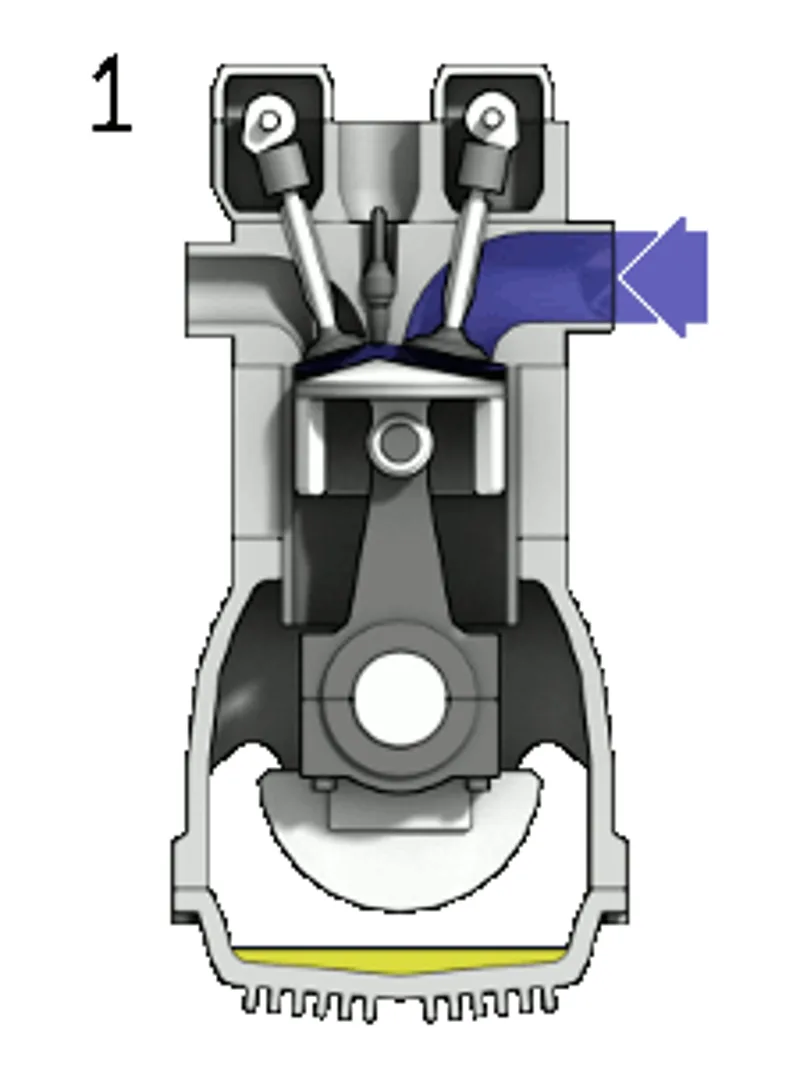
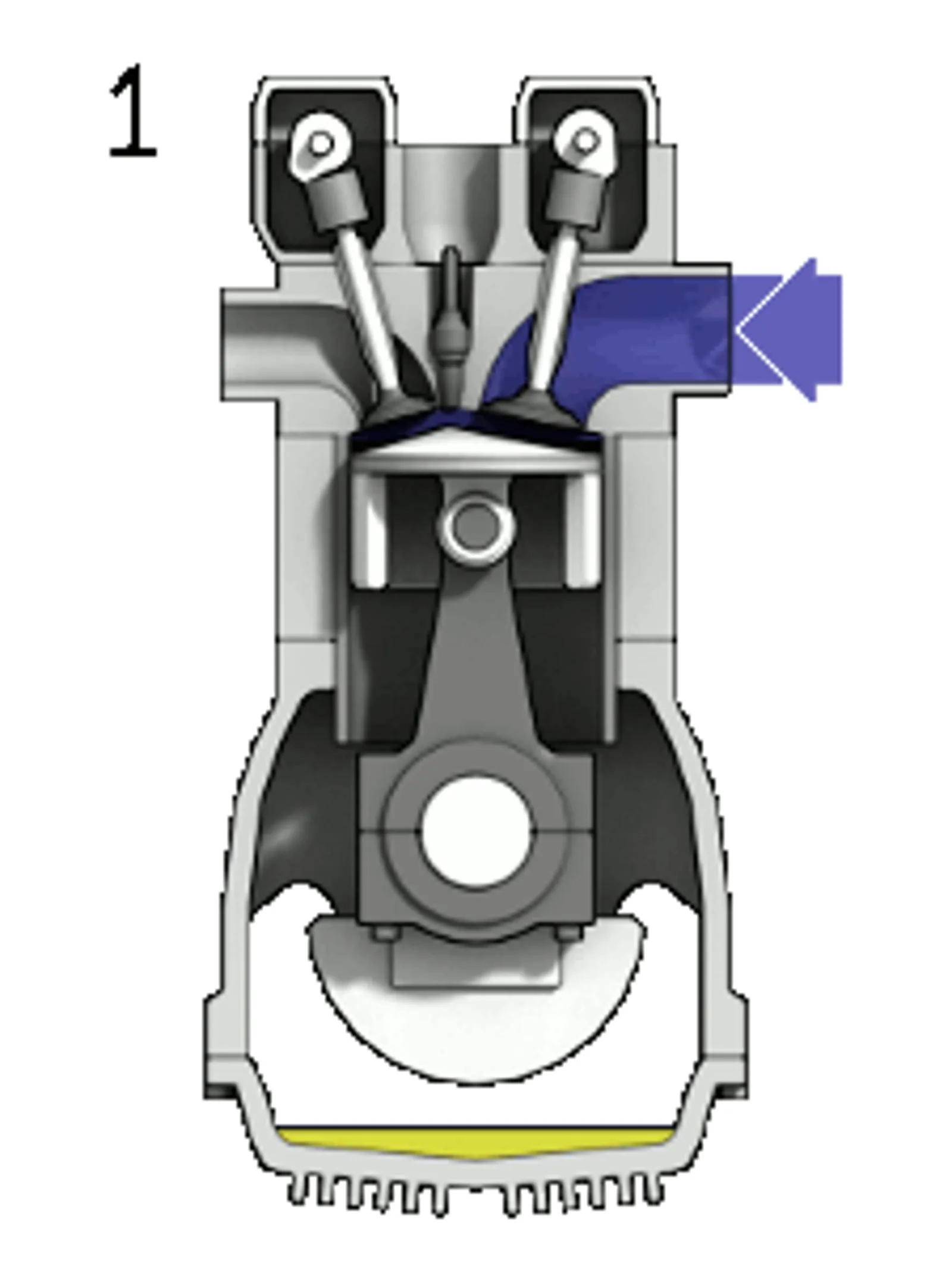
In a petrol engine the spark plug is meant to light the mixture at one precise moment, and a flame front is meant to sweep across the cylinder. Knocking, also known as pinging, pinking, spark knock or detonation, happens when one or more pockets of mixture explode outside that front.
Picture ripples spreading across a pond from a dropped stone. Now drop a second stone somewhere else, just as the first set of ripples is crossing the water. The two wave patterns collide, and the surface is thrown into a mess. Inside the cylinder the collision of two combustion waves produces a shock wave, the metallic pinging sound, and a sharp rise in cylinder pressure.
The consequences range from trivial to catastrophic. At the mild end, knock means a bit of extra heat and some lost power. Moderate knocking causes particle wear, with fine debris travelling into the oil and giving surfaces a sandblasted look. Severe knocking can melt holes through a piston or cylinder head. Hypereutectic pistons are known to break easily under the shock waves.
Knock is separate from pre-ignition, which occurs before the combustion event, but the two feed each other. Knock heats the cylinder quickly, and that can lead on to destructive pre-detonation.
A problem with a long history
Lodge Brothers, the spark plug makers, set the phenomenon out in a letter of November 1914, tracing the sound of pinging in motorcycles to early ignition. Harry Ricardo investigated it in experiments between 1916 and 1919, looking for the cause of failures in aircraft engines.
How engineers prevent it
Detonation can be tamed by several routes: retarding the ignition timing, enriching the air-fuel ratio, cutting peak cylinder pressure, lowering boost or throttle opening, reducing engine load, adding a knock inhibitor, or using a fuel with a higher octane rating. Compression ratio, exhaust gas recirculation, combustion chamber design and cooling all matter as well, and knock is less common in cold climates. Good turbulence in the cylinder also helps keep knock down.
Can you use lower octane fuel than your engine calls for?
Using petrol with lower octane than an engine was built for may cause knocking or pre-ignition. That is the baseline warning. Modern engines, however, defend themselves. Most engine management systems include a knock sensor, and the computer alters the ignition timing automatically to bring knock down to an acceptable level.
The control loop works in small steps. Piezoelectric sensors turn vibration into an electrical signal, and when the telltale pressure peak appears the timing is retarded by a few degrees. When the signal settles, the timing is advanced again. This holds the engine at its so-called knock limit, and modern systems can adjust each cylinder separately and regulate boost pressure at the same time. The result is that performance stays near its best while the risk of knock damage is mostly eliminated, even on a poor grade of fuel. Turbocharged Saab H engines were an early case, with Automatic Performance Control reducing boost if it caused knock.
The aim of knock control is a trade-off between protecting the engine and maximising torque, and the trade-off is handled statistically, because knock events arrive as a random process.
Is premium petrol worth it?
Whether a higher octane fuel helps or hurts an engine's performance comes down to how that engine is designed. Higher octane fuels belong in higher-compression petrol engines, which may produce more power. The extra power comes from the way the engine compresses the mixture, not from the rating itself.
LPG shows the principle. It has a high octane rating, yet in an engine optimised for petrol, with its typical 10:1 compression ratio, overall power output is lower. An engine tuned for LPG with a higher ratio, typically 12:1, improves the power. High octane lets an engine run higher compression without knocking, which raises cylinder temperature and efficiency.
For an engine that is not built to exploit it, higher octane brings drawbacks.
- Higher octane fuel is harder to ignite and needs a hotter spark, which loads the ignition system and calls for earlier spark timing. As octane, spark energy and timing precision rise, the engine becomes harder to tune and keep in tune.
- As octane rises, the specific gravity and the energy per unit weight of the fuel fall, so more of it must be burned to make the same power.
- Thinner high-octane fuels frequently contain alcohol compounds. These attract moisture and may be incompatible with older fuel system parts.
- They evaporate more readily, which leads to more accumulated contaminants, and some components slowly polymerise into gum-like deposits known as varnish.
Ethanol adds a further wrinkle. Where octane is raised by blending it in, the energy content per volume is reduced.
Where does octane come from?
Petrol is made in oil refineries by blending several streams, each with its own character. Roughly 72 to 74 litres of petrol comes from a 160-litre barrel of crude oil, depending on the crude and the grade.
Straight-run petrol, or naphtha, comes straight off the distillation tower and has a low octane rating. Only between 0 and 20 percent of it goes into finished petrol, because the quantity is below demand and its Research Octane Number is too low. Reformate rates high for octane and high for aromatics, catalytic cracked petrol has a moderate rating, and hydrocrackate has a medium to low rating. Alkylate has a high MON and no aromatics or olefins, and it was used in aviation fuel in World War II. Isomerate offers a medium RON and MON.
Oxygenates round out the blend. In the United States they are mostly ethanol, while Europe and other countries may also use MTBE and ETBE. Most US states banned MTBE in the early-to-mid-2000s. Limits on aromatics, benzene and olefins have led to a growing preference for isomerate and alkylate, whose octane rating is higher than that of straight-chain alkanes. The European Union caps benzene at one percent by volume.
The lead chapter
Tetraethyllead was once a common additive. Concerns about its toxicity led to its use in road fuels being progressively phased out worldwide from the 1970s, and the US phaseout began in 1975. Aviation, off-road vehicles and some racing engines still use leaded fuels.
Diesel and aircraft: where octane does not apply
Diesels run on fuel with a low octane number but a high cetane number. A diesel compresses only air and injects fuel into it, so there is no mixture waiting to detonate. Its distinctive knock is a separate matter, caused by the fast rate of pressure rise.
Piston aircraft use a variant system with two ratings, lean and rich. The lean rating matches the MON for figures up to 100, while the rich rating reflects supercharged running. The most common fuel, 100LL, has a lean rating of 100 and a rich rating of 130.
Where this goes next
Rules on benzene and olefins keep pushing refiners toward isomerate and alkylate. On the engine side, knock simulation tools now let engineers identify the designs and operating conditions where knock may occur, so that it can be designed out while keeping thermal efficiency high.