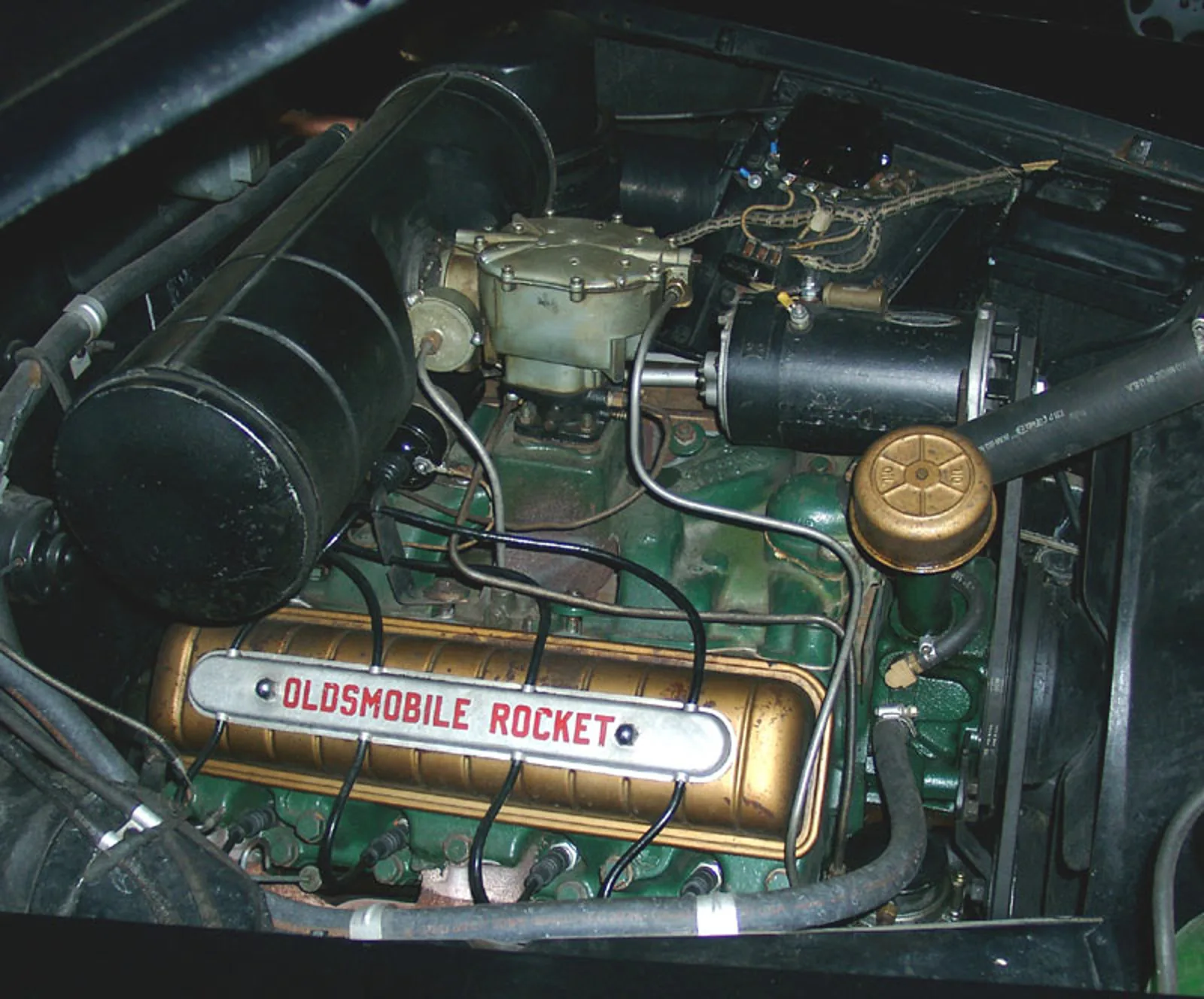
Oldsmobile's Rocket V8 arrived in 1949 as one of GM's first post-war overhead valve V8s and ran until 1990, through small blocks, big blocks and a turbocharged Jetfire.
The Oldsmobile V8, sold as the Rocket, was built from 1949 to 1990. It was one of GM's first post-war pushrod overhead valve V8s, and it grew from the 303 to the 455 while also producing the aluminium 215 and the turbocharged Turbo-Rocket.
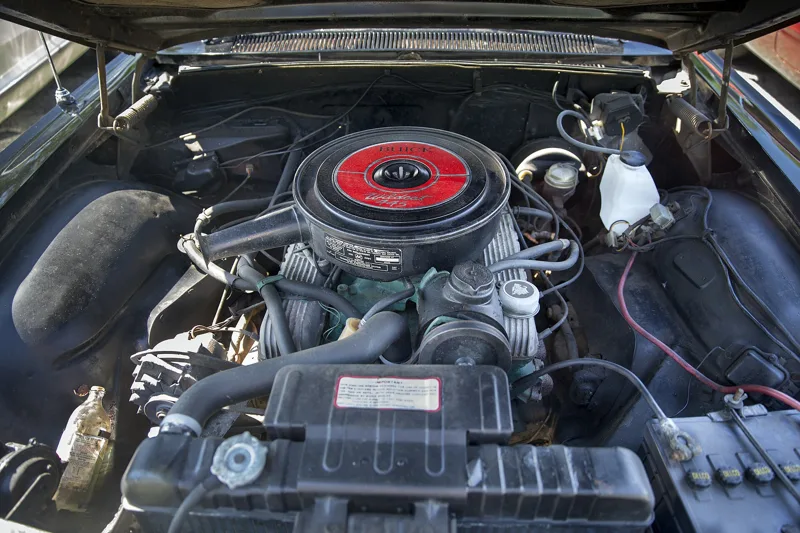
Oldsmobile's Rocket was a series of engines that the division built from 1949 until 1990. The Rocket and Cadillac's 1949 V8 were the first post-war pushrod overhead valve crossflow V8s built by General Motors, and the Rocket was the first mass-produced pushrod OHV V8 of any kind. Through its life the family moved from tall-deck big blocks to small blocks, aluminium and turbocharged experiments, and finally to the Chevrolet-based engines of the 1980s.
Why was the first Rocket so important?
Oldsmobile's own V8 was intended to be called Kettering Power after the company's chief engineer, Charles Kettering, but company policy stopped the name being used. Influenced by the space race between the United States and the USSR, the division chose the Rocket instead. The engine proved so popular that Oldsmobile's 88 models were widely called Rocket 88s.
The engine was built at Lansing, Michigan, where all Oldsmobile V8s were assembled, while its block and cylinder heads were cast at the Saginaw Metal Casting Operations. Its 90-degree bank angle and a common stroke set the pattern that the division followed for decades, and the early engines were painted gold or blue, depending on the era and the size.
The Rocket was the first mass-produced pushrod V8, and its block later became the backbone of a Formula One championship car.
How did the 303 and 324 perform?
The original 303 cu in (5.0 L) had hydraulic lifters, an oversquare bore and stroke ratio, a counterweighted forged crankshaft and aluminium pistons. Production ran from 1949 to 1953, with the bore at 3.75 in (95 mm) and the stroke at 3.4375 in (87.31 mm). In its first form it had a two-barrel carburettor and produced 135 hp (101 kW) and 253 lb ft (343 N m) of torque.
Oldsmobile claimed 0.45 hp per cubic inch for the 303, which was 7% better than the 0.42 hp per cubic inch of the popular Ford flathead. A four-barrel 1952 88 made 160 hp (119 kW), and the 1953 four-barrel raised compression to 8.0:1 for 165 hp (123 kW). The 324 that followed from 1954 to 1956 had a 3.875 in (98.4 mm) bore and was shared with GMC trucks.
The 324 had a reputation problem early on. Skirted pistons in engines built during the first part of 1955 could fail once the cast aluminium skirt separated from its steel brace. The problem did not appear until an engine had covered more than 50,000 miles (80,000 km), and by late 1956 many dealers had learned about it.
What were the 371 and the J-2 Golden Rocket?
The 371 arrived as standard equipment on every Oldsmobile in 1957 and ran until 1960. Its bore was 4.0 in (100 mm) and its stroke 3.6875 in (93.66 mm), which gave 371 cu in (6.1 L). The four-barrel 1957 engine made 277 hp (207 kW), with torque at 400 lb ft (542 N m), and the 1958 version with 10:1 compression reached 305 hp (227 kW).
The J-2 Golden Rocket used three two-barrel carburettors on a vacuum-operated linkage, with only the centre unit tied to the throttle pedal. It was rated at 312 hp (233 kW) and 415 lb ft (563 N m). Owners who did not drive hard enough to engage the outer carburettors had linkage and throat problems, and Oldsmobile discontinued it after 1958 because it was expensive to produce.
How did the 394 and Sky Rocket compare?
The 394 was the largest first-generation Rocket, built from 1959 to 1964, with its bore at 4.125 in (104.8 mm). Most used two-barrel carburettors, but high-compression four-barrel versions were offered from 1961. The base 394 produced up to 315 hp (235 kW) at 9.75:1 compression, and the Super 88 and 98 of 1959 and 1960 were rated at 435 lb ft (590 N m) of torque.
The Sky Rocket of 1961 to 1963, followed by a 1964 Rocket, was a high-compression four-barrel 394. The 1961 model made 325 hp (242 kW) at 10:1 compression, and the 1962 to 1964 units raised that to 330 hp (246 kW) at 10.25:1. A special 1963 version with 10.5:1 compression made 345 hp (257 kW), and the 1964 Jetstar I reached the same figure with 440 lb ft (597 N m) of torque.
| Engine | Years | Displacement | Bore | Stroke | Peak output |
|---|---|---|---|---|---|
| 303 (first Rocket) | 1949 to 1953 | 303 cu in (5.0 L) | 3.75 in (95 mm) | 3.4375 in (87.31 mm) | 135 hp (101 kW), two-barrel |
| 324 | 1954 to 1956 | 324 cu in (5.3 L) | 3.875 in (98.4 mm) | 3.4375 in (87.31 mm) | 230 hp (172 kW) in the 1956 88 |
| 371 | 1957 to 1960 | 371 cu in (6.1 L) | 4.0 in (100 mm) | 3.6875 in (93.66 mm) | 305 hp (227 kW) in 1958 |
| 350 | 1968 to 1980 | 350.1 cu in (5.7 L) | 4.057 in (103.0 mm) | 3.385 in (86.0 mm) | 325 hp (242 kW) at the top of the range |
| 455 | 1968 to 1976 | 454.6 cu in (7.4 L) | 4.126 in (104.8 mm) | 4.25 in (108 mm) | 400 hp (298 kW) at the top of the range |
What was the aluminium 215 at Oldsmobile?
Oldsmobile built its own version of the Buick-designed all-aluminium 215 from 1961 to 1963 for the F-85 compact. Known as the Rockette, Cutlass and Turbo-Rocket, it measured 28 in (71 cm) long, 26 in (66 cm) wide and 27 in (69 cm) high. Its dry weight was only 320 lb (150 kg), which made it a very light engine for its class.
The Oldsmobile 215 differed from the Buick in several ways. It had larger wedge combustion chambers with flat-topped pistons, six head bolts per cylinder head instead of five, and slightly larger intake valves. The two-barrel version made 155 hp (116 kW) at 4800 rpm, while the four-barrel manual reached 185 hp (138 kW) at 10.25:1 compression and the automatic 195 hp (145 kW) at 10.75:1.
What was the Turbo-Rocket?
The Turbo-Rocket was a turbocharged version of the aluminium 215, offered only in the Oldsmobile Jetfire from 1962 to 1963. It used a small Garrett T5 turbocharger that gave a maximum of 5 psi (34 kPa) of boost, and it was rated at 215 hp (160 kW) at 4600 rpm with 300 lb ft (407 N m) of torque at 3200 rpm.
Spark knock on hard throttle applications forced Oldsmobile to develop a water-injection system that sprayed distilled water and methyl alcohol into the intake, and a float valve closed a second butterfly if the reservoir ran dry. Many owners did not keep the reservoir full, and many turbo installations were later replaced with a conventional four-barrel carburettor.
Why did the 425 and 455 big blocks matter?
The 425 cu in (7.0 L) was the first tall-deck big block, built from 1965 to 1967 with a 4.126 in (104.8 mm) bore and a 3.975 in (101.0 mm) stroke. The standard version, called the Super Rocket, was offered at 310 hp (231 kW) with 9.0:1 compression or 360 hp (268 kW) at 10.25:1. A Toronado Rocket version of the 425 made 385 hp (287 kW) in 1966 and was painted slate blue.
The 455 replaced it in 1968 with a 4.25 in (108 mm) stroke, giving 454.6 cu in (7.4 L). It produced between 275 and 400 hp (205 and 298 kW) across its applications, from the 4-4-2 and Cutlass to the Toronado and the GMC motorhome. Production ended in 1976, although a small number were built through 1978 for power equipment and marine use.
What was the Repco connection?
The Oldsmobile engine block formed the basis of the Repco-Brabham V8 that gave Brabham the Formula One world championships of 1966 and 1967. Early Repco engines produced up to 300 bhp (220 kW), and their SOHC heads and iron cylinder liners marked a major change from the Oldsmobile original. Later Repco units used proprietary blocks, but the Rocket's architecture had given the team its start.
How did the 350 and 403 differ from the big blocks?
The Rocket 350 was built from 1968 to 1980. The bore measured 4.057 in (103.0 mm), and the stroke was the small-block 3.385 in (86.0 mm), giving 350.1 cu in (5.7 L) in total. Output ran from 160 to 325 hp (119 to 242 kW). The 1976 to 1979 Cadillac Seville used a version with electronic port injection, making it the first American mass-produced car with fuel injection as standard.
The 403 replaced the 455 in 1977 as a 402.6 cu in (6.6 L) small block. Its bore was 4.351 in (110.5 mm), and no small-block V8 had ever used a wider one. Its cylinder walls were siamesed, so no coolant passed between the cylinders, and it made 185 hp (138 kW) with 320 lb ft (434 N m) of torque. Buick and Pontiac used it as well as Oldsmobile, until production ended after 1979.
Build quality changed across the 350's life. Engines from 1968 to 1976 used heavy castings, beefier crankshafts and better flowing heads. From 1977 to 1980 the castings were lighter, with a thinner block and large windows in the main bearing bulkheads, and the cylinder heads, made by Pontiac Motor Division, were prone to cracking. Owners who want the most durable example usually look for the earlier engines.
How did Generation 2 end the Rocket?
The second generation ran from 1964 to 1990 on a common 9.33 in (237 mm) deck, raised to 10.625 in (269.9 mm) on big blocks. Its wedge heads used a valve angle of only 6 degrees, far flatter than the 23 degrees of the Chevrolet small block. That open chamber was efficient and low in emissions, and Oldsmobile's version was the only GM engine to meet US standards with a carburettor all the way to 1990.
The end came from the Generation 2 family's shift to smaller V8s and the GM corporate engines of the 1980s. The 307 became the only gasoline V8 in Oldsmobile's line in 1982 when the 260 was dropped, and the division moved to Northstar-based engines when the Aurora arrived with a 4.0-litre DOHC V8.