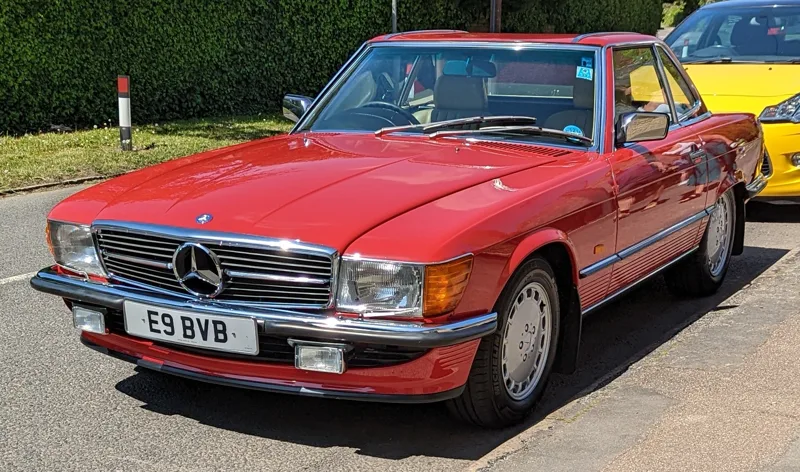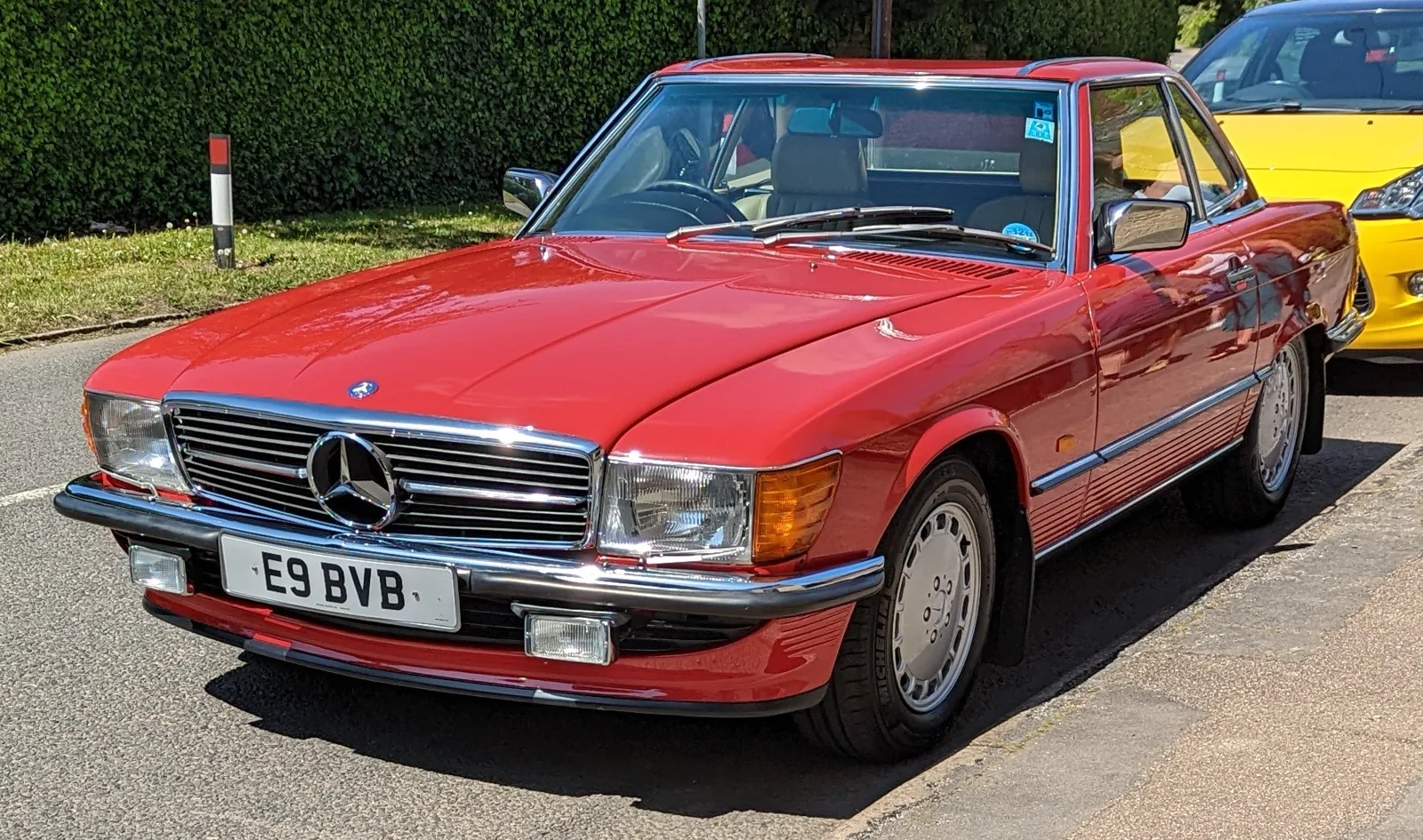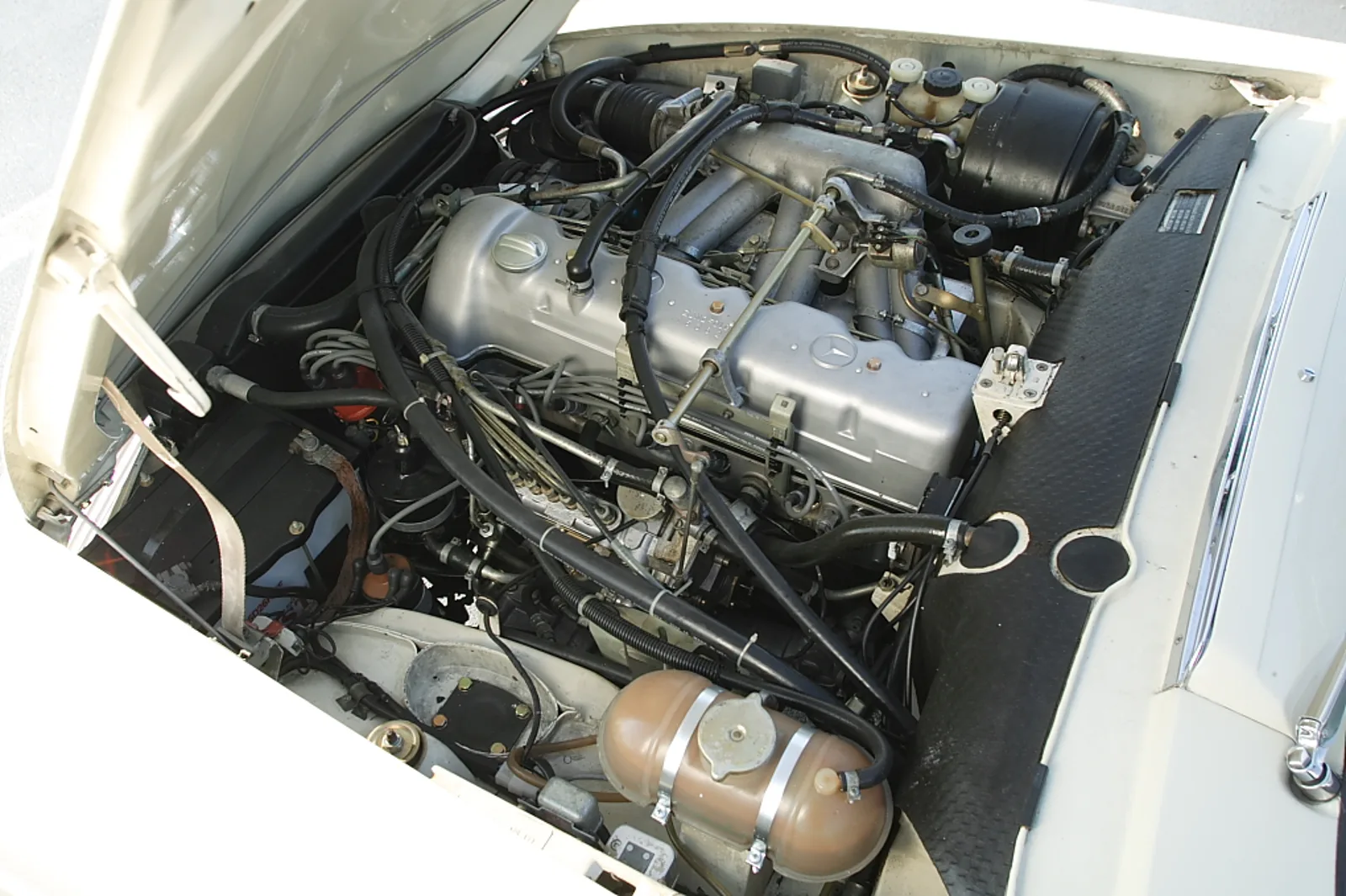
A single-overhead-camshaft straight-six that started at 80 PS in the 220 and grew, through fuel injection and stroking, into the 2.8-litre M130.
The Mercedes-Benz M180 was an inline-six engine family built from 1951 to 1976. It had a single overhead camshaft and displacements from 2.2 to 2.8 litres, and powered the 220 Ponton, the Pagoda roadster and many Fintail and W123 models, as well as the Unimog 404S.
The Mercedes-Benz M180 was a family of inline-six petrol engines that powered Mercedes-Benz cars and trucks for about a quarter of a century. It debuted in 1951 in the 220 and grew from 2.2 litres to a 2.8-litre flagship without changing its basic layout. Along the way it gave birth to a fuel-injected line, a four-cylinder cousin and a diesel family that lasted into the 1970s.
What is the Mercedes-Benz M180 engine?
The M180 is a family of inline-six engines built by Mercedes-Benz from 1951 to 1976, with later descendants running until 1985. It used a single overhead camshaft, a reverse-flow cylinder head and displacements between 2.2 and 2.8 litres. Both carburettor and fuel-injected variants were produced, and the family covered a wide spread of cars and commercial vehicles.
The family is usually described through its engine codes, which include the M127, M108, M129, M130, M114 and M123. Some of these codes share a block or a head with the M180, while others were new designs that borrowed its architecture. The M110 double overhead camshaft engine is related too, because it used the M130 cylinder block.
A single overhead camshaft six that carried Mercedes-Benz from the Ponton era into the W123, one stroke at a time.
Where did the M180 engine come from?
The M180 was designed by Wolf-Dieter Bensinger and unveiled at the Frankfurt show in April 1951. Its first home was the 220, known as the W187, which used the chassis of the 170S. The engine ran alongside a separate, larger six, the M186, but the two were of entirely different design and shared almost no parts.
The M180 also shaped the company's other engines. Its architecture carried over into the M121 overhead-cam four-cylinder of 1955, and that engine in turn influenced the OM621 diesel of 1958. Those diesel designs evolved into the M115 and OM615 in 1968. The diesel range later grew with the OM616 in 1973, followed by the OM617 five-cylinder in 1974.
How was the M180 built?
The M180 used a reverse-flow cylinder head and a staggered valve arrangement, with one camshaft in the head driven by a duplex chain. The first version measured 80 mm by 72.8 mm, giving 2,196 cc, and it ran a compression ratio of 6.5:1. Twin Solex 30 PAAJ carburettors fed the engine in its earliest form.
The layout was oversquare, which means the bore was wider than the stroke. Piston speeds reached 11.1 m/s at the maximum and 6.1 m/s on average. Later generations kept the same basic concept while the bore, stroke and head changed to meet new demands.
How much power did the first M180 make?
The first M180 produced 80 PS (59 kW; 79 hp) at 4600 rpm. Output rose to 85 PS (63 kW; 84 hp) when the second generation arrived in 1954 with a compression ratio of 7.6:1 and Solex 32 PAATJ carburettors. The third generation of 1956 reached 100 PS (74 kW; 99 hp) at 4800 rpm.
Compression rose again in August 1957, to 8.7:1 on the second-generation engine and on the third-generation unit used in the 220S. The 220S then made 106 PS (78 kW; 105 hp) at 5200 rpm, a useful gain for a carburettor engine of its size.
What changed when fuel injection arrived in 1958?
In October 1958 Mercedes-Benz fitted Bosch mechanical fuel injection to the 220 series, creating the W128 220SE with the M127 engine. The engine kept the same cylinder block but received a new chassis and model code. The M127 I produced 115 PS (85 kW; 113 hp) at 4800 rpm, a clear step up on the carburettor cars.
The system delivered fuel through a mechanically controlled, multi-point arrangement that fired in groups. Two pistons served three cylinders each, with an injection pressure of 15 atmospheres, about 1570 kPa. The engineers also relied on resonance-effect induction, which gave the engine a volumetric efficiency above 100 per cent. Injection had previously been reserved for the 300S and 300SL, so the 220SE brought the technology to a far wider audience.
What did the 2.3-litre engine add?
The 2.3-litre M127.981 arrived in the Pagoda roadster in 1963, with a 9.3:1 compression ratio and a bore enlarged to 82 mm. It displaced 2,306 cc and produced 150 PS (110 kW; 148 hp) at 5500 rpm. The Pagoda's six-plunger injection pump and larger bore made it the strongest engine in the family to that date.
Other 2.3-litre versions followed for the Fintail sedans. The M180.947 powered the 230S from July 1965 with a milled head that brought the ratio to 9.0:1 and gave 120 PS (88 kW; 118 hp) at 5400 rpm. The lower-priced 230 used the M180.945 with 105 PS (77 kW; 104 hp), before it too received the 230S power package in July 1966.
The last 2.3-litre was the M180 V 23 of 1968, which kept the older motor in the W114 230/8 series. A 0.25 mm smaller bore, chosen for better durability and cooling, left 2,292 cc and 120 PS (88 kW; 118 hp). The car kept selling beyond the 1973 facelift, and output stopped in autumn 1976, ending the original design's 25-year run.
Why did the 2.5-litre M129 engine fail?
The 2.5-litre M129 was built by stroking the 2.3-litre block, which kept the cylinders spaced asymmetrically in pairs. That uneven arrangement caused uneven cooling between each pair. Its peak piston speed of 14.4 m/s was well above the 13.1 m/s of the 2.3, and the combination of stress and heat produced premature failures.
Mercedes-Benz responded by redesigning the cylinder block with symmetrical bores. Two new engines came out of the work: the M114 for the 2.5-litre capacity, and a bored-out M130 that became the 2.8-litre. The M129 itself was short-lived, and the fix turned a troublesome design into the basis for the later family.
What was the M114 engine?
The M114 was the smaller-displacement version of the symmetrical block, with 2.5 litres and 9.0:1 compression. The M114.920 produced 130 hp (96 kW) at 5400 rpm and was fitted to the 250/8 flagship of the new series. It kept Zenith carburettors and the pistons of the M108.
The M114.980 was the first Mercedes-Benz engine to use Bosch D-Jetronic electronic fuel injection. It produced 150 hp (110 kW) at 5500 rpm and went into the 250CE coupe in late 1968. That made the M114 a technical bridge between the mechanical injection of the 1950s and the electronic systems that followed.
How big did the 2.8-litre M130 become?
The M130 used the symmetrical block to take the bore out to 86.5 mm, a 4.5 mm increase over the 2.5-litre, for a 2,778 cc displacement. That was the largest capacity the block could sensibly carry, and the engine became the family's most powerful expression of the original idea.
The carburetted M130 V 28 with 9.0:1 compression went into the 280S for the 1968 model year. Its fuel-injected sibling, the M130 E 28, made 160 hp (118 kW) at 5500 rpm in the 280SE and replaced the M129 across the W108 sedan and the W111 coupe and cabriolet. The M130.981 pushed output to 170 hp (125 kW) at 5750 rpm for the 300SEL, and the Pagoda received a more aggressive camshaft version of the same engine.
What was the M123 engine?
The M123 was a 2.5-litre redesign that arrived with the W123 range in 1975. The bore was set at 86 mm so that pistons could be shared with the M110, and the stroke was cut to 72.4 mm for a total of 2,525 cc. Thanks to the short stroke, the crankshaft could remain a four-pin design with big journals and no counterweights.
Fleet operators, especially those running stretched six-door taxis, made up most of the buyers. Private demand dropped once the modular M102, launched in the 230E and 230TE in 1980, matched its performance for less money and with better economy. The original M123 produced 129 hp (95 kW) at 5500 rpm, and a power increase in September 1979 lifted it to 140 hp (103 kW) at 5500 rpm before the family was replaced in 1985 by the M103 in a 2.6-litre form.
How did the M180 family reach the Unimog?
The 404S Unimog, built from 1955 to 1980, was a 4WD truck developed for military use within NATO and elsewhere. The truck needed a petrol engine, reliable lubrication on steep slopes and good off-road performance. The 82 hp M180.922 was chosen, and the design later moved on through the M180.928, M180.953 and M180.953 variants.
From 1971 the factory also offered the 2.8-litre M130 in 110 hp form, alongside a second M130 variant. When military Unimogs were sold to private owners, many owners swapped in newer petrol engines or one of the more efficient diesel units from civilian models such as the Unimog 406.
What replaced the M180 family?
The final iteration was the M110, a cross-flow double overhead camshaft engine with 12 valves and hemispherical combustion chambers. Its bore was reduced to 86 mm, with a stroke of 78.8 mm, to protect the cylinder walls from higher compression and speeds. It used the M130 block and is usually treated as part of the same family.
The M110 was the top engine for the mid-range W114 and W123, and the starting engine in the W116 and W126 S-Class. It also powered the R107 SL and C107 SLC. The M103 took over in 1985 with a larger 3.0-litre capacity, although the M110 kept going in the W460 280GE G-Wagen until 1991.
Specifications at a glance
| Engine code | Year | Displacement | Output | Typical car |
|---|---|---|---|---|
| M180.920 | 1951 | 2,196 cc | 80 PS (59 kW; 79 hp) at 4600 rpm | 220 W187 |
| M180.924 | 1956 | 2,196 cc | 100 PS (74 kW; 99 hp) at 4800 rpm | 220S W180 |
| M127.980 | 1958 | 2,196 cc | 115 PS (85 kW; 113 hp) at 4800 rpm | 220SE W128 |
| M127.981 | 1963 | 2,306 cc | 150 PS (110 kW; 148 hp) at 5500 rpm | 230SL W113 |
| M108.920 | 1965 | 2,496 cc | 130 hp (96 kW) at 5400 rpm | 250S W108 |
| M129.980 | 1965 | 2,496 cc | 150 hp (110 kW) at 5500 rpm | 250SE W108 |
| M130.980 | 1968 | 2,778 cc | 160 hp (118 kW) at 5500 rpm | 280SE W108 |
| M130.981 | 1968 | 2,778 cc | 170 hp (125 kW) at 5750 rpm | 300SEL W109 |
| M123.920 | 1975 | 2,525 cc | 129 hp (95 kW) at 5500 rpm | 250 W123 |