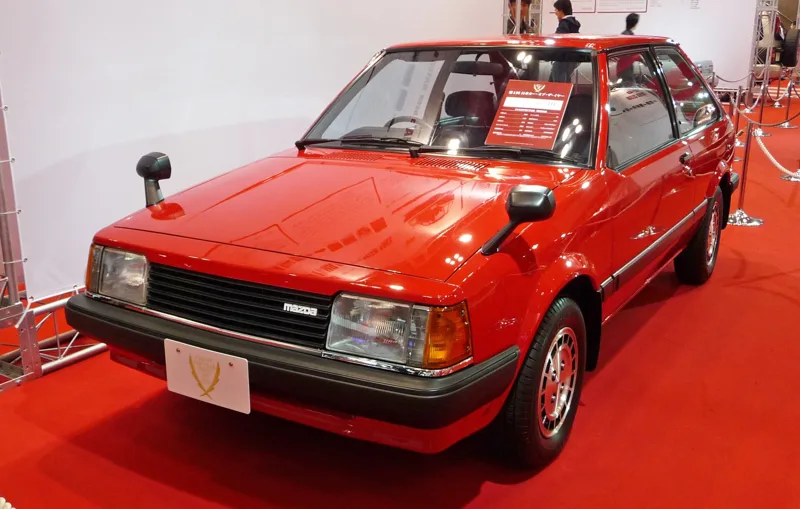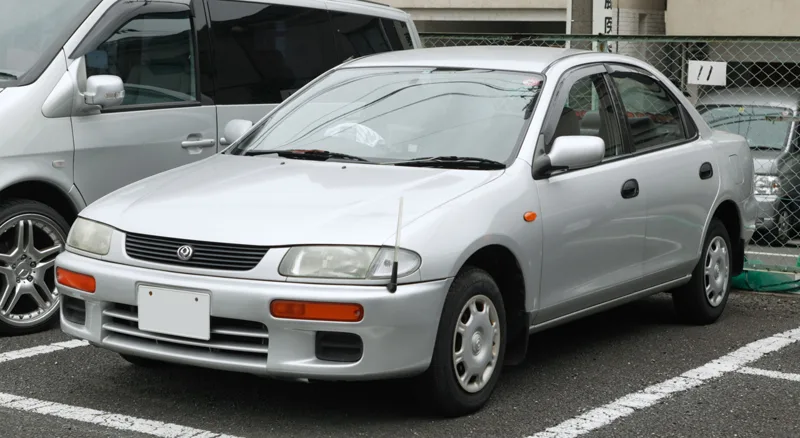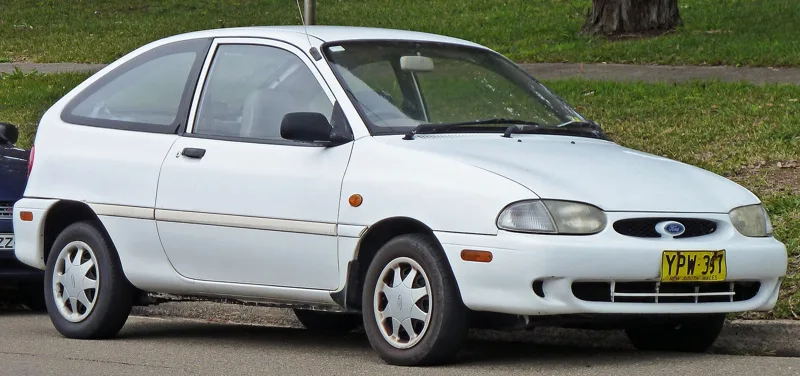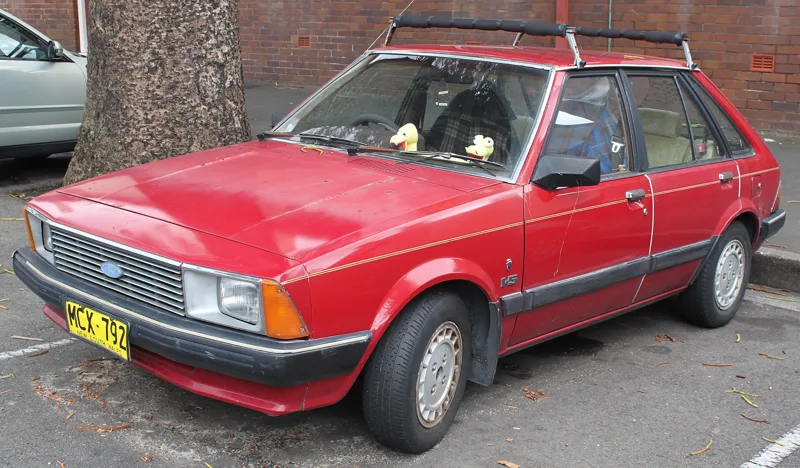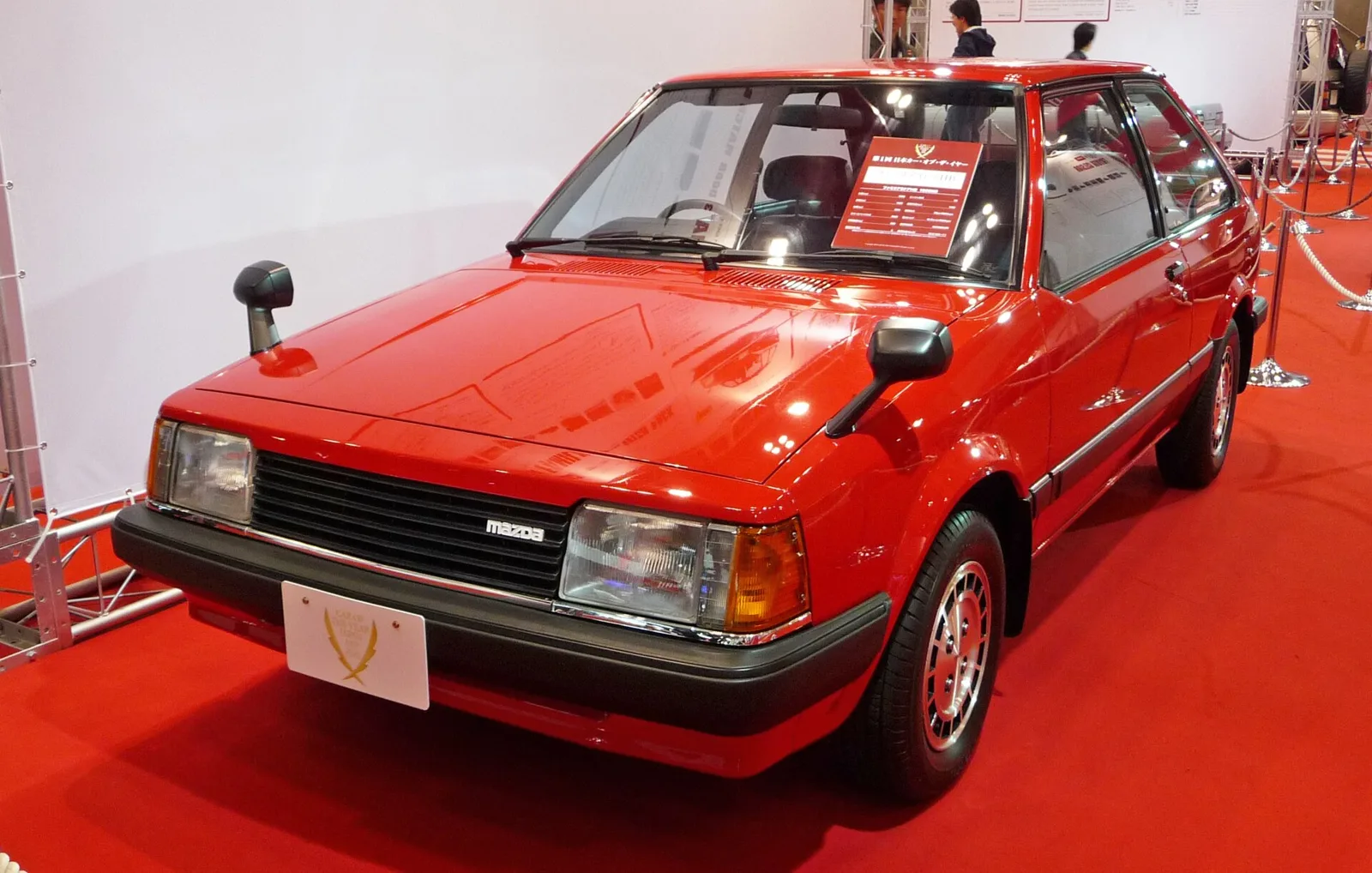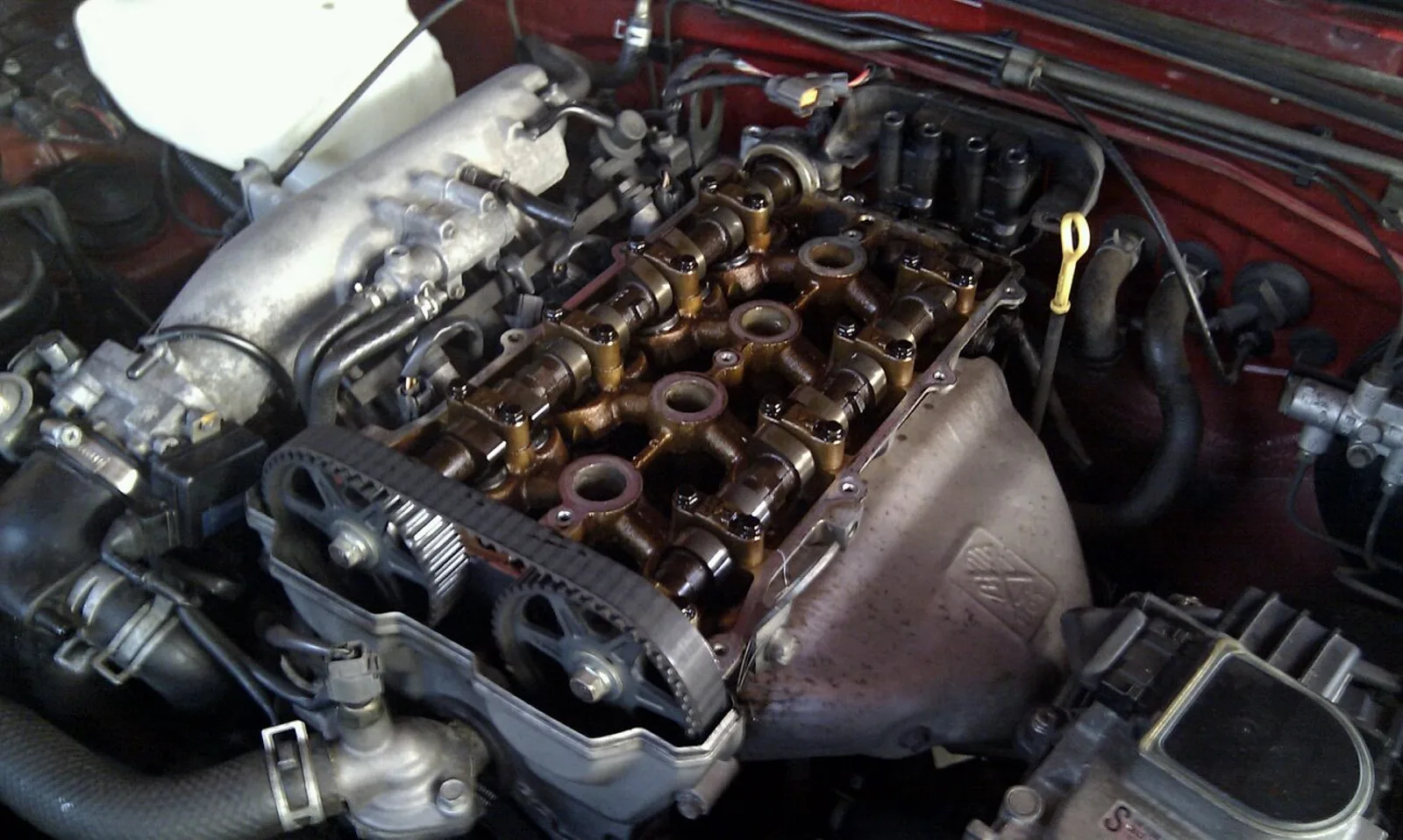
An iron-block family that ran from economy cars to the turbocharged BPD designed to help Mazda win a world rally championship.
Built as iron-block inline-fours from 1.1 to 1.8 litres, the family used belt-driven valve gear and a non-interference layout. Its cars ranged from economy models to the rear-wheel drive Miata.
The Mazda B-series is a family of small inline-four engines with iron blocks, belt-driven valve gear and capacities from 1.1 to 1.8 litres. Mazda fitted it to front-wheel drive economy cars, to the turbocharged 323 GTX with full-time four-wheel drive and to the rear-wheel drive Miata, so one basic design covered very different jobs.
What makes the B-series a non-interference engine?
The B-series is built as a non-interference design. If the timing belt breaks, the valves and pistons are not damaged, because the valve opening, the depth of the combustion chamber and, in some variants, the shape of the piston crown leave enough room for the open valves at every piston position.
For an owner, that means a broken belt stops the car without wrecking the valves or pistons, which is the whole purpose of the layout.
One iron-block four-cylinder family that stretched from 1.1 litre economy cars to a 209 hp turbo built for rallying.
What were the 1.1 and 1.3 litre B-series engines?
The smallest member is the B1, a 1,138 cc unit with a single SOHC cylinder head and eight valves. It appeared in the 1987-1989 Mazda 121 and in later Kia Sephia models sold in European and Asian markets. A fuel-injected version was used in selected European 1991-1995 Mazda 121s.
Two 1.3 litre engines followed. The BJ was a short-stroke DOHC 16-valve unit at 1,290 cc, and it was sold solely in Japan, as the Ford Festiva GT, GT-X and GT-A. It made 88 PS (65 kW) at 7000 rpm with Mazda's EGi single-point fuel injection.
The B3 was a larger 1,324 cc SOHC engine with a 71.0 by 83.6 mm bore and stroke. Its fuel-injected form produced 64 PS (47 kW) at 5000 rpm and 73 lb-ft (99 N m) of torque at 3000 rpm. Later versions reached 73 PS (54 kW) at 5500 rpm, with 104 N m (77 lb-ft) at 3700 rpm, and the B3 served in the Ford Festiva, the Kia Pride and the Mazda Familia.
How did the 1.5 litre B5 develop?
The 1.5 litre B5 displaced 1,498 cc. Its 8-valve SOHC form powered the 1987-1989 Mazda Familia and Ford Laser, and it stayed in production until 1994 beside the newer BG generation. A 16-valve SOHC version, usually with single-point injection, was mainly sold in the Japanese domestic market.
The sporting 1.5 litre option was the B5D, a Japanese-only DOHC 16-valve unit with fuel injection and a revised head and intake. Output stood at 120 PS (88 kW) at 6,500 rpm, while torque peaked at 132 N m (98 lb-ft) and arrived at 5,500 rpm, and it powered the BG Familia and the Ford Laser S. The later B5-ZE reached 125 PS (92 kW) at 7,000 rpm in the Eunos Presso and Familia Interplay X from 1994.
The 2000 to 2005 Kia Rio used a B5 variant with a 75.5 mm bore and 83.4 mm stroke. That version produced 100 PS (74 kW) and 135 N m (100 lb-ft) of torque.
What did the 1.6 litre B6 family offer?
The B6 was a bored-out B3 with a capacity of 1,597 cc and an 83.6 mm stroke. It came as a 16-valve SOHC, as a DOHC unit, and as an 8-valve SOHC in the 1985-1994 Mazda 323. A fuel-injected version called the B6F was sold in Japan, Britain and Australia, and the 16-valve DOHC form went into the Mazda Miata from 1989 to 1993 and the Mazda Xedos 6 from 1993 to 1999.
How did the turbocharged B6T compare around the world?
The B6T is the turbocharged, fuel-injected and intercooled 16-valve DOHC B6, introduced in 1985. In North America it produced 132 hp (98 kW) and 136 lb-ft (184 N m), while the Japanese version reached 140 PS (103 kW) and 19.0 kg-m (186 N m) thanks to better intake design and its ability to run on 100 octane fuel.
Most B6T engines were mated to four-wheel drive, although front-wheel drive versions existed. The 1987 BFMR Familia GT-Ae, a special rally homologation model, got a different turbocharger that raised output to 150 PS (110 kW) and 20.0 kg-m (196 N m), with otherwise identical internals.
The naturally aspirated B6D took a different route. It had higher compression, no turbo and the first Mazda use of the Variable Inertia Charge System, known as VICS. Its third generation had an alloy cam cover, a VICS intake, 9:1 compression and 107 hp (79 kW).
What made the B6ZE special in the MX-5?
The B6ZE(RS) was developed for the Mazda MX-5 (Miata) from 1989 to 2005, while a Japanese-only Familia used it in full-time four-wheel drive guise from 1994 to 1998. Its DOHC 16-valve alloy head sat on a lightened crankshaft and flywheel, which allowed a 7,200 rpm redline, and an unusual aluminium sump with cooling fins completed the package.
Output changed across markets and years. The US and European version of 1990 to 1993 had a 9.4:1 compression ratio and 115 hp (85 kW) at 6,500 rpm, while the later European version of 1994 to 1997 made 90 hp (66 kW). From 1998 to 2005 the European engine returned to 110 hp (81 kW) at 6,500 rpm. Japanese cars started at 120 hp (88 kW), with 125 hp (92 kW) after 1998.
Were there B-series diesels?
Alongside the petrol engines, Mazda built two 1,720 cc diesels, the PN27 and PN46. Both were B6-based units with a 78 by 90 mm bore and stroke. The PN27 powered the 1986-1989 Mazda Familia, and the PN46 went into the 1987-1989 model, which made the diesels a small but distinct part of the family.
What was the 1.8 litre B8 and where was it fitted?
The B8 is not simply a bored and stroked B6. It uses a new block with wider cylinder spacing, an 83 mm bore and an 85 mm stroke for 1,839 cc. This SOHC four-valve engine powered Australian Mazda 323s, the American 1990-1994 Mazda Protege and Canadian 323 hatchbacks.
The B8 used hydraulic lash adjusters and a belt-driven camshaft. Its compression ratio was 8.9:1, and multi-port fuel injection fed a 6,000 rpm redline. Quoted output was 103 hp (77 kW) with 111 lb-ft for US and Canadian cars, and 106 PS (78 kW) at 5,300 rpm for Europe.
What did the DOHC BP add to the B8?
The BP is a DOHC variant of the B8 with four valves per cylinder, called BP-ZE by Mazda engineers. It has a forged crankshaft, piston oil squirters, a 7,000 rpm redline and a variable inertia charging system that boosts power in the upper rev range. Base form on 91 RON fuel produced 96 kW (131 PS; 129 bhp) at 6,000 rpm.
The BP's structure reflected its performance role. A structural aluminium oil pan with cooling fins sat under the engine, and the engine became a favourite with both naturally aspirated and turbo enthusiasts for its robust design and materials. The BP appeared in the 1989-1994 Mazda Familia GT in Japan, the Ford Laser TX3 in Australia, the Mazda Protege LX and the 1990-1993 Mazda 323 in Europe.
A simpler SOHC version sat alongside it, recognisable by a black stamped-steel oil pan. It had a cast crankshaft, no oil squirters and less aggressive camshafts, and it went into the 1995-1998 Mazda Protege ES.
How strong were the turbo BPT and BPD engines?
The BPT is a turbocharged and intercooled BP that produced 180 PS (132 kW) at 6,000 rpm in Japanese specification. The BPD, a revised version with a much larger turbocharger, reached 209 hp (156 kW) and 184 lb-ft (255 N m). Mazda built the BPD to help win a world rally championship, and it went into the limited production Familia GT-R and GT-Ae.
The BPT used an IHI RHB5 VJ20 turbocharger, a sidemount intercooler and 330 cc injectors. On 95 octane fuel, European models were quoted at 166 PS (122 kW), with 219 N m (162 lb-ft) of torque. Only all-wheel drive Familia and Laser models received it, with viscous limited-slip differentials at the centre and rear.
The BPD revised the BP with a larger crank nose, bigger oil squirters, a main bearing support plate and better flowing ports. Its IHI RHF6CB water-cooled turbocharger was far larger than the BPT's, and the engine also used sodium-filled exhaust valves, a front-mounted intercooler and 440 cc low impedance injectors. The VICS system of the naturally aspirated BP was removed, along with the boost cut in the engine control unit. Production reached 2,200 Familia GT-R cars and 300 GT-Ae cars.
What changed in the BP-4W and BP-Z3?
The BP-4W is a modified BP for the 1998 Roadster. It replaced the old hall effect cam sensor with two units at the front, adopted solid lifters in place of problematic hydraulic ones and produced 140 hp at 6500 rpm. The BP-Z3 of 2001 added S-VT variable valve timing on the intake side.
The 2004 to 2005 Mazdaspeed MX-5 used the BP-4W type rather than the later BP-Z3 and produced 178 bhp (180 PS; 133 kW) at 6000 rpm, with a 9.5:1 compression ratio and no VICS. Its VTCS was a different system, though the two are often confused.
The BP-Z3, also called BP-VE, swapped VICS for a Variable Tumble Control System, which restricted the intake on cold start for emissions. It went into the 2001 onward Miata, and Australia's turbocharged version in the MX-5 SP produced 157 kW (211 hp) and 280 N m (207 lb-ft). The later Z family grew out of this engine.
Which cars used the B-series?
| Variant | Capacity | Valvetrain | Published output | Notable applications |
|---|---|---|---|---|
| B1 | 1.1 L (1,138 cc) | SOHC 8-valve | Not given | 1987-1989 Mazda 121, Kia Sephia |
| BJ | 1.3 L (1,290 cc) | DOHC 16-valve | 88 PS (65 kW) at 7000 rpm | Ford Festiva GT, GT-X, GT-A (Japan) |
| B3 | 1.3 L (1,324 cc) | SOHC | 64 PS (47 kW) at 5000 rpm, fuel injected | Ford Festiva, Kia Pride, Mazda Familia |
| B5D | 1.5 L (1,498 cc) | DOHC 16-valve | 120 PS (88 kW) at 6,500 rpm | BG Familia, Ford Laser S |
| B6T | 1.6 L (1,597 cc) | DOHC 16-valve, turbo | 132 hp (98 kW) North America; 140 PS (103 kW) Japan | Familia turbo, Ford Laser TX3 turbo, Mercury Capri XR2 |
| B6ZE | 1.6 L (1,597 cc) | DOHC 16-valve, alloy head | 115 hp (85 kW) at 6,500 rpm, 1990-1993 | Mazda MX-5 (Miata), 1989-2005 |
| B8 | 1.8 L (1,839 cc) | SOHC 4-valve | 103 hp (77 kW), US and Canada | Australian Mazda 323, Mazda Protege |
| BP | 1.8 L (1,839 cc) | DOHC 4-valve | 96 kW (131 PS; 129 bhp) at 6,000 rpm | Familia GT, Ford Laser TX3, Mazda Protege LX |
| BPT | 1.8 L (1,839 cc), turbo | DOHC 4-valve | 180 PS (132 kW) at 6,000 rpm, Japan | Familia GT-X, Mazda 323 GT, Ford Laser GT-X |
| BPD | 1.8 L (1,839 cc), big turbo | DOHC 4-valve | 209 hp (156 kW) | Familia GT-R and GT-Ae |
| BP-4W | 1.8 L (1,839 cc) | DOHC 4-valve, solid lifters | 140 hp at 6500 rpm | 1998 MX-5 Roadster |
| BP-Z3 | 1.8 L (1,839 cc) | DOHC, S-VT intake | 157 kW (211 hp), turbo in MX-5 SP | 2001 onward Miata |
Why does the B-series still matter?
The B-series matters because one basic design spanned economy cars, a rally-bred turbo and sports roadsters. Its non-interference layout, wide capacity range and enthusiast following have kept it relevant to the people who still study Mazda's engine history.
The BP in particular is prized by both naturally aspirated and turbo enthusiasts, who value its robust design. Several systems carry similar names, including VICS and VTCS, so reading the variant codes closely matters for anyone buying or rebuilding one.
Mazda's development path ran from small, cheap economy units to a rally-capable turbo and then onward to the Z family that evolved from the BP-Z3. Each step kept the same basic architecture while changing the head, the injection and the valve systems around it.