How breath-alcohol locks work, why they hold the starter rather than the engine, and how the rules differ across Australia, Europe, Canada and the US.
A breath-testing unit wired into a car's ignition blocks the starter until the driver's breath-alcohol reading falls under a set limit. It also demands random retests while the car runs, and it sounds an alarm when a test fails. Rules and costs differ widely by country and US state.
An ignition interlock device is a breath-testing unit fitted to a vehicle, and it stops the engine starting unless the driver's breath-alcohol reading is below a set limit. The limit varies by country, and the device is often ordered for people convicted of drink driving. It is a form of electronic monitoring rather than a simple theft-deterrent immobiliser.
How does an ignition interlock device work?
The driver blows into a mouthpiece before the engine starts, and the device interrupts the signal from the ignition to the starter until a valid sample meets the limit for that jurisdiction. If the sample is too high, the engine stays off. A short time-out allows a quick restart without a new test if the engine stalls.
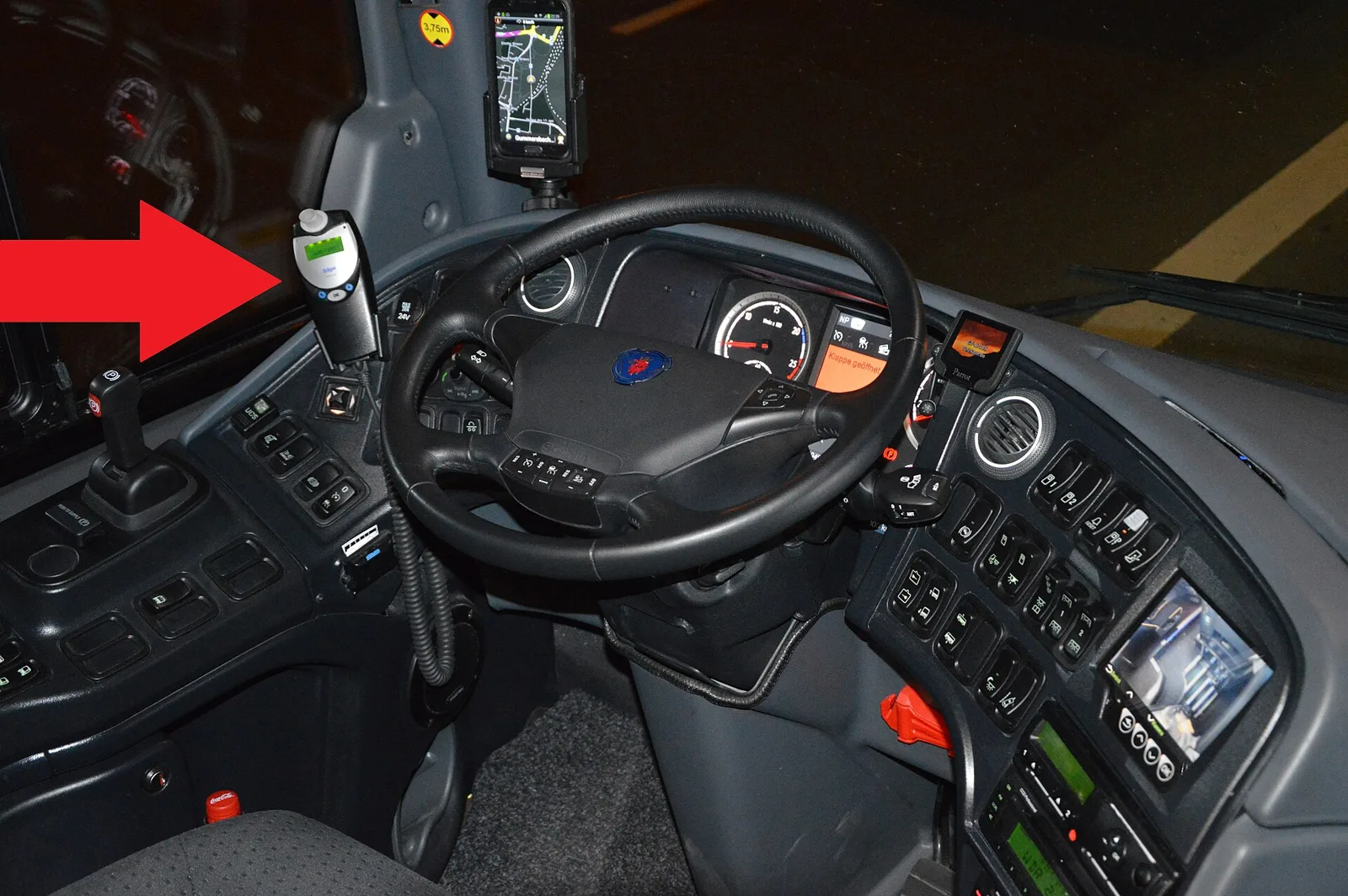
The interlock sits inside the vehicle near the driver's seat, and it is wired directly into the ignition system. Because it governs starting, it acts as a gate rather than a warning light, which is why installation is handled by a certified provider.
While the car is running, the device demands rolling retests at random times. In many US implementations these fall approximately 20 to 40 minutes apart, and the driver must blow again within a period that allows the car to pull safely off the road. The purpose is to stop someone other than the driver providing the sample. If a test is missed or fails, the device logs the event, warns the driver and sounds an alarm.
The device does not switch the engine off; it refuses to let the driver start the car in the first place.
Why doesn't the device simply switch off the engine?
A common assumption is that an interlock cuts the engine as soon as alcohol is detected. Regulators avoided that design, because a sudden stop would create an unsafe situation on the road. Instead, the alarm continues, with lights flashing and the horn sounding, until the ignition is turned off or a clean sample is provided.
Each jurisdiction sets its own alarm rules within state regulations. The alarm resembles the one used when a car's immobiliser is triggered, but it works independently of the immobiliser, so the two systems do not depend on each other.
Violations do not always mean the driver drank. They can come from a driver below the zero tolerance level, from use by another person within legal limits, or from test anomalies such as mouth alcohol. Some states routinely discount anomalies, while others automatically treat a failed reading as a violation.
How did the technology develop?
Borg-Warner developed the first performance-based interlocks in 1969. In 1981, a New Jersey student, Jeffrey Feit, entered a statewide innovation contest with a rough breathalyser design. Two years later, Limerick student Hans Doran showed a working prototype at a Dublin science contest.
Breath-sensing units became the norm through the 1980s, using semiconductor sensors. These units were rugged and helped the field get started, but they held calibration poorly, responded to altitude and gave false readings from some non-alcohol sources. Wider sale was slowed while makers worked to prevent tampering.
By the early 1990s, the industry had moved to a second generation of interlocks with reliable and accurate fuel cell sensors. In the US, interlocks must meet National Highway Traffic Safety Administration (NHTSA) standards.
What sensors do modern interlocks use?
Modern devices use an alcohol-specific fuel cell sensor. Alcohol reacts at a platinum electrode and generates a current, which is measured and converted into an alcohol-equivalent reading. Fuel cells are less accurate than the infrared spectroscopy used in evidentiary breathalysers, but they are cheaper and tend to be more specific to alcohol.
The category of alcohol that a sensor must handle is broader than the drink in a glass. It includes isopropanol, sorbitol, menthol and methanol, as well as ethanol. The table compares the three main sensor families in use.
| Sensor | Period | Notes |
|---|---|---|
| Semiconductor (Taguchi) | 1980s | Sturdy, but held calibration poorly and reacted to non-alcohol sources |
| Fuel cell | Early 1990s onward | Alcohol-specific and cheaper; less accurate than infrared |
| Infrared spectroscopy | Evidentiary breathalysers | More accurate and reliable than fuel cells |
How are interlocks calibrated and monitored?
Interlock sensors are recalibrated at set intervals, commonly every 30, 60 or 90 days. Calibration uses either a pressurised alcohol-gas mixture of known concentration or a wet bath containing a known alcohol solution, and each visit prints or downloads a log of the device's activity and of the vehicle's electrical events.
Authorities may require periodic review of those logs, and violations found there can lead to further sanctions. Some devices include a camera, which a jurisdiction may require or which may be fitted voluntarily. The camera can show who gave a failed sample, which helps clear a report when the failure was triggered by a third party.
How much does an interlock cost?
The offender generally pays for installation, maintenance and calibration, and costs vary widely around the world. Averages reported for the US in 2015 put installation at roughly $70-400, with monitoring and calibration adding around $60-160 each month. California's pilot set installation at $70-150, with fees of $60-80 per month afterwards.
European figures are higher. In Austria's pilot, the device came to 2,500 euros a year, with 300 euros for fitting and removal and a mentoring course costing at least 600 euros. In Belgium the cost of 3,500 euros, paid by the driver, acts as a deterrent to use.
In France, the purchase price was 1,300 euros, or a rental of 100 euros per month plus installation fees.
Where are interlocks required?
Interlocks are required as a condition for many drink-driving convictions, especially for repeat offenders, and the approach has spread across Oceania, Europe and North America. In Australia, Victoria, South Australia, Western Australia, Tasmania, New South Wales and Queensland all use them, while the Northern Territory and the ACT were looking into their use.
New Zealand made interlocks a sentencing option in August 2012, and the first device was reported installed that December. Sweden trialled them in 1999 and offered a programme with medical certificates for drivers, and interlock devices are used in buses in Stockholm.
Other countries took different routes. Austria consolidated interlocks into federal law after a 2012-2013 pilot, and Finland began with a trial in 2005 before writing the programme into law in 2008, requiring participants to meet a health care professional. Lithuania handed more than 80 new school buses fitted with interlocks to municipalities.
| Country | Start | Reported result |
|---|---|---|
| Finland | Trial 2005, law 2008 | 5.7% re-offended with the programme, against 30% without |
| Denmark | Voluntary trial 2015, redesigned 2017 | Only 24 drivers at first, then 450 by 2020 on a three-year programme |
| Netherlands | From December 2011 | Over 5,000 participants; cancelled in 2015 |
| Sweden | Trial 1999 | About 3,000 people driving with interlocks by 2020 |
| Poland | Since 2015 | Court orders: 609 in 2017, 2,180 in 2018, 840 in early 2019 |
How do US states and Canadian provinces apply the rules?
All 50 US states permit interlock sentences, and about half require installation after a first offence. Ontario, Quebec and Manitoba require interlocks for some offenders, while Nova Scotia can impose a lifetime driving ban after enough convictions. Thresholds vary widely.
Texas requires interlocks even for first offenders at a blood alcohol concentration of .15% and over, while Utah applies its rule to any DUI, with 18 months for a first offence from July 2, 2009. New York's mandate took effect on August 15, 2010, and requires an interlock for at least 6 months. The rule was introduced in memory of Leandra Rosado, who died while riding in a car driven by a drunk driver.
California's AB 91 pilot began on July 1, 2010, in four counties. First offenders there install a device for five months and second offenders for one year. In Georgia and Washington, a first DUI brings one year of interlock use, a second conviction requires at least five years, and a third or later requires at least ten years.
What does a standard US interlock look like?
The standard US device is a mouthpiece on a handheld unit, with a cord that attaches to the vehicle's ignition system and runs on the battery. It must be installed at a certified service centre, and it is shipped directly to that centre and never handled by the customer.
Several providers dominate the market, including Draeger, Smart Start, Guardian, Intoxalock and LifeSafer. Intoxalock is based in Des Moines, Iowa. Most states set a zero tolerance level, so even small readings can count as a fail.
Disabling the device is treated seriously. Some states penalise a driver if a family member or mechanic bypasses it, and some criminalise a temporary bypass. Other states allow mechanics to disable a device for servicing, provided the authorisation is obtained, which can be a problem if only licensed mechanics are allowed to do it.
Which countries trialled interlocks without adopting them?
Italy trialled 53 systems on a fleet of buses in 2018, but no rehabilitation programme or legislation on alcohol interlocks followed. Britain tested the device in 2006 and chose not to expand it. Trials are not always the end of the story.
The Netherlands ran a programme with over 5,000 participants from December 2011, but it was cancelled in 2015 because of legal and technical problems.
Should interlocks be fitted to every new car?
Some proposals call for interlocks on every new vehicle, with the threshold matched to the legal limit for the driver. Politicians in Sweden, Japan, Canada, the United States and other countries have called for devices to be standard equipment in every motor vehicle sold.
Several obstacles remain. Consumer and voter acceptance is one, along with the difficulty of obtaining accurate measurements without inconvenience. The device also needs high reliability so that it does not interfere with the usability of the vehicle.
Some organisations already fit interlocks to their fleets voluntarily, to reduce the risk of monetary and reputational damage from accidents caused by a drunk-driving employee.