A ticket is paper, points are a record, and the rules linking them change from state to state and country to country.
Demerit points are a tally of traffic offences kept against a driver's licence. Most systems count up from zero, a few count down from a starting balance, and crossing the threshold brings a suspension. In Australia a full licence is lost at 12 points in three years, or 13 in New South Wales.
In New South Wales, a single speeding ticket of any size is enough to suspend a P-1 provisional licence for three months. The offence is worth 4 points and a P-1 holder is allowed no more than 4. Every demerit points system runs on the same idea, a tally kept against the licence, but the thresholds, the clocks and the penalties change at almost every border.
Most of the confusion lives in the gap between the ticket and the points. A ticket is a piece of paper; points are an entry on a database; and the link between them is a finding of guilt, which is reached very differently in Sydney, Toronto and Dublin. Follow that chain and the rules for losing a licence stop looking arbitrary.
How do demerit points work?
A demerit point system lets a licensing authority keep score on drivers. Each offence carries a set number of points, the points sit on the record for a fixed period, and passing a threshold brings a consequence: a fine, a course, a re-examination, a suspension or a revocation. The details differ by jurisdiction and by the body that runs the scheme.
Most systems count upwards. A driver starts at zero and collects points on conviction, which is why Ontario's rules are so often misread: nobody there actually loses points, they pick them up. A smaller group runs the other way. France and Italy give every driver a balance up front and take points off for infractions. The French reasoning is that a driver handed a starting capital will behave in order to protect it.
The limit is rarely the same for everyone. Younger and less experienced motorists generally face lower ceilings, and the figure can also turn on a driver's earlier record or age. Points can usually be wiped, either by going a set time without another offence or by finishing an approved driver-training course. The gravest conduct, such as hit-and-run or drink driving, often sits outside the scheme and brings a mandatory suspension and sometimes prison.
A ticket is paper, points are a record, and a finding of guilt links the two.
How does a traffic ticket turn into points?
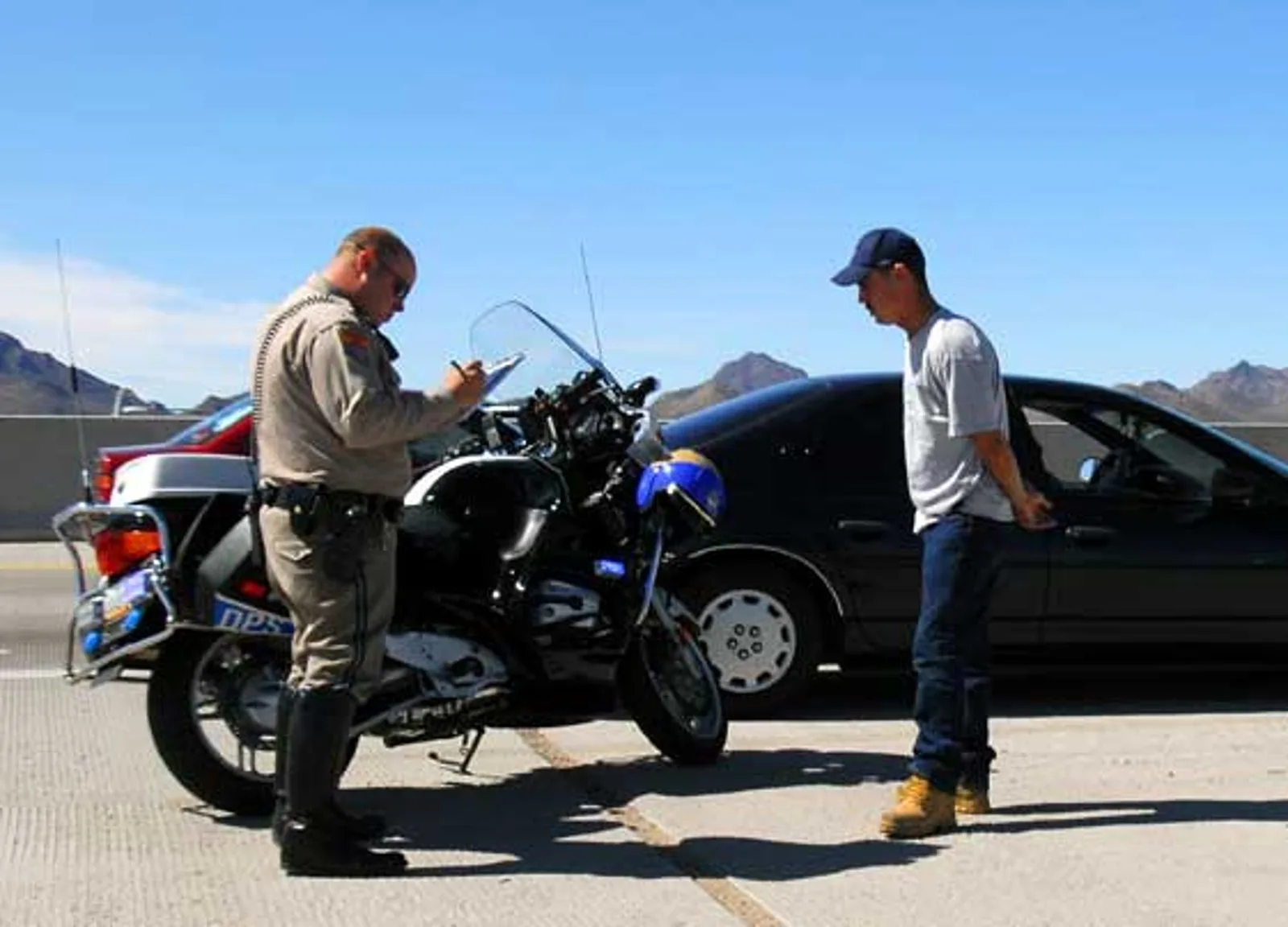
A traffic ticket is an officer's notice that a road user has broken the traffic laws. It cites either a moving violation, say a speeding offence, or a non-moving one such as illegal parking. In some places the ticket itself says that a fine or points have been or will be assessed. In others it is only a citation and a summons to court.
That split decides when points land. Where the ticket is a notice of penalty, ignoring it risks prosecution, or a civil claim for the fine. Where it is a summons, guilt is settled in court and the points follow the verdict. Canada works the second way: a guilty plea has the same effect as a conviction after trial, and on conviction the motorist is fined and, for moving violations, given demerit points under the provincial scheme.
New South Wales: paying is pleading
Every traffic and parking infringement notice in New South Wales sits inside the Self-Enforcing Infringement Notice Scheme, designed to keep people who intend to plead guilty out of the courtroom. A driver who pays, or part-pays, is treated as having pleaded guilty, and the licence takes the demerit points. A court hears the matter only if the driver elects it.
Pleading not guilty means filling in the back of the driver's copy of the notice and sending it to the debt recovery office. A hearing before a magistrate follows. The officer builds a brief of evidence from observations, notes made at the time, a vehicle description and any photographs. Pictures that the original notice does not record as taken at the scene can be excluded.
Camera tickets and the registered owner
Speed cameras, fixed and mobile, and red light cameras produce a different kind of notice. These are "owner onus" tickets: the registered owner carries the liability unless a statutory declaration names someone else as the driver.
The clock after the ticket
If a fine goes unpaid, a penalty reminder notice usually arrives about 28 days after the offence. Under the Fines Act of 1996 (NSW) the due date falls 21 days after service, and service is taken to happen within 7 days. Miss that date and an enforcement order follows with extra costs. After that can come suspension of the licence or registration, wage garnishing, seizure of property or community service.
How many points cost a full licence in Australia?
All Australian states and territories run demerit schemes, and the road authorities share information about interstate offences. A driver on a full, unrestricted licence is disqualified on reaching 12 points within three years, except in New South Wales, where the figure is 13. Drivers who can prove they are professionals get one extra point.
A suspension lasts three months, lengthened by a month for each four points over the threshold. In most states the ceiling is five months, reached at 8 points or more over the limit, which on a full licence means 20 points or more. A driver can instead ask for a 12-month "good behaviour" period. In most states one or two further points during it bring a suspension of double the original length, and Victoria tolerates no further offences at all.
Some conduct skips the points. Most states allow immediate suspension, instead of or alongside points, when a driver is impaired by alcohol or other drugs, or is travelling at greatly excessive speed.
How do the limits compare around the world?
| Jurisdiction | Direction of count | Figure that bites | What follows |
|---|---|---|---|
| New South Wales, full licence | Up | 13 points in three years | Suspension of three months plus a month per extra four points |
| New South Wales, P-1 / P-2 | Up | 4 / 7 points | Three-month suspension |
| Victoria, full licence | Up | 12 points over three years | Three-month suspension or 12-month good behaviour bond |
| Victoria, learner or probationary | Up | 5 points in 12 months | Three-month suspension or bond |
| Queensland, open licence | Up | 12 points in three years | Three-month suspension or 12-month bond |
| South Australia | Up | 12 points in 3 years | 3 months at 12 to 15 points |
| Ontario, full licence | Up from zero | 15 points (points last two years) | 30-day suspension |
| France | Down from 12 (6 for new permits) | No points left | Licence invalid |
| Germany | Up | 8 points | Revocation |
| Ireland | Up | 12 points | Six months' disqualification |
| Italy | Down from 20 (maximum 30) | No points left | Licence revoked |
| Denmark | Up | 3 penalty points | Conditional suspension |
Why do new drivers get a smaller allowance?
Learner and provisional drivers are given far less room. In New South Wales a P-1 licence, which lasts 12 to 18 months and can be renewed, is capped at 4 points, and a P-2 holder has 7 across a 24- to 30-month period, before a three-month suspension. Victoria, the Northern Territory and Queensland set their own limits over a single year.
Victoria, which introduced its scheme in 1970, suspends learners and probationers who reach 5 points within 12 months unless they take a 12-month good behaviour bond, and any further point in the bond means six months off the road. The Northern Territory, whose scheme began on 1 September 2007, uses the same 5 points over 12 months. Queensland allows learners and provisional drivers 4 points in a year, and an open licence 12 in three years, before the choice of a three-month suspension or a 12-month bond.
Double points
Some rules multiply the damage. New South Wales applies double demerits over holiday periods for speeding, seat-belt and helmet offences, and school-zone offences carry heavier point values. Queensland doubles the points all year for a repeat of the same offence within 12 months: a full-licence driver caught on a phone is given 4 points, and caught again inside the year collects a further 8, which reaches the limit. Victoria does not use double demerit periods.
When does a licence go without any points?
Several jurisdictions now treat the worst conduct as a matter for immediate suspension rather than points. In New South Wales, every drink- and drug-driving offence brings an automatic suspension, as does speeding by more than 30 km/h.
Victoria has moved furthest. Exceeding the limit by more than 25 km/h, or going faster than 130 km/h at all, carries an automatic suspension of at least three months. Since 1 November 2018 these offences no longer attract demerit points; the suspension replaces them. From 12 November 2020, a margin of 45 km/h or more, or a speed of 145 km/h or more where the limit is 110 km/h, also brings vehicle impounding.
Drink driving follows the same logic. A fully licensed Victorian with a blood alcohol concentration of 0.10 or higher can have the licence cancelled on the spot, and for learners and probationers the line is 0.07. Since 30 April 2018 every drink-driving conviction carries a suspension, and getting licensed again requires an alcohol interlock device.
How long do points stay on a driving record?
It depends on the jurisdiction. Ontario keeps points for two years from the date of the original offence. Australian schemes look at a three-year window, which South Australia measures by the dates the offences were committed. Denmark deletes points three years after they were assessed, and Germany lets them lapse somewhere between 2.5 and 10 years, depending on the offence.
Ontario shows a ladder of consequences on one record. A fully licensed driver gets a warning letter at six points. At nine comes a mandatory interview, where the driver must argue against suspension, and skipping it can mean automatic suspension. At 15 or more the licence is suspended for 30 days and must be handed to the Ministry of Transportation; refusing can mean a suspension or loss of up to two years.
South Australia uses bands. A driver on 12 to 15 points loses the right to drive for 3 months, on 16 to 20 points for 4 months, and on 20 or more for 5 months. The points count whether the offence happened in South Australia or interstate, so crossing a border does not reset the tally.
How do the subtracting systems in France and Italy work?
France and Italy give each driver a points balance and remove points as offences occur. A driver who loses every point loses the licence. The two countries differ in how the balance starts, how it is rebuilt and how severe a single event can be.
France has run its permis a points since 1992. A driver holds twelve points, or six on a new permit, and one event can cost at most six points, or eight where several infractions are involved. New drivers serve a three-year probation: they begin with six points and earn two more for each full year without an infraction, reaching twelve after the third year if the record is clean. An infraction during probation caps the balance until it ends, and lost points can come back after six months of good conduct, though only up to the cap.
With no points left, a French licence is invalid. The driver must wait six months, then reapply after medical and psychological tests and a fresh written exam. A licence that lapses during probation means a written and a driving test, and a new three-year probation. A voluntary driver education workshop can speed recovery of lost points.
Italy starts every driver on 20 points and adds a bonus of 2 for every 2 years of correct behaviour, up to a maximum of 30. Ignoring a traffic light costs 6 points. Losing everything revokes the licence, as does a second alcohol offence within 2 years. A suspension takes effect when the driver is handed the notice in person, and the licence goes to the person delivering it.
What do Germany and Ireland do differently?
Germany's Federal Motor Transport Authority, the Kraftfahrt-Bundesamt, keeps its register in Flensburg, which is why drivers talk about "points in Flensburg". The system was introduced in May 2014 with a limit of 8 points, replacing an 18-point scheme that dated back to 1974. Training events can reduce the total in some circumstances. Reaching 8 points revokes the licence, and it comes back only once a medical-psychological assessment has followed the ban.
Ireland sorts offences into tiers. Twelve points brings six months' disqualification. Thirty-eight regulatory offences are notified by post and carry 1 or 2 points when the fine is paid. Ten more serious offences require a court appearance and carry 3 to 5 points. The most serious sit outside the scheme, with automatic bans and in some cases prison. Every traffic offence in Ireland is a crime, and the posted ticket offers an exit: pay the Garda Siochana within 28 days, or the fine plus 50% within 56 days, and the driver is not prosecuted.
Why does a speeding fine in Finland depend on income?
Most Nordic countries set some traffic fines according to income. Finland begins with an estimate of a person's daily spending money, halves it, and treats the result as a reasonable sum to take away. The severity of the offence then fixes how many days the offender goes without it. Driving about 15 mph over the limit is rated at 12 days.
The usual daily sum for reckless drivers is $30 to $50, so the bill comes to roughly $400 or $500. At the top end, a Nokia executive caught on a motorcycle in 2002 paid the equivalent of $103,000 after riding at 75 km/h (47 mph) where the limit was 50 km/h (31 mph). Estonia has experimented with a time out instead of a fine, the motorist waiting at the roadside for 45 minutes or an hour.
Can a traffic ticket be contested?
The route varies, but a ticket can be fought in both Canada and the United States. In Canada the motorist or a representative must attend court in the town or city where the violation happened. A not-guilty plea brings a trial date, and the officer attends too. If the officer fails to appear, the judge will often find for the motorist and dismiss the charge, though the date is sometimes moved. Some provinces now pay officers time and a half for traffic court. Prosecutors and motorists can also strike a plea bargain.
The United States treats traffic law as a patchwork of state, county and municipal codes. Minor violations, such as equipment defects, seat belt breaches or missing proof of insurance or registration, are treated as infractions, or as civil or criminal matters, depending on the place. Jurisdictions grew more willing, around the late 1970s and early 1980s, to recast certain speeding violations as civil infractions. Serious violations, involving repeat offences, wilful disregard of public safety, death or injury, can be prosecuted as misdemeanours or felonies.
A contested American ticket goes to a hearing before a magistrate or judge. Officers and witnesses can be subpoenaed, dates can be adjourned, and a motorist may hire an attorney for full representation or only for advice. If the officer fails to show for a civil infraction and no good cause is given, the charge may be dismissed. In some states a jury may hear a criminal case.
What has changed in demerit schemes recently?
The most recent changes cluster at the extremes. Victoria took extreme speeding out of the points scheme in 2018 and added impounding in 2020. Germany swapped an 18-point scheme for an 8-point one in 2014, and Bulgaria, which began with 34 points in 1999, raised its total to 39 in 2017. New South Wales has also created a task-force aimed at stopping demerit points being sold illegally on Facebook Marketplace.