From the pink slip to Smog Check, who has to inspect which car, when, and what changes when a car crosses a state line.
Neither Australia nor the United States has a single national inspection test for ordinary cars. Each state sets its own triggers: sale or interstate transfer in much of Australia, and in the US twelve states with periodic safety checks plus emissions programmes in polluted areas.
In Sydney the old pink slip has a new name, the e-Safety Check, though the old term is still used in everyday talk. Across the Pacific, Louisiana has all but retired the safety inspection of private cars as of 30 June 2026. Neither country has one national test for ordinary cars. In both, the state or territory decides whether a car needs an inspection, how old it must be before it needs one, and what happens when you cross a border.
Australian rules tend to fire on events such as a sale or a move from another state. American ones mix safety checks with emissions programmes, many of them born of federal clean-air law. The question "do I need a roadworthy certificate?" has a different answer almost every time the postcode changes.
How do roadworthy inspections work in Australia?
Inspection in Australia is largely left to the states, heavy vehicles registered federally being the exception. Every state and territory bar the self-governing Norfolk Island has a scheme of some kind, either on a schedule or when a car changes hands. Many Australian systems are triggered by an event, such as selling the car, bringing it in from another state, or fixing a defect, rather than by a calendar.
| State or territory | What triggers an inspection |
|---|---|
| Australian Capital Territory | New vehicle registration; transfer of a car over six years old; any interstate transfer; registration lapsed over 12 months; defect notice |
| New South Wales | e-Safety Check for cars over five years old before annual registration renewal or an interstate transfer |
| Northern Territory | At 5 years, at 10 years, then annually; also first NT registration of a car aged 5 or more |
| Queensland | Safety certificate before sale or interstate transfer; no periodic inspection |
| South Australia | Mostly none; required after certain modifications, write-offs, police citations and for some imports |
| Tasmania | Interstate transfer, long-lapsed registration, repaired write-offs, left-to-right-hand-drive conversions |
| Victoria | Certificate of Roadworthiness for sale or interstate registration; police-cited defects |
| Western Australia | First registration, lapsed registration, modifications, police "yellow sticker" |
In both countries the trigger for an inspection depends on where the car is registered.
Roadworthy certificate rules, state by state
New South Wales and the ACT
The pink slip inspection in New South Wales is now the e-Safety Check. Vehicles older than five years need one before annual registration renewal or before an interstate registration is transferred in. The ACT works differently. It asks for an authorised examiner when a brand-new vehicle is first registered, when a car over six years old changes owner, and before any interstate registration transfer whatever the age. A car whose registration has been cancelled or expired for more than 12 months must be inspected before it goes back on the road, and so must any car given a defect notice.
Once registered, a car with the same owner generally does not need another inspection in the ACT, but the territory runs a random inspection scheme and can spot check vehicles, occupied or not. A defect notice means repairs and a full inspection by a licensed examiner within 14 days. For egregious safety violations an inspector can suspend the registration immediately, leaving the operator to arrange a tow. Gas-powered vehicles have an extra requirement, a special annual inspection for natural gas or propane systems.
Queensland
Queensland puts the burden on sellers. Any vehicle needs a safety inspection, and the resulting certificate must be shown prominently, before the car is advertised or an interstate registration is moved across. The check covers general condition, such as suspension and body, along with basics like tyres, brakes, lights and windscreen. A certificate from a dealer sale lasts 1,000 km or 3 months, whichever comes first; one from a private seller lasts 2,000 km or 2 months. Rural sales are exempt where reaching an inspection station would cause hardship, as are cars sold only for parts. A seller without a certificate, or one who fails to display it while the car is advertised, faces a $500 on-the-spot fine.
After registration, nothing periodic happens. Mobile teams working under a programme called OVERT do random emissions checks, and drivers may be summoned if a car is outside legal limits or smokes visibly. Police also run group operations such as Operation Lift, which went after heavily modified four-wheel-drives.
The Northern Territory, Victoria, Tasmania, South Australia and Western Australia
The Northern Territory is the closest Australian system to a calendar. Light vehicles under 4.5 ton GVM/ATM need a roadworthy inspection at 5 years, at 10 years and then every year, and every car over 10 years old is inspected annually. Victoria resembles Queensland: a licensed inspector's Certificate of Roadworthiness is needed for a car being sold or registered from interstate, and for any car police have cited for defects. Interstate transfer does not trigger an inspection in Victoria if the vehicle stays with the same owner.
In Tasmania the triggers are an interstate transfer, registration that has been dead for over three months, a car written off and repaired, and a car converted from left-hand to right-hand drive. South Australia asks the least of private owners. Most do not need an inspection to drive legally or to bring in an interstate registration, although certain modifications (engine, chassis, wheelbase, seating capacity, brakes, steering and suspension) and several categories of vehicle need a certificate of roadworthiness. Those categories are police-cited cars, write-offs and salvage, rebuilt or home-built vehicles such as classic restorations and kit cars, interstate arrivals that are over seven years old and heavier than 4.5 tonnes, cars converted from left-hand to right-hand drive and buses seating 13 or more. Western Australia asks for an inspection before first registration, after a lapse, after certain modifications, or when police issue a yellow sticker, and some commercial and public transport vehicles are inspected annually.
Heavy vehicles, modified cars and kit cars
Heavy vehicles sit under the Heavy Vehicle National Law, enforced by the National Heavy Vehicle Regulator. Operators who cross state lines can hold National Heavy Vehicle Registration, which lets them work in every state.
Modifications are mostly state business too, though most states follow Vehicle Standards Bulletin 14, a national framework whose alternative title is the code of practice for light-vehicle modifications. Queensland has its own code, which differs slightly. A modified car is generally inspected and certified by an Approved Person. Kit cars and trailers fall under Individually Constructed Vehicles, with light trailers covered nationally by VSB1 and approval sought case by case. The modification categories run from engines and transmissions to brakes, bodies, seating, fuel systems, suspension and steering, and now include electric conversions, while motorcycles and trikes have special provisions.
How vehicle inspections work in the United States
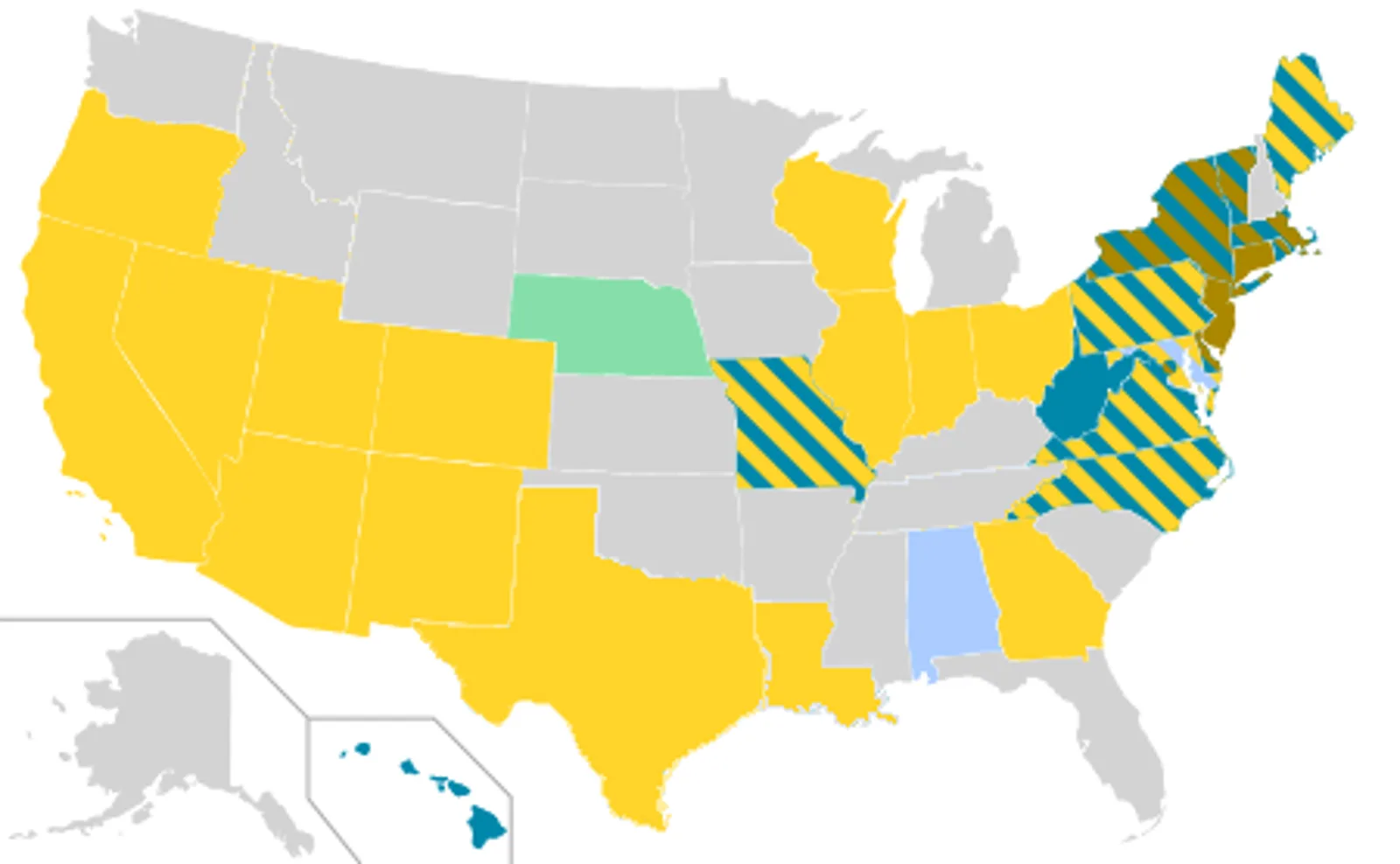
American safety and emissions inspections are governed state by state. Twelve states run periodic safety inspection programmes, annual or biennial. Maryland requires a safety inspection when a pre-owned vehicle is sold or transferred, and Alabama checks only the VIN on a sale or transfer of a vehicle previously registered elsewhere. On the emissions side, seven states require periodic inspection statewide and eighteen more apply it only to cars registered where the air is heavily polluted.
The emissions programmes owe their existence to Congress. In 1977 an amendment to the federal Clean Air Act required states to set up inspection and maintenance programmes in major metropolitan areas that failed federal air quality standards. New York's started in 1982, California's Smog Check in 1984 and Illinois's in 1986. A second Clean Air Act, passed in 1990, pulled in more states with metropolitan areas that missed the standards. Some, including Kentucky and Minnesota, have since dropped their programmes with federal approval, and Idaho's requirement ended in July 2023.
Which US states require a safety inspection?
The count of twelve is easier to state than to apply, because the state-by-state list is full of exceptions. Connecticut checks certain commercial vehicles, trucks, salvage and some trailers but not passenger cars. The District of Columbia ended private-car safety inspection on 1 October 2009, and New Jersey exempted passenger vehicles from 1 August 2010 while keeping annual inspection for commercial vehicles such as taxis and buses. Louisiana's personal-vehicle requirement effectively ended on 30 June 2026, with commercial trucks, school buses and certain farm vehicles still inspected.
The annual states
Annual inspection, usually with a windscreen sticker, remains the pattern in Hawaii, Maine, Massachusetts, New York, Pennsylvania and Virginia, and in North Carolina until a vehicle reaches 30 years old. Details vary sharply:
- Hawaii: new cars get an inspection valid for two years; emergency, school, rental and public transport vehicles are checked every six months; the sticker goes on the rear bumper.
- Maine: the sticker colour changes every year, school buses are inspected every six months, and vehicles registered as antiques are exempt.
- New York: a current out-of-state sticker is honoured until it expires or for one year after registration, whichever is sooner; farm vehicles are exempt.
- Pennsylvania: school vehicles, motor coaches and transit buses are inspected every six months; antique plates are exempt but classic or collectible plates are not; trailers over 3,000 pounds (1,400 kg) and motorcycles are inspected annually.
- Vermont: inspections expire only in even-numbered months, so a car checked in an odd month is stamped to the following even one.
- Virginia: a car brought in from another state must be inspected as soon as it is registered, with no credit for an out-of-state inspection. The sticker changed from yellow to blue in January 2019, and as of 2026 it carries a holographic state seal, a dogwood flower and QR codes, all aimed at making forgery harder.
Biennial states and other models
Missouri inspects biennially by model year, though since 28 August 2019 cars within ten model years of manufacture that have covered under 150,000 miles are exempt, and historic plates are exempt entirely. Rhode Island is biennial, exempts new registrations for two years and inspects antiques for safety but not emissions. West Virginia moved to a biennial system from 1 January 2024. Delaware inspects annually or biennially but exempts new cars for their first seven years under one owner. Alabama requires only a VIN check on sale, Kentucky and Nebraska inspect only vehicles brought from another jurisdiction, and Maryland inspects when a car is registered from another state or a used car is purchased.
Emissions testing by state
Where safety inspections have faded, emissions testing has become geographic. The programmes aim at the cities.
- California: biennial Smog Check for out-of-state vehicles, and for post-1975 vehicles and post-1997 diesels more than eight years old in zip codes across 41 of 58 counties; electric vehicles and family transfers are exempt.
- Colorado: biennial in five counties (Boulder, Broomfield, Denver, Douglas, Jefferson) and slices of four more, with a break for cars up to seven years old.
- Georgia: annual in 13 metro Atlanta counties, with the three most recent model years exempt.
- Illinois: biennial once a car is four years old, in Chicago and the eastern suburbs of St. Louis.
- Maryland: biennial in 13 of 23 counties and Baltimore.
- Massachusetts: annual since 2008. Cars under 15 years old get an OBD-2 scan; older cars get a visual check and must not produce visible smoke. The tailpipe test for 1995 and older vehicles ended in 2008.
- Nevada: the urban parts of Clark County, home to Las Vegas, and Washoe County, home to Reno; new vehicles are exempt for their first three years of registration.
What it means if you are buying, selling or moving a car
In Queensland and Victoria, the seller does the paperwork: a safety certificate in Queensland displayed while the car is advertised, a Certificate of Roadworthiness in Victoria. In New South Wales, a car older than five years cannot be re-registered or brought in from another state without an e-Safety Check. In the ACT, an interstate car needs an examiner's inspection whatever its age. In the Northern Territory, a car of five years or older registering there for the first time needs a roadworthy inspection.
In the US, moving a car can go either way. Virginia inspects a car registered from another state at once, New York honours a current out-of-state sticker for up to a year, and Maryland, Kentucky and Nebraska look at cars arriving from elsewhere. In California, every vehicle from out of state needs a smog check.
Where this goes next
Several changes are already dated. Louisiana's brake tags, as locals call its inspection stickers, are due to give way to QR codes from 1 January 2027. West Virginia has been on a biennial cycle since 1 January 2024, and Virginia's new holographic stickers carry QR codes for anti-counterfeiting. Queensland is slowly shifting from its own modification code towards the national one as changes are needed.