A brief flash of the headlights can mean thanks, a warning or a threat, and its legal status changes from one state or country to the next.
Headlight flashing is a quick signal used to warn, thank or yield to other drivers, but its meaning is not fixed. Its legal status ranges from protected speech to outright bans, and rules differ between states and countries.
Headlight flashing is the brief switching on of headlights, or a quick toggle between high and low beams, to signal another driver. Some owner's manuals call it an optical horn, because it draws attention in much the same way as the horn. Its meaning is not fixed, and its legal status depends on where the driver happens to be.
What is headlight flashing?
Headlight flashing means briefly switching headlights on, or moving between high and low beams, to communicate with another driver or drivers. It is sometimes called an optical horn in owner's manuals, because it draws the attention of other drivers. Its purpose is to alert others to hazards on the road.
The practice has many uses. A driver may flash to say they are there, to thank someone, to yield at a junction controlled by stop signs, or to warn of a crashed car or a police speed trap. Each use depends on context, and the same flash can mean different things to different people.
A flash of the headlights is quick, free and open to interpretation, which is exactly why the law around it keeps changing.
How did headlight flashing start?
Headlight flashing may have become more common as a way of driver communication by the mid-1970s, when cars began to come with beam selectors on the steering column. Those selectors were usually operated by pulling the turn signal stalk. Later designs wired the stalk to flash high beams even when the headlamp switch was off.
Before that, foot-operated pushbutton switches controlled the beams. Motorcycles took a different route. Their headlamp modulators oscillate the light intensity automatically, so the bike stands out to other traffic.
What are the common uses?
Common uses include letting other drivers know a car is present, acknowledging another driver's actions, yielding at a stop-sign intersection, warning of hazards and giving thanks for a warning. A flash can also tell someone that a headlamp is off or that a high beam is being misused.
Drivers also use the signal in less friendly ways. It can pressure a slower car to speed up or change lanes, or try to intimidate others into driving unsafely. Some drivers use it to express protest, or to celebrate an event or a political position.
The meaning often depends on what the flashing car is doing. A driver who flashes while slowing may be letting a merging car in, while one who flashes and keeps speed may be saying stay back. An overtaking driver may flash to ask for room, and a driver who has just passed may flash to say the lane is clear.
How reliable is the signal?
Researchers have questioned how well headlight flashing communicates. One finding was that drivers' ability to communicate this way is roughly comparable to the signalling of insects. Flashed lamps can carry ambiguous or contradictory meanings, and a driver cannot always tell whether a flash means yield or take the right of way.
Misreading a flash can cause a crash. That is the central weakness of the practice: the signal is quick and free, but it does not carry a fixed message, so the receiving driver has to guess.
Is headlight flashing legal?
The answer depends on where you drive. In some places flashing is protected as speech, in others it is restricted, and in some it can lead to a charge under a general law on obstruction or high beams. Rules vary between states in the United States and between Australian states, so drivers should check current local law. This is general information, not legal advice.
In Australia, Queensland makes flashing to warn of enforcement cameras illegal. The penalty is a $30 fine and one demerit point, or a $1500 fine if the ticket is challenged unsuccessfully in court. Officers may also fine a driver for improper headlight use or charge them with hindering police. South Australia restricts flashing by ordinary drivers to emergencies and to the moment before overtaking.
| Place | Position on flashing | Detail |
|---|---|---|
| Queensland, Australia | Illegal to warn of enforcement cameras | $30 and one demerit point |
| South Australia | Restricted to emergencies and before overtaking | Applies to ordinary drivers |
| Ontario, Canada | Not prohibited by the Highway Traffic Act | Sections 168 and 169 cover high beams and alternating lights |
| Tamil Nadu, India | Explicitly prohibited | Section 495 of the motor vehicle rules |
| Michigan, US | Illegal within 500 feet of oncoming traffic | High beams |
| North Dakota, US | Illegal within 500 feet of oncoming traffic, or at night for any purpose | High beams |
| Washington, US | Restricted within 500 feet of oncoming traffic and 300 feet of traffic ahead | $124 traffic infraction |
In Victoria, a traffic superintendent said in 2013 that he was happy for motorists to flash their lights to warn others of a speed camera. Ontario's Highway Traffic Act does not prohibit flashing head beams, although some drivers who were ticketed took the matter to court.
Other countries read the signal differently. In Bangladesh, large buses and trucks flash to alert smaller vehicles to make way on narrow roads. In the Philippines a flash can announce presence or assert the right of way, and at a crossroads the vehicle that flashed first is usually treated as crossing first. In India the signal depends heavily on local practice.
What is the US position on flashing?
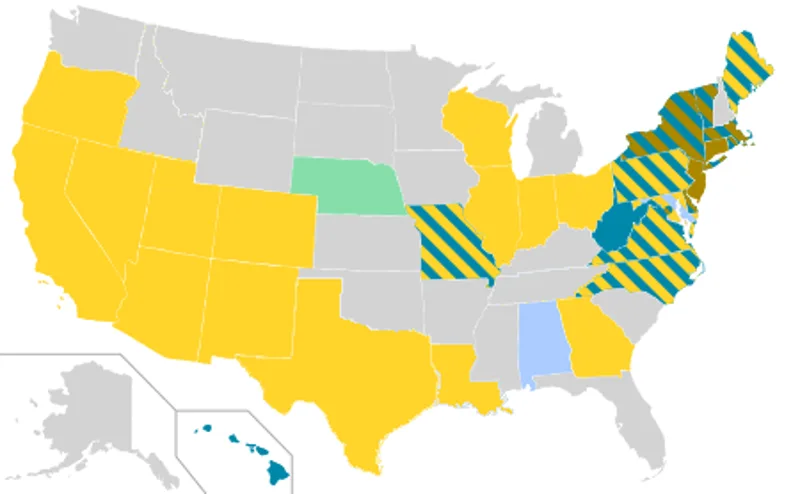
In the United States the law varies by state. A federal court ruled that flashing headlights to warn of radar was constitutionally protected speech and barred a police department from citing drivers for it. On 23 April 2019 another court said flashing may be protected by the First Amendment, and two state circuit courts have also ruled that flashing is protected activity.
Florida protects flashing as free speech and legalised it from 1 January 2013. New Jersey's appellate court found in 1999 that a high-beam flash warning of radar did not break the limit on how far high beams may project. In New York, flashing is not illegal, and a 2009 appellate decision held that stopping a car for flashing alone was improper.
Other states draw firmer lines. Michigan bans flashing high beams within 500 feet of oncoming traffic, and North Dakota bans flashing high beams within 500 feet of oncoming traffic or for any purpose at night. Minnesota tolerates brief flashing that does not blind approaching drivers, and Wisconsin allows a flash at an oncoming vehicle whose high beams are lit.
California allows a flash to signal intent to pass where passing on the right is not allowed, but flashing on multi-lane highways is illegal. Pennsylvania's Supreme Court held that daytime high-beam flashing to warn of speed traps is legal, and Tennessee treats the practice as free speech. Virginia does not outlaw flashing to warn of police, although radar detectors are banned there.
Court outcomes often turned on the wording of local statutes. In Illinois a flashing-to-warn citation was successfully defended in Boone County on 7 May 2015, because the judge found the lighting statute addressed equipment rather than driver behaviour. In Ohio, courts held that flashing to warn of a radar trap did not obstruct police. Louisiana bans flashing lights except on emergency vehicles, school buses, for turn signals and for traffic hazards, so drivers who flash there are typically cited under that statute.
Maryland shows how contested the wording can be. Police there ticketed drivers for flashing under laws on flashing lights and on obstructing investigations, mostly in the 1990s. The ACLU of Maryland argues the law refers to an adjective, not a verb, so a manual flash is not covered. Police in Maryland and Washington DC later said flashing was not against the law in either place. In Alaska, a state trooper was found to have probable cause to stop a driver who flashed both high beams and moose lights.
What is the urban legend about gang initiations?
A widespread rumour from the early 1980s claimed that gangs ran an initiation in which a recruit drove with the headlights off, and any driver who flashed back became the target. The story spread by fax and later by the internet, and it was repeatedly shown to be false. It still resurfaces, most recently in a 2020 version.
The legend began in Montana, where it named the Hells Angels, and by 1984 it had reached Eugene, Oregon. In August 1993 a fax warned of a blood initiation weekend on 25 and 26 September, and some police departments issued warnings after receiving it. In February 1994 a resident of Massillon, Ohio, revived the rumour with flyers, and was arrested for inciting panic after sending faxes to local businesses.
A version circulated in October 1998 claimed to come from a DARE officer in Texas, and a San Diego fax was briefly treated as a legitimate government document. A 2006 email blamed the Bloods, and Judy Muller of the University of Southern California found the claim false while investigating for NPR. The rumour inspired the 1998 film Urban Legend, and an incident inspired by it drove the 2007 film Death Sentence.
What are the advantages and drawbacks of flashing?
Flashing works quickly and needs no words, so it fills a gap that horns and gestures do not always cover. Its drawbacks are ambiguity, the risk of misreading in fast traffic, and its use for intimidation. Its legal status also changes from one place to the next.
A flash costs nothing and can be seen from a distance. It can tell a driver to yield, warn of police or a crash, or confirm that another driver has been seen. Several courts in the United States have treated it as protected speech, which reflects its value as a warning.
Ambiguity is the main problem. Researchers doubt how well drivers can communicate by flashing, and a flash may mean yield or take the right of way. Other risks are less common but serious. In 2008 a Jamaican fugitive evaded checkpoints after a flash warned of police ahead, and the UK Highway Code cautions against flashing to intimidate. Flash-for-cash scams in the UK use a flash to lure drivers out of a junction, then crash into them to make false claims.