From no limit outside the towns to 130 km/h, a trial of freedom on the Stuart Highway, and the limits that apply across Australia today.
Until 1 January 2007 the Northern Territory set no speed limit outside towns, and drivers only had to travel at a speed safe for the conditions. A general limit of 110 km/h and 130 km/h highway zones followed. A trial of unlimited speed on part of the Stuart Highway ran from 2014 until November 2016.
Until the end of 2006, a driver on the Northern Territory's stretch of the Stuart Highway, once clear of the towns, had no numerical speed limit to obey. The law asked only for a speed that suited the conditions.
What was the Northern Territory's open speed limit?
It was the absence of a limit. Beyond the towns and built-up areas, the Territory fixed no maximum speed until 1 January 2007. Drivers simply had to judge a safe speed for the conditions, so on the Territory's main road nothing on a sign told a motorist how fast was too fast.
That freedom came with a particular kind of road. Police do not patrol most of the Territory's section of the Stuart Highway, which was fully sealed only in February 1987, as one of the roadworks of the Australian Bicentenary. It is a long, quiet road, and for decades the law left the choice of speed to the driver.
Signs added to the confusion. In the Northern Territory, the slashed derestriction sign marked the end of speed restrictions, while other jurisdictions used the same sign to mean something quite different.
The law asked only for a speed that suited the conditions.
Where does the Stuart Highway run?
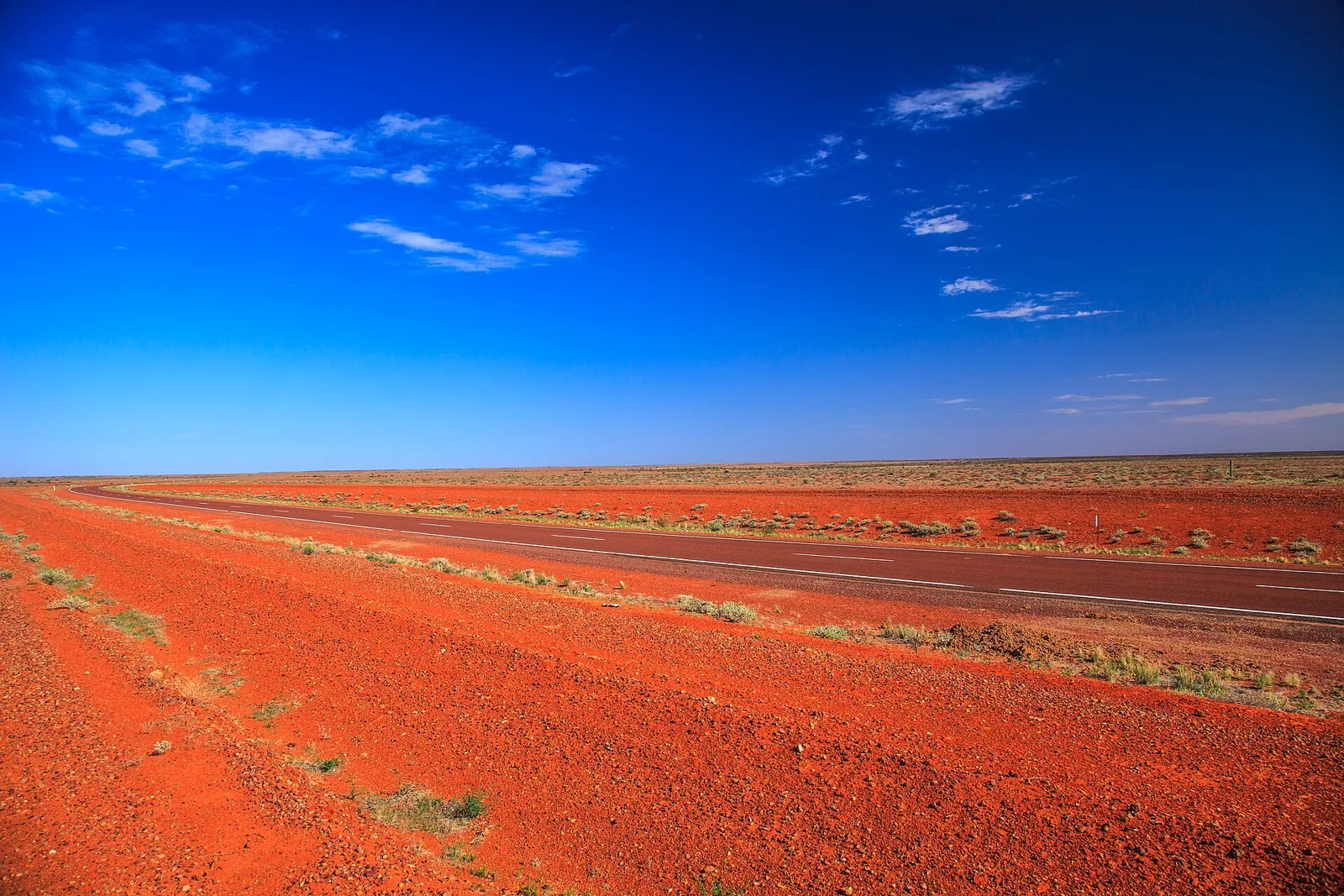
The Stuart Highway links Darwin in the north with Port Augusta in South Australia, passing through Tennant Creek and Alice Springs on the way. The total distance is 2,720 km (1,690 mi). Locals call it "the Track", and it is the main road running north to south through the middle of the mainland.
The name honours John McDouall Stuart, the Scottish explorer who led the first successful expedition across the mainland from south to north and back, in 1861 and 1862. The Overland Telegraph Line followed his route in 1871 and 1872, a track grew up beside the wire, and the modern road approximates the same line.
Inside the Territory the road starts at Daly Street on the edge of Darwin's central business district and runs as a dual carriageway to Howard Springs. From there it covers 317 km (197 mi) to Katherine, a further 673 km (418 mi) to Tennant Creek, and then 508 km (316 mi) to Alice Springs. The highway leaves the Territory south of Kulgera. The route is numbered A1 as far as Daly Waters and A87 beyond it.
War shaped the road. With supply lines to the north judged vital, a sealed all-weather highway between Alice Springs and Birdum, 306 miles (492 km) long, was finished by December 1940 in under 90 days. One week's work added 11 miles (18 km), which was claimed as a world record. The Darwin extension followed, with American and Australian engineers and transport units working alongside civilian groups.
Why did the Territory bring in a speed limit in 2007?
From January 2007 the Territory set a general rural limit of 110 km/h (68 mph) and gave its four major highways, the Stuart, Arnhem, Barkly and Victoria, zones of 130 km/h (81 mph). Penalties for speeding rose significantly at the same time, as the Territory's traffic laws were brought into line with those of the rest of Australia.
Supporters of limits pointed to the numbers. They pointed to 2006, when deaths per head of population in the Territory were the highest in the OECD and double the national figure.
How did the open limit come back?
The Country Liberal Party, then in opposition, argued against the new limits more than once. After it won government, the open road returned as a trial. From 1 February 2014, a planned 12-month de-restriction began on 200 km (120 mi) of the Stuart Highway between Alice Springs and Barrow Creek.
The arguments began earlier. In 2009 the opposition unsuccessfully sought to remove the 130 km/h limits on three of the four highways where they applied, saying total fatalities in the Territory had risen significantly in the first two years. The government answered with more detailed statistics than are normally published. According to the government, those figures showed fewer deaths on the highways where 130 km/h zones were introduced. In 2011 the opposition called for a return to open limits, and for the 2012 election the party promised an evidence-based approach.
The trial grew. Later in 2014 it was extended over another 72 km (45 mi), and in January 2015 it was allowed to continue indefinitely while the first results were reviewed, because no fatalities had been recorded in the first 11 months. Then, from September 2015, another stretch between Barrow Creek and Alice Springs had its limits lifted for a 12-month trial. Its length is reported as between 276 km (171 mi) and 336 km (209 mi).
The end came in 2016. The 130 km/h limits were restored on 20 November 2016, a move tied to the Country Liberal Party's electoral loss.
How has the Territory's rural limit changed?
The rule went from no number at all, to a fixed ceiling, to a trial of freedom, and back to a ceiling.
| When | Rule on the main Territory highways |
|---|---|
| Before 1 January 2007 | No absolute limit outside towns; travel at a safe speed for the conditions |
| January 2007 | General rural limit of 110 km/h (68 mph); 130 km/h (81 mph) zones on the Stuart, Arnhem, Barkly and Victoria highways |
| 1 February 2014 | Planned 12-month de-restriction begins on 200 km (120 mi) between Alice Springs and Barrow Creek |
| Later in 2014 | Trial extended over another 72 km (45 mi) |
| January 2015 | Trial continues indefinitely during a review of the early results |
| September 2015 | Barrow Creek to Alice Springs stretch freed from limits for a 12-month trial |
| 20 November 2016 | 130 km/h (81 mph) limits restored |
What is the highest speed limit in Australia?
The highest posted limit is 130 km/h (81 mph), found along most of the Stuart, Arnhem, Barkly and Victoria routes in the Territory. At the other end, Australian limits drop to 5 km/h (3.1 mph) in shared zones. Everything in between moves in steps of ten.
That last point has one exception. South Australia signposts its school and roadworks zones at 25 km/h, the only limits in the country that are not multiples of 10 km/h. All speed signs have shown kilometres per hour since metrication on 1 July 1974, and the limits themselves are set by state and territory legislation, with co-ordination between governments.
Can you drive 130 in Australia?
Yes, but only where a 130 km/h sign says so, and in practice that means the Territory's four big highways. Elsewhere the ceiling is lower. Some highways and freeways are zoned for 110 km/h (68 mph), and the South Australian part of the Stuart Highway, between Port Augusta and the border, is signposted at 110 km/h outside built-up areas.
Your licence also matters. The restriction on a learner, provisional or probationary licence applies only when the road's posted speed is higher than the licence allows, and it travels with the driver. A New South Wales P1 holder is held to 90 km/h on roads signed 100 or 110 km/h in any state, while a Queensland provisional driver is not speed limited, even when in New South Wales. New South Wales also sets 100 km/h for heavy vehicles of more than 4.5 tonnes, a rule that is not part of the Australian Road Rules.
What are the default speed limits across Australia?
A default limit applies automatically when no sign says otherwise, and Australia sets different defaults for built-up and open country. Inside built-up areas the default is 50 km/h (31 mph), except in the Northern Territory, which keeps 60 km/h (37 mph). Out in the country the figure depends on the state.
- 100 km/h: the ACT, New South Wales, Queensland, South Australia and Victoria, plus sealed roads in Tasmania.
- 110 km/h: the Northern Territory and Western Australia.
- 80 km/h: unsealed roads in Tasmania.
Model national road rules were introduced by the states in 1999, yet Western Australia, Tasmania and the Northern Territory kept their own defaults. Between the extremes, the common limits run from 10 km/h shared zones through 30 km/h streets where vehicles mix with people walking or cycling, 40 km/h school zones and 60 to 90 km/h on connector roads and smaller highways.
How are limits enforced?
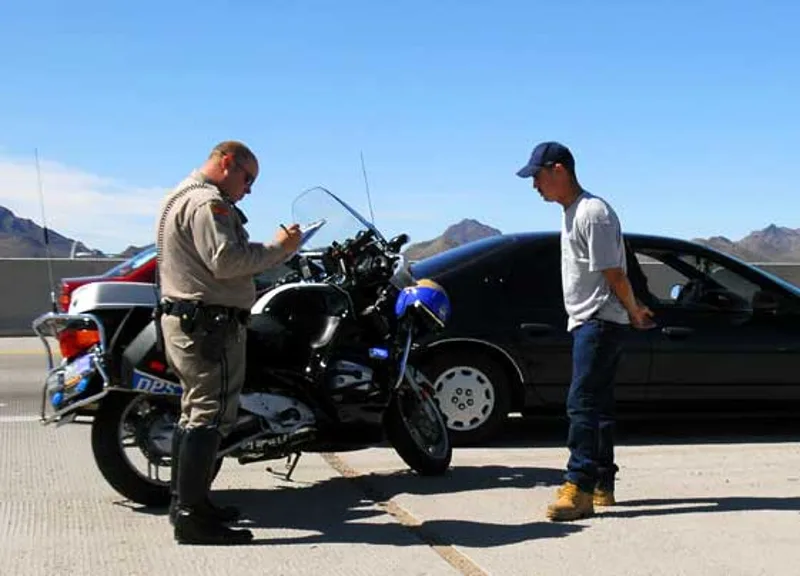
Speed limits are enforced everywhere in the country, using radar, LIDAR, fixed and mobile cameras, Vascar, pacing and aircraft. Most states allow a tolerance before a ticket follows. In South Australia, for example, it is roughly 6 km/h in town and 9 km/h on the highway, and other states have similar margins.
Victoria works differently. It takes 2 to 4 km/h off the speed reading, so that any doubt favours the driver. The reason is partly historic, because earlier Australian Design Rules let a speedometer be up to 10% out. That changed in 2006, when the rules began requiring that the indicated speed be no lower than the true speed.
How did Australia's limits end up here?
Before metrication in 1974, Australia worked in miles per hour with a simple pair of defaults for towns and country. The urban limit stood at 30 mph (48 km/h) before the 1930s, then crept up to 35 mph (56 km/h), New South Wales being the last to move, in May 1964. Metric conversion made that 60 km/h, and in 1996 and 1997 Australia had one of the highest general urban limits anywhere. Across the late 1990s and early 2000s it was lowered nationally to 50 km/h, mainly to protect pedestrians.
The country side changed differently. Outside built-up areas the old limit was prima facie, which meant a starting presumption rather than a hard ceiling. In New South Wales and Victoria it was 50 mph (80 km/h in New South Wales after metrication). During the 1970s, absolute limits took over. Victoria trialled 70 mph (113 km/h) in 1971, cut it to 60 mph (97 km/h) in late 1973, and South Australia chose 65 mph (105 km/h) in 1974. Metrication turned 60 mph into 100 km/h and 65 mph into 110 km/h.
New South Wales shows how a sign can mislead. Its prima facie 80 km/h limit was enforced only when a driver's speed could be shown to be excessive or dangerous for the road, and it was often marked by derestriction signs. Many drivers concluded that no limit applied at all. Studies kept finding 85th percentile speeds above 120 km/h (75 mph) on major routes, road tolls were comparatively high, and speeding was hard to prosecute. The state set an absolute 100 km/h in 1979. The same sign meant a rural default in Victoria and Western Australia, and the end of all restrictions in the Northern Territory.
The Territory followed in 2007 with an absolute rural limit of 110 km/h and 130 km/h zones on its four major highways.
What did the 1994 Cannonball Run show?
It showed what the open road could cost. Australia's only Cannonball Run, modelled on similar races in the United States, went from Darwin to Yulara and back. A Ferrari F40 that had slid out of its driver's control hit a checkpoint south of Alice Springs, and two event officials and two competitors died.
The rest of the race was run under a 180 km/h (112 mph) limit to prevent further accidents. Motor races had been proposed or run on the highway since the 1950s. Today the road is better known for the World Solar Challenge, a 3,000 km (1,900 mi) race that starts in Darwin, follows the Stuart Highway to Port Augusta, and finishes in Adelaide by way of Highway 1.
What should you know before driving the Track?
Distance and spacing come first. Petrol, meals and toilets are usually found about every 200 km (120 mi), with rest stops in between. Some are scenic points with information boards, and others offer just a picnic table and a bin in empty country.
Marked sections of the highway are prepared as emergency landing strips for the Royal Flying Doctor Service, and police close the road before aircraft use it. In South Australia the road crosses the Woomera Prohibited Area, and travellers are not allowed to leave it.
The climate asks for planning. The northern end has a wet season from October to April and a dry season from May to September. The central region around Alice Springs is semi-arid with very hot summers. The road can close, too: in March 2021 a serious accident at Wirraminna, 500 km north of Adelaide, burned diesel that melted plastic culverts and collapsed the road, which stayed shut during repairs and was tested with a road train before reopening.
Where this goes next
The Territory's highways have kept their 130 km/h limits since November 2016. Elsewhere, speed settings are under debate. In December 2025 a federal proposal to cut some country-road limits from 100 km/h to 80 km/h was dropped after seven years of consideration. It would have required 80 km/h unless engineering grounds justified more, and it was dropped 11 days after about 11,000 submissions came in.
Urban limits are the other front. The National Road Safety Strategy 2021-30 recommended a national guide to consistent speed-limit setting. A 2023 review of the New South Wales speed zoning standard suggested exploring 30 km/h zones outside schools, and advocates claim that 30 km/h limits in residential areas would cut the annual road toll by 13 per cent. The City of Sydney asked Transport for NSW in 2023 to lower the limit in the city centre to 30 km/h, and by June 2024 the agency was in early planning discussions.