A failed 1950s plan to share the alphabet, a recall of faulty Victorian plates and a controversial slogan competition explain why a plate can tell you where a car lives.
Australian number plates differ by state because each state and territory government issues its own, a pattern set when every state began at number 1 in 1910. A 1950s plan to share the alphabet failed, so NSW, Victoria and the rest went on to develop separate formats, colours and slogans.
In the early 1950s Australia tried to give each state its own slice of the alphabet so that no two plates would clash. The plan fell apart within a generation: one territory refused to join, another state invented its own scheme, and the biggest states ran into each other's letters.
Why does each state issue its own Australian number plates?
Every state, every territory, the Commonwealth and the Australian Defence Force issue their own. Each began numbering from 1 in 1910. Standard size is shared, 372 mm (14.6 in) by 134 mm (5.3 in), but the lettering, colours and slogans belong to whoever issues the plate.
That shared size arrived slowly. In 1936 the decision was taken that plates should be uniform and embossed with standard Australian dies, with NSW, the Federal Capital Territory (now the Australian Capital Territory) and Victoria going first. By 1956 the other states and territories had followed, and the embossing dies themselves were standardised in all jurisdictions in 1954.
A plate belongs to a vehicle rather than a person, and it is meant to last as long as the vehicle stays registered. If it becomes unreadable it can be remade like for like. Registration itself runs on a cycle that depends on the state or territory: monthly, quarterly, half yearly or annual.
Local identity shows up in the details. Plates tend to carry the state or territory name, sometimes with a motto or slogan, and since the 1980s many have borrowed the state's colours or used its logo as the separator between characters.
The 1950s plan to give every state its own letters collapsed within a generation, and the plates have been regional ever since.
What happened to the 1950s plan to share the alphabet?
A uniform scheme was drawn up for use after 1952, giving each jurisdiction a block of letters. It was never fully adopted. The Northern Territory declined, Western Australia went its own way for a time, and the two busiest states used up their allocations and spilled into letters meant for someone else.
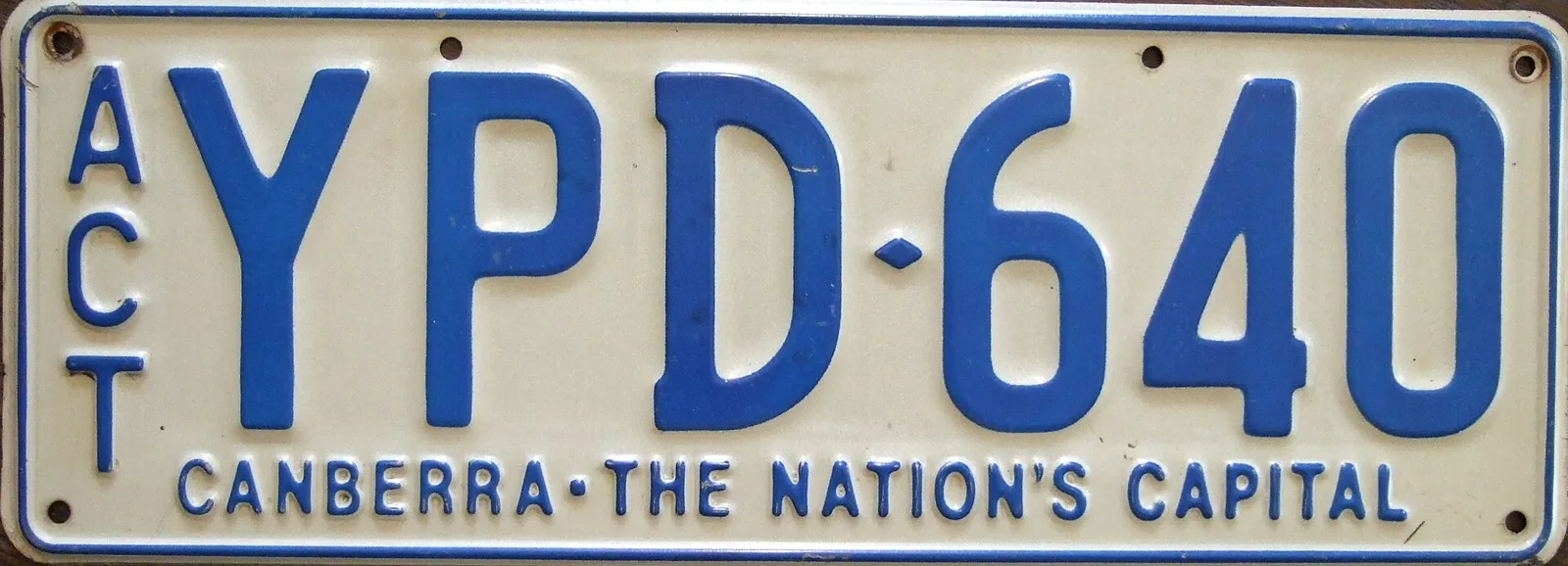
NSW and Victoria had both been issuing white characters on black, in the form of two letters then three digits, which was not entirely popular with states that wanted their own identity. The new scheme gave NSW the letters A to F, and Victoria G to H and J to M. Queensland received N, P and Q, South Australia R to T, and Western Australia U and V. Tasmania was given W, the Australian Capital Territory Y and the Northern Territory X. Z went to Commonwealth departments, with the second letter showing the department. I and O were left out because they look too much like 1 and 0.
Western Australia judged itself too large for the proposal. The scheme that did start in 1951-52 proved less popular than expected, and the Northern Territory kept its all-number system. Western Australia then adopted the plan after all and took XAA-000 to XZZ-999, the block meant for the Territory. WAG-000 to WAG-999 was reserved for state government vehicles and later stretched to XZZ-999. Many rural shires issued their own plates in state colours, starting with the shire abbreviation and ending in digits.
The overflow came next. In 1972 NSW pushed on from FZZ-999 into GAA-000, a series first issued to Victoria. Victoria did the same in 1974, running from LZZ-999 into IAA-000 after reserving the Maa-nnn series for its own government vehicles, and from 1977 it moved on through IZZ-999 into AAA-000, which had been NSW's. South Australia went from SZZ-999 to UAA-000, having set aside the Taa-nnn series for trailers. Today every state and territory runs its own series, and the grouped allocations of the 1950s are long exhausted.
How have NSW number plates changed since 1910?
NSW plates began as black characters on white, with the state abbreviation added in 1912. Colours were reversed in 1924, a three-letter format arrived in 1951 on yolk yellow, and reflective sheeting followed in 1980. The current AA-00-AA format started in July 2004, after the previous run reached ZLF.
The early system was patchy. Rear plates came from the government, and drivers had to get front plates made themselves. From February 1936 the new embossed plates were issued in pairs, which ended the do-it-yourself front plate. On 16 April 1937 NSW adopted two letters followed by three numbers, running from AA-000 to ZZ-999 with I and Q left out because they could be mistaken for 1 and 0, all in white on black.
The two-letter run was exhausted on 3 May 1951. Three letters starting at AAA-000 took over, and the colours changed to black on a yolk yellow base. A brighter lemon yellow replaced it in 1961, by which time the series had reached the middle of the C block. I and Q were permitted from 1970, and from October 1980 plates with reflective sheeting were issued, starting from KWO-050.
Replacement is free. If a black-on-yellow plate looks past its best, Transport for NSW has to manufacture a new one without charging the owner, which is why older serials often appear on plates in the current format. Personalised and standard plates can both move from one vehicle to another.
Slimline plates, a narrower black-on-reflective-white style, first appeared in March 1991 from AAA-11A, and a bordered version took over on 24 October 2005 from AWA-00A. Dealer slimlines start from YBA-00A with the dealer's name screened along the bottom, business plates became available in 2021, and from 5 September 2025 an embossed EV or H identifier has been available for electric and hydrogen vehicles on both yellow and slimline plates.
Trailers and motorcycles have their own histories. Trailers got a separate format in 1948, then a white TR-00-AA plate in August 2014 and a yellow TA-00-AA plate from December 2014, the latter reading NSW - TRAILER. Motorcycles have carried a single plate since October 1980. The yellow motorcycle series started at ZZZ-99 in August 1989 and counts backwards, a white series began at ABA-00 in November 2009, and the diamond separator has been vertical since October 2023.
How have Victorian number plates changed?
Victoria has issued plates since 1910, and has used its own serial dies since 1977. Numerals gave way to AA-000 in 1939 and to GAA-000 in January 1953. From November 1977 the colours were green on white, then blue on white in 1994, and in 2013 the state moved to the naa-naa format.
The first plates ran from 1 to 285-000 in numerals alone, with a Vic insert down the left-hand side from 1930. The first three-letter plate, GAA-000, was issued on 27 January 1953 in white on black. I and Q were not issued in any combination at first, and in 1964 the state skipped the whole I series, going from HZZ-999 to JAA-000. In 1974 it ran on from LZZ-999 into IAA-000 anyway.
The green plates of November 1977 ran from AAA-000 to FZZ-999 and carried the slogan Victoria - Garden State, an idea of premier Rupert Hamer. By the early 1990s it had emerged that the reflective properties of many plates, mainly in the C series, were defective, just as traffic cameras were spreading. Unreadable photographs led to a recall, and replacements were free. The rush used up stock so fast that two blocks, the FV and FY series, were made in Queensland; they can be spotted by their different dies and a vertical diamond rather than Victoria's horizontal one. A popular story blames prisoners for ruining the paint. That is described as a myth, although Victorian plates are indeed made at Hopkins Correctional Centre in Ararat.
Slogans multiplied from there. Late 1984 and 1985 brought Victoria - 150 Years, 1985 saw Vic - Nuclear Free State under premier John Cain, the Bicentenary in 1988 produced Australia 1788 - 1988, and in 1992 came Victoria - Drive Safely. In September 1994 premier Jeff Kennett introduced blue on white, from NAA-000 to QDQ-999, with a crown-and-triangle state logo and the line Victoria - On the Move.
The change of government in 1999 led to a public search for a new slogan, announced by Steve Bracks on 4 January 2000. The winner, Victoria - The Place to Be, was announced on 18 May 2000 and proved controversial: A$87,000 had gone to an advertising firm associated with Labor to help with the slogan and design, although the exercise was billed as a public competition. The first plates went to the three winning entrants on 17 October 2000, starting at QNG-000. In December 2010 the Baillieu government announced it would drop the slogan from standard-size plates, and on 10 June 2013 the government declared the series used up, with the last plate, ZZZ-999, already bought.
Slogans on the plates, side by side
| Slogan | State | When |
|---|---|---|
| NSW - The Premier State | NSW | October 1980 to November 1988 |
| NSW - The First State | NSW | June 1989 to September 1994 |
| NSW - Towards 2000 | NSW | September 1994 to September 1996 |
| Victoria - Garden State | Victoria | From November 1977 |
| Victoria - 150 Years | Victoria | Late 1984 to 1985 |
| Vic - Nuclear Free State | Victoria | 1985 |
| Australia 1788 - 1988 | Victoria | Bicentenary plates, 1988 |
| Victoria - Drive Safely | Victoria | 1992 |
| Victoria - On the Move | Victoria | From September 1994 |
| Victoria - The Place to Be | Victoria | From 17 October 2000 |
| Vic - Stay Alert Stay Alive | Victoria | From 19 August 2013 |
| Victoria - The Education State | Victoria | From 16 October 2015 |
What is the current Victorian plate format, and why is it awkward?
The current format has the pattern number, two letters, number, two letters, launched on 19 August 2013 from 1AA-1AA under the slogan Vic - Stay Alert Stay Alive. It was estimated to last 50 years. It is also one of the most complex plate structures in the world, with four separate sequences in one combination.
The design has drawn two practical complaints. A leading 1 followed by two letters can be misread as I, so that 1CE might look like ICE. And in the font Victoria uses, the letter O and the number 0 share a shape, so a plate ending in 4OW can easily be taken for 40W. The older series avoided this because a separator isolated the letters from the numbers.
On 16 October 2015 The Education State slogan arrived, starting at 1GA-1AA, and only in standard dimensions; slimline plates carried on in the 1F series. Plates with the new Victorian state logo have been issued since 1 September 2016, starting at 1IL-1AA, and since 31 December 2022 every plate has been made with a hologram as an extra security measure. Meanwhile, old aaa-nnn combinations have been reissued as white-on-black slimline plates since June 2013, skipping any still in active registration, and had reached EBA-000 by May 2026.
What are the rules for personalised plates in NSW and Victoria?
In NSW, personalised plates come through the MyPlates range, run by Plate Marketing Pty Ltd for Transport for NSW since 1 October 2010. Buyers choose the format, colour and content. Victoria offers formats from a single character up to six letters, plus mixed styles such as aa-nnn and nnn-nnn, in any colour.
Before 1 October 2010 the Roads and Traffic Authority ran the NSW business, and before 1969 any motorist who asked for a personalised plate was put on a waiting list for blocks not yet issued. From 2009 every non-reflective base was changed over to a reflective one. NSW offers different format menus by vehicle type: for light vehicles they include aa-nnn, aaa-nnn and nn-aaaa as well as fully custom styles, for motorcycles aa-nnn, aaa-nn and nn-aaa, and for trailers and heavy vehicles a similar spread.
Victoria's menu runs from a, aa and aaa up to aaaaaa, with number-and-letter mixes such as aa-nnnn and nnn-aaa. The number series spans 300-000 to 999-999, while 285-001 to 299-999 was never issued. The two-letter, three-number format came back in 1972 as an optional personalised style for cars, with an embossed Vic above the characters.
What is a Heritage plate in Victoria?
Victoria reserves the range from 100 to 285-000 for its Heritage series, which consists of exclusive, handmade plates. The ordinary numbers-only personalised series runs separately, from 300-000 to 999-999, and the block from 285-001 to 299-999 was never issued. Victoria's first plates, between 1910 and 1939, were numerals only and ran from 1 to 285-000.
How do heavy vehicles, military and diplomatic plates differ?
Heavy vehicles, the Defence Force and diplomats all sit outside the ordinary system. Trucks over 4.5 tonnes can use national heavy vehicle plates, army plates carry the year of first registration, and diplomats receive powder-blue plates from the Australian Capital Territory Government rather than a state.
The Federal Interstate Registration Scheme ran from 1 January 1987 to 1 July 2018 for heavy vehicles over 4.5 tonnes GVM, using WX-00AA plates in green on reflective yellow, and closed on 1 July 2019. Its successor, the National Heavy Vehicle Registration Scheme, began on 1 July 2018 in NSW and several other jurisdictions, with Victoria joining on 1 October 2018 and the Northern Territory from 1 August 2019. Western Australia is not taking part, so its heavy vehicles stay on state-based plates. The format is FB-12AA in black on white with a blue band, and owners can still ask for state-based personalised plates.
Military plates were once nnn-nnn, with the first digit showing the military district. Army plates since 2003 follow the Annnnn pattern, where the two digits after the A give the year of registration, so a 2008 coach could carry A08227. The Defence Force, Navy and Air Force use D, N and R. The Chief of the Defence Force travels on plates reading ADF1. Commonwealth vehicles used a leading Z until the Commonwealth Vehicle Registry closed in 2000, and the Prime Ministerial limousine plate, C*1, was updated on 11 November 2015 to show the Australian Government crest.
Diplomatic plates use the formats DC and DX, in black on powder blue. DC goes to members of the diplomatic corps and DX to people attached to missions who are not diplomats themselves, such as household staff. They once granted immunity from traffic laws, parking infringements and tolls in the course of duty, but that is no longer the case.
Which fuel labels must a car display?
Under the Australian Light Vehicle Standards Rules 2015, vehicles running on fuels other than petrol or diesel must display a label on both the front and rear plates. The labels help emergency crews recognise hazards. Standards were updated in March 2019 to cover hydrogen and electric vehicles.
Cars with more than one LPG, LNG or CNG tank need an additional diamond on the front and back plates. Vehicles built or converted before 1 January 2019 follow state rules: in Victoria, all electric-powered vehicles, hybrids included, need EV labels on both plates, and cars registered before 4 October 2020 were required to carry a different style of label.
Where this goes next
In NSW the yellow motorcycle series is issuing its I prefix, and both motorcycle series are expected to hand over to a fresh combination series eventually. At the start of 2026 NSW also introduced a full-size dealer style with slimline combinations in the middle. Victoria's naa-naa format is estimated to last 50 years, and the state has allowed general-series plates beyond the current allocations, up to 9ZZ-9ZZ for light vehicles, since 2020.