Regenerated gas turbines that moved from concept cars to 1970s transit bus trials, and why cost and fuel use ended the programme.
The GM Whirlfire was a family of free-turbine gas turbine engines developed by General Motors in the 1950s. It ran from the 370 hp GT-300 of 1953 to the 325 hp GT-404 of the 1970s and powered concept cars, buses and trucks. Fuel use and cost against piston engines were never solved, and development ended in the early 1980s.
The GM Whirlfire was a family of gas turbine engines that General Motors developed in the 1950s and fitted to concept vehicles through the 1960s. Its free-turbine layout and regenerators defined the series, and later versions reached transit bus trials before GM ended the work in the early 1980s.
When were GM Whirlfire engines developed?
The Whirlfire engines came from the research division of General Motors in the 1950s. The first version, the GT-300, appeared in 1953, and GM Research built the early engines itself. Later generations were handed on to Allison, and development continued until the early 1980s.
Concept vehicles carried the family through the 1960s, among them the Firebird concept cars, the Turbo-Cruiser buses and the Turbo-Titan trucks. From the GT-305 onward the Allison Engine division took over commercialisation of the technology.
Allison later merged with Detroit Diesel, creating Detroit Diesel Allison. That company built about one hundred of the final GT-404 engines, which used ceramic components.
A gas turbine family that powered concept cars and transit buses, then ran into the cost of its own materials.
How did a free-turbine Whirlfire engine work?
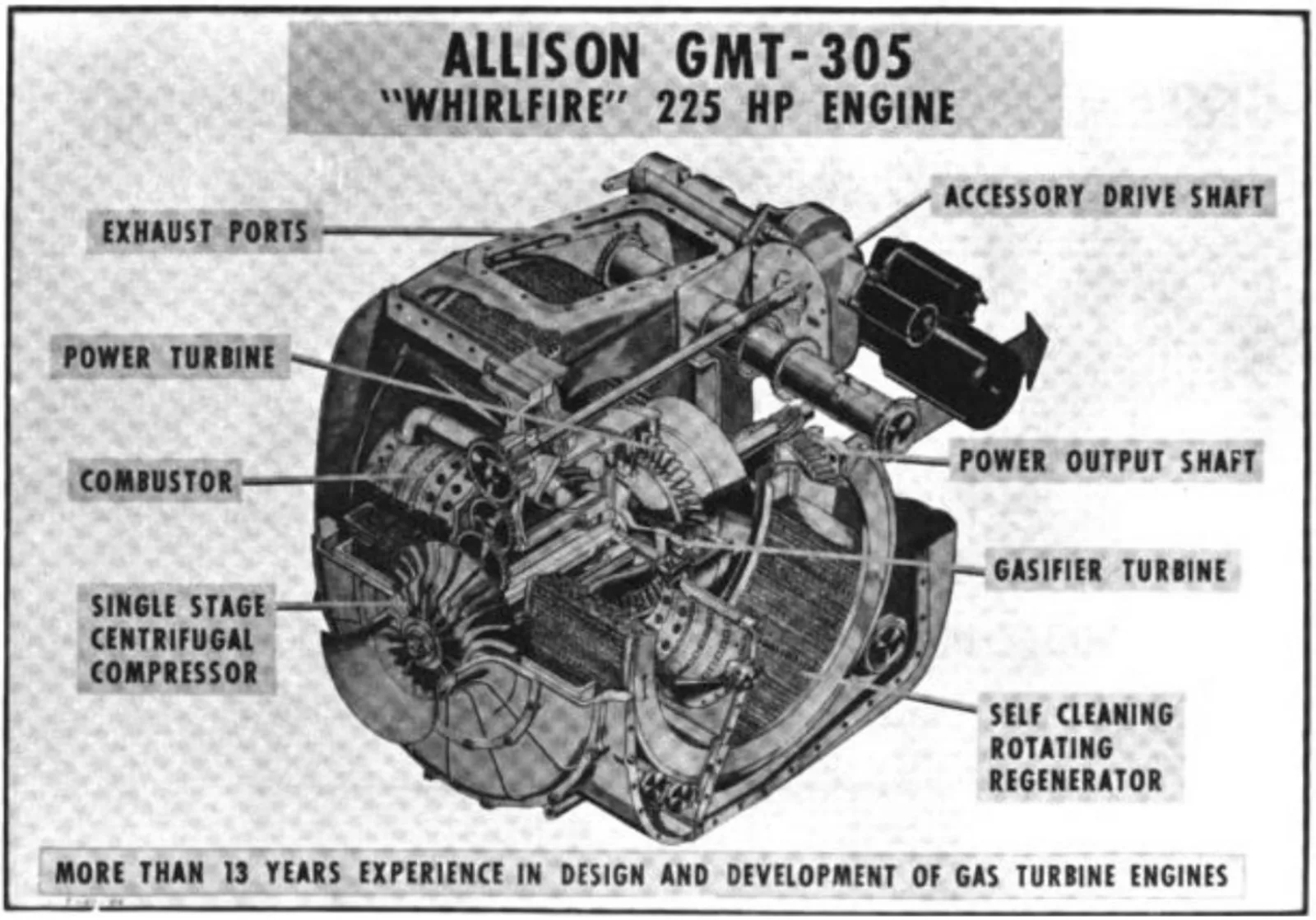
Whirlfire engines were free-turbine turboshaft machines with two spools on a common axis. One turboshaft carried the compressor and gasifier, and the other carried the power turbine and output shaft, with no mechanical coupling between them. The two spools therefore run independently, which matters for the torque and fuel figures below.
Because the output shaft is not mechanically tied to the compressor, maximum torque develops when the output shaft is stalled, at roughly double the torque at full power. The lowest fuel consumption, by contrast, comes at full power.
In the third-generation GMT-305 a single-stage rotary compressor pushed air out radially into side compartments. The design gasifier inlet temperature was 1,650 degrees F (900 degrees C). The gasifier ran at 33,000 RPM and the power shaft at 24,000 RPM at full power.
Reduction gearing brought the output shaft down to 3,500 RPM so that it matched automotive components, and a governor allowed it to turn up to 4,500 RPM.
Why did the regenerators matter so much?
A regenerator recovers heat from the exhaust and hands it to the compressed air before fuel is added. The first GT-300 and GT-302 had none, and their fuel use was high compared with piston engines. Adding regeneration to the GT-304 cut consumption by approximately half, so later generations all carried one.
On the GMT-305, two drum regenerators sat either side of the turboshafts and turned at approximately 30 RPM. About two-thirds of each drum sat in the low-pressure exhaust section, and the remaining third handled the high-pressure inlet air.
The regenerators also muffled noise and heat, which lowered exhaust temperatures. Sealing mattered because the exhaust side ran at lower pressure than the inlet side.
How did engine braking work on the Whirlfire?
A piston engine can slow a vehicle without touching the friction brakes, but a free-turbine engine cannot do this on its own. GM found the gasifier turbine could make more power than the compressor needed, so a clutch was added to link the two turboshafts.
That clutch arrived with the GT-309 in 1964. Engine braking was available at two to three times the effect of a piston engine when the system was engaged, and the same Power Transfer system improved fuel economy at partial load.
What fuels could a Whirlfire burn?
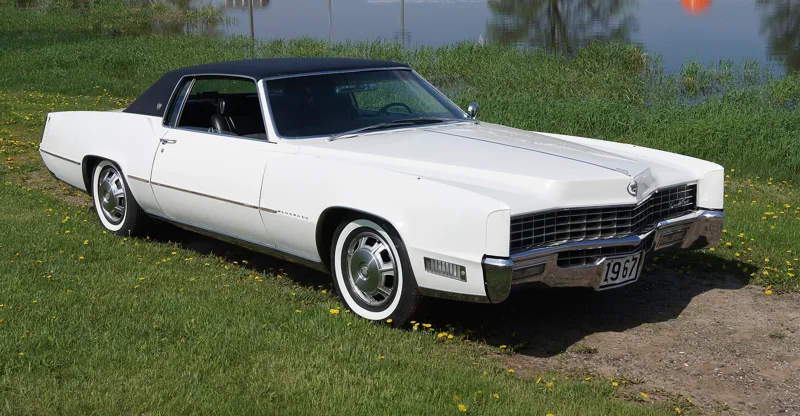
As external combustion engines, Whirlfire gas turbines could burn a wide range of fuels. Powdered coal was tried in a Cadillac Eldorado and an Oldsmobile Delta 88 in the early 1980s, a response to the 1979 oil crisis. Because the heat came from outside the working air, the fuel choice was open.
Other candidate fuels were methanol, ethanol, liquefied coal and shale oil.
What were the GT-300 and GT-302 like?
The GT-300 of 1953 had no regenerator. It produced 280 kW (370 hp) with the gasifier turning at 26,000 RPM and the power turbine at 13,000 RPM, and it weighed 775 lb (352 kg). It went into an Old Look transit bus branded as the Turbo-Cruiser.
The GT-302 replaced the single large burner with two smaller burners and went into Firebird I (XP-21). The design used a 3.5:1 compression ratio, with nominal speeds of 24,000 RPM for the gasifier and 12,000 RPM for the power turbine.
A nickel-base alloy called GMR-235 was developed for the turbine blades, and the Turbo-Cruiser racked up 9,000 mi (14,000 km) during trials. Its rearmost seats were removed to make room for a mobile laboratory with instruments for two engineers.
Fuel consumption was the weak point. At 1.63 lb/hp-h it was far worse than the roughly 0.40 lb/hp-h of the Detroit Diesel 8V71.
What changed with the GT-304?
The GT-304 of 1956 was the first GM gas turbine with a regenerator. It brought fuel consumption down to 0.77 lb/hp-h, and in the Firebird II it produced 150 kW (200 hp) at 35,000 RPM. At idle the gasifier ran at 15,000 RPM, while the power turbine could reach 28,000 RPM.
Turbine inlet temperature went up from 1,500 degrees F (820 degrees C) to 1,650 degrees F (900 degrees C), once GM Research had re-rated the GMR-235 alloy. With the regenerators fitted, the engine weighed 850 lb (390 kg), and each regenerator weighed 150 lb (68 kg).
Reduction gearing of 7.27:1 made the output speed suitable for conventional automotive accessories. The GT-304 also went into the first Turbo-Titan, a Chevrolet Model 10413 truck-tractor. It replaced a 5.3-litre (322 cu in) Loadmaster V-8 that made 145 kW (195 hp).
What made the GT-305 a step forward?
The GT-305 of 1958, fitted to the Firebird III, produced 168 kW (225 hp) and achieved 0.55 lb/hp-h. That was 25% better than the GT-304. Its outside measurements were 940 mm (37 in) long, 710 mm (27.8 in) high and 660 mm (26 in) wide.
The engine weighed 270 to 290 kg (600 to 650 lb), and exhaust temperature dropped to 271 degrees C (520 degrees F) at full power.
In 1959 the engine was redesignated GMT-305 and handed to Allison for further development. It contained about 14 kg (30 lb) of nickel in its alloys, including the turbine blades.
The first GMT-305 prototypes shipped in November 1959 for US military vehicles, including the M56 Scorpion. The M56 logged 1,000 mi (1,600 km) in service with little trouble. Another GMT-305 powered an ore hauler at a nickel mine in Sudbury, Ontario.
Why did GM move to heavy-duty engines with the GT-309?
The GT-307 reached its design stage in 1960 but was never built. GM then turned away from passenger cars, and the GT-309 of 1964 was aimed at heavy-duty applications, producing 210 kW (280 hp) at 35,000 RPM on the power shaft.
With reduction gearing the output turned at 4,000 RPM, and stall torque reached 1,186 N m (875 lb ft) at idle. Turbine inlet temperature rose again, to 930 degrees C (1,700 degrees F), and fuel consumption fell to 0.45 lb/hp-h.
The GT-309 was 910 mm (36 in) long, 760 mm (30 in) wide and 900 mm (35.5 in) high. Its ready-idle speed in gear was 19,300 RPM, and the gasifier climbed to 32,130 RPM within 2.7 seconds, which reduced the throttle lag that had troubled earlier engines.
Detroit Diesel and Allison merged in 1970, creating the Detroit Diesel Allison division, which reunited road vehicle gas turbine development inside GM.
What did the GT-404 offer?
The GT-404 represented the last stage of GM's gas turbine work, developed by Detroit Diesel Allison after the Whirlfire name was dropped. It produced 242 kW (325 hp) at gasifier and power turbine speeds of 37,103 and 30,830 RPM, with stall torque of 807 N m (595 lb ft).
The GT-404 returned to side-mounted regenerators, although it used discs rather than drums. It weighed 770 kg (1,700 lb), far heavier than the GT-309, and its fuel consumption was 0.475 lb/hp-h.
The first GT-404 engines shipped in 1971 to Detroit and to Portland, Oregon, for prototype over-the-road tractors. The MIM-104 Patriot fire unit relied on a GT-404 for its generator set.
Why did the GT-404 fail to win customers?
The first versions were listed at US$9,000, which in 2025 money is $50,000. Demonstration units later cost far more, at US$250,000 each. Contemporary reports described that figure as barely adequate to cover production costs, and the engine was not competitive with conventional diesel engines.
Serial production was scheduled for 1972, with the GT-505 and GT-606 variants planned for 1973. The GT-505 was to produce 300 to 340 kW (400 to 450 hp), and the GT-606 was rated at 410 kW (550 hp).
Limited field experience ran from 1974 to 1977, including use in Greyhound MC-7 buses.
How did the transit bus demonstration go?
In the late 1970s a joint federal programme, the Gas Turbine Transit Bus Demonstration Program, used the GT-404 in transit buses and highway coaches. Eleven GT-404-4 engines were built for the scheme, each with a nominal output of 220 kW (300 hp).
The engines ran with a turbine inlet temperature of 1,024 degrees C (1,875 degrees F). Tested output ranged from 210.9 kW to 226.9 kW (282.8 to 304.3 hp), which was close to the nominal rating.
Four RTS-II buses went into service with MTA in Baltimore, and four MC-8 coaches entered revenue service with Greyhound. The GM RTS-3T prototype of 1972 had also tested under the Transbus Program with a GT-404.
July 1981 brought the end of the MTA trial, after three months of revenue service. Each GT-404-4 was hand-built, costing US$250,000 at the time, or $1,230,000 in 2025 money.
How did the Whirlfire buses perform on fuel?
Greyhound service covered 170,610 mi (274,570 km) for the four MC-8 coaches, which returned 55.2 L/100 km (4.26 mpg-US) on average. Diesel peers on piston power returned 41.6 L/100 km (5.66 mpg-US), so the turbine coaches were less efficient. Both figures came from revenue service rather than test rigs.
Across 19,660 mi (31,640 km) in MTA revenue service, the RTS-II fleet of four averaged 87 L/100 km (2.7 mpg-US). On comparable routes, peer transit buses managed 55 L/100 km (4.3 mpg-US), which made the turbines the thirstier option by a clear margin.
Why did gas turbine development end at GM?
Cost and fuel consumption proved insoluble when the turbines were compared with conventional piston engines. The same two problems appear from the first GT-300 to the GT-404. The exotic alloys and materials needed for the turbine parts drove costs up, and GM discontinued further gas turbine development in the early 1980s.
The Whirlfire never reached passenger cars. Chrysler's contemporaneous turbine engines reached a comparable level of development.
What were the main GM Whirlfire specifications?
| Model | Year | Output | Fuel use (lb/hp-h) | Weight |
|---|---|---|---|---|
| GT-300 | 1953 | 280 kW (370 hp) | 1.63 | 775 lb (352 kg) |
| GT-304 | 1956 | 150 kW (200 hp) | 0.77 | 850 lb (390 kg) |
| GT-305 | 1958 | 168 kW (225 hp) | 0.55 | 600-650 lb (270-290 kg) |
| GT-309 | 1964 | 210 kW (280 hp) | 0.45 | n/a |
| GT-404 | 1971 | 242 kW (325 hp) | 0.475 | 770 kg (1,700 lb) |
Fuel figures fell from 1.63 lb/hp-h on the GT-300 to 0.45 on the GT-309, but the bus trials still lagged diesel coaches.