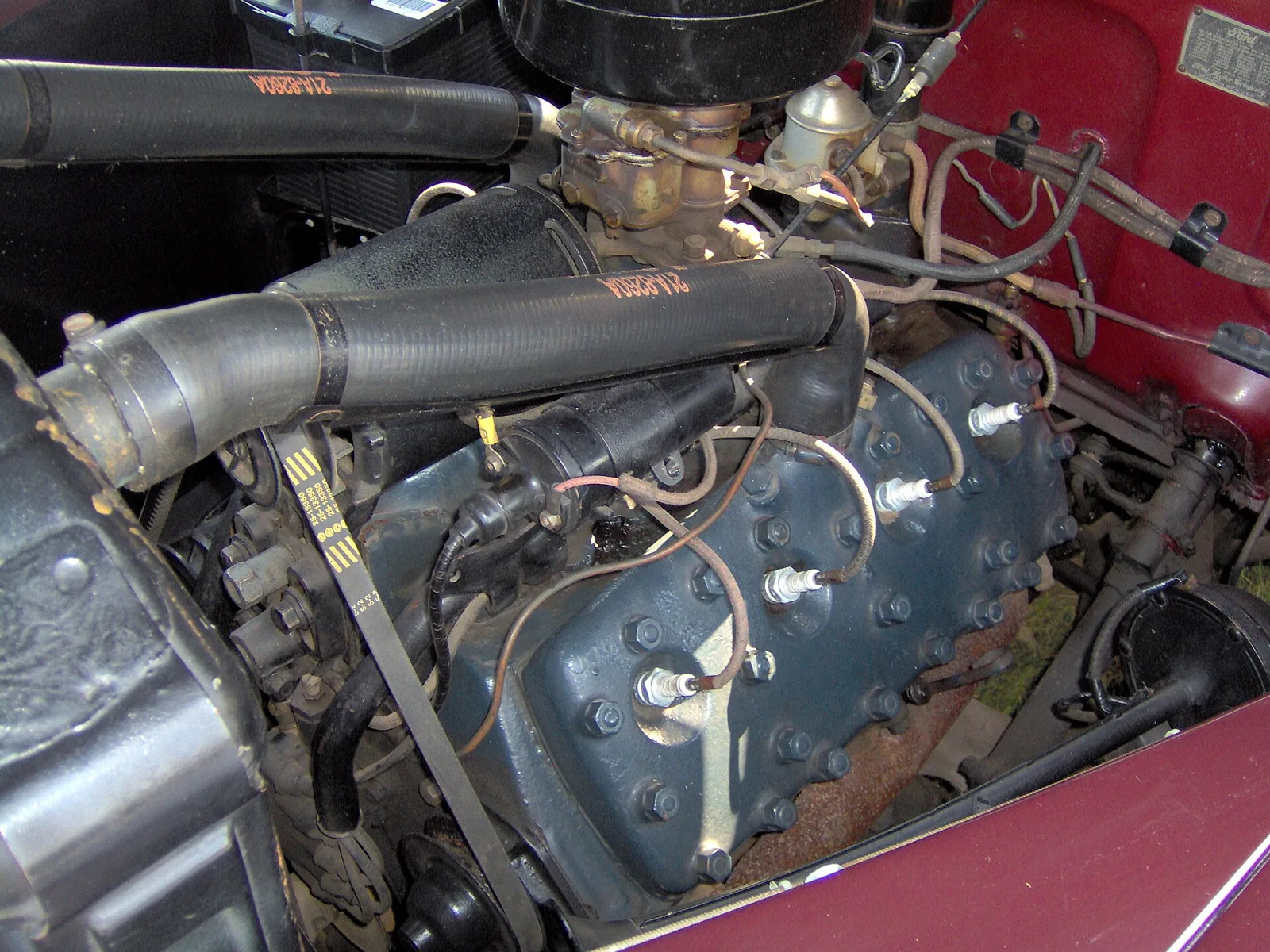
Introduced in 1932 and built until 1953, the flathead gave ordinary buyers a V8 and then became the engine hot rodders could not leave alone.
Introduced by Ford in 1932 and built until 1953, the flathead was the first affordable V8. Its layout and wide aftermarket support made it a favourite for hot rodders, and its 21-year production run for US buyers was longer than that of the Model T engine.
The Ford flathead V8 is a V8 with a flat cylinder head that Ford introduced in 1932 and built until 1953. Its 21-year run was longer than the 19-year production of the Model T engine, and it is still the engine most people picture when they think of classic hot rods.
When did the Ford flathead V8 arrive?
Ford introduced the flathead in 1932, and it was the first affordable V8 on the market. In its first ten years, few manufacturers used overhead valves, so buyers tended to call it the Ford V-8. The first car to use it, the Model 18, was often called the Ford V-8 after its new engine.
The engine was intended for big passenger cars and trucks. It was installed in them, with minor incremental changes, until 1953. Ford licensees also built it independently, which spread the design beyond the company's own factories.
The flathead has earned a place in engineering history. It was named on Ward's list of the 10 best engines of the 20th century, and it remained a staple of hot rodders in the 1950s, despite the huge variety of V8s that followed.
An affordable 1932 V8 whose awkward cooling and cheap design made it the engine hot rodders could not leave alone.
Why was the engine called a flathead?
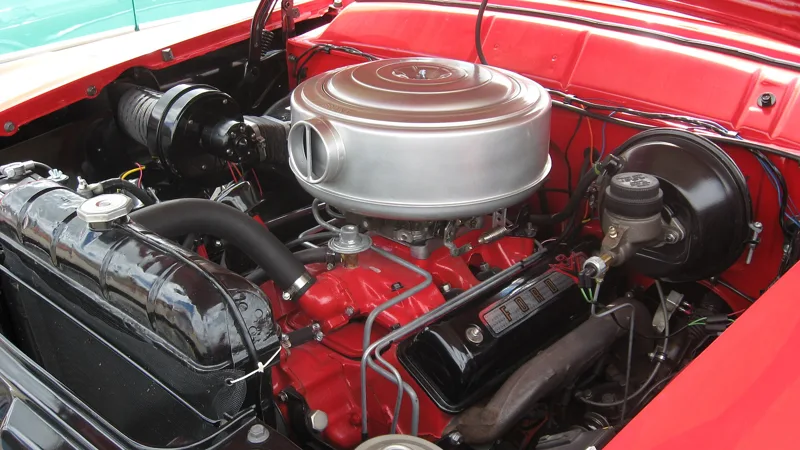
The name comes from the flat cylinder head, which had no valve arrangement on top in the way later overhead-valve engines did. The camshaft sat above the crankshaft, and the valves on each bank sat inside the triangle formed by the vee.
Ford used a design economy that set the engine apart. It supported the crankshaft with three main bearings rather than the five customary in most V8s of the time. It was simple and cheap to build, which mattered to the company's aim of a mass-market V8.
The design also had a clear weakness. Exhaust ports ran between the cylinders to reach the outer manifolds, which sent heat through the block. That imposed a large cooling load, and the engine needed far more coolant and radiator capacity than equivalent overhead-valve V8s.
How did the flathead's block and crankshaft work?
One of the most important innovations was the casting of the crankcase and all eight cylinders as a single monobloc block. Monobloc V8 blocks had been made before, but never in mass production. Making that practical was a production development that helped bring a V8 to a wide market.
Charles E. Sorensen, known at Ford as Cast-Iron Charlie, led the foundry work that made the block possible. The cooling jacket reached unusually low, the exhaust passages were tall and narrow in places, and early blocks sometimes had thin cylinder walls where cores shifted during casting.
The crankshaft was just as pioneering. Ford began with a forged steel crank but then developed cast steel cranks that were just as strong and cheaper to produce. The new methods were patented, and the short three-bearing crank proved durable compared with six-cylinder engines when it was roughly handled.
Which bearings and lubrication did the flathead use?
Engines built from 1932 to 1935 had poured main bearings, which required specialist machining to rebuild. From part of 1936 onward the bearings were replaceable shells, and the rod inserts could be swapped too, which made rebuilding simpler and cheaper.
Ford's high oil pressure lubrication was a clear advantage. Full pressure lubrication allowed continuous use above 3500 rpm and kept the rod bearings supplied, which mattered for racing. It also removed the need for a complex oil jet system to feed the rod bearings from the oil pan.
The system had a practical side for buyers. The oil pressure gauge could reveal the condition of the connecting rod and main bearings once the vehicle was warm, provided the oil had a normal viscosity. Bank robber Clyde Barrow was also said to prefer stealing Fords as getaway vehicles.
What were the flathead's main displacements?
The flathead came in several displacements, and each one carried its own nickname among enthusiasts. The 221 cubic inch original was the first, and the 239 became the most familiar. The table summarises the main versions and when they were built.
| Version | Years | Notable detail |
|---|---|---|
| 221 cu in (3.6 L) | 1932 to 1936 | 65 hp (48 kW) in the 1932 V8-18 |
| 136 cu in (2.2 L) | 1937 to 1941 | 60 hp (45 kW), used in midget race cars |
| 239 cu in (3.9 L) | 1939 to 1953 | 95 hp (71 kW) at launch, 110 hp (82 kW) by 1952 |
| 255 cu in (4.2 L) | 1948 to 1953 | Model BG for Mercury and heavy trucks |
| 337 cu in (5.5 L) | 1948 to 1951 | Largest version, for trucks and Lincoln cars |
The 239 was the best-known version because it powered Mercury cars from 1939 and later Ford cars. It was redesigned in 1948 as the 8RT for trucks and the 8BA for cars, and it used a revised cooling and ignition system from that point.
How did the 221 and 239 engines compare on power?
The 221 started at 65 hp (48 kW) in the 1932 V8-18, with compression of 5.5:1. The 1933 and 1934 V8-40 edged compression up to 6.33:1, lifting output to 75 hp (56 kW). By 1935 the V8-48 reached 85 hp (63 kW) with torque of 144 lb ft (195 Nm).
The 239 was introduced in 1939 as the V8-99A, with 95 hp (71 kW) and 170 lb ft (230 Nm) of torque. By 1952 the V8-B2 made 110 hp (82 kW) and 194 lb ft (263 Nm), and the final 1953 version reached 196 lb ft (266 Nm). Enthusiasts called the early engines 85 horse motors and the 239 family 100 horse engines.
The 255 used a longer crank in the 239 block and was used only in Mercury cars and heavy service trucks. It produced 110 hp (82 kW) in its 1949 form and 125 hp (93 kW) in the 1952 V8-MA.
How did the studs and water pumps change?
Early 221 engines had their water pumps at the front of the heads. From 1937 the pumps moved onto the block, and the outlet moved to the top centre of the heads. The 1937 and 1938 V8-78 engines came with aluminium heads at 6.2:1 compression, rated 85 hp (63 kW), or iron heads at 7.5:1, rated 94 hp (70 kW).
Late in 1938 Ford introduced the V8-81A, which used 24 studs to hold down each head instead of 21. It debuted alongside the 239 and ran 6.12:1 compression. The 21 stud motors were made from 1932 to 1938, and the 24 stud design was used through 1942 for civilian vehicles.
Why did hot rodders love the flathead?
The short crankshaft proved durable and became a favourite among hot rodders. That created a rich supply of aftermarket performance parts, and the stroke could be increased by welding and regrinding the crank, usually alongside overboring the block. Many rodders also turned to modified heads and manifolds to extract more power.
Many rodders bored their blocks out by 0.1875 in (4.76 mm) in the 1950s, and the 255 crankshaft was a popular swap into the 239 because of their interchangeability. Some flatheads ran crankshafts of up to 4.125 in (104.8 mm) stroke, which shows how far builders pushed the basic design.
Modifications were varied. Porting and relieving improved airflow, and polishing the rough sand-cast passages helped too. Compression could be raised by milling the head or fitting aluminium heads, and higher capacity intake manifolds were widely available.
What did the overhead-valve conversions achieve?
A popular modification was conversion to overhead valves, and many kits were available. The Ardun heads from Zora Arkus-Duntov, later known as the father of the Corvette, were among the best known. Those kits were in demand from trucking users, where high loads kept the older design running hot.
Trucks and other heavy-load users found that hot exhaust flowing through the block made the engine overheat. Overhead-valve heads routed the exhaust out more directly, away from the block, which addressed the heat problem of the original design.
Why did the flathead disappear from hot rodding?
In the early 1950s, many hot rodders could not afford even a cheap flathead, and bringing one to the performance of stock overhead-valve V8s needed large investment in machine work and parts. Some inline sixes could be modified into more practical power than a flathead Ford V8.
As modern overhead-valve V8s became affordable in salvage yards, the flathead rapidly left the scene. Rising parts and labour costs also priced many hot rod shops out of business, and the culture of cheap modification by working owners faded with them.
Today the flathead is mainly used in retro hot rod builds. Those builders value a historic feel and recreating the past more than outright performance, and even four-cylinder Ford engines appear in such builds to keep them correct.
Is the flathead still used for speed?
Flatheads still race for speed in a dedicated land speed record class, and the current holder is reported at about 700 hp (522 kW). A flathead V8 has also been driven above 300 mph, and builders still treat the old block as a platform for big power.
Those figures show how far the design can be pushed when a builder commits to extensive machine work and parts.
Where else was the flathead used?
The engine was built in several countries outside the US, including France, Australia, Germany and Sweden. Simca used it in France until 1961, and in Brazil until 1964 for cars, while the Simca Unic Marmon Bocquet military truck kept it until 1990.
During the Second World War the engine was used on the first prototype of a Romanian tank destroyer. It was judged too weak, and more powerful engines replaced it in later versions. In the United States the overhead-valve Ford Y-block replaced the flathead in 1954.
Farm tractors also used the design. Ford experimented with V8 tractors in the 1930s to 1950s, and the Funk brothers sold many converted Ford N-Series tractors using flathead V8 engines and inline sixes from Ford's industrial range.